
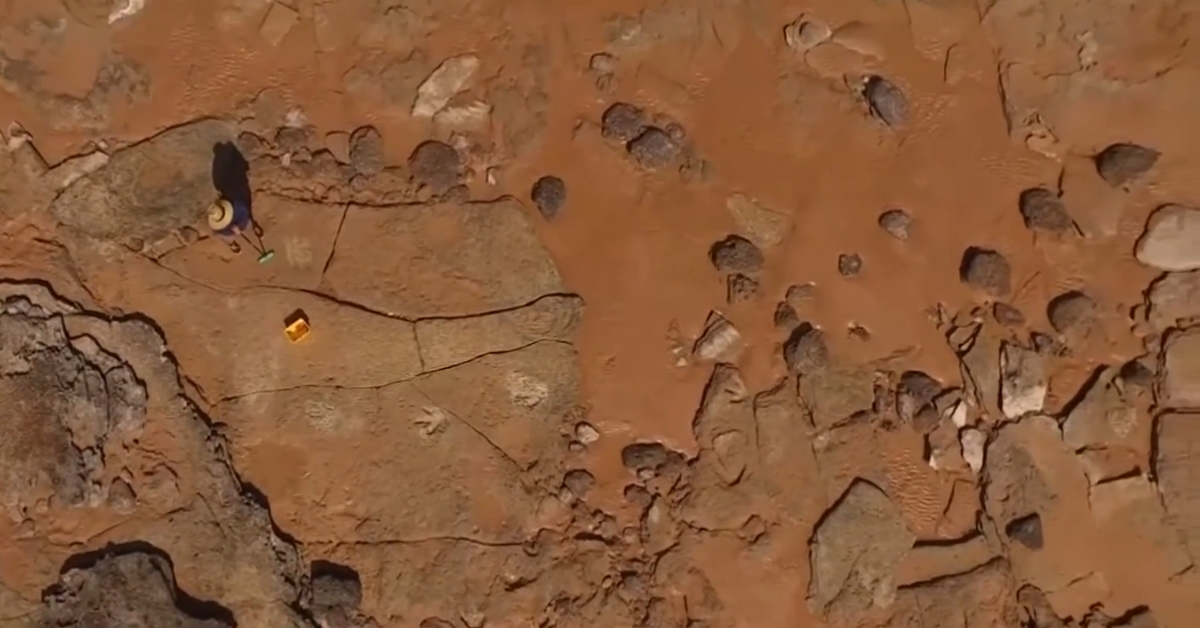
A 25-kilometre stretch of coastline on Western Australia’s Dampier Peninsula has emerged as one of the most extraordinary dinosaur track sites on Earth – home to the largest known dinosaur footprints in the world and the highest track diversity ever recorded.
Research from the Walmadany (James Price Point) area documents dinosaur tracks preserved in 130-million-year-old Broome Sandstone, including giant sauropod footprints up to 1.75 metres long, so large that a grown adult can stand inside them.
But this is more than a fossil story. It’s also a rare modern example of Indigenous knowledge and Western science working together – and a conservation win where heritage protection helped stop an industrial development that would have transformed the coastline forever.
A Dinosaur Discovery On a Living Coastline
Unlike many famous dinosaur finds locked behind museum glass, the Walmadany tracks are part of an active shoreline environment.
They appear and disappear with tides, shifting sands, and storms – revealed for short windows before the ocean covers them again.
Scientists documented an astonishing 21 distinct dinosaur track types, making this the most diverse dinosaur footprint site recorded worldwide. The footprint record captures an entire ecosystem – nicknamed the “Cretaceous Serengeti.”
The trackmakers include:
The Giant That Set a World Record
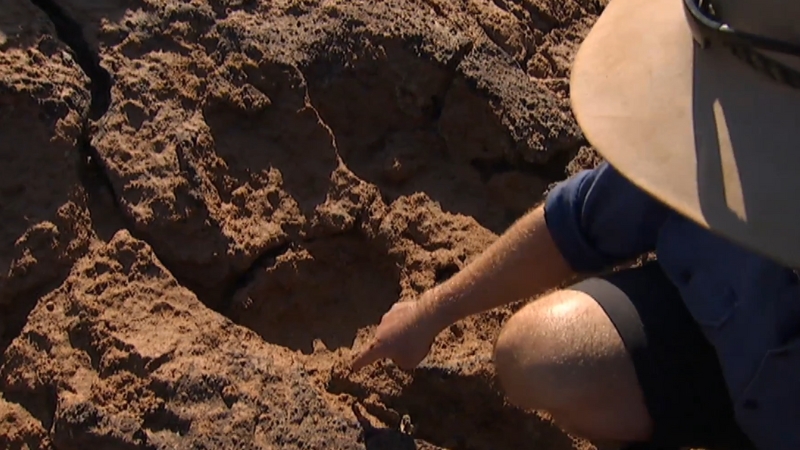
The headline find is a sauropod track measuring 1.7–1.75 metres in length, described as the largest dinosaur footprint ever recorded.
Researchers named the track type Oobardjidama foulkesi, with “Oobardjidama” drawn from the Goolarabooloo language and translated in the report as “Foulkes’ little thunder.”
Based on the track size, the animal’s hip height is estimated at about 5.5–5.7 metres, and its body length likely exceeded 30 metres.
This matters globally because it suggests Australia’s ancient landscapes may have been a southern refuge where gigantic dinosaur lineages persisted longer than expected.
Tracks That Are Also a Songline
View this post on Instagram
For the Goolarabooloo people, these are not “new discoveries.”
The tracks are part of a living cultural landscape – woven into a coastal Song Cycle stretching roughly 450 kilometres and connected to the journey of Marala (the Emu Man), a creator and lawgiver in Bugarrigarri (Dreamtime) tradition.
In the report, three-toed theropod tracks known scientifically as Megalosauropus broomensis are identified in Goolarabooloo tradition as Marala’s footprints-an extraordinary meeting point where cultural knowledge and scientific classification describe the same features through different lenses.
The result is a rare kind of heritage site: one that records both deep geological time and continuous human custodianship.
A Conservation Win That Changed History
The Walmadany area is home to the world’s largest dinosaur tracks. Law Boss Richard Hunter and a 1.7m sauropod track https://t.co/B3NAlwBreD pic.twitter.com/X2Ii5GiC7u
— Steve Salisbury (@implexidens) March 27, 2017
The Walmadany coastline was once selected as the location for a proposed $40 billion liquefied natural gas (LNG) processing precinct, which would have required major construction across the area.
The report describes how a coalition of Traditional Owners, community members, environmental groups, and scientists helped halt the project-using detailed documentation and cultural testimony to demonstrate the site’s global significance.
The West Kimberley region, including the dinosaur coast, was later added to Australia’s National Heritage List, and in April 2013, the project was abandoned.
In practical terms, the coastline survived because:
How Researchers Captured a Coastline That Vanishes Twice a Day
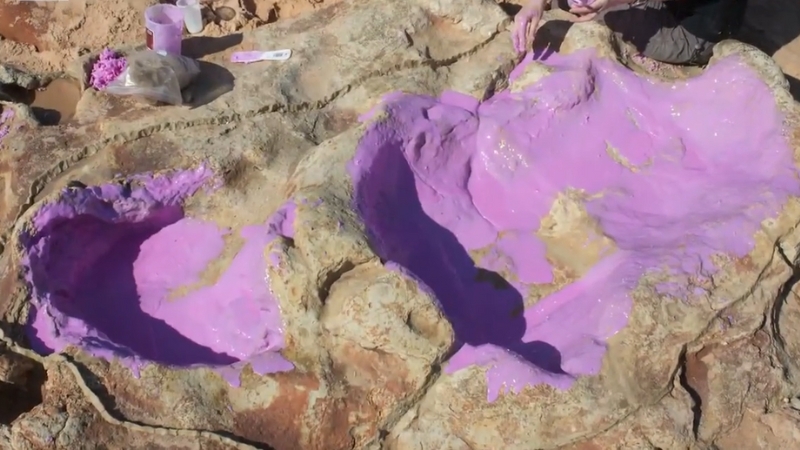
Working on the Dampier Peninsula is extreme field science. The report notes tides up to 10 metres, short windows of access, and track visibility that can depend on light angle and water reflection.
To preserve the site without removing it, researchers used:
This kind of digital archiving is increasingly vital because coastal erosion is ongoing-meaning some tracks may not survive indefinitely in the natural environment.
Why This Matters
This isn’t just a story about dinosaur footprints-it’s a global example of:
Walmadany stands out because it combines size, diversity, and cultural continuity in one place – something almost unheard of at a world scale.
Quick Fact Box
Age
~130 million years
Biggest footprint
Up to 1.75 m
Track diversity
21 types (world-highest recorded)
Location
Dampier Peninsula, Western Australia
Significance
Science + living culture + conservation victory