
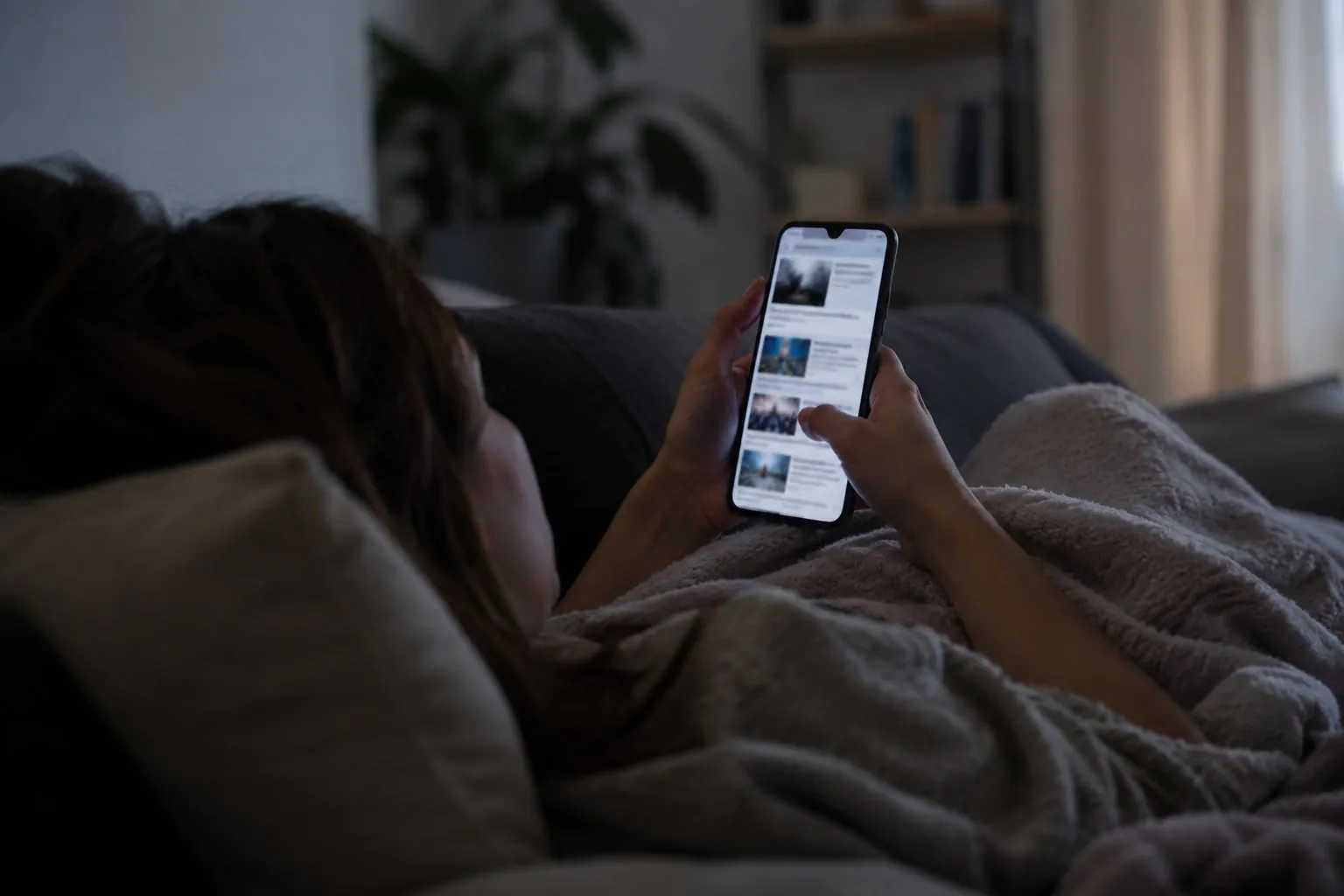
Millions of Americans are exhausted by the news, yet checking their phones has become part of their daily routine.
A troubling headline leads to another, followed by videos of disasters, political conflicts and predictions of what might go wrong next. Thirty minutes disappear, and the person holding the phone may feel more anxious than when they started.
Researchers call this behavior doomscrolling. It involves repeatedly consuming negative or threatening information online, sometimes even when the experience becomes unpleasant.
A study published in September 2026 found meaningful associations between doomscrolling and anxiety, depression and psychological distress. The researchers examined 44 studies, making it one of the most extensive evaluations of the subject to date.
The findings do not prove that scrolling causes mental illness. They do, however, raise questions about the emotional cost of repeatedly exposing ourselves to frightening information, especially when stopping feels difficult.
More Than Half of Americans Are Already Exhausted by the News
News fatigue has become a widespread problem in the United States.
In February 2026, Pew Research Center published the results of a survey conducted among more than 3,500 American adults in December 2025. The researchers found that 52% felt worn out by the amount of news they encountered.
Another 60% said they had reduced their overall news consumption at some point, while 67% had stopped getting news from a particular source.
The national survey on news fatigue also found that only 9% of Americans followed the news solely because they enjoyed it. Another 24% did so entirely because they felt an obligation to stay informed.
Feeling responsible for following important events can make disengaging uncomfortable. Someone may want to stop reading about a crisis but worry that stepping away means missing a major development.
That tension helps explain why a person can feel exhausted by the news and continue checking it throughout the day.
View this post on Instagram
New Research Links Doomscrolling to Anxiety and Depression
The evidence connecting doomscrolling with mental health problems has expanded considerably.
In September 2026, researchers Qi Li and Xinrui Yin published a major review in Frontiers in Psychology. They examined 44 research reports and used data from 21 studies for their main statistical calculations.
The results showed positive correlations between doomscrolling and several mental health outcomes.
| Mental Health Outcome | Correlation With Doomscrolling |
| Psychological distress | 0.51 |
| Anxiety | 0.35 |
| Depression | 0.35 |
| Psychological well-being | -0.29 |
| Life satisfaction | -0.25 |
Source: September 2026 research review. Values represent pooled correlation coefficients, not the percentage of people affected or the probability of developing a disorder.
Psychological distress had the largest measured association, with a correlation coefficient of 0.51. People reporting more doomscrolling also tended to report greater emotional distress.
However, the researchers rated the certainty of evidence as very low across all five outcomes. Many studies relied on surveys collected at a single point in time, making it impossible to determine the direction of the relationship.
People experiencing anxiety may turn to negative news more frequently, and repeated exposure may contribute to their distress. Both processes could occur together.
The results identify a relationship worth investigating, but they cannot establish how much mental illness is caused by doomscrolling.
Negative News May Change How People See the World

The emotional consequences of doomscrolling may extend into how people judge their safety and the intentions of others.
In August 2024, researchers published a study involving 620 Iranian and 180 American university-student social media users. Participants completed questionnaires measuring doomscrolling, existential anxiety and attitudes toward other people.
Higher doomscrolling scores were associated with greater existential anxiety in both countries.
Among Iranian participants, researchers also identified an association between doomscrolling and misanthropy, meaning more negative views of humanity. The American sample did not show the same significant relationship.
The cross-cultural doomscrolling study examined how repeated exposure to negative information relates to fears involving existence, security and the future.
Its findings suggest that consuming distressing news may be connected to anxieties that extend past the events themselves. However, the study involved university students recruited through nonrandom sampling, so its results cannot represent the entire population.
News also carries important information. Reports about emergencies, public health threats and unsafe conditions help people protect themselves. Problems arise when continuous consumption creates distress without improving a person’s ability to respond.
Endless Scrolling Can Interfere With Sleep
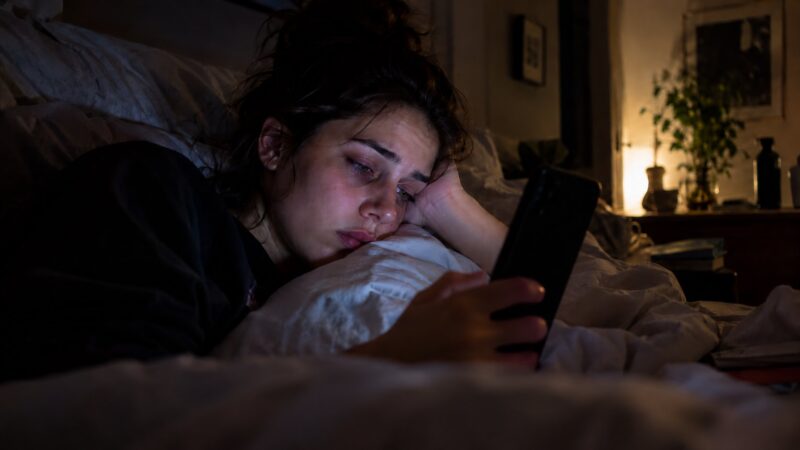
Late-night phone use creates another concern. A person planning to check one headline before bed may continue scrolling through videos and news reports well past the intended bedtime.
Time spent reading reduces the opportunity to sleep, particularly when the phone remains within reach. Distressing stories can also leave someone worrying about events after they have put the device away.
The Centers for Disease Control and Prevention advises adults to turn off electronic devices before bedtime, recommending at least 30 minutes without them. Most adults between 18 and 60 need seven or more hours of sleep each night.
Insufficient sleep is associated with greater stress and problems involving attention and mood. The potential consequences of late-night doomscrolling therefore extend into the following morning, when someone may struggle with fatigue or concentration.
However, the current research does not establish that negative-news scrolling independently causes insomnia. Delayed bedtimes, existing anxiety and other digital habits may contribute to sleep problems.
A useful first change is to stop checking news in bed and charge the phone elsewhere overnight.
Breaking the Habit Without Disconnecting From the World
Staying informed does not require following every breaking-news alert or reading the same disturbing story across several platforms.
Someone checking updates every few minutes may encounter repeated commentary without receiving any substantial new information. Reading a complete report from a reliable source can provide more context than scrolling through dozens of short posts.
- Choose specific times for news: Reading updates once in the morning and once later in the day limits repeated checking.
- Disable unnecessary notifications: Keep alerts for emergencies and information that directly affects your safety.
- Avoid negative-news feeds before sleeping: Give yourself enough time to settle into an evening routine without constant updates.
- Use reliable sources: Complete reporting provides context that short clips and isolated headlines may leave out.
- Notice how you feel afterward: If checking the news repeatedly leaves you distressed, consider reducing the frequency.
People trying to replace habitual scrolling with more intentional screen time can also explore personal development activities through apps such as Overwell, which offers lessons and reflection exercises focused on well-being skills.
The goal is to retain access to useful information without spending hours consuming updates that offer little new knowledge.
Young Adults Report Particularly High Levels of News Fatigue
News fatigue is especially widespread among younger Americans, according to recent national survey data.
Pew Research Center found that 55% of adults aged 18 to 29 and 58% of those aged 30 to 49 felt worn out by the volume of news.
Among Americans aged 65 and older, the corresponding figure was 42%.
The age-based news consumption findings also showed that 52% of adults aged 18 to 29 considered most of the news they encountered irrelevant to their lives.
Younger adults are also more likely to encounter news through social media, where reporting appears alongside entertainment, advertisements and personal updates.
The survey did not measure doomscrolling directly, so the age figures cannot establish that younger people engage in the behavior more frequently. They do show that many young adults feel overwhelmed by the information reaching them.
Screen use is already a concern in discussions of youth mental health. NCHStats previously examined digital fatigue among Generation Z, including research on screen time, psychological symptoms and sleep.
For younger users, separating social interaction from news consumption may help reduce unwanted exposure to distressing stories.
People With Existing Anxiety May Be More Vulnerable
Someone who already experiences frequent worry may find uncertainty in the news particularly difficult to manage.
Checking headlines can temporarily provide reassurance that nothing new has happened. The relief may be short-lived when another alarming update appears.
However, researchers have not established that doomscrolling affects everyone with anxiety in the same way. Personal circumstances, news content and existing mental health symptoms may influence the experience.
Anxiety is already widespread in the United States. CDC data examined by NCHStats found that 19% of American adults reported having received an anxiety disorder diagnosis at some point in their lives.
That national figure does not measure doomscrolling or establish a connection to news consumption. It does indicate how many people may already be managing anxiety before considering the emotional demands of a constant news feed.
For someone experiencing persistent anxiety, panic symptoms or repeated sleep disruption, reducing news exposure may help make daily routines less stressful. However, controlling screen time is not a replacement for appropriate mental health treatment.

What Researchers Still Need to Establish
Researchers have gathered growing evidence that people who doomscroll report poorer mental health, but several questions remain unanswered.
Scientists still need to determine how exposure affects individuals over time and how much improvement occurs when people reduce their negative-news consumption.
Long-term studies can help establish if repeated scrolling precedes worsening symptoms. Controlled experiments may also reveal how changing news habits affects stress and emotional well-being.
Researchers must also separate doomscrolling from general social media use. Spending 40 minutes chatting with friends is not the same experience as spending 40 minutes reading alarming headlines, even though both involve a phone screen.
Differences in age, country, personal circumstances and the type of information consumed could influence the results. Future studies need to examine those factors before researchers can reliably estimate the psychological effects of doomscrolling across the population.
The Bottom Line
Reading negative news does not automatically indicate a mental health problem. Feeling upset after learning about a tragedy is a normal emotional response.
Concern increases when checking the news becomes difficult to control or starts interfering with sleep, work and relationships.
Someone who repeatedly loses sleep to scrolling, struggles to concentrate after checking headlines or feels unable to disconnect despite growing distress has a concrete reason to examine their news habits.
Reducing unnecessary alerts, setting limits around news consumption and protecting time for sleep are reasonable first steps. Persistent anxiety or depressive symptoms deserve attention from a qualified health professional, regardless of screen habits.