

NASA’s Latest Discovery is a Game-Changer for Future Mars Missions
For years, the “space brain” mystery has loomed over long-duration missions. A massive new study of ISS astronauts finally gives us an answer: humans are surprisingly resilient, but life in orbit does change how we think in subtle, unexpected ways.
When you’re hurtling around the Earth at 17,500 miles per hour, your brain has a lot to process. From the lack of gravity to the constant hum of life-support systems, the stressors are immense. But does the brain actually “slow down” or degrade during a six-month stint on the International Space Station (ISS)?
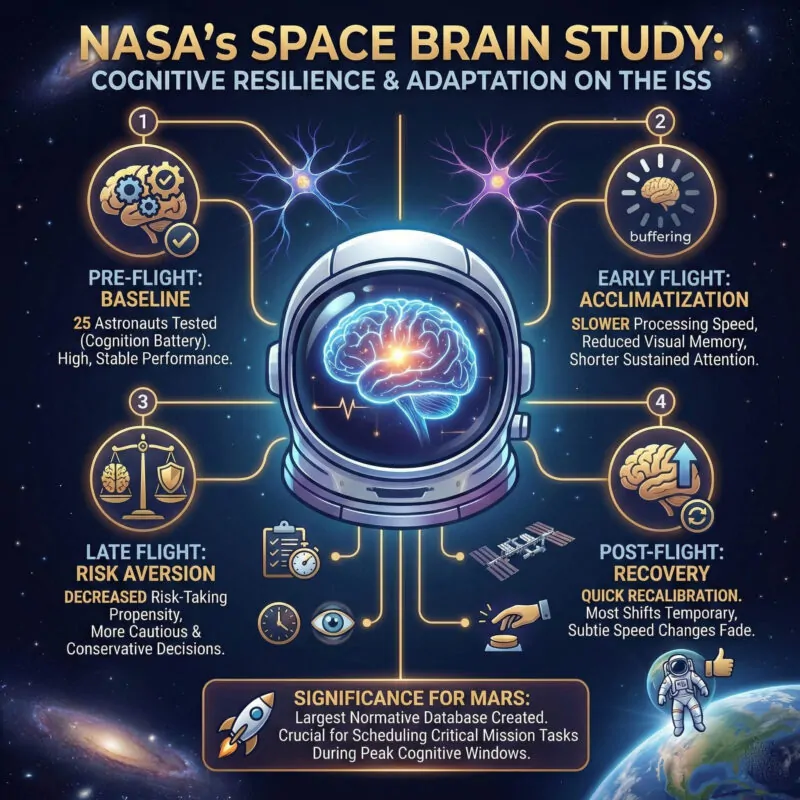
A groundbreaking study recently published in Frontiers in Physiology has provided the most comprehensive look yet at cognitive performance in orbit. Analyzing data from 25 professional astronauts, researchers found that while our brains are remarkably stable, specific “glitches” appear at different stages of the mission.
The Findings: Stable, But Slower
The good news? There is no evidence of a systematic decline in cognitive ability. Astronauts aren’t losing their “edge” over time. However, the study highlighted a few key areas where space travel leaves its mark:
-
The “Early Flight” Slump: During the first weeks in space, astronauts showed slower processing speeds, reduced visual working memory, and shorter sustained attention. Researchers believe this is likely the brain’s “acclimatization” period as it adapts to microgravity.
-
The Risk Factor: One of the most fascinating findings was a decrease in risk-taking propensity during late-flight and post-flight phases. As the mission progresses, astronauts appear to become more cautious and conservative in their decision-making.
-
Fast Recovery: Most cognitive shifts were temporary. Once back on Earth, the brain quickly recalibrates to 1G conditions, though some subtle changes in speed remained noticeable in the “early post-flight” window.
Why This Matters for Mars
This isn’t just about ISS crews. As NASA prepares for the Artemis missions to the Moon and eventually a multi-year journey to Mars, understanding cognitive health is a matter of life and death.
A mission to Mars won’t have the “quick return” safety net of the ISS. Knowing that processing speed and risk-taking behavior shift over time allows mission planners to schedule complex tasks (like landing a spacecraft or performing emergency repairs) during “peak” cognitive windows.
The Bottom Line
The human brain is a masterpiece of adaptation. While “space fog” might be a real phenomenon in the early days of a mission, professional astronauts remain high-functioning throughout their stay.
This study now serves as the largest normative database of its kind, providing a benchmark that will help protect the minds of the next generation of explorers heading into deep space.
Fast Facts from the Research:
-
Participants: 25 professional astronauts (the largest sample size to date for this type of testing).
-
The Test: A “Cognition Battery” assessing 10 different domains, from memory to emotional processing.
-
The Result: Cognitive performance is generally stable, but speed and risk-taking are the most susceptible to change.
For those interested in the deep data, the full study “Cognitive performance in ISS astronauts on 6-month low earth orbit missions” can be found in Frontiers in Physiology (2024).