
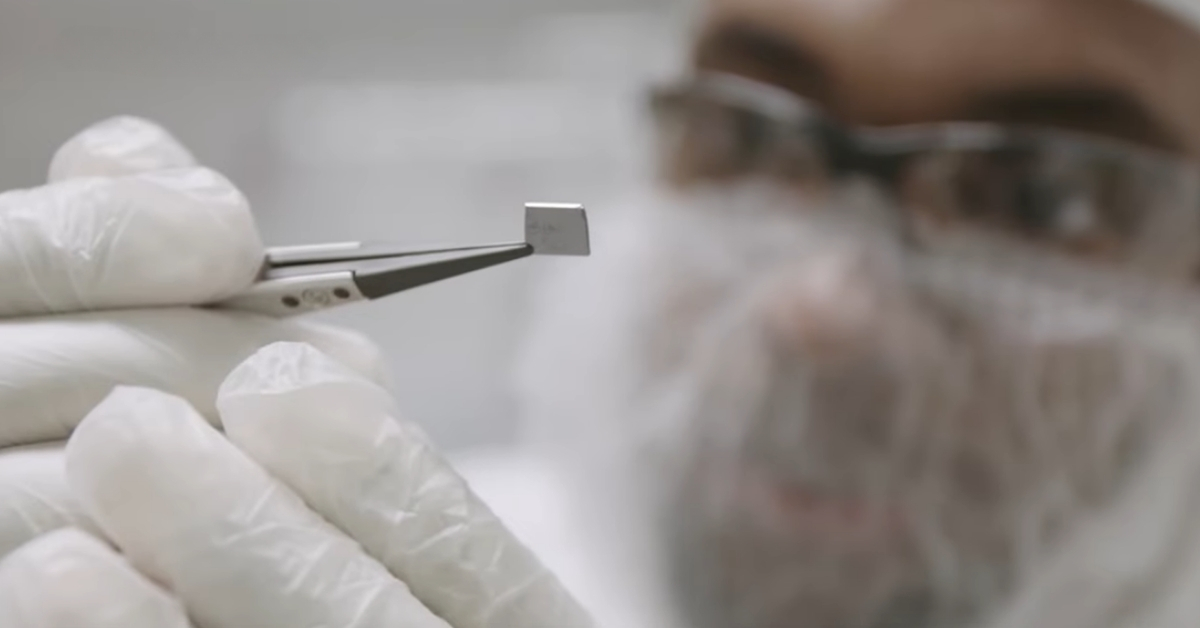
Imagine this: a microchip no bigger than a grain of rice is helping people once considered permanently blind see again, not just light, but letters, shapes, and everyday details. It sounds like something out of a sci-fi movie, but it’s real, and it’s changing lives.
Developed through a massive collaboration involving 17 hospitals across five countries, the PRIMA system is a retinal implant that’s giving patients with advanced macular degeneration a shot at regaining central vision.
According to a recent study published in the New England Journal of Medicine, the results are remarkable, 84% of participants experienced meaningful improvements.
Seeing More Than Just Light
Unlike older visual prosthetics that offered little more than vague flashes or light sensitivity, the PRIMA chip goes a step further, offering what’s known as “form vision.” In plain terms, users can actually make out letters, outlines, and shapes.
“This is the first time blind patients have had central vision restored in a way that’s actually useful,” said Dr. Mahi Muqit of University College London, who co-authored the study.
Replacing Damaged Cells with Light-Responsive Tech
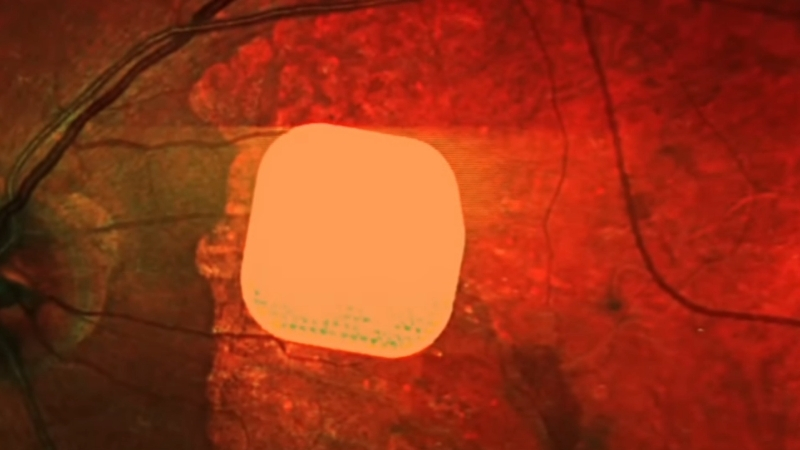
At the heart of the system is a tiny photovoltaic chip, designed to address one of the most severe forms of age-related macular degeneration (AMD), known as geographic atrophy. This condition destroys photoreceptors, the cells in the retina that detect light, making central vision disappear over time.
View this post on Instagram
The concept for PRIMA was born in 2005 when Dr. Daniel Palanker, a physicist at Stanford University, was working with lasers to treat eye conditions. He realized that since the eye is naturally transparent, it could be retrained to receive visual data directly using light, no photoreceptors needed.
Two decades later, that idea became reality.
How It Works: A Tiny Chip and a Pair of Smart Glasses
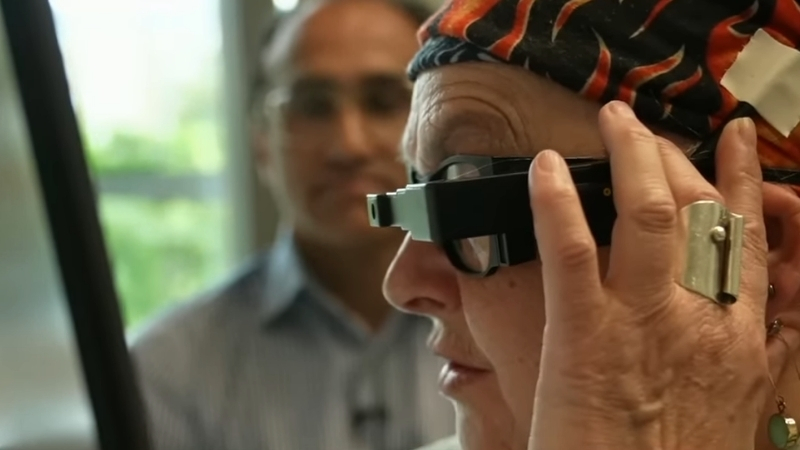
The chip itself is just 2 millimeters across, roughly the size and thickness of a credit card. During a short surgical procedure, it’s implanted beneath the central retina. Once healed, it’s wirelessly activated and synced with a pair of specialized glasses equipped with a tiny built-in camera.
Here’s the cool part: the camera captures the world in real-time and beams images to the implant using infrared light.
The chip then translates those signals into electrical impulses, mimicking how natural photoreceptors work. These signals stimulate the retina and send information to the brain, which begins to interpret what the eye “sees.”
Patients also carry a small waist-worn computer that helps control functions like zoom.
Wireless, Wearable, and Life-Ready
One of the most groundbreaking aspects of PRIMA is its wireless setup. Older vision prosthetics often relied on clunky wires and external power sources, limiting how they could be used in daily life. PRIMA, by contrast, is remote, sleek, and designed for real-world functionality.
“Previous tech could barely give users light perception,” Palanker said in a Stanford release. “We’re the first to restore form vision, real visual information.”
Learning to See Again, One Step at a Time
@thetelegraph 🔴 Blind patients can read and recognise faces again with a “revolutionary” bionic chip, signalling a “new era” for artificial vision. The implant is an ultra-thin wireless microchip, measuring 2mm by 2mm, which is inserted under the retina and links to a video-camera fitted on a pair of augmented-reality glasses. Dozens of patients who lost their eyesight through age-related macular degeneration (AMD) were fitted with the device on a trial including Moorfields Hospital in London, with more than 80 per cent seeing major improvements. About 600,000 people in the UK suffer from AMD, a number that is expected to increase with an ageing population, but there is currently no cure and the condition can be managed only with injections to slow the damage. Click the link to find out how the device works 🖇️ #blindness #science #ai ♬ original sound – The Telegraph
After the procedure, it takes time for the brain to adapt to this new kind of input. But the progress is real. Patients in the clinical trial were able to read an average of five lines on a standard eye chart, a major leap for people who couldn’t even see the chart before.
The visual experience is currently in inverted black and white, meaning high-contrast items (like the edges of a crossword puzzle) might appear as white lines on a dark background. It’s not perfect, but it’s a powerful beginning.
One patient in France now uses the system to navigate the Paris Metro. Another, Sheila Irvine, has returned to doing crosswords and puzzles.
“It was so exciting when I saw a letter for the first time,” she said. “It’s not easy, it’s like learning to read all over again, but the more I practice, the better I get.”
Looking Ahead: Face Recognition and Sharper Vision
Right now, facial recognition isn’t part of the package; it requires more complex imaging and grayscale rendering, which the current chip doesn’t yet support.
But that’s changing. Science Corporation, the neurotech company behind PRIMA, is already developing higher-resolution chips and software that could enable facial recognition and crisper, more detailed vision.
And this technology might not stop at AMD. Researchers believe it could eventually be adapted to help people with other degenerative eye diseases like retinitis pigmentosa or Stargardt disease.
As Dr. Muqit put it, “The door is open now.”