

Losing central vision can turn ordinary tasks into daily negotiations. Reading a menu, spotting a face across a room, checking a medicine label, or following text on a phone can all become hard once the center of sight fades out.
For people with advanced dry age-related macular degeneration, especially geographic atrophy, that loss has long meant adaptation rather than recovery.
A retinal prosthesis called PRIMA is now changing that conversation by pairing a tiny implant under the retina with camera-equipped glasses and digital image processing.
In a recent clinical study, many participants regained enough central visual function to identify letters, words, and other forms again.
Key Points
- A retinal implant and smart glasses helped some patients regain central vision.
- The system targets severe vision loss from geographic atrophy.
- Many participants could read letters, words, and shapes again.
- The technology is promising, but it is not a full cure.
Why Central Vision Loss Matters So Much
Age-related macular degeneration, often shortened to AMD, damages the macula, the part of the retina responsible for sharp, straight-ahead vision. When AMD reaches a late stage, people can lose the central detail needed for reading, driving, cooking, and recognizing faces.
The National Eye Institute describes AMD as a leading cause of vision loss in older adults, and notes that late dry AMD can leave a blurry or blank spot near the center of sight.
A major form of late dry AMD is geographic atrophy. In geographic atrophy, light-sensing photoreceptors in the macula die off over time, creating central blind spots called scotomas.
The PRIMA clinical paper describes geographic atrophy as a major global cause of irreversible blindness, affecting more than 5 million people worldwide. In North America, the same paper notes that geographic atrophy accounts for about 20% of legal blindness cases.
For years, treatment options for geographic atrophy mostly focused on slowing damage, not restoring vision that had already been lost.
Patients trying to make sense of current care options, from monitoring and retinal imaging to conversations about macular degeneration treatment, often start with providers such as Discover Vision Centers.
Reviews of geographic atrophy therapy note that complement-inhibitor drugs such as pegcetacoplan and avacincaptad pegol can slow lesion growth, but they do not bring back meaningful central visual function.
That gap helps explain why the implant-and-glasses approach has drawn so much attention.
View this post on Instagram
What Makes PRIMA Different
The PRIMA system is built around a simple idea with very demanding engineering behind it. If photoreceptors are gone, but some downstream retinal cells remain alive, a device may be able to stand in for the missing photoreceptors and pass usable signals forward.
According to the clinical paper, the implant is a 2 mm by 2 mm silicon array only 30 micrometers thick. It contains 378 photovoltaic pixels, each 100 micrometers wide.
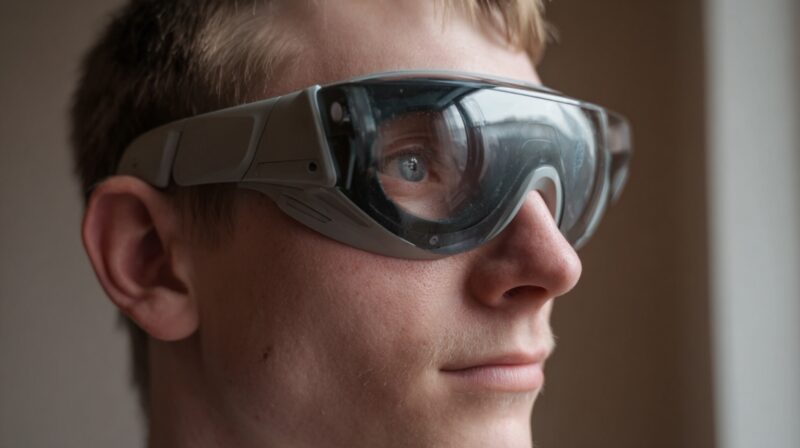
Surgeons place it under the retina, inside the damaged central area. A camera on the glasses captures the scene in front of the user. A pocket processor refines that image, then the glasses project it onto the implant using near-infrared light at 880 nm.
Each implant pixel converts light into electrical pulses that stimulate surviving retinal bipolar cells, which then pass the signal deeper into the visual pathway and onward through the optic nerve to the brain.
That setup matters for another reason. The glasses remain transparent, so users can combine prosthetic central vision with natural peripheral vision. In geographic atrophy, peripheral sight often remains better preserved than central sight.
PRIMA does not replace the whole visual field. It fills in part of the missing center and leaves surrounding natural sight available at the same time. Reuters’ summary of the study highlighted that point, noting that restored central vision worked alongside preserved peripheral vision.
The phrase smart glasses can be a little misleading here. Many readers picture consumer eyewear that records video, takes calls, or shows notifications.
PRIMA’s glasses serve a medical role. They capture, process, and project a medically useful image in a way the retinal implant can interpret. Zoom and other digital adjustments are part of the package, which helps explain why some patients could handle surprisingly small print after training and device use.
How the Clinical Study Worked
The key confirmatory study, called PRIMAvera, was an open-label, prospective, multicenter trial involving patients age 60 and older with geographic atrophy caused by AMD.
The Health Research Authority summary says participants were followed for up to 36 months, with the main goal of measuring safety and visual function after implantation. The published clinical report says 38 participants were enrolled across 17 sites in five European countries, and 32 reached the 12-month endpoint.
Researchers measured visual acuity with and without the PRIMA glasses at six and 12 months. Their main efficacy marker was a gain of at least 0.2 logMAR, roughly equivalent to 10 letters on the ETDRS eye chart.
Among the 32 participants who completed 12 months, 26 met that mark. Using statistical methods to account for missing follow-up data, investigators estimated that about 80% of the full 38-person group achieved clinically meaningful improvement at 12 months.
Reuters summarized the practical result in plain language: many participants could read letters, numbers, and words soon after implantation and still do so one year later.
Average improvement was substantial by low-vision standards. Reuters reported an average gain of about 25 ETDRS letters, which is more than five lines on a standard eye chart. The Stanford report added that digital enhancements such as zoom and contrast helped some participants reach the equivalent of 20/42 vision after one year.
A Study Result Worth Paying Attention To
One of the strongest points in the trial was not only better letter recognition, but preservation of peripheral natural vision. The clinical paper reported no significant decline in peripheral natural visual acuity compared with baseline.
Earlier follow-up from smaller groups also found no meaningful loss of peripheral function over several years, which matters because preserving remaining sight is often as important as gaining any new function.
Another important point is that gains were functional rather than purely laboratory-based. Researchers were not only asking whether patients could detect light flashes.
Past retinal prostheses often produced light perception or crude shapes. PRIMA moved farther into form vision, meaning recognition of letters, patterns, and words.
Stanford described the result as the first time a prosthesis restored functional vision for patients with incurable central vision loss from late-stage dry AMD.
What Life With the Device May Look Like
A medical paper can tell you how many letters a patient gained on an eye chart, but daily life is where meaning becomes clear. Stanford profiled trial participant Sheila Irvine, who had gradually lost sight from dry AMD and later joined the trial at Moorfields Eye Hospital in London.
After implantation and device use, she was among the patients who could read letters, numbers, and words again with the glasses. Her story gives a human face to a field that often sounds dominated by silicon, optics, and regulatory filings.
For someone living with a central blind spot, vision restoration does not mean a full return to normal sight. A better comparison is a partial repair of a broken sensory channel.
The implant can supply central detail where none was usable before, while the brain continues to rely on remaining peripheral input for orientation and movement.
Reading, object identification, and other close-up tasks may become more possible, especially when paired with image processing tools like zoom and contrast enhancement.
Rehabilitation is part of the story. Earlier PRIMA follow-up papers note that performance improved after optimization and training. In practical terms, patients need time to learn how prosthetic signals relate to familiar objects, letters, and spatial patterns.
No one should picture a person waking from surgery with crisp ordinary sight. The device opens a channel. Training teaches the user how to exploit it.
Why the Engineering Matters More Than the Headline
A lot of coverage has described PRIMA as a bionic eye or brain-computer interface. Both labels capture part of the story, but neither is enough on its own. The real advance comes from how several components work together, not from any single piece of hardware alone.
Reviews of retinal prostheses have stressed that practical vision restoration depends on the full chain of performance, including signal quality, image encoding, user training, comfort, and long-term tolerance.
- a wireless subretinal implant small enough for delicate eye surgery
- camera glasses that collect visual information in real time
- near-infrared projection that powers and activates the implant
- image processing that can enlarge or enhance what the user needs to see
- preserved peripheral sight that can merge with prosthetic central input
Taken together, that stack turns a retinal chip into a usable system rather than a lab curiosity.
PRIMA appears to have moved farther than many earlier attempts because its design treated the whole chain, from camera to cortex, as one problem.
Where PRIMA Fits Among Existing Treatments
People often lump all advanced eye treatments into one category, but the main options do very different jobs. Information in the PRIMA paper and later reviews makes the distinction clear.
Current drug therapy for geographic atrophy can slow disease progression, and low-vision tools remain important, but neither approach directly replaces missing photoreceptors. PRIMA was designed for that missing link.
| Approach | Main goal | Who it may help | What it can do | Main limitation |
| Complement-inhibitor injections | Slow progression of geographic atrophy | Patients with GA from AMD | Reduce lesion growth over time | Does not restore lost central vision |
| Low-vision aids | Improve day-to-day coping | People with many causes of vision loss | Magnify text, improve contrast, support daily tasks | Relies on remaining vision |
| Retinal prosthesis such as PRIMA | Restore part of central visual function | Patients with central photoreceptor loss and retained downstream retinal circuitry | Allow recognition of letters, forms, and some words | Requires surgery, training, and careful patient selection |
The Risks and Limits Readers Should Keep in Mind
Strong early results do not erase the hard parts. Surgery under the retina is serious, and adverse events did occur in the trial.
The clinical paper reported 26 serious adverse events in 19 participants, though 81% happened within the first two months and 95% of that subgroup resolved within two months of implantation.
Reuters listed examples including increased eye pressure, retinal tears, and subretinal blood. Most events were described as mild or moderate and resolved.
Sample size remains limited. Thirty-eight enrolled patients is an important number for a vision prosthesis trial, but still small compared with drug approvals in common diseases. Also, the target population is specific.
PRIMA is aimed at people with severe central vision loss from geographic atrophy, where photoreceptors are gone but enough inner retinal circuitry remains available for stimulation. A person with a different cause of blindness may not be a candidate at all.
Another limit is resolution. Even with strong gains, prosthetic vision is not the same as healthy macular vision. The implant uses 100-micrometer pixels, and earlier researchers linked device resolution to a practical ceiling around 20/420 without digital support.
Later training and zoom improved functional performance, but natural reading vision remains a much higher bar. What makes the result meaningful is not perfection. It is the jump from a central blind spot to usable central form perception.
Why Many Specialists See a Turning Point Here
Retinal implants are not new. Argus II, an epiretinal prosthesis for severe retinitis pigmentosa, received a humanitarian device exemption from the FDA years ago and showed that electronic vision restoration was possible.
Even so, earlier systems often offered limited acuity and a heavy rehabilitation burden. Reviews published in recent years note that the field has struggled with image quality, device durability, surgical demands, and the challenge of turning artificial signals into practical sight.
PRIMA stands out because it is targeting central vision loss from macular degeneration, a far larger public-health problem than rare inherited retinal disease, and because trial participants were doing more than detecting flashes or coarse shapes.
A Nature news report described people with blindness from AMD reading again after implantation. Stanford’s summary framed the achievement as a move from crude perception toward functional form vision.
For many clinicians and engineers, that marks a meaningful shift in what a retinal prosthesis may realistically offer.
What Happens Next
As of March 2026, PRIMA was still awaiting regulatory decisions. STAT reported that Science Corporation was awaiting an FDA decision and expected a European launch later in 2026.
Other trade reporting around the same period said the company had submitted both a CE mark application in Europe and an FDA application in the United States.
In other words, the technology has moved beyond pure proof of concept, but it is not yet a routine clinic option for patients walking into an eye practice today.
Research will now focus on several practical questions. Can image processing improve more? Can smaller pixels raise acuity further? Which patients benefit most? How durable is performance over many years? How steep is the rehabilitation curve outside specialized trial centers?
Earlier long-term follow-up suggests room for improvement through better software and upgraded implants, which may end up mattering almost as much as the original surgery.
View this post on Instagram
What Patients and Families Should Take From the News
For patients with geographic atrophy, the most honest message is hopeful but restrained. PRIMA is aimed at restoring part of lost central vision, not normal sight. Candidacy depends on the specific disease pattern in the retina.
Surgery and follow-up are major parts of treatment. Training and device adaptation shape the final result. Approval status still depends on regulators.
Even with that caution, the direction of travel is hard to miss. For a field that has spent decades trying to convert electronics into usable sight, reading letters and words again is a serious milestone.
Summary
Vision restoration has often sounded like a future-tense promise. PRIMA makes it feel more concrete.
By linking a subretinal implant with medically designed camera glasses and digital processing, researchers have shown that at least some people with advanced geographic atrophy can recover meaningful central form vision.
Full natural sight remains far away. Still, a person moving from a blank center to reading letters again is not a minor step. It is a real clinical change, and one worth watching closely as regulators and longer-term data shape what comes next.