A doorway to a house of worship in New York can now become the boundary of a criminal case.
Governor Kathy Hochul has signed a statewide measure that classifies blocking access to a religious facility as a crime. The legislation also penalizes actions that cause worshippers to reasonably fear for their safety while entering or exiting.
Notably, the statute grants law enforcement the authority to establish 50-foot security perimeters outside houses of worship during public demonstrations, according to Associated Press reporting.
The law follows a series of intense demonstrations outside local synagogues, including protests targeting events focused on Israeli real estate. Supporters argue the measure provides vital protections for citizens attempting to practice their faith.
Critics counter that the state has established a problematic precedent regarding the regulation of public sidewalks, police authority, and constitutionally protected political speech.
Table of Contents
ToggleProvisions of the Access Legislation
New York lawmakers approved 50-foot buffer zones meant to shield houses of worship https://t.co/6WSwwlfWal
— Nick Reisman (@NickReisman) May 27, 2026
The statute establishes a new misdemeanor charge specifically for interference with access to a place of religious worship. Under the provisions, individuals can face criminal prosecution if they physically obstruct entrances or engage in behavior designed to intimidate congregants.
The provision allowing for a 50-foot security perimeter represents the most contested element of the legislation. Law enforcement officers may deploy this buffer zone to distance demonstrators from building entrances if they determine that public safety or physical access is compromised.
The mandate applies uniformly across the state. It encompasses all religious facilities, including churches, synagogues, mosques, temples, and other designated spiritual centers.
Catalysts for the Legislative Action
Political momentum for the bill intensified following demonstrations outside synagogues hosting seminars that promoted real estate purchasing in Israel and the West Bank.
Pro-Palestinian advocacy groups argued that these events actively supported settlement expansion and displacement. Conversely, Jewish communal leaders and lawmakers described the demonstrations as targeted campaigns of intimidation and antisemitism.
A protest outside a synagogue in Queens drew widespread condemnation from municipal and state officials after participants chanted slogans interpreted as supportive of Hamas. CBS News New York reported on the widespread political backlash following that rally.
A separate confrontation occurred outside Park East Synagogue on the Upper East Side of Manhattan. Spectrum News NY1 reported that a tense crowd of protesters and counter-protesters gathered on the public street during an Israeli real estate function hosted inside the building.
Civil Liberties and Constitutional Precedent
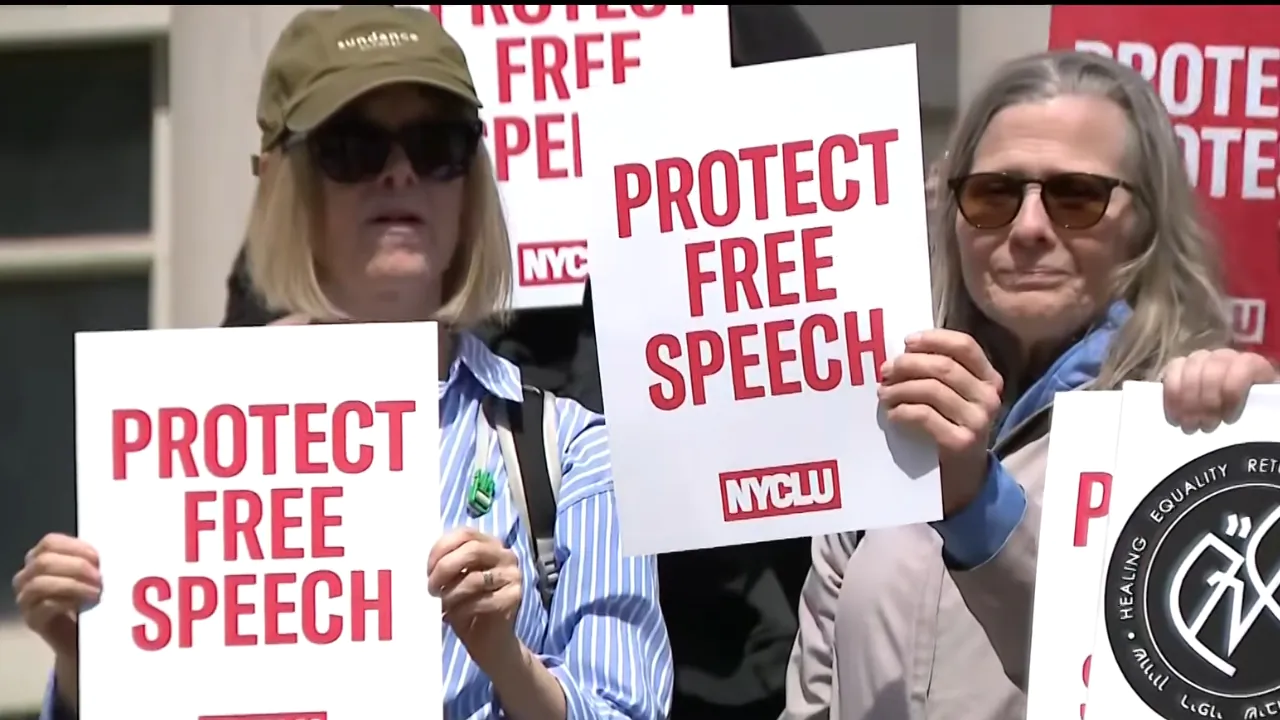
The New York Civil Liberties Union formally opposed the legislation, warning that broad spatial restrictions near religious buildings risk penalizing lawful protest.
The organization maintained that existing state statutes already adequately address harassment, criminal trespass, and physical obstruction, arguing that the new buffer zones provide law enforcement with an unnecessary tool that could be used to suppress unpopular speech. Its arguments are detailed in an official NYCLU legislative memo.
The core legal question centers on the balance between protecting citizens entering a house of worship and preserving the right to free expression on public sidewalks.
The issue carries significant constitutional weight. In the 2014 case McCullen v. Coakley, the United States Supreme Court struck down a Massachusetts statute that mandated a 35-foot protest-free zone outside reproductive health clinics.
The high court ruled that the mandatory buffer zone burdened substantially more speech than necessary to achieve the state’s public safety objectives.
New York prosecutors and city attorneys will likely face the burden of proving that the new distance restrictions are narrowly tailored enough to protect worshippers without unconstitutionally clearing public space during political controversies.
Municipal Measures in New York City
The state legislation arrives alongside separate municipal action. The New York City Council passed local legislation requiring the New York City Police Department to formulate and publish specific response protocols for demonstrations that carry a high risk of intimidation or injury near religious sites.
Local lawmakers stated the city measure aimed to secure physical access while upholding constitutional protections for assembly, according to a New York City Council announcement.
Mayor Zohran Mamdani permitted the local house-of-worship security bill to take effect without his signature. However, the mayor vetoed a parallel bill aimed at school protest zones, citing concerns over an overly broad definition of educational properties, as noted in Associated Press updates.
Public Debate Over Safety and Expression
View this post on Instagram
A post shared by NYC Public Advocate Jumaane D. Williams (@nycpublicadvocate)
Proponents of the state law maintain that citizens should not have to navigate hostile crowds to attend religious services. They argue that congregants should be insulated from political confrontations when attempting to enter a sanctuary.
Opponents view the expansion of police authority as a dangerous shift. They argue that demonstrations outside influential institutions and politically significant gatherings are foundational elements of American public discourse.
Critics worry that empowering police to push demonstrations away from their intended targets makes peaceful dissent less visible and easier to marginalize.
The implementation becomes more complex when religious properties host secular, political, or commercial events. Because a house of worship can function as a sanctuary on one day and a venue for commercial real estate the next, the judiciary and law enforcement must now determine exactly where religious protection ends and the restriction of public dissent begins.
Related Posts:
- Map of New York City, New York – Geography,…
- FDA Approves First mRNA Flu Vaccine for Adults 50 and Older
- What Makes a German Hospitals the Global Benchmark…
- Could Donald Trump Face End Up On A 250 Dollar Bill,…
- Map of State of New York - Cities, Geography,…
- New York State Population 2026 - Growth, Decline,…