


Hazel eyes are the kind of eyes people notice before they know what to call them. They are not simply brown, and they are not fully green either. In one room they can look warm and golden. Outside, the same eyes can suddenly show green, amber, or a darker ring around the pupil.
I always found that interesting because hazel eyes are easy to recognize in real life, but harder to count on paper. Most global estimates put them at about 5% of the population, yet that number changes depending on the country, the source, and the way people describe their own eyes.
Brown eyes are still the most common eye color in the world. They appear in roughly 70% to 79% of people, according to Medical News Today. Blue eyes are usually listed at around 8% to 10%. Green eyes are much rarer, at about 2%. Gray and amber are usually counted in the low single digits.
Hazel eyes are different because they rarely stay in one visual category. One iris can have a brown center, a green outer area, and small gold or amber flecks. Indoor light can make them look light brown. Sunlight can bring out the green and gold.
The U.S. numbers show why the answer is not always neat. A large PLOS One study of U.S. driver license data found hazel eyes in 10.3% of more than 235 million active license records from 31 states. A YouGov America survey put the figure higher, at 15% of U.S. adults.
That gap says a lot about hazel eyes. They are real, but they live close to other color categories. Some people call them green. Some call them light brown. Some see amber. Hazel sits right in that middle space, which is exactly why it stands out.
How Common Hazel Eyes Are Compared with Other Eye Colors?
| Eye Color | Estimated Global Share | Where It Is More Common | Melanin Level | What Creates The Look |
| Brown | 70% to 79% | Africa, Asia, Latin America, Southern Europe | High | Dense pigment gives the iris a darker, more even color |
| Blue | 8% to 10% | Northern Europe, Eastern Europe, Baltic region | Low | Low pigment and light scattering create the blue appearance |
| Hazel | About 5% | United States, parts of Europe, the Middle East, North Africa, Brazil | Medium | Mixed brown, green, gold, or amber tones inside the iris |
| Amber | About 5% | South America, the Middle East, parts of Asia | Medium to high | A more even golden or copper tone |
| Gray | About 3% | Eastern Europe, Baltic region, Russia | Very low | Low pigment and stronger light scattering |
| Green | About 2% | Ireland, Scotland, Iceland, Germany, Northern Europe | Low to medium | Lower melanin with yellowish pigment and light scattering |
Hazel belongs to the group of intermediate eye colors. That is where the counting gets messy. Brown and blue are easier to classify. Hazel sits between categories, so it often gets grouped with green, light brown, or amber.
That is why I would read global hazel estimates as a useful guide, not as a perfect count. The main pattern is clear. Brown eyes dominate worldwide. Blue eyes are much less common. Green, gray, amber, and hazel eyes are all uncommon, but hazel becomes much more visible in populations with mixed ancestry.
What the US Numbers Tell Us?
The United States has one of the more interesting eye color patterns because its population comes from many ancestry lines. European, Latin American, Middle Eastern, African, Asian, and mixed ancestry groups all shape the national picture.
Older summaries often put hazel eyes at about 18% in the U.S. I would be more careful with that number now. A better range is probably closer to 10% to 15%, depending on the source and method.
The strongest recent dataset comes from the PLOS One driver license study. It used active license records from 31 states and found brown or black eyes at 53%, blue at 23.7%, hazel at 10.3%, green at 9%, gray at 0.7%, and other colors at 3.3%.
Survey data gives a slightly different picture. The YouGov poll found that 15% of U.S. adults described their eyes as hazel. Women reported hazel eyes more often than men in that survey, 18% compared with 11%.
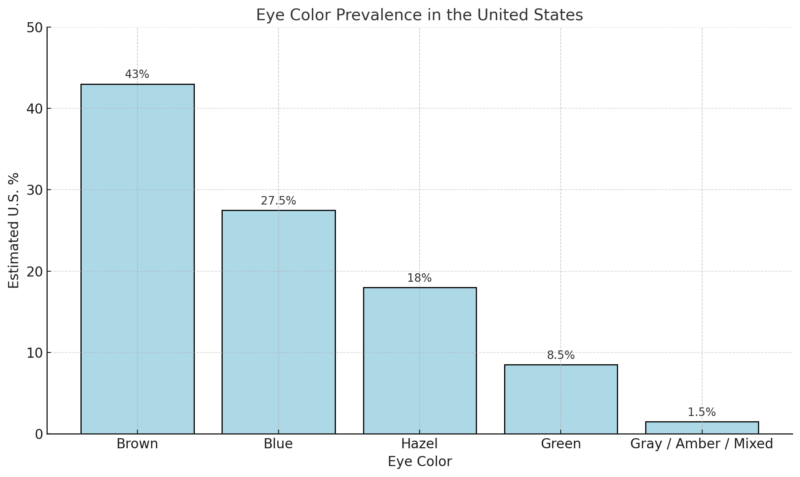
That gap makes sense to me. Driver license records depend on fixed categories and official forms. Surveys depend on how people see themselves, how their eyes look in daily life, and how they interpret mixed colors.
Hazel eyes are exactly the type of feature where self reporting can move the number. A person with a brown center and green outer iris may choose hazel. Another person with the same pattern may choose green. Someone looking at the same eye from a distance may call it light brown.
Even with those differences, both sources agree on the larger point. Hazel eyes are much more common in the United States than they are worldwide, and they are one of the main eye color groups after brown and blue.
Why Hazel Eyes Can Look Brown One Day and Green the Next?
The most interesting thing about hazel eyes is not only their rarity. It is how much they can change depending on light, clothing, makeup, pupil size, and photo angle.
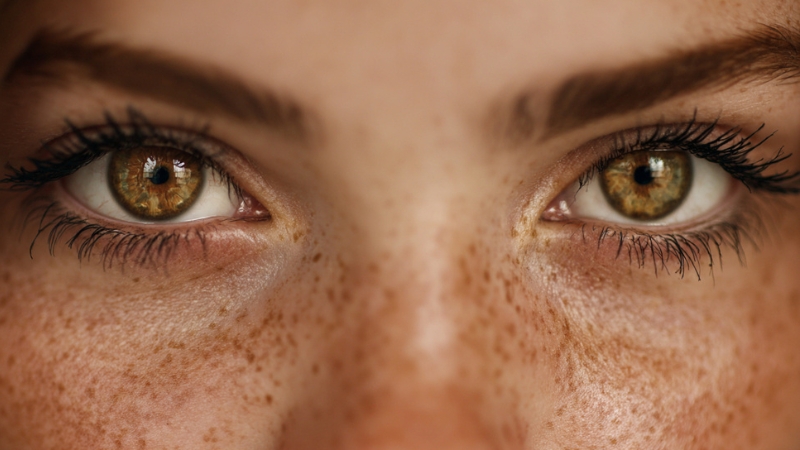
Hazel eyes usually have more than one visible color. Many have a brown or amber ring around the pupil, with green, gold, or lighter brown tones farther out. In indoor light, they may look mostly brown. In direct sunlight, the green or gold parts can become much more obvious.
I think that shifting look is the main reason hazel eyes stand out. They are not static. They can look warm, green, brown, golden, or almost gray depending on the setting.
That also explains why people mislabel them so often. Hazel is not just one shade on a chart. It is a mixed pattern inside the iris.
Hazel Eyes Run in Families, but Not in A Simple Way
Hazel eyes do not come from one hazel gene. Eye color is polygenic, which means several genes work together to shape the final result.
When I first learned that, it explained why hazel eyes can look so different from one person to another. One person may have hazel eyes that lean green. Another may have hazel eyes that look golden brown. Another may have a darker brown center with a lighter outer ring.
Genes such as OCA2, HERC2, TYR, and SLC45A2 all play a role in how much melanin is produced and how that pigment appears inside the iris, according to PMC research.
The HERC2 and OCA2 region is especially important because it helps regulate pigment production. Still, hazel eyes are not as simple as turning one gene on or off. The final color depends on a wider mix of inherited variants, pigment amount, pigment placement, and iris structure.
Hazel eyes usually sit in the middle of the melanin range. They have more pigment than blue or gray eyes, but less dense pigment than dark brown eyes. That middle level allows light scattering and mixed pigment patterns to show through.
A hazel iris may include:
- A brown ring around the pupil
- A green or golden outer iris
- Amber, yellow, or light brown flecks
- A darker border around the iris
- A visible color shift under different lighting
That is why two hazel eyed parents do not always have a hazel eyed child. Their child may have brown, blue, green, hazel, or another intermediate color, depending on the full combination of inherited genes.
Where Are Hazel Eyes More Common?
| Region | Estimated Hazel Eye Frequency | Why Hazel Eyes Appear There |
| United States | About 10% to 15% | Mixed European, Middle Eastern, Latin American, and other ancestry lines |
| Middle East | Often estimated around 10% to 15% | Long history of Arab, Persian, Mediterranean, and Central Asian ancestry mixing |
| Brazil and Argentina | Often estimated around 10% | European immigration, Indigenous ancestry, African ancestry, and Middle Eastern communities |
| Western Europe | Often estimated around 8% to 12% | Overlap between lighter northern ancestry and darker Mediterranean ancestry |
| North Africa | Often estimated around 5% to 10% | Berber, Arab, Mediterranean, and southern European ancestry patterns |
Hazel eyes tend to appear more often in places where lighter and darker eye color ancestry lines have mixed over time. That includes parts of Europe, the Middle East, North Africa, Latin America, and the United States.
In the United States, the newer DMV based data puts hazel at 10.3% in the 31 states that shared usable records. That is still much higher than the usual global estimate of about 5%.
In the Middle East, hazel eyes are also more visible than in many parts of the world. Countries such as Lebanon, Iran, and Turkey have long histories of migration and population mixing, which helps explain the wider range of eye colors.
Brazil and Argentina also have noticeable hazel eye populations because of ancestry from Europe, Indigenous populations, Africa, and the Middle East. In Western Europe, hazel eyes are often seen where northern European lighter eye color ancestry overlaps with darker Mediterranean ancestry.
In East Asia and sub-Saharan Africa, hazel eyes are much less common because brown eyes are strongly dominant across most populations. Hazel eyes can still appear, but they are not a common population trait in those regions.
Studies in human genetics continue to show that mixed pigmentation traits become easier to understand when researchers look at ancestry, migration, and gene combinations together instead of treating eye color as one simple trait.
Why People Find Hazel Eyes so Attractive?
It is interesting how often hazel eyes show up in conversations about attractive or unusual eye colors. I do not think that comes only from rarity. Green and gray eyes are rarer. Hazel eyes stand out because they change more visibly.
Several psychology studies indexed on PubMed have looked at how people respond to facial features and eye color. The results do not prove that one eye color is objectively more attractive than another, but they do show that people often connect uncommon eye colors with stronger impressions.
I think hazel eyes benefit from that effect because they are hard to pin down. They can look soft brown in one moment and bright green in another. That makes them feel more unusual than a single, steady color.
Media and celebrity culture also play a role. Hazel eyes are often described as rare, warm, intense, or hard to define. Once that idea becomes familiar, people notice the color more often.
The better explanation is probably simple. Hazel eyes combine rarity, visible color changes, and mixed tones in one iris. That gives people more to notice.
How to Tell Hazel from Amber, Green, and Light Brown?
Hazel eyes often get confused with amber, green, and light brown eyes. The easiest way to separate them is to look at pattern, not only shade.
| Feature | Hazel Eyes | Amber Eyes | Green Eyes | Light Brown Eyes |
| Base Look | Mixed brown, green, gold, or amber | More even golden or copper color | Green with less brown near the pupil | Brown, but lighter than dark brown |
| Color Change In Light | High | Low to moderate | Moderate | Low |
| Common Pattern | Brown center with green or gold outer tones | Uniform honey, copper, or golden tone | Green iris with yellow or light brown flecks | Mostly one brown shade |
| Common Confusion | Often called green, amber, or light brown | Often called hazel | Often called hazel if brown is visible | Often called hazel if the eye has golden tones |
Amber eyes usually look more evenly golden or copper. Green eyes are usually more clearly green across the iris. Light brown eyes have a softer brown color, but they do not always show the green or gold pattern that hazel eyes have.
The easiest way to identify hazel eyes is to look in natural light. If the iris has a visible mix of brown, green, gold, or amber rather than one main shade, hazel is usually the better label.
Methodology
To put this article together, I used a mix of scientific literature, population genetics research, ophthalmology sources, and survey data. I focused on sources that explain both the biology of hazel eyes and the reason prevalence estimates vary.
For global estimates, I used Medical News Today and ophthalmology based summaries as a general guide. For U.S. prevalence, I gave more weight to the PLOS One driver license study because it covers a very large dataset from 31 states. I also included YouGov because it shows how people describe their own eye color in a survey setting.
For the genetics section, I relied on peer reviewed research from PubMed and PMC, especially studies on iris pigmentation, melanin, and genes such as OCA2, HERC2, TYR, and SLC45A2.
When sources gave different numbers, I avoided treating one estimate as final. Hazel eyes are often misclassified, so a range is more honest than a single exact percentage.
Final Thoughts
Hazel eyes are not the rarest eye color, but they may be one of the hardest to define. That is what makes them interesting.
They sit between brown, green, amber, and gold. They change in different lighting. They are common enough in the United States to feel familiar, but uncommon enough worldwide to stand out.
Genetic traits like eye color can also connect with broader questions about heredity, including topics such as the most common birth defects in the U.S., where inherited and biological factors can also matter.
If you have hazel eyes, the color may say something about your ancestry, but it also shows how complicated human traits can be. One word on a form cannot fully describe the way pigment, light, and genetics come together inside the iris.
References
- Medical News Today – Eye color percentage: How common are your eyes?
- American Academy of Ophthalmology – Your Blue Eyes Aren’t Really Blue
- National Institutes of Health – The genetics of eye color
- YouGov America – Eye Colors Poll Results
- PLOS One – Demographic analysis of self reported iris color in the United States
- PMC – Genetic insights into pigmentation traits and eye color
- PMC – Pigmentation genetics and human eye color