
Camping has long been treated as the budget alternative to hotels. A tent, a cooler, and a quiet patch of land were supposed to mean low daily costs. But recent data suggests that assumption no longer holds, especially for younger campers.
According to the 2025 Camping and Outdoor Hospitality Report published by KOA, Gen Z campers now spend an average of $266 per day while camping. That figure is not only the highest of any generation, but it is also nearly double what Baby Boomers spend on a typical camping day.
Daily Camping Spend by Generation
KOA measures what it calls “spending in local communities”, which includes food, gear, supplies, entertainment, transportation, and services tied to a camping trip. Using that framework, the generational split in 2024 looked like this:
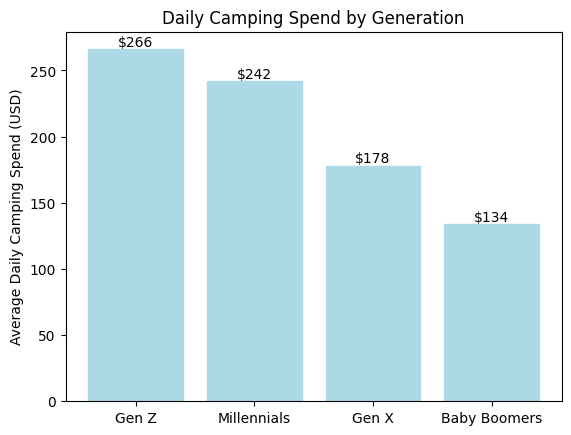
The headline number draws attention for good reason. A Gen Z camper spends $132 more per day than a Boomer on average. Over the course of a short trip, that gap compounds quickly.
What the Numbers Look Like Over a Real Trip
Daily averages are abstract. Trip totals show the financial difference more clearly.
| Generation | 3-Day Trip | 5-Day Trip |
| Gen Z | $798 | $1,330 |
| Millennials | $726 | $1,210 |
| Gen X | $534 | $890 |
| Baby Boomers | $402 | $670 |
At five days, a Gen Z camping trip often crosses the $1,300 mark. That is no longer “cheap travel” by any traditional definition. Yet younger campers continue to go, suggesting the value they see in the experience outweighs the cost.
Camping Is Getting More Expensive for Everyone
The generational gap exists within a broader trend. Camping itself has become more expensive across the board.
KOA reports that average daily camping spend across all age groups reached about $199 per day in 2024, up sharply from previous years.
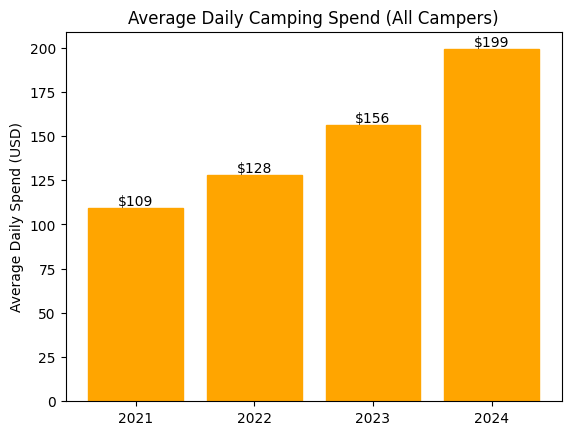
The jump from 2023 to 2024 alone was $43 per day, a rise that reflects higher food prices, fuel costs, campground fees, and the increasing popularity of paid amenities.
Gen Z enters this more expensive environment without the cost buffers older campers already have.
The “Starter Cost” Problem Younger Campers Face
One of the most important factors behind Gen Z’s higher spending is simple: they are new.
Older campers often spent decades building their gear collection. Tents, sleeping bags, cookware, lanterns, chairs, and storage systems were purchased long ago and reused repeatedly.
Their daily costs today exclude those sunk investments.
Gen Z campers usually start from zero. Their first trips require buying or renting nearly everything at once. Even modest, entry-level gear adds hundreds of dollars to early trips, pushing up daily averages in survey data.
This is not luxury spending. It is a startup cost.
Food Has Become a Destination Expense
Traditional camping economics assumed self-cooked meals. You packed dry food, cooked over a stove, and minimized outside spending.
That model has changed. Younger campers are far more likely to treat food as part of the travel experience. Local restaurants, breweries, food trucks, and specialty grocery stops now factor into trip planning.
KOA explicitly ties higher Gen Z spending to food and local experiences, not campground fees alone.
When meals shift from “bring everything” to “buy local,” daily costs rise fast, even without indulgence.
Glamping and Amenity-Heavy Camping Skew the Average
View this post on Instagram
KOA reports that glampers spend around $251 per day on average, nearly identical to Gen Z’s overall daily spend. Younger campers disproportionately choose these options, either for convenience or because they lack traditional gear.
Even when trips are short, the inclusion of showers, power hookups, rental units, and on-site activities raises the daily spend profile.
For many younger campers, the problem is not just buying gear, but keeping it. Tents, sleeping pads, coolers, camp stoves, and folding furniture take up real space, something that is increasingly scarce for renters and apartment dwellers.
Unlike older generations who may have garages, basements, or long-term homes, Gen Z campers often move frequently and live in smaller units where storing bulky outdoor gear year-round is impractical.
This storage gap quietly pushes behavior toward rentals, disposable gear, or repeated re-purchases, all of which raise the effective daily cost of camping. In regions where outdoor recreation is seasonal, some campers turn to off-site solutions like NSA Storage to keep equipment accessible without sacrificing living space, reducing the need to rebuy essentials each season and smoothing costs over time.
Why Boomers Spend So Much Less
Just went camping with my family.
Amazing memories. Zero regrets.
But I’ll never fully understand why we spend so much money to live like homeless people for a weekend. ?️?
Still… would do it again.
Camping – 1
My back – 0Who loves camping?
— Hector Resendez – Trade School Secrets (@TS_Secrets) December 21, 2025
The lower daily spend among Baby Boomers does not necessarily mean they camp less or enjoy it less. It reflects structural advantages.
Boomers are far more likely to own their equipment outright, travel in RVs that double as lodging and kitchens, and take longer trips where fixed costs are spread over more days.
Cooking habits also differ. Older campers are more likely to prepare meals on-site and minimize discretionary spending during travel days.
The result is a lower daily spend even when the total trip length is longer.
What the $266 Figure Does — and Does Not — Mean
The Gen Z number often circulates without context, which leads to confusion.
The $266 per day figure:
- Represents average daily spending tied to camping trips
- Includes local purchases and trip-related expenses
- It is based on survey data, not receipts
- It is best used for comparative analysis, not individual budgeting
It does not mean every Gen Z camper spends that amount, nor does it imply luxury travel. It reflects how modern camping is structured for new entrants into the activity.
The Bigger Shift Camping Is Undergoing
Camping is no longer defined purely by cost savings. For younger generations, it competes with flights, hotels, festivals, and short-form travel experiences. Spending patterns reflect that shift.
Gen Z is not spending more because camping has failed to stay cheap. They are spending more because camping has become something different: a hybrid of travel, food exploration, outdoor recreation, and social experience.
Older generations are not wrong to camp cheaply. Younger generations are not wrong to spend more. They are simply participating in different versions of the same activity, shaped by timing, access, and expectations.
Bottom Line
Gen Z’s $266 per day camping spend is real, documented, and meaningful. It is nearly double what Baby Boomers spend, not because of extravagance, but because of structural differences in gear ownership, food habits, and camping formats.
At the same time, camping itself has become more expensive for everyone. The generational gap sits inside a broader cost shift that is redefining what “budget travel” means in the outdoor economy.
Camping is still outdoors. It is still about escape. But financially, it no longer belongs to the same category it once did.