

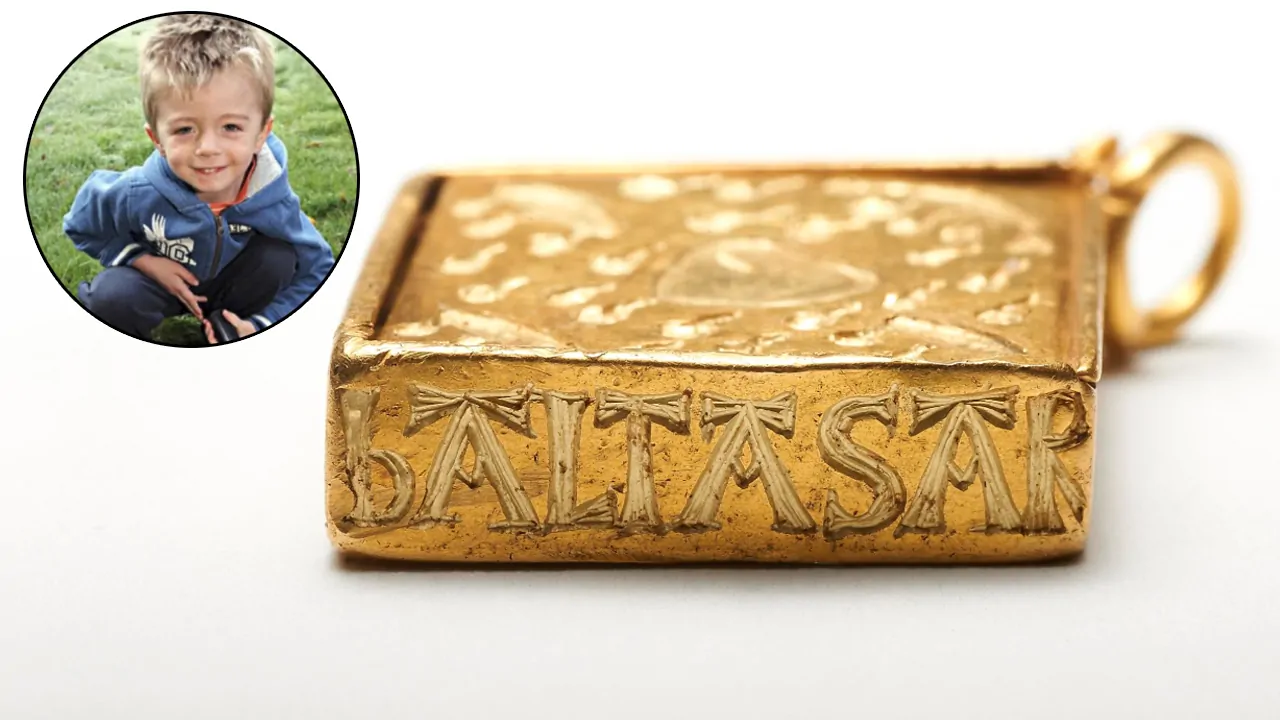
While most three-year-olds are busy hunting for bugs or plastic toys in the garden, James Hyatt was making archaeological history.
According to Gulfnews, on a Sunday afternoon in May 2009, the toddler from Billericay proved that you don’t need years of experience – or even a treasure map – to strike it rich.
Exploring a field in Hockley, Essex, with his father and grandfather, James was allowed to hold the metal detector for the first time.
Within just five minutes, the device began to scream.
“It went beep, beep, beep,” James later recalled. “Then we dug into the mud. There was gold there”. Despite the magnitude of the find, the boy’s logic remained charmingly simple: “We didn’t have a map. Only pirates use treasure maps”.
A “Flash of Gold” from the Tudor Era
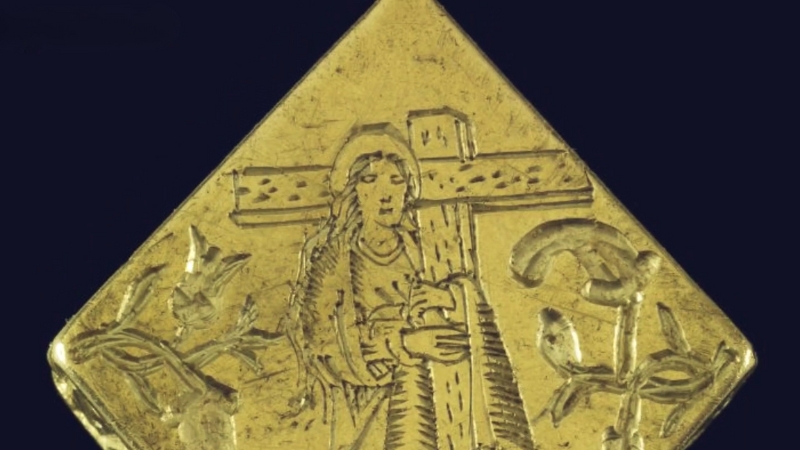
The trio dug roughly eight inches into the soil before seeing a “flash of gold”. What they pulled from the earth was a 500-year-old reliquary – a diamond-shaped gold pendant designed to hold sacred religious relics.
BBC article said that experts believe the artifact dates back to the early 16th century, specifically between 1500 and 1550, during the reign of King Henry VIII.
The pendant is a masterpiece of late medieval piety. The front features an engraving of a female saint – likely Saint Helena, the patroness of archaeologists, holding the True Cross.
The reverse side depicts the “Five Holy Wounds of Christ,” showing a central bleeding heart surrounded by four weeping cuts, a popular devotional symbol of that era intended to protect the wearer.
Even the sides of the pendant are meaningful, inscribed with the names of the Three Magi: Caspar, Melchior, and Balthazar, which were believed to heal fevers and epilepsy.
From Speculation to the British Museum
As news of the discovery broke, media outlets speculated the find could be worth as much as £2.5 million ($4 million). While the official valuation by the Treasure Valuation Committee eventually landed at £70,000 (approx. $110,000 at the time), the historical value remains priceless.
The proceeds were split between the Hyatt family and the landowner, as required by the Treasure Act 1996.
One of the greatest mysteries was what lay inside the sealed locket. After careful conservation by British Museum experts, the sliding back panel was opened for the first time in centuries.
View this post on Instagram
Instead of a splinter of the cross, researchers found flax fibres – likely root hairs that had infiltrated the locket during its 500-year stay underground.
Today, the “Hockley Pendant” is a permanent resident of the British Museum’s Medieval Europe gallery. For James’s father, Jason, the find was a testament to his son’s uncanny luck.
“He’s the kind of kid that goes to the doctors, searches down the side of a sofa and pulls out a tenner,” Jason joked. For the rest of the world, it is a reminder that sometimes, the greatest treasures are found when you aren’t even looking for them.