

Hospital codes are short emergency alerts used to bring the right people to the right place quickly. A cardiac arrest, fire, weapon threat, missing child or hazardous spill can trigger a completely different response within seconds.
Code Blue means cardiac or respiratory arrest in the hospital systems and state standards that use the term. Code Red means fire or smoke. Code Silver identifies an armed person or weapon threat in many standardized systems.
Other colors are much less predictable. Code Pink is the clearest example. One hospital uses it for an infant abduction. Another uses the same words to summon a pediatric resuscitation team.
No federal rule gives every US hospital the same emergency code list. The American Hospital Association reports 6,100 US hospitals in 2026, including 5,121 community hospitals. Those figures come from the 2024 AHA Annual Survey and appear in the 2026 edition of AHA Hospital Statistics. There is still no national registry showing which emergency terminology each facility uses.
Direct announcements remove part of that uncertainty. “Medical emergency, room 412” or “security alert, armed person, emergency department” tells people what is happening without asking them to decode a color first.
Common Hospital Codes And Their Meaning
The table shows the meanings found across many US hospital systems and state code standards. Blue, Red and Silver are more consistent than the colors farther down the list.
| Hospital Code | Meaning | What Happens |
|---|---|---|
| Code Blue | Cardiac or respiratory arrest | CPR starts and the resuscitation team responds with airway equipment, medications and a defibrillator. |
| Code Red | Fire or smoke | Staff activate the fire response, contain smoke and move people away from danger when necessary. |
| Code Silver | Armed person, active shooter or weapon threat | Security procedures begin and access may be restricted. |
| Code Pink | Infant or child abduction in some hospitals, pediatric arrest in others | The response can mean locking exits or sending a pediatric resuscitation team. |
| Code Orange | Hazardous material event in many systems | Staff isolate the area and begin hazmat or decontamination procedures. |
| Code Green | Evacuation or another facility event | Patients and staff may be relocated under the local emergency plan. |
| Code Black | Bomb threat in many systems | Security and law-enforcement procedures begin. |
| Code White | Facility-defined medical or security response | The meaning changes significantly between hospitals. |
| Code Gray Or Grey | Combative person or another security event in many systems | Security or a trained response team attends. |
| Code Yellow | Bomb threat, disaster, missing patient or another local alert | The hospital policy determines the response. |
A nurse who changes hospitals should not bring the old badge card and assume the colors still match. The emergency policy for the new facility is the one that counts.
Hospital Codes Can Be Confusing
Color codes were built for speed. A few words over a speaker could call a trained team without describing an emergency to everyone in the building.
The weakness appeared as individual hospitals and states built their own systems.
In 2012, the Missouri Hospital Association surveyed 134 hospitals. Its 2013 Missouri implementation guide records four different codes for fire, seven for medical emergencies, six for abduction, nine for evacuation and 10 for security threats. The same guide says the standardized recommendations were developed by a workgroup representing 30 hospitals and supported by the MHA Emergency Preparedness Advisory Committee.
The numbers show the problem clearly. Missouri was dealing with fewer than 150 survey responses and still found 10 separate terms for a security emergency. A nurse working across several facilities could know the color perfectly and still react to the wrong event.
The Emergency Nurses Association supports plain-language emergency alerts because the announcement itself can identify the event and tell people what action follows.
How Much Standardization Exists Across The US?
No current national survey tells us how many US hospitals use plain-language announcements today.
The clearest national snapshot we found comes from Iroquois Healthcare Association. Its January 2020 hospital-code review found that at least 23 state hospital associations had recommended standardized emergency codes. At least eight had recommended plain-language alerts, equal to at least 16% of the 50 states at that time.
Washington introduced a statewide plain-language system in 2024. Combining that later rollout with the eight states counted in the Iroquois document produces a minimum of nine states. The nine-state figure is our calculation for this article, not a figure published by Iroquois or a national survey.
Even that minimum should not be treated as the current US total. Four years separate the Iroquois review from Washington’s rollout, and individual hospitals can adopt new terminology without waiting for a statewide program.
| State | Status Found In Published Guidance |
|---|---|
| Minnesota | Plain-language toolkit published in 2011 |
| Colorado | Plain-language recommendation added in 2013 |
| Florida | Combined color and plain-language guidance in 2014 |
| Iowa | Plain-language recommendations in 2014 |
| Missouri | Plain-language implementation guidance |
| North Carolina | Plain-language implementation guidance |
| New Jersey | Plain-language guidance published in 2018 |
| Texas | Voluntary plain-language guidance endorsed in 2018 |
| Washington | Statewide plain-language rollout in 2024 |
| California | Statewide standardized color codes documented |
| Maryland | Uniform color codes required by state regulation |
| Oregon | Standardized color-code system documented |
| Ohio | Standardized color-code guidance documented |
The table also shows why “standardized” does not always mean “plain language.” California, Maryland and several other states standardized colors instead. Colorado and Florida combined colors with direct wording. Other systems moved farther toward announcing the emergency itself.
1. Code Blue Means Cardiac Or Respiratory Arrest
A patient becomes unresponsive on a medical floor. The nurse at the bedside checks breathing and pulse, activates the emergency response and starts CPR. The team is already moving before a physician reaches the room.
That is the purpose of Code Blue.
The final 2025 American Heart Association guideline gives hospitals a specific recommendation for the people who answer that call. Part 4, Systems of Care states that in-hospital code teams should include members with advanced life support training.
The recommendation is Class 1, Level B-NR, meaning the AHA recommends the practice based on moderate-quality nonrandomized evidence. The same AHA Systems of Care guideline gives dedicated teams with defined roles, different areas of expertise and simulation training a Class 2a, Level B-NR recommendation.
What The First 90 Seconds Look Like
The first person at the bedside does not wait for a complete team. Chest compressions begin. Someone brings the crash cart and defibrillator. Another responder takes responsibility for the airway.
As more people arrive, the room changes quickly. One clinician leads the resuscitation. Another records rhythms, shocks, medications and times. People without an assigned role step away from the bed so those performing compressions, ventilation and defibrillation have room to work.
From the bedside, ninety seconds passes fast. You hear the monitor, instructions, the crash cart arriving and someone counting compressions. The useful difference between an organized Code Blue and a crowded room is that everyone knows who is doing what before several people reach for the same piece of equipment.
Our separate guide looks at what happens after successful resuscitation for cardiac arrest survivors.
How Fast Does The Code Team Arrive?
There is no federal rule requiring every US Code Blue team to reach a patient within the same number of minutes.
Hospitals set expectations around the size and layout of the facility. UCSF provides a useful public example. Its MRI emergency protocol states that the Code Blue team arrives within three minutes.
The same UCSF protocol tells MRI staff to remove an unresponsive patient from the scan room, call the code, secure the scan-room door and begin CPR while the team is on its way. The magnetic field makes the sequence different from a cardiac arrest on a normal inpatient floor.
On a nursing unit, CPR begins where the patient is found. In MRI, radiology, an outpatient clinic or another off-unit location, the hospital may add instructions for access, safe equipment and external emergency services.
2. Code Red Means Fire Or Smoke
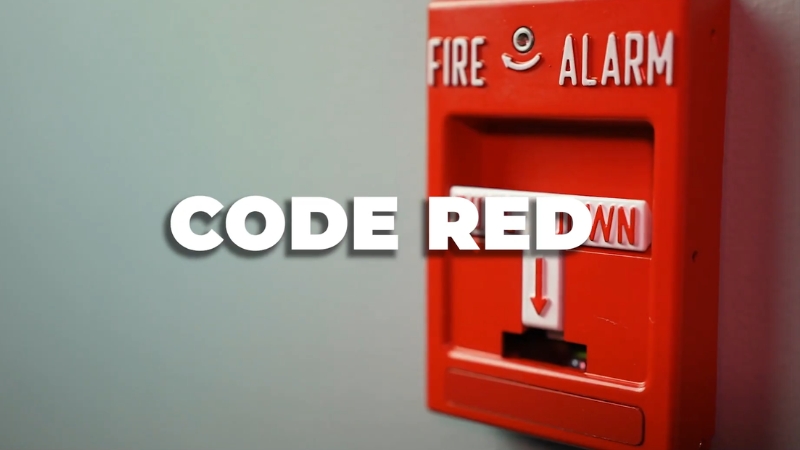
A fire alarm on a hospital floor creates a problem that does not exist in most office buildings. Walking everybody outside is impossible when some patients are sedated, ventilated, recovering from surgery or connected to oxygen, monitors and IV pumps.
Hospital fire protection is designed around that reality.
Buildings are divided into fire and smoke compartments so patients can first move from a threatened area into another protected section of the same floor. The NFPA smoke compartment guide explains how those barriers support a defend-in-place strategy in health-care facilities.
Why Patients Move Sideways First
Moving through fire doors into the next compartment lets a patient stay in a bed with a monitor, oxygen and IV equipment attached.
Taking the same patient several floors down is harder. Elevators may be restricted. Hospital beds are not designed for staircases. A ventilated patient can require several staff members plus portable oxygen, monitoring and airway equipment throughout the move.
Horizontal evacuation creates a safer area without immediately turning every patient movement into a trip through a stairwell. Vertical evacuation follows when the floor itself can no longer remain occupied.
What A Real Hospital Fire Looks Like
A nursery fire at Pakistan Institute of Medical Sciences in Islamabad killed 14 babies in August 2026. Nurse Razia Noreen ran into the nursery and carried one infant out before smoke prevented another entry.
She later told the Associated Press, “I wanted to save the others.”
Her account shows why a hospital fire cannot be reduced to an alarm and an exit sign. Staff may be responsible for patients who cannot move themselves, and every extra floor adds people, equipment and time to the evacuation.
3. Code Silver Means A Weapon Threat
@steveioe Thoughts from the ER @dr.karanr #code #silver #gun #duck #sword #alert #hospital #dangerous #drop #hide #silence #phone #ranger ♬ original sound – Steveioe
Code Silver identifies an armed person, active shooter, hostage event or other weapon-related threat in many standardized US hospital systems.
That changes the direction of the response. Code Blue pulls trained people toward one patient. A weapon alert can require staff to move away from the reported location, secure doors, limit access and protect patients who cannot leave on their own.
An emergency department illustrates the difficulty. It may have several public entrances, waiting rooms full of visitors, ambulance access and patients who depend on oxygen, infusions or continuous observation. Locking a hospital down is not the same operation as locking an empty office.
“Security alert, armed person, emergency department entrance” gives everyone who hears it the threat and the location. “Code Silver” gives that information only to people who already know the local system.
4. Code Pink Can Mean Two Different Emergencies

Code Pink is where memorizing a color from another hospital becomes dangerous.
Tallahassee Memorial HealthCare uses Code Pink for an infant or child abduction. Its training material tells the employee who discovers the child missing to contact the operator and provide details including age, sex and unit location.
Tri-City Medical Center in California published a very different policy. Code Pink Resuscitation there refers to an impending or actual cardiopulmonary arrest in a pediatric patient.
Loma Linda University Health also uses Code Pink for infant abduction and includes the alert in its security procedures and drills.
| Hospital Or System | State | Code Pink Meaning | Published Source |
|---|---|---|---|
| Tallahassee Memorial HealthCare | Florida | Infant or child abduction | TMH training guide |
| Tri-City Medical Center | California | Pediatric cardiopulmonary arrest | Tri-City Code Pink policy |
| Loma Linda University Health | California | Infant abduction | Loma Linda Code Pink policy |
Imagine a nurse trained at Tri-City starting a shift in a facility where Code Pink locks maternity exits. Running toward a pediatric resuscitation location is the wrong action because no pediatric arrest has been called. The alert is about a missing infant.
“Infant abduction alert” and “pediatric cardiac arrest” remove that ambiguity before the responder has to remember which hospital uses which definition.
Other Codes Become Harder To Carry Between Hospitals
A nurse who learned Code Gray as a combative-person alert can walk into another health system where Gray refers to a different operational event. Code Yellow has been used for disasters, bomb threats and other facility-defined emergencies. Green can mean evacuation in one system and something else in another.
Orange, Black, Green, White, Gray and Yellow therefore work poorly as knowledge carried from one employer to the next. Their definitions have to come from the facility itself.
| Code | Meaning Found In Many Systems | Where It Can Differ |
|---|---|---|
| Code Orange | Hazardous material spill or release | Some facilities use it for disaster or mass-casualty response. |
| Code Black | Bomb threat | Some systems assign bomb threats another color. |
| Code Green | Evacuation or relocation | Other systems use it for elopement or another operational event. |
| Code White | Violent person or medical response | Some hospitals use it for pediatric emergencies. |
| Code Gray Or Grey | Combative person or security response | Other systems assign Gray to different facility alerts. |
| Code Yellow | Facility-defined emergency | Published systems have used it for bomb threats, disaster activation and trauma. |
For permanent staff, those meanings become routine. The greater risk falls on people who change buildings and hear a color they already associate with something else.
Why Hospitals Are Moving Toward Plain-Language Alerts

The move did not begin with one federal order.
Hospital groups first tried to make the colors themselves more consistent. California was working on standardized emergency colors by 2000. Minnesota took a different route in 2011 and developed a toolkit encouraging plain-language overhead announcements. Missouri followed after its 2012 hospital survey, with implementation guidance published in 2013. Other states adopted similar or blended systems during the years that followed.
CMS added a separate federal requirement in 2016. Its Emergency Preparedness Final Rule does not tell hospitals what to call a fire, cardiac arrest or security threat. The rule requires participating providers to maintain an emergency plan, written policies, a communication plan, and a training and testing program. Facilities had to comply by November 15, 2017.
The CMS emergency preparedness rule therefore affects how hospitals plan, communicate and test emergency procedures without creating a federal Code Blue, Red or Pink dictionary.
The Joint Commission also examined coded, plain-language and blended announcements. A December 2018 EC News review discussed hospital executive polling on the competing approaches. No single national vocabulary followed from that work, but emergency communication was increasingly being judged on how clearly staff, patients and outside responders could understand it.
Washington offers a recent example. Hospitals in the state had accumulated more than 50 separate emergency codes before the Washington State Hospital Association developed a shared system organized around facility, medical and security alerts. The statewide transition began October 1, 2024.
The WSHA 2024 implementation guide lays out staff education, testing, a defined launch date, drills and post-launch review rather than treating a new list of words as sufficient by itself.
How Hospital Alert Language Changed
| Period | What Changed |
|---|---|
| 2000s | States including California, Maryland, Louisiana, Oregon and Washington worked on standardized color codes. |
| 2011 | Minnesota developed a toolkit for plain-language overhead paging. |
| 2012-2014 | Missouri surveyed hospitals and several states adopted plain-language or blended approaches. |
| 2016-2017 | CMS emergency-preparedness requirements were finalized and then became mandatory for covered providers. |
| 2018-2019 | The Joint Commission and patient-safety groups continued discussing coded, plain and blended alerts. |
| 2024 | Washington launched a statewide plain-language system after documenting more than 50 codes in use. |
What A Plain-Language Alert Sounds Like
| Coded Alert | Plain-Language Version |
|---|---|
| Code Blue | Medical emergency, room 412 |
| Code Red | Fire alarm, east wing, second floor |
| Code Silver | Security alert, armed person, emergency entrance |
| Code Pink | Infant abduction alert, maternity unit |
| Code Green | Evacuation, third floor, south unit |
Code Blue has proved harder to displace because resuscitation teams already recognize it across much of health care. Minnesota’s guidance, for example, allowed Code Blue to remain as the medical-emergency term while recommending direct language for less consistent alerts.
How A Hospital Code Actually Reaches The Team
Walk through a modern hospital during an emergency and the overhead speaker may be only one part of what is happening.
The employee who finds the emergency might dial an internal number, push a wall button, contact the operator or trigger an electronic alert. The operator can then send the same event through several channels at once.
Care does not wait for that communication chain to finish. CPR begins when cardiac arrest is recognized. A fire response starts by protecting people in immediate danger and activating the alarm. An abduction alert can trigger locked exits and a description of the missing child before every department has received the full message.
Some Codes Never Reach The Speaker
UNC Hospitals moved several clinical response calls away from overhead paging. Operators send alerts through Vocera and pager notifications, allowing the response team to receive the location without broadcasting every event across the building.
Other hospitals use smartphones, dedicated pagers, secure messaging systems, wearable devices or mass-notification software. Fire alarms and public safety events may still require broader announcements because everyone in an affected area needs instructions.
The channel therefore depends on who needs the information. A cardiac arrest may require a small clinical team. A fire or armed-person event can affect an entire floor or building.
Calling A Code Is Different From Clearing One
An unresponsive patient cannot wait while staff search for a senior physician. Medical emergency systems are designed so the person who recognizes the arrest can start the response.
Ending an emergency is different. A missing-child alert, lockdown or armed-person warning should remain active until the authority named in the local policy clears it. Depending on the event, that may be security, incident command, hospital administration or law enforcement.
That difference is easy to miss during orientation. Knowing that a hospital has Code Pink is less useful than knowing how to activate it, how the alert reaches you, what your assigned role is and whose announcement ends the response.
Hospital Emergency Codes Are Not Billing Codes

Searching for “hospital codes” also brings up ICD-10, CPT and HCPCS, which belong to a different part of health care.
Code Blue and Code Red trigger operational responses inside the building. ICD-10-CM records diagnoses. ICD-10-PCS records inpatient procedures. CPT and HCPCS identify medical services and supplies in billing and reporting systems.
| Type Of Code | Purpose | Example |
|---|---|---|
| Hospital emergency code | Activates an immediate safety or medical response | Code Blue, Code Red, Code Silver |
| Diagnosis code | Documents a medical condition | ICD-10-CM |
| Procedure code | Documents an inpatient procedure | ICD-10-PCS |
| Billing code | Supports claims and reimbursement | ICD, CPT or HCPCS |
What Staff Need To Know Before A Code Happens
A traveling nurse hears Code Pink during the first week at a new hospital. The color is familiar. The problem is that the nurse learned it as pediatric arrest and the new hospital uses it for infant abduction.
Orientation needs to prevent that moment.
Before working independently, temporary and permanent staff need to know the number or button that activates an emergency, where the alert appears, what equipment comes with the team and who takes command after responders arrive.
The first two minutes also change with the event. During Code Blue, CPR and defibrillation preparation begin. During Code Red, staff protect people near the hazard and contain smoke. An infant-abduction response shifts attention toward exits, stairwells and a description of the missing child. A weapon alert can require the exact opposite of a medical code by keeping people away from the reported location.
| Emergency | First Actions |
|---|---|
| Code Blue | Activate the response, begin CPR, bring the defibrillator and establish team roles. |
| Code Red | Protect people near the fire, activate the alarm, contain smoke and prepare patient movement. |
| Code Pink Abduction | Notify the operator or security, give a description, secure exits and begin the search plan. |
| Code Silver | Move away from the threat and follow security or police instructions. |
A single event may reach staff through the overhead system, pager groups, smartphones and wearable devices at the same time. Agency and traveling staff need to learn those mechanics during facility orientation, not reconstruct them from memory after the announcement begins.
FAQs
What These Codes Show
Code Blue works because hospitals across the country have attached the same medical response to the term for years. Code Red has a similarly recognizable role. The system becomes weaker once colors such as Pink, White, Gray and Yellow start carrying different meanings between facilities.
The US has spent more than two decades trying to reduce that confusion. Some states standardized colors. Others moved toward direct announcements. Several use both. CMS added national rules for emergency planning, communication, training and testing without creating a federal dictionary of code names.
Plain language deals with the part color standardization never fully fixed. A person hearing “infant abduction, maternity unit” does not need to remember which color means abduction in that building. A visitor hearing “armed person, emergency department entrance” immediately has more useful information than someone hearing Code Silver without knowing the local system.
Color codes are fast only after everyone has learned the same vocabulary. US hospitals still do not share one vocabulary, which is why direct language has become the stronger direction for alerts where misunderstanding can cost time.
Sources
- American Hospital Association
- Missouri Hospital Association
- Emergency Nurses Association
- Iroquois Healthcare Association
- American Heart Association Guidelines
- UCSF Health
- National Fire Protection Association
- CNN
- Associated Press
- Tallahassee Memorial HealthCare
- Tri-City Medical Center
- Loma Linda University Health
- Centers for Medicare and Medicaid Services
- Washington State Hospital Association
- UNC Health