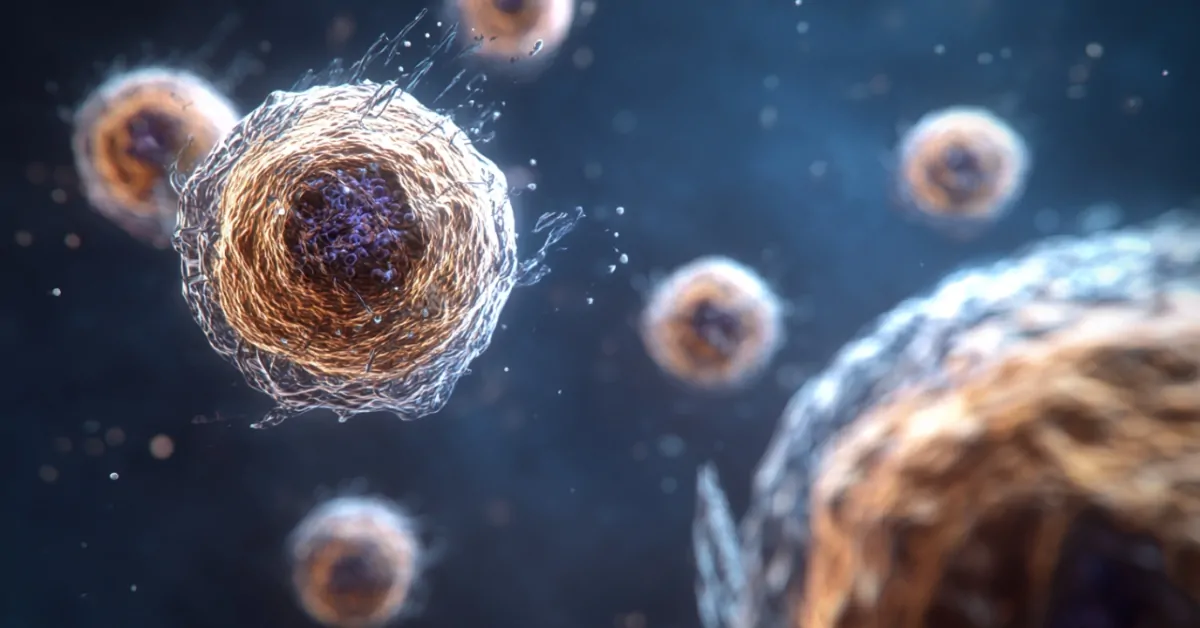
For decades, aging at the cellular level has been blamed on one tiny structure inside our cells: the mitochondria. These microscopic power plants generate the energy that keeps cells alive and functioning.
As we grow older, mitochondria break down, slow down, and multiply less efficiently. When that power supply weakens, diseases begin to appear across the heart, brain, muscles, and immune system.
Now, researchers at Texas A&M University believe they have found a way to help worn-out human cells regain power by giving them fresh mitochondria from healthier neighboring cells.
Instead of forcing damaged cells to repair their own energy systems, the new method allows them to receive fully functional replacements, almost like swapping out a dead battery for a charged one.
The research, published in the Proceedings of the National Academy of Sciences (PNAS), describes how specially designed nanoflowers made from molybdenum disulfide can trigger this process naturally inside the body.
If confirmed in animal and human trials, the implications could extend across cardiology, neurology, cancer recovery, and degenerative muscle disease.
Table of Contents
ToggleThe Science Behind the Discovery Explained Simply
Mitochondria produce the energy that allows cells to move, repair damage, regulate temperature, and perform every vital chemical task required for life.
As mitochondria wear out with age, cells enter a low-energy state. Once that happens, tissues weaken, inflammation increases, and recovery ability collapses.
The Texas A&M team used microscopic “nanoflowers” designed with tiny pores that absorb harmful reactive oxygen species. These molecules are one of the main causes of mitochondrial breakdown.
Once the oxidative stress was removed, genes responsible for mitochondrial production were activated.
This caused stem cells in the experiment to rapidly increase the number of mitochondria inside themselves. These energized stem cells then transferred their surplus mitochondria to old, damaged, neighboring cells.
Instead of forcing weak cells to repair themselves, the system allowed them to be directly recharged using healthy replacements.
What the Lab Results Actually Showed
In controlled human cell experiments, the effects were measurable and dramatic:
- Mitochondria transfer between cells doubled compared to natural rates
- Heart smooth muscle cells increased three to four times in number
- Chemotherapy-damaged heart cells showed a significantly higher survival rate
- Energy levels inside previously dying cells restored to near-normal function
This means the process did not just slow damage. It actively reversed the energy collapse inside injured cells.
The Biomedical Engineering Perspective
Akhilesh Gaharwar, the biomedical engineer leading the work, explained the concept plainly. Instead of rewriting DNA or relying on drugs to force repair, the method trains healthy cells to share spare mitochondria with weaker ones.
This allows damaged cells to regain function without genetic manipulation.
From an engineering standpoint, this is critical. Genetic therapies carry long-term risks that can take decades to understand fully. Drug therapies often come with systemic side effects.
This nanotechnology-regulated mitochondria transfer uses a natural biological process that already exists in the body and simply amplifies it.
That makes it far safer in theory than many aggressive regenerative technologies currently under development.
The Geneticist’s View: Why This Is a Big Shift
Geneticist John Soukar describes the discovery as being at the very beginning of a new therapeutic class. In his view, mitochondria sharing could become a foundational method for treating cellular failure across multiple organs.
What makes this especially powerful is that it is not targeted at one disease. Any condition where cell energy failure is a factor could potentially benefit.
That includes heart failure, stroke recovery, Parkinson disease, Alzheimer’s pathology, chemotherapy recovery, muscular dystrophy, and chronic fatigue disorders.
Rather than designing separate treatments for each disease, this approach addresses the shared energy collapse beneath many of them.
From my perspective, this discovery feels different from many flashy anti-aging headlines that appear every year. Most “rejuvenation” research promises change at the genetic or molecular control level, which always raises alarms about mutation risk, cancer triggers, and long-term instability.
This approach does something far more grounded. It works with a process the body already uses. Cells already share mitochondria under stress. The nanoflowers simply remove the toxic barriers that prevent that exchange from happening efficiently with age.
That does not make it risk-free. But it does make it biologically logical. Instead of overriding nature, it amplifies what nature already does when it can.
Where This Could Be Used in the Human Body
Stem cell therapy has shown promise in treating a wide range of diseases and injuries, from cancer to spinal cord injuries. https://t.co/B70EBu88la
— BBN Times (@BBNTimes_en) November 7, 2025
The researchers believe that targeted placement of donor stem cells could allow controlled recharging of specific tissues.
For cardiovascular disease, the cells could be delivered near the heart muscle. For muscular dystrophy, they could be implanted directly into affected muscle groups.
For neurodegenerative conditions, the placement could focus on localized brain regions responsible for motor or memory function.
The treatment is not systemic in its current form. It is location-based. That adds another layer of safety because it limits unintended interactions elsewhere in the body.
What This Does Not Yet Do
Despite the excitement, this discovery does not reverse aging in people today. The entire process has only been validated in controlled cell environments.
No animal studies have yet confirmed long-term safety. No human trials have begun.
Critical unanswered questions remain:
- How long do the transplanted mitochondria continue functioning
- How often would treatments need to be repeated
- Could an uncontrolled transfer create abnormal cell behavior
- What are the long-term immune responses
- Could it affect cancer risk in unpredictable ways
Until these questions are answered through rigorous animal and human trials, this remains a powerful laboratory breakthrough rather than a clinical therapy.
Why This Could Reshape Aging Research
@dr.stefanosinicropi Our cells have tiny antennas that receive specific wavelengths of light. Red and infrared light stimulate mitochondria, the powerhouses of our cells, to produce more energy. This boost not only fuels the cell but also changes gene expression, telling cells to stay healthy and work efficiently. Light acts like a conductor, guiding the orchestra of cellular processes. Harnessing this is at the heart of photobiomodulation and regenerative wellness. #photobiomodulation #redlighttherapy #mitochondria #wellness #drsinicropi ♬ original sound – Dr.Sinicropi
For decades, aging research has focused on DNA damage, telomere shortening, and epigenetic drift. This work shifts attention back to something more fundamental: energy availability inside the cell.
Without energy, every repair system fails. Without repair, every tissue degenerates. By addressing the problem at the energy source instead of the genetic blueprint, this discovery may open an entirely different medical roadmap for longevity science.
The next step is animal testing to determine how safely mitochondria transfer can be activated inside living tissue. Researchers must measure not only short-term recovery but multi-month and multi-year cellular behavior.
If animal trials show stable safety, early human trials would likely focus on chemotherapy recovery or localized muscle disease, where benefits can be measured clearly and quickly.
Only after those stages could broader anti-aging applications even be considered.
Bottom Line
This discovery does not make humans immortal. It does not reverse aging overnight. But it offers something far more realistic and potentially transformative: a way for old, exhausted cells to regain lost energy using clean replacements instead of chemical force.
Instead of pushing broken machinery harder, this approach quietly swaps in new parts.
If future trials confirm safety and durability, this could become one of the most important cellular repair technologies developed in this generation.