

There’s a new COVID variant making the rounds. You probably haven’t heard much about it. That’s not an accident.
It’s called BA.3.2. And while the federal health establishment is carefully, methodically, bureaucratically assuring you that there’s “no clear signal of increased severity”, the same people are simultaneously running a multi-continent genomic surveillance operation to track its every move.
Think about that for a second. They’re monitoring airplane sewage. Literally collecting wastewater from commercial flights. That’s not something you do about a variant you’re not worried about.
So what exactly is BA.3.2, and why should you pay attention?
Let’s start with the basics. This variant was first found in a five-year-old child in South Africa in November 2024. By early 2026, it had quietly spread to at least 23 countries.
The CDC, to its credit, has been tracking it through what they call a “multimodal genomic surveillance system”, a fancy way of saying they’re watching wastewater, swabbing travelers at airports, and collecting nasal samples from people who have no idea their mucus is part of a federal surveillance program.
By March 12th of this year, BA.3.2 had been detected in 29 U.S. states and Puerto Rico. Two hundred and sixty wastewater samples. Twenty-nine clinical patients. Six airplane sewage samples from three planes. This is not a variant that is staying in one place.
The Mutation Problem Nobody Wants to Talk About
Here is the part that should get your attention. BA.3.2 carries somewhere between 70 and 75 mutations and deletions in its spike protein, the very part of the virus that your immune system was trained to recognize and fight, whether through vaccination or prior infection.
Seventy to seventy-five changes. The 2025–2026 COVID vaccines were formulated against LP.8.1 and JN.1. BA.3.2 is substantially different from both of those strains.
What does that mean in plain English? It means the antibodies your body has been building up, through shots, through getting sick, through all of it, may not work as well against this version of the virus. The CDC calls this “immune evasion potential.” Scientists call it a problem. Regular people call it being back at square one, or something close to it.
Lab studies have confirmed it: BA.3.2 can dodge antibodies generated by previous infection or by current vaccines. That’s not speculation. That’s in the report.
Now, and this is the part where the official language gets very careful and very measured, the CDC is quick to note that “clinical outcomes to date do not yet indicate a clear signal of increased severity.”
Translation: the people who got it survived. That’s the good news. The hospitalized patients they know about were older adults with pre-existing conditions, and they all pulled through.
But here’s the thing. The variant is still new. It hasn’t spread widely enough yet for us to have a definitive read on what it does to large populations. And in parts of Europe, specifically the Netherlands, Germany, and Denmark, it already accounts for nearly 30% of all COVID sequences being reported.
Thirty percent. That’s not a blip. That’s a variant that is gaining ground, even if it hasn’t yet declared total victory.
The Wastewater Story Is the Real Story
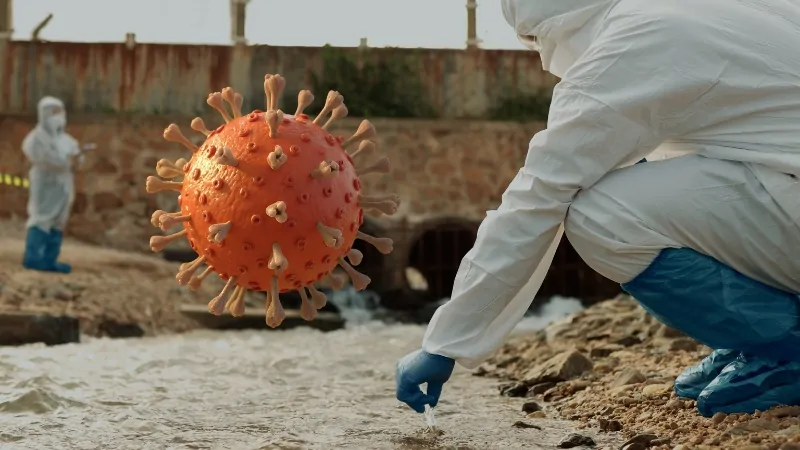
If you want to understand what’s actually happening with COVID surveillance in this country, forget the hospital reports. Forget the press conferences. The real leading indicator is the sewer system.
Here’s something that almost nobody is talking about: in the United States, wastewater monitoring identified BA.3.2 weeks before a single clinical sample came back positive. Weeks.
The variant was circulating in communities, going through people’s bodies, leaving its genetic fingerprint in the water supply, and the clinical system had no idea.
The CDC has approximately 1,300 wastewater monitoring sites across the country. WastewaterSCAN monitors another 150. These programs caught BA.3.2 in Rhode Island in November 2025. The first confirmed patient case wasn’t reported until December. That’s a month of lead time that the formal medical system simply did not have.
This is worth pausing on. We live in a country where federal agencies are analyzing the contents of airplane toilets for viral RNA, and they’re finding things before doctors even know there’s something to look for.
The surveillance apparatus is far more sophisticated than most people realize. Whether that comforts you or concerns you probably says something about your politics. But either way, it’s real.
The Big Question: Should You Be Worried?
View this post on Instagram
The CDC’s official position is: keep watching, but don’t panic. That’s roughly equivalent to your doctor saying your test results are “interesting”, technically reassuring, but not exactly settling.
Here’s what we know. BA.3.2 has not rapidly replaced other circulating COVID strains. It’s been co-circulating alongside the JN.1 family of variants without achieving dominance.
One possible reason: laboratory research suggests the subvariants BA.3.2.1 and BA.3.2.2 may have reduced ability to enter lung cells compared to other strains. If a virus can’t get into your lungs efficiently, it has a harder time getting severely ill out of a population.
That’s somewhat reassuring. But here’s the counterpoint: viruses evolve. They don’t stay static.
The very fact that this variant has 70+ spike protein changes compared to existing strains is evidence that it has already undergone enormous evolutionary pressure. There’s no guarantee the next version of it will have the same limitation.
And consider the backdrop. The 2024–2025 respiratory virus season, which is ongoing, was responsible for an estimated 390,000 to 550,000 hospitalizations and somewhere between 45,000 and 64,000 deaths in the United States alone.
COVID remains a serious public health burden, regardless of where any particular variant falls on the severity spectrum.
What the Government Is, and Isn’t, Telling You
New COVID variant with immune escape potential confirmed in US & 22 other countries.
BA.3.2 represents a new lineage of SARS-CoV-2, genetically distinct from the JN.1 lineages that have circulated in the US since January 2024.
Read more: https://t.co/8OYD8OQhM4
Credit: NIAID pic.twitter.com/4VqlwXBAEq
— CIDRAP (@CIDRAP) March 23, 2026
The CDC has not issued any alarm about BA.3.2. They have not changed vaccine recommendations. They continue to recommend the 2025–2026 formulations, the LP.8.1 mRNA version and the JN.1 protein version, even while acknowledging in the same report that BA.3.2 has significantly diverged from both of those antigens.
What they are doing is watching. Carefully. Persistently. Using tools most Americans don’t know exist, tracking a virus through toilet water on transcontinental flights and sewer systems in 29 states.
The official message is: sustained genomic surveillance will guide future decisions on vaccine composition and healthcare preparedness. Which is bureaucratic language for: we don’t know yet, but we’re keeping a very close eye on it, and we’ll let you know when we do.
Maybe that’s enough. Maybe the early detection, the wastewater early warning systems, and the close international coordination are exactly what they look like, a genuinely functional public health infrastructure doing its job. Or maybe the reassuring language is outrunning the actual data, as it has before.
Either way, BA.3.2 is here. It’s in your state, almost certainly. It’s in the water. And the people tasked with protecting your health are spending a great deal of time and money making sure they know exactly how it moves.