Year 2026 marks a clear turning point for agriculture. After a long period of testing digital tools, pilot projects, and early automation, the sector is moving into a phase centered on execution.
Year 2025 can be framed as a period of exploration, while 2026 is better defined by execution and resilience. Growers are no longer asking abstract questions about innovation.
More practical questions now lead the conversation:
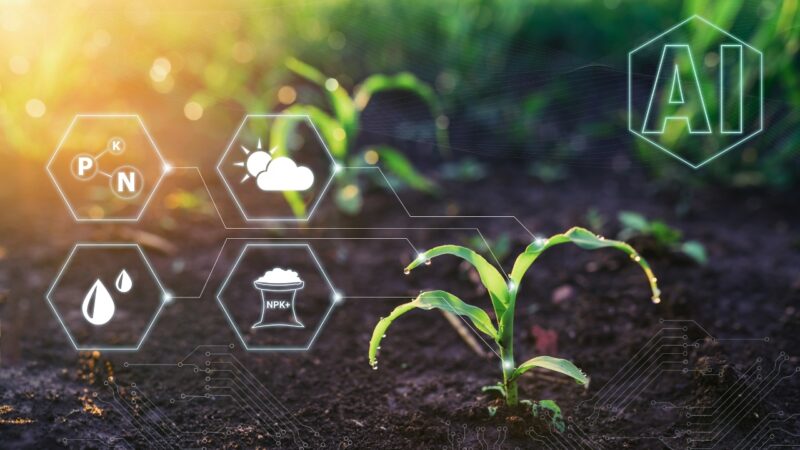
Pressure on the global food system gives those questions unusual weight. The global population is moving toward 9.7 billion by 2050. Food demand is expected to rise by at least 70% during that same long-range period. So, can AI help with growing enough food and be of help with other relevant factors? Global AI in agriculture value rises in 2026 to $3.37 billion, up from $2.71 billion in 2025. That increase represents a 24.5% compound annual growth rate. Numbers at that level place agricultural AI in a serious commercial category with visible momentum. Longer-term projections strengthen that picture. Global market value is expected to reach $8.23 billion by 2030. Forecast period growth across 2026 to 2030 implies a 25.0 percent compound annual growth rate. Scale and tracking depth also matter here. A February 2026 market report runs 250 pages and mentions 32 companies, which signals a category that investors and industry planners are now watching closely. Forecast growth is linked to smart farming adoption, climate-related efficiency needs, agri-robotics expansion, government support for digital agriculture, and rising agri-tech investment. Agriculture has spent years collecting large volumes of data. Many operations now have sensors, apps, connected machines, field records, and weather feeds. Yet more data has not always created better decisions. A core problem has been a gap between data collection and actionable insight. Agriculture has often been drowning in big data while starving for insights. Year 2026 is pushing the sector toward a more useful model. Standardization and connectivity are taking priority over adding one more sensor or one more disconnected platform. Better value comes when systems can exchange data in compatible formats and turn historical records into recommendations that matter at the field level. Decision support systems become more effective when data can speak the same language. With AgData standardization advancing, algorithms can work across years of historical records and improve prediction quality for: Better interoperability makes those systems more practical for everyday farm use. AI also adds mechanism-level value in the field. Large volumes of data gathered through IoT devices and sensors can be analyzed to improve diagnostics for soil fertility, irrigation needs, pest control, and crop disease. More responsive systems also support faster reactions to agronomic and environmental conditions as they change in real time. AI is a core enabler of precision agriculture because it improves productivity, sustainability, and resource efficiency. OECD places precision agriculture across a broad set of production systems: Scope also includes both automation and digitalization, which shows that precision agriculture is not limited to row crops. Practical use cases make that value easier to see. AI and computer vision can automate tasks, improve food quality and safety, and support crop-growth optimization through more accurate monitoring. Computer vision also helps automate fruit and flower counting, which improves yield estimation while saving time and reducing labor costs. Ag robotics is entering 2026 with a clearer payback case, a shift also captured by icl-group.com. Labor shortages are pushing farms to evaluate automation in terms of ROI rather than novelty. Pressure on farm operations is making robotics more attractive for a few direct reasons: AI-enabled automation also addresses one of agriculture’s biggest operating problems by taking over time-consuming, repetitive tasks. That link matters because ROI is easier to justify when technology solves a daily constraint. Machine adoption is also becoming easier to map to market growth. Autonomous tractors, harvesters, and related agricultural machinery are gaining traction as tools for precision, yield-quality improvement, drudgery reduction, and production stability under climate stress. Research and Markets also identifies autonomous agricultural machinery and smart resource management solutions as central trends in the 2026 to 2030 growth phase. Agrifood robotics and automation are moving fast from pilots to real-world use. Watch our joint @EBRD–@FAO E-Dialogue on governance, finance and evidence — the factors shaping whether automation drives real sustainability gains or creates new lock-ins.https://t.co/AtcEi5qpeM pic.twitter.com/oGy0F5tJSn — The EBRD (@EBRD) March 10, 2026 Europe offers strong evidence that agricultural robotics is moving into field deployment. Focus is shifting toward named projects, pilot sites, completion dates, equipment categories, and economic results. Smart Droplets shows that pattern clearly. Project work used real-time field-demonstrator data to optimize pesticide and fertilizer use. Autonomous robotic platforms, innovative spraying, digital twins, and AI models were all part of the system. Environmental and economic benefits were explicit goals. End date was February 2026. Flexigrobots adds a multi-robot example with documented field testing. OECD describes an open AI platform built for flexible, heterogeneous multi-robot systems that include unmanned aerial vehicles and unmanned ground vehicles. OECD says those pilots demonstrated significant economic value in operational settings. Project closed in December 2023. Robs4Crops tested mechanical weeding and spraying in vineyards, crop fields, and apple orchards. Goals included lower manual labor, greater safety, and optimized input use. Large-scale pilots took place in the Netherlands, France, Spain, and Greece. Project closed in December 2024. Climate resilience is one of the main reasons AI adoption is accelerating in agriculture. Survivability is becoming a core business issue because extreme weather can reduce yield, lower quality, and increase seasonal risk. AI and robotics matter in that context because they support production stability under stress. AI-enabled and robotics-enabled machinery can optimize yield quality, reduce drudgery, and stabilize food production under climate change. Labor shortages are making automation economics more urgent. AI and automation help farms maintain productivity by taking over repetitive and time-consuming work. One practical example shows the cost case clearly. Computer-vision systems can automate fruit or flower counting, which speeds up yield estimation and reduces labor costs. OECD gives one specific example that captures the trust barrier. A 10-hectare vineyard owner needed three years to trust and apply the technology. Small and medium-sized farms face even more pressure because hardware and integration burdens are harder to absorb at that scale. AI in agriculture has entered a mainstream investment category. Market value reaches $3.37 billion in 2026 and is projected to hit $8.23 billion by 2030. Europe’s project pipeline also shows what scaling looks like in practice. OECD project examples combine robots, AI models, sensors, spraying systems, and digital twins across pilots in Spain, Finland, Serbia, Lithuania, the Netherlands, France, and Greece. Adoption is still constrained by fragmented data, interoperability problems, language variation, farm-size differences, digital literacy gaps, and regulatory issues tied to drones and data security. The year 2026 is defined by a small set of measurable shifts that carry major significance. Global AI in agriculture reaches $3.37 billion. Market projections point to $8.23 billion by 2030. Robotics pilots are showing documented economic value in field conditions. Judgment criteria are also changing. Payback, labor substitution, input optimization, deployment maturity, and climate resilience are becoming the standards that matter most.
The AI Agriculture Market in 2026
Market growth in 2026 shows that AI in agriculture is no longer a fringe category.
AI Adoption Is Shifting From Data Collection to Decision Support
Precision Agriculture by the Numbers
Robotics Crosses the ROI Barrier
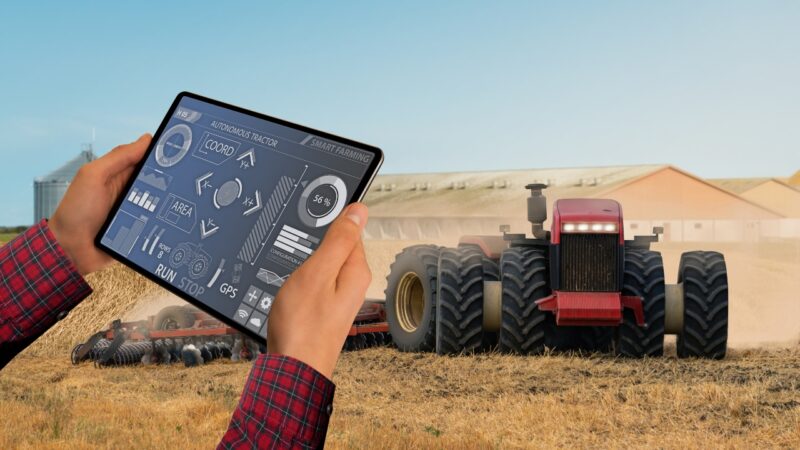
Europe’s Robotics Pipeline: From Pilots to Field Deployment
Climate Resilience as the Real Adoption Driver
Labor Shortages and Automation Economics

What the Numbers Imply for 2026 Farm Strategy
FAQs
Closing Thoughts