
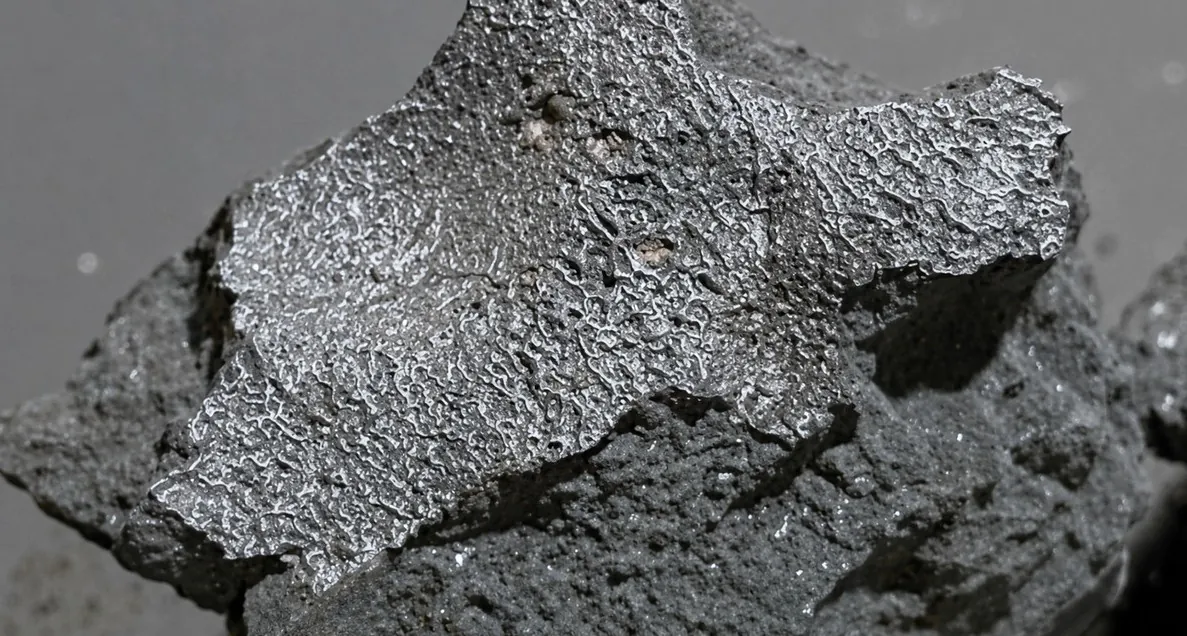
A meteorite that tore through the roof of a New Jersey home has turned out to be far more scientifically valuable than anyone realized on the afternoon it landed.
Researchers examining the recovered fragments found amino acids, carbon-bearing compounds and evidence of ancient salty water. The findings do not show that the meteorite carried life, but they offer a rare look at chemical reactions that may have helped produce the ingredients needed for life on early Earth.
The object, now known as the Hillsborough meteorite, struck a house in Hillsborough, New Jersey, after a bright fireball and sonic boom startled people across the region in July 2024. Its scientific importance became clear after an international research team completed a detailed analysis of the fragments.
Table of Contents
ToggleA Fireball Over New York Ended Inside a New Jersey Bedroom
The incoming space rock entered the atmosphere at roughly 32,000 mph. Around 60 observers across New Jersey, New York, Connecticut, Rhode Island and Pennsylvania reported seeing the meteor, while several people felt the resulting shockwave.
Cameras recorded the fireball passing south of the Statue of Liberty. Doppler weather radar at Newark Liberty International Airport later detected a trail of debris extending from Staten Island into New Jersey as the object broke apart.
The original rock may have weighed about 110 pounds before much of it burned or fragmented in the atmosphere. One surviving piece, weighing more than two pounds, crashed through the roof of a Hillsborough house and penetrated the ceiling of the main bedroom.
The homeowner heard the impact, discovered black fragments scattered across the bed and carpet, and noticed a strong sulfur-like smell. According to the reporting on the New Jersey fireball and its unusual remains, the fragments were preserved before ordinary household exposure could seriously alter them.
The Homeowner’s Quick Thinking Preserved the Evidence
What happened after the impact proved almost as important as the fall itself.
The homeowner used disposable gloves, aluminum foil and glass jars to collect the fragments. That simple decision limited contact with skin oils, humidity and other sources of contamination.
Carbon-rich meteorites are especially vulnerable once they reach Earth. Their minerals readily absorb moisture, while fragile organic compounds can be altered through handling and prolonged exposure to the atmosphere.
The homeowner also documented the damaged room and contacted meteor specialists quickly. Researchers were therefore given unusually clean samples from a witnessed fall, complete with eyewitness reports, camera recordings and radar evidence showing the object’s path.
The SETI Institute described the recovered material as the most pristine known example of its particular meteorite class.
A Rare Type of Primitive Meteorite
Scientists classified Hillsborough as a CM1/2 carbonaceous chondrite. Carbonaceous chondrites are primitive rocks containing material preserved from the early history of the solar system.
The CM1/2 designation means the meteorite has characteristics between two related groups. CM2 meteorites have experienced some alteration by water inside their parent asteroids. CM1 material has generally undergone more extensive water-driven changes.
Hillsborough is only the second witnessed fall classified as CM1/2. The first was the Kolang meteorite, which fell in Indonesia in 2020. That rarity, combined with the careful recovery of the New Jersey fragments, gives researchers an unusually clean sample for laboratory analysis.
The results were published in the peer-reviewed journal Science Advances.
Ancient Brine Left Its Mark Inside the Rock
The most striking discovery was evidence that parts of the meteorite had once been exposed to concentrated salty fluids on its parent asteroid.
Researchers found small, salt-rich fragments that appear to have originated near the asteroid’s surface. Their working explanation is that liquid water moved through the asteroid before evaporating and leaving concentrated salts behind.
Brines matter because salty water can keep phosphate in solution and encourage reactions between minerals and organic molecules. Such environments could help produce or concentrate compounds used by living organisms.
Analysis also detected amino acids, carboxylic acids and a wide range of soluble organic compounds. Some magnesium-bearing organic compounds resembled chemical arrangements that play important roles in blood and photosynthesis on Earth.
Scientists are not claiming that blood, plants or organisms existed inside the asteroid. Similar chemical structures can form without biology. The important finding is that a small, primitive world contained water, minerals and organic material capable of interacting through complex chemistry.
Researchers told CBS News that the fragments contained prebiotic molecules, meaning compounds relevant to chemistry that can occur before life emerges.
What the Meteorite Can and Cannot Tell Us About Life?
The discovery supports a long-standing scientific possibility: asteroids and meteorites may have delivered organic molecules to the young Earth.
Early Earth endured frequent impacts. Carbon-rich objects carrying water-altered minerals, amino acids and other organic material could have added to the planet’s supply of chemical ingredients. Those deliveries may have contributed to the environment in which the first living systems eventually developed.
Hillsborough does not prove that meteorites created life. It also does not establish that its parent asteroid ever supported an organism. The fragments preserve chemistry associated with potentially habitable processes, not evidence of extraterrestrial biology.
That distinction is important. As Space.com reported on the possible connection to life’s origins, the value of the meteorite lies in showing how briny asteroid environments could promote reactions among minerals and organic molecules.
Scientists May Be Able to Trace Where It Came From
Camera footage, eyewitness accounts and weather radar allowed researchers to reconstruct the object’s atmospheric path. Their calculations point toward the inner asteroid belt as its likely source region.
The possible source overlaps with an area explored by NASA’s Lucy spacecraft, although researchers cannot identify the exact parent asteroid. Laboratory comparisons with samples returned from the asteroids Ryugu and Bennu may help clarify how common salt-rich environments were on primitive solar system bodies.
Some Hillsborough fragments will be curated by the American Museum of Natural History in New York, preserving material for future studies as analytical technology improves.
A Remarkable Delivery With Lasting Scientific Value
The Hillsborough meteorite arrived violently, leaving a hole in a roof, debris across a bedroom and black dust on a bed. What survived the impact was a remarkably intact record of water and organic chemistry on an ancient asteroid.
Its story also shows why witnessed meteorite falls are so valuable. Doorbell cameras helped track the fireball, airport radar followed its falling debris, and one homeowner’s careful response protected delicate material that could easily have been contaminated.
A rock that began as an alarming crash inside a suburban home has become a clean sample of another world. Its fragments cannot settle the question of how life began, but they give researchers a rare piece of the chemistry that existed before Earth had life at all.
Related Posts:
- A Newly Discovered Giant Virus Found in a Pond Is…
- Is Mounjaro the New Ozempic? Experts Reveal What You…
- Closer Look at New Jersey’s Population Data in 2025
- Hawaii Population 2026 - Census Numbers Reveal A…
- Dental Care in the US: What the Numbers Reveal About…
- State Department Issues Rare Worldwide Caution for…