
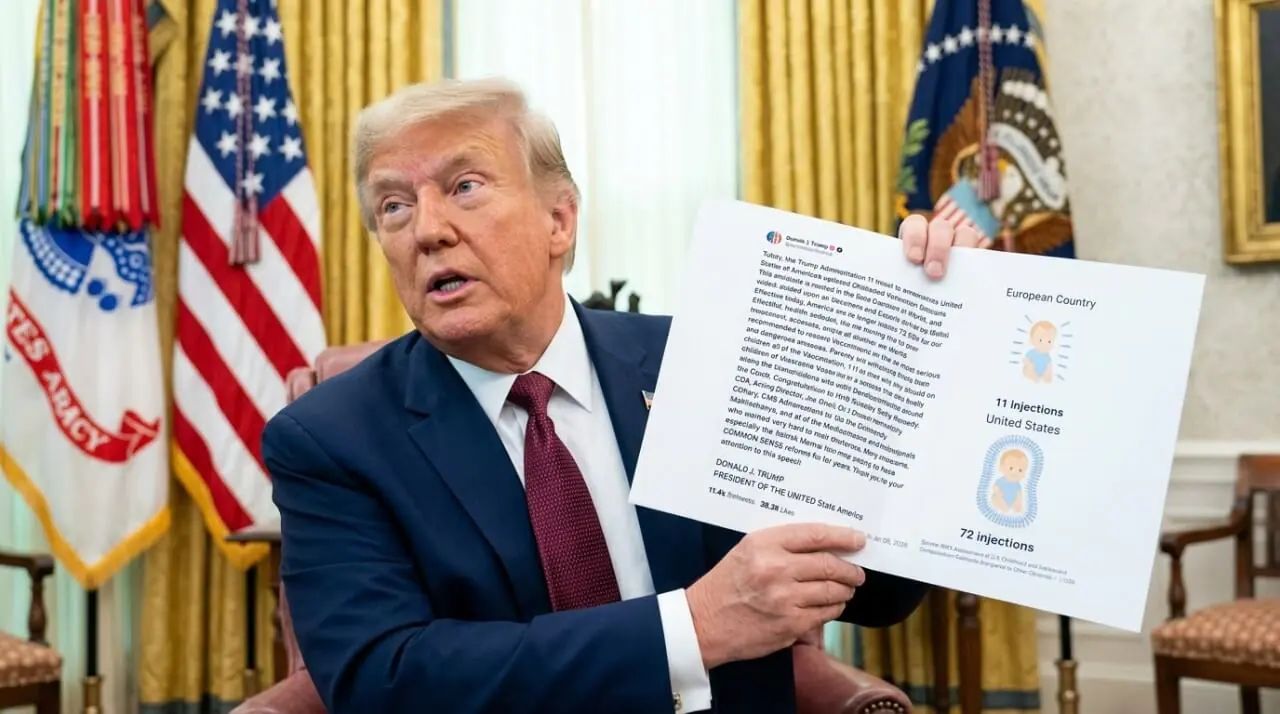
President Donald Trump signed a Vaccine Executive Order on August 10, 2026, directing the federal government to recognize a narrower set of routine childhood vaccine recommendations and calling for the combined measles, mumps and rubella vaccine to eventually be separated into three individual shots.
The order does not immediately rewrite every vaccination requirement in the United States. States retain authority over school vaccination rules, while an earlier federal attempt to reduce the childhood immunization schedule remains tied up in litigation. The White House order instead establishes administration policy and directs federal agencies to pursue changes within their existing legal authority, according to the executive order.
Table of Contents
ToggleWhat the Vaccine Executive Order Changes
The order creates three categories of childhood immunization recommendations. Vaccination against 11 diseases remains recommended for all children: measles, mumps, rubella, diphtheria, tetanus, pertussis, polio, Haemophilus influenzae type B, pneumococcal disease, human papillomavirus and varicella.
RSV monoclonal antibodies and immunizations against hepatitis A, hepatitis B, meningococcal B, meningococcal ACWY and dengue are placed in a category for certain high-risk groups.
Hepatitis A, hepatitis B, rotavirus, meningococcal disease, influenza and COVID-19 are also listed under shared clinical decision-making, meaning vaccination may be considered following discussions between clinicians and families.
The order additionally says the MMR vaccine should be given as separate measles, mumps and rubella shots once individual products become available domestically. It calls for childhood immunizations to be administered at separate medical visits “to the maximum extent feasible.” Individual measles, mumps and rubella vaccines have not been available in the United States since 2009, according to the American Academy of Pediatrics.
Latest Update: WHO Pushes Back on August 11
The World Health Organization responded on August 11, saying national vaccination schedules are developed after extensive review of disease risks, immune-system development and local health conditions. WHO spokesperson Tarik Jašarević said its recommendations draw on more than 60 years of research and independent expert review, according to Reuters.
Merck, which manufactures the M-M-R II vaccine, has also challenged the rationale for separating the three components. The company said there is no published scientific evidence demonstrating a benefit from splitting MMR and warned that additional appointments could result in delayed or missed vaccinations.
President Trump repeatedly raised the possibility of a connection between vaccines or vaccine timing and autism during Monday’s signing event. Decades of research have not established a causal link between childhood vaccination and autism, a point reiterated by the American Academy of Pediatrics and other medical organizations responding to the order, as The Associated Press reported.
A Federal Court Ruling Complicates Implementation
The administration previously attempted a similar restructuring in January 2026. On March 16, U.S. District Judge Brian E. Murphy granted partial preliminary relief in American Academy of Pediatrics et al. v. Kennedy et al., staying the January CDC memorandum that revised the childhood schedule.
Murphy also stayed appointments to the Advisory Committee on Immunization Practices and votes taken by those members. The ruling is available through federal court records.
The CDC’s website currently identifies its July 2, 2025 schedule as the operative schedule in compliance with that court order. It continues to show routine recommendations that include hepatitis B, rotavirus, influenza and other immunizations affected by the new executive policy. The current CDC schedule remains available to clinicians and the public.
The dispute is unfolding during elevated measles activity. CDC data updated August 7 show 2,465 confirmed U.S. measles cases in 2026 through August 6, adding urgency to arguments over vaccination policy and coverage. The agency publishes updated figures through its national measles data.
What Happens Next
Trump ordered the Department of Health and Human Services’ Task Force on Safer Childhood Vaccines to submit plans within 90 days addressing single-disease vaccine options, vaccine timing and sequencing, safety monitoring and further research.
The order also directs the Justice Department to support legal challenges to state vaccination laws where the administration believes federal constitutional or statutory protections are implicated.
For families and clinicians, the immediate picture remains fragmented: the White House has announced a new federal policy, while the existing CDC schedule remains posted under a federal court order and state vaccination requirements have not automatically changed.
Related Posts:
- SSA Targets 15 Million Field Office Visits in 2026,…
- Trump Pressures RFK Jr. to Cut Childhood Vaccines as…
- Will Birthright Citizenship In The US Change As…
- Federal Judge Allows Trump Mail Voting Order, Legal…
- Shingles Vaccine Linked to Lower Heart Attack and…
- FDA Approves First mRNA Flu Vaccine for Adults 50 and Older