


A routine blood test could reveal an important detail about your future heart health that a cholesterol check alone might miss. The clue comes from a protein your body naturally produces in response to inflammation.
Researchers analysing data from 448,653 adults found that people with elevated levels of C-reactive protein (CRP) had a 34% higher risk of major cardiovascular events, including heart attacks, strokes and cardiovascular death, compared with those who had low levels.
The study, published online in December 2025 and appearing in the April 2026 edition of the European Heart Journal, also identified significant associations with premature death.
Perhaps the most interesting finding is that inflammation provided valuable information about cardiovascular risk even after researchers accounted for several established risk factors.
A seemingly reassuring cholesterol result may leave part of the picture unexplored.
What Is C-Reactive Protein?
C-reactive protein is a substance produced primarily by the liver in response to inflammation. Its concentration in the bloodstream can increase when the immune system responds to infection, injury, or disease.
In laboratory research, scientists can use an active protein to examine how specific biological molecules function and interact with other components of the immune system.
Imagine developing a bacterial infection or recovering from surgery. Your immune system becomes more active, and CRP levels can rise considerably as part of the body’s protective response.
Persistent, low-grade inflammation is a different situation. It can continue for years without producing noticeable symptoms.
According to the National Library of Medicine, doctors can measure very small concentrations of CRP using a high-sensitivity C-reactive protein test, commonly abbreviated as hsCRP.
The test is particularly useful when evaluating cardiovascular risk because it can detect relatively subtle elevations in inflammation.
What Researchers Discovered in Nearly 450,000 Adults
An international research team led by Berkan Kurt examined health information from the UK Biobank, a large biomedical research database containing genetic, medical, and lifestyle information.
The participants had no previously identified atherosclerotic cardiovascular disease when they entered the study.
Their median age was 57, and women accounted for 55.4% of the study population.
Researchers monitored major cardiovascular events over a median follow-up period of 13.7 years, during which 23,624 participants experienced a qualifying event.
Participants were divided into three groups according to their initial hsCRP measurements.
| hsCRP concentration | Inflammation category | Number of participants |
| Less than 1 mg/L | Low | 177,007 |
| 1–3 mg/L | Intermediate | 170,811 |
| Above 3 mg/L | High | 100,835 |
Source: European Heart Journal.
More than 100,000 participants, approximately 22.5% of the entire study population, fell into the highest category.
Elevated CRP Was Associated With Several Health Outcomes
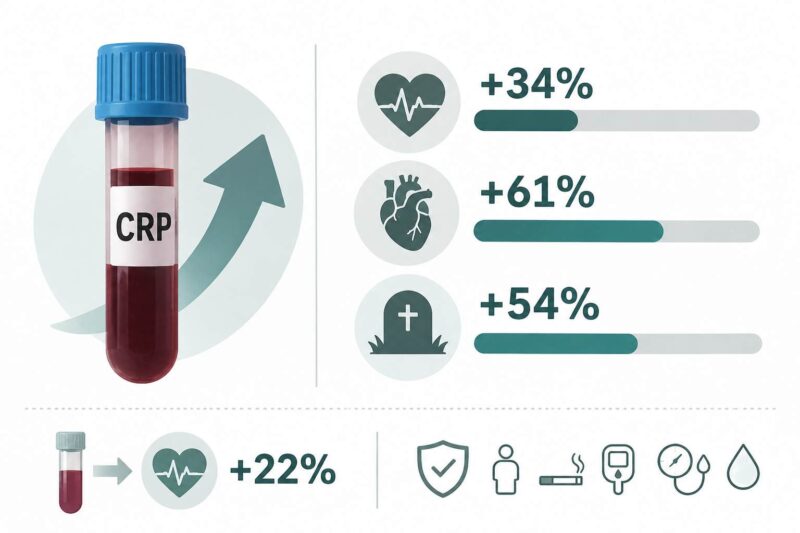
Compared with participants whose hsCRP levels were under 1 mg/L, those with levels above 3 mg/L experienced the following increases in adjusted relative hazard.
| Health outcome | Increase in relative hazard |
| Major cardiovascular events | 34% |
| Cardiovascular death | 61% |
| Death from any cause | 54% |
Adjusted associations from the UK Biobank study. Figures represent relative increases, rather than absolute probabilities of experiencing an event.
Researchers also found meaningful associations at the lower threshold of 2 mg/L, where the relative hazard of major cardiovascular events increased by 22%.
The findings remained significant after statistical adjustments for age, smoking, diabetes, blood pressure, LDL cholesterol, and other established risk factors.
What Does a 34% Higher Risk Actually Mean?
Medical statistics can sound considerably more alarming than their real-world implications suggest.
A 34% higher relative hazard does not mean that 34 out of every 100 people with elevated CRP will experience a heart attack or stroke.
Individual cardiovascular risk depends on several personal characteristics, including age, medical history, and existing health conditions.
For a simplified illustration, imagine two hypothetical groups with different underlying cardiovascular risks.
| Initial hypothetical risk | After a 34% relative risk increase | Absolute increase |
| 2% | 2.68% | 0.68 percentage points |
| 5% | 6.70% | 1.70 percentage points |
| 10% | 13.40% | 3.40 percentage points |
The examples illustrate relative versus absolute risk. The study itself measured hazard ratios, which cannot be directly converted into individual probabilities using simple multiplication.
Someone with several existing cardiovascular risk factors may have considerably greater reason for concern than a younger adult with otherwise favourable health measurements.
How Chronic Inflammation Affects the Heart

Cardiovascular disease often develops gradually, sometimes over several decades.
During atherosclerosis, fatty deposits accumulate inside artery walls. Immune cells become involved in the process, contributing to inflammation and the development of arterial plaques.
Over time, certain plaques can become unstable and rupture. A blood clot may subsequently form, potentially restricting blood flow to the heart or brain.
Inflammation plays an important role throughout the process.
However, elevated CRP itself may primarily serve as a warning signal. Earlier genetic research published in the British Medical Journal found evidence suggesting that CRP concentration itself was unlikely to be a direct cause of coronary heart disease.
Think of CRP as something resembling a smoke detector. Its activity can alert you to a developing problem, while identifying and addressing the underlying cause requires further investigation.
Could CRP Testing Improve Traditional Heart Disease Screening?
One of the more promising findings concerns the potential to improve existing cardiovascular risk assessments.
Doctors routinely consider measurements such as blood pressure, cholesterol, blood sugar, and body weight when assessing someone’s likelihood of developing cardiovascular disease.
Adding inflammatory biomarkers could help identify additional risk.
Measurements such as non-HDL cholesterol levels can also provide useful information about cardiovascular risk alongside inflammatory markers.
The research team incorporated hsCRP measurements into SCORE2, a cardiovascular risk prediction model used in Europe. The addition produced a net reclassification improvement of 14.1%, a statistical measure indicating improved risk classification.
The finding could eventually help clinicians recognise patients who would benefit from earlier preventive care.
There are limitations, however. Observational research cannot establish cause and effect, and the characteristics of UK Biobank volunteers may differ from those of other populations. Further research must establish the benefits of broader screening.
Should You Ask Your Doctor for an hsCRP Test?

An hsCRP test may be worth discussing with your doctor, particularly if your cardiovascular risk is uncertain.
The 2026 ACC/AHA dyslipidemia guidelines recognise persistent hsCRP readings of at least 2 mg/L as a risk-enhancing factor that can influence preventive treatment decisions in adults with borderline cardiovascular risk.
- Recent infections or illnesses
- Autoimmune and inflammatory conditions
- Obesity
- Smoking
- Recent injuries or surgery
A blood sample collected while recovering from an infection could produce a misleading impression of someone’s usual inflammation levels.
For that reason, repeat testing may be appropriate before making long-term treatment decisions.
Can You Reduce Chronic Inflammation and Protect Your Heart?
Many established cardiovascular prevention strategies also address factors associated with chronic inflammation.
Regular physical activity, adequate sleep, smoking cessation, and maintaining a healthy weight can all contribute to better cardiovascular health.
The American Heart Association’s Life’s Essential 8 framework recommends at least 150 minutes of moderate-intensity physical activity per week for adults, alongside healthy eating and appropriate management of cholesterol, blood pressure and blood sugar.
Dietary habits deserve particular attention. Vegetables, fruits, legumes, whole grains, nuts and unsaturated fats can form the foundation of a heart-healthy eating pattern.
People with persistently elevated CRP should work with a healthcare professional to investigate potential causes and determine appropriate treatment.
The objective is improved long-term health rather than simply achieving a lower laboratory reading.

A Small Blood Measurement With Important Implications
Research involving nearly 450,000 adults provides compelling evidence that inflammation deserves attention in cardiovascular risk assessment.
C-reactive protein offers clinicians an additional clue about health problems that may develop many years before symptoms appear.
Cholesterol checks, blood pressure measurements, and established preventive practices remain essential. Adding inflammatory markers where clinically appropriate could help doctors build a more complete picture of a patient’s future cardiovascular health.