

Chicago has 2,731,585 residents according to the latest U.S. Census Bureau estimate available in 2026. The figure refers to July 1, 2025 and keeps Chicago in third place among U.S. cities, behind New York and Los Angeles.
The estimate is 10,277 higher than the revised 2024 figure of 2,721,308. That is an increase of about 0.4% in one year. It suggests that the population losses seen earlier in the decade have slowed, although one annual estimate is not enough to establish a new long-term trend.
Chicago counted 2,746,388 residents in the 2020 Census. The city therefore remains 14,803 residents below that count.
Other numbers help explain what is changing inside the city. Homicides fell in 2025, rents continued to rise, Chicago Public Schools lost students, international arrivals affected migration patterns and the metro unemployment rate stayed near 5% during spring 2026.
Key Takeaways
- Chicago had an estimated 2,731,585 residents on July 1, 2025.
- The estimate increased by 10,277 residents from the previous year.
- The city remains 14,803 residents below the official 2020 Census count.
- Chicago recorded 416 homicides in 2025, the lowest annual total since 1965.
- Chicago Public Schools enrolled 316,224 students for the 2025-2026 school year.
- Rent growth in 2026 was much higher than annual growth in home listing prices.
- Foreign-born residents account for about one-fifth of Chicago’s population.
Chicago Has Stopped Losing Population at the Pace Seen Earlier in the Decade
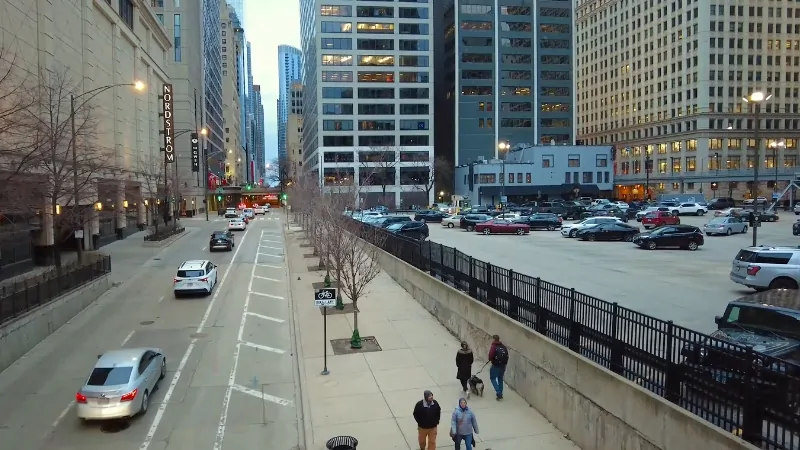
The Census Bureau reports 2,731,585 residents for July 1, 2025. Chicago’s official 2020 Census count was 2,746,388, which puts the current estimate about 0.54% below the 2020 total.
| Year | Chicago Population | Type of Figure |
|---|---|---|
| 2010 | 2,695,598 | Decennial Census |
| 2020 | 2,746,388 | Decennial Census |
| 2024 | 2,721,308 | Annual estimate |
| 2025 | 2,731,585 | Vintage 2025 estimate |
The 2020 Census count and the Census estimates base are not identical. QuickFacts also lists a 2020 estimates base of 2,748,333 because annual population estimates use a revised statistical starting point. The official decennial count remains 2,746,388.
The wider Chicago urban area is also larger than it was a year earlier. Macrotrends puts its Chicago series at 9.109 million in 2026, compared with 9.042 million in 2025. That is a private urban-area estimate and should not be confused with the Census city population or the official Chicago-Naperville-Elgin metropolitan area.
Children Still Outnumber Seniors in Chicago
Census QuickFacts reports that 19.4% of Chicago residents are under 18 and 13.8% are age 65 or older. Using the latest population estimate, those shares represent about 530,000 children and 377,000 seniors.
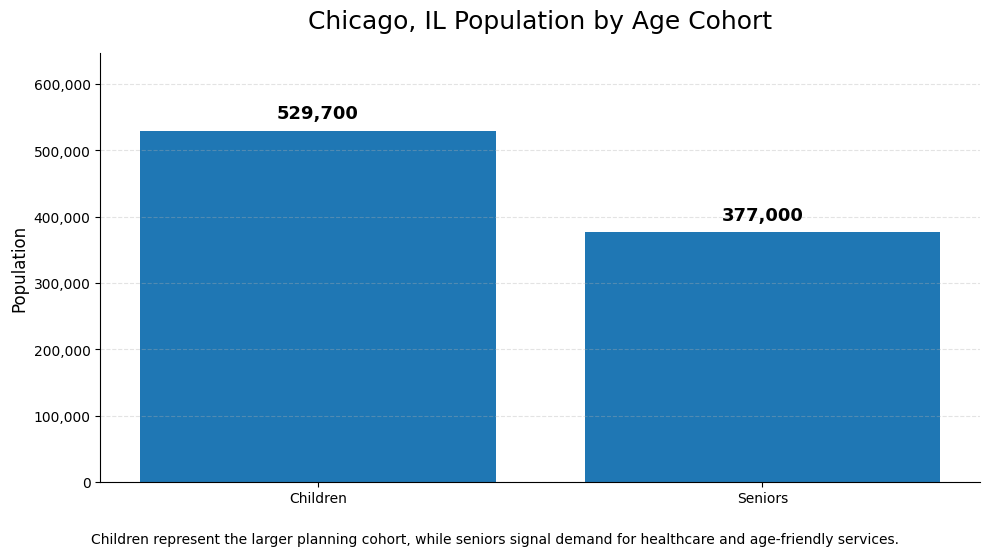
The difference affects several parts of city planning. Chicago still needs a large school system, childcare services and housing suitable for families. At the same time, the number of older residents increases demand for healthcare, accessible housing and services aimed at seniors.
School enrollment is falling faster than the total population, so fewer CPS students do not automatically mean the entire city is losing residents at the same rate.
Chicago Has No Majority Racial or Ethnic Group
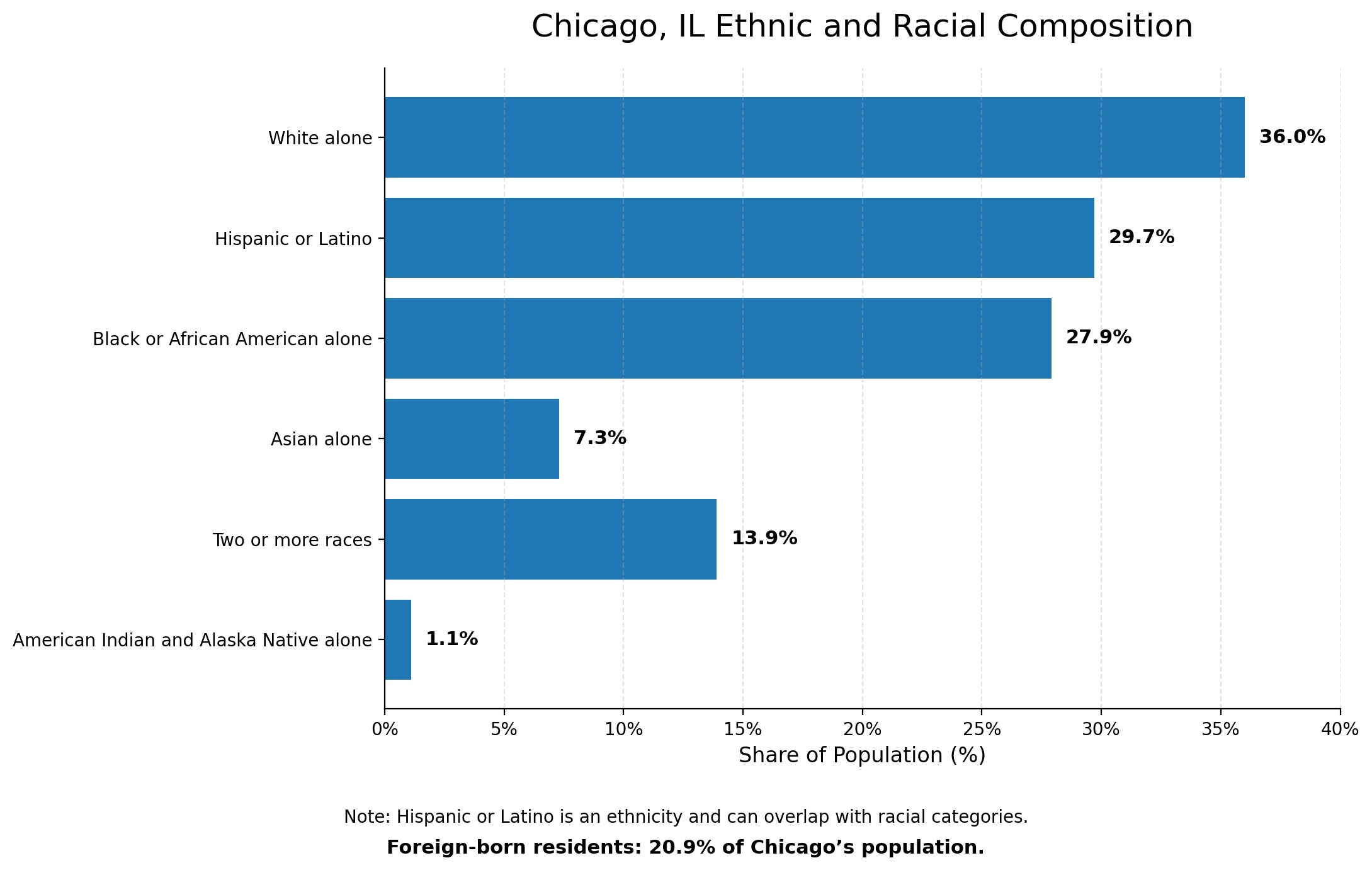
Chicago’s population is 36.0% White, 27.9% Black and 7.3% Asian. Hispanic or Latino residents account for 29.7% of the population.
Hispanic origin is recorded separately from race by the Census Bureau, so the percentages should not be added together as separate population groups.
Immigration has a major role in the city’s demographics. Census figures show that 20.9% of residents were born outside the United States. Another 35.4% of people age five and older speak a language other than English at home.
Population Change Depends Heavily on the Neighborhood
Chicago has 77 official community areas, but the names people use for neighborhoods do not always follow the same boundaries. A ranking that mixes community areas with informal neighborhood names can therefore produce misleading comparisons.
The CMAP Community Data Snapshots use consistent Census and American Community Survey geography. They show large differences across the city.
Central and North Side areas that added housing have followed a different population path from several South and West Side communities that remain below earlier population levels. New apartments, household size, age and immigration all affect where residents are being added or lost.
A citywide increase of 10,000 people can therefore exist at the same time that individual neighborhoods continue losing residents.
Chicago Recorded 416 Homicides in 2025
The Chicago Police Department’s 2025 year-end report recorded 416 homicides. It was the lowest annual count since 1965.

The city recorded more than 700 homicides in 2021. The 2025 figure is therefore more than 40% lower than the count four years earlier. CPD also reported shooting incidents down 35% and shooting victims down 34% during 2025.
CrimeAtlas records 5,817 robberies and 17,253 motor vehicle thefts for the year. Individual reports are available through the City of Chicago Crimes 2025 dataset and the CPD statistics hub.
Citywide crime totals do not tell a resident the chance of becoming a victim in a specific area. Crime varies substantially by block, neighborhood, time of day and type of offense.
Unemployment Stayed Near 5% in Spring 2026
The Bureau of Labor Statistics recorded a Chicago metro unemployment rate of 5.1% in March 2026 and 4.9% in April.
The March labor force included close to 5 million people, with about 254,700 unemployed. The number fell in April as the unemployment rate moved below 5%.
Chicago has an advantage in the range of industries operating across the region. Healthcare, professional services, finance, education, transportation, hospitality and government all employ large numbers of workers, reducing dependence on a single sector.
CPS Enrollment Fell by More Than 9,000 Students in One Year
Chicago Public Schools reported 316,224 students for the 2025-2026 school year. CPS records listed 325,305 students in September 2024, a decline of 9,081 students.
The drop is much larger, in percentage terms, than the change in Chicago’s total population. Several factors affect the school figures, including smaller school-age cohorts, family moves, charter enrollment and population changes in individual neighborhoods.
The current CPS student body is 46.4% Latino, 34.3% Black, 11.8% White and 4.9% Asian. About 71.8% of students are classified as economically disadvantaged.
Among adults age 25 and older, Census data shows that 87.2% have completed high school and 44.3% hold a bachelor’s degree or higher.
Rent Increased Much Faster Than Home Listing Prices
Realtor.com reported a median Chicago listing price of about $369,000 in May 2026, up around 1.4% from the previous year. Median rent reached about $2,369 after increasing around 7.7%.
The difference is important for households deciding to stay in the city. Tenants faced a much larger annual increase than the change in listing prices suggests.
Redfin reported a median closed sale price near $410,000. Census figures for 2020-2024 show a median owner-occupied home value of $334,100 and median gross rent of $1,440. Census numbers are lower because they cover a multi-year survey period rather than the current housing market.
Housing supply also affects population growth. New units allow the city to add households without increasing crowding. High rents can push families toward suburbs or other metropolitan areas even when their jobs remain in Chicago.
Healthcare Is the Largest City Industry by Employment

Data USA counts 190,894 workers in Health Care and Social Assistance. Professional, Scientific and Technical Services follows with 187,681 workers, while Educational Services employs 146,269.

At metro level, BLS figures show large employment totals in trade and transportation, education and health services, and professional and business services.
Chicago’s hospitals, universities, corporate offices and transportation network continue to support the population because they provide jobs that are difficult to replace elsewhere in the city economy.
Income and Poverty Remain Far Apart

Median household income stands at $77,902 and per capita income at $50,086. At the same time, 16.8% of residents live below the poverty line.
The CMAP Gini coefficient indicator provides more detail on income inequality across the Chicago region.
International Migration Is Helping Chicago Hold Its Population
Chicago’s recent population figures cannot be separated from international migration. The City of Chicago New Arrivals Dashboard tracks migrants who entered the city’s emergency response system after 2022.
The 40th Ward has cited around 40,000 asylum-seeker arrivals since late 2022. That number is not the same as net international migration. Some arrivals later move elsewhere, and many immigrants enter Chicago through routes that are not recorded in the emergency shelter system.
The arrival figures still help explain why migration, school enrollment, shelter spending and healthcare became connected issues for the city during the same period that the population estimate stopped falling.
Chicago Is Still Below Its 2020 Population
Chicago needs another 14,803 residents to return to its official 2020 Census count. The latest annual increase closed part of that gap, but future population figures will depend on housing, migration, family retention and job growth.
@jacobfriedmanrealtor Is this the future of downtown Chicago… or another Chicago Spire?
The 2025 estimate gives Chicago a better population result than the city recorded earlier in the decade. Crime also fell during the same period, and several major industries continue to employ hundreds of thousands of people.
Housing costs and falling CPS enrollment remain problems for population retention. International arrivals are replacing part of the population lost through moves elsewhere in the United States.
The next Census estimates will show if Chicago continues adding residents or stays close to its current level. For now, the city is still below its 2020 count, but the gap is much smaller than the losses recorded after the pandemic.
Methodology
Population figures use U.S. Census Bureau Vintage 2025 estimates and the official 2020 decennial count. Demographic, education, income and housing figures come from Census QuickFacts and American Community Survey data.
Crime figures use Chicago Police Department and City of Chicago records. Labor figures come from the Bureau of Labor Statistics. Chicago Public Schools provides current enrollment data, while Realtor.com and Redfin provide current housing-market figures.
CMAP provides community-area context, Data USA supplies city industry employment figures and the City of Chicago New Arrivals Dashboard provides information on migrants who entered the city’s emergency response system. Macrotrends is used only for its separate urban-area series and is not presented as an official Census metro estimate.