

The Ohio State University (OSU) has long been synonymous with academic excellence, Big Ten athletics, and Buckeye pride. By 2026, the university’s appeal will have only grown.
National rankings place Ohio State among the country’s top public universities, its research enterprise now exceeds US $1.58 billion, and the Buckeye network spans over 600,000 alumni, according to the USN.
University Profile: Scale and Strength
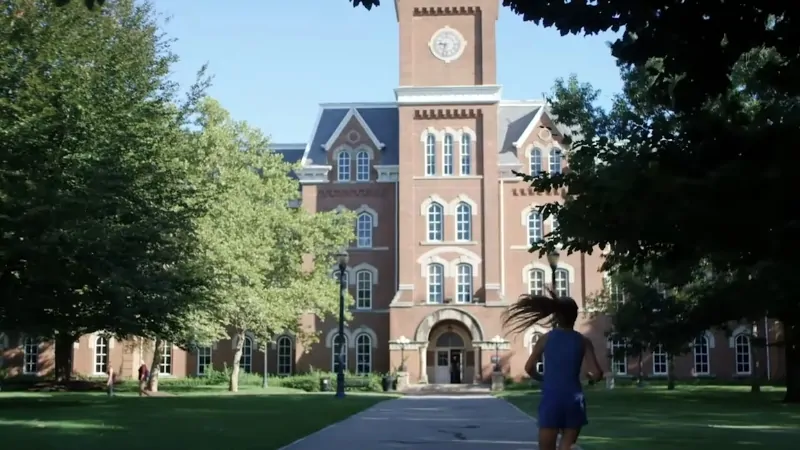
Established in 1870, Ohio State has grown into one of the largest universities in the United States. The 2025‑26 Statistical Summary reports 61,326 students on the Columbus campus and 67,255 students university‑wide.
The student body includes 29,161 men and 32,165 women on the Columbus campus and draws learners from all 88 Ohio counties, 56 U.S. states, and more than 121 countries. International students comprise roughly 9.73 % of enrollment.
Ohio State occupies a sprawling footprint. Across its Columbus, regional, and agricultural campuses, the university owns more than 14,500 acres of land and operates 1,256 buildings.
Academic offerings are equally expansive: OSU maintains 15 colleges, more than 200 undergraduate majors, 177 master’s programs, 104 doctoral programs, and eight professional degree programs. Students choose from an estimated 12,500 courses, and class sizes remain manageable; nearly 80 % of first‑year classes have 50 or fewer students.
Research is a core strength. In fiscal year 2024, the university recorded US $1.58 billion in research expenditures and ranked 12th nationally for overall research spending and 6th for industry‑sponsored research.
The university has also produced more Fulbright U.S. Scholars than any other institution and consistently ranks among the top 20 public schools for internships and the top seven institutions for study‑abroad participation.
Ranking Highlights
U.S. News & World Report’s 2026 Best Colleges list ranked Ohio State 15th among public universities and 41st nationally. Notable undergraduate programs include:
Program
2026 ranking/recognition (public universities)
National rank
Source
Nursing (BSN)
#1 among public universities
4th overall
U.S. News & World Report 2026
Business (Fisher College)
6th among publics
12th overall
U.S. News & World Report 2026
Supply Chain & Logistics
4th among publics
5th overall
U.S. News & World Report 2026
Production Operations Management
9th among publics
12th overall
U.S. News & World Report 2026
Engineering (overall)
15th among publics
28th overall
U.S. News & World Report 2026
Online Undergraduate Programs
7th (U.S. News & World Report 2026)
,
U.S. News & World Report
These rankings reinforce Ohio State’s reputation as a comprehensive academic powerhouse. Beyond rankings, OSU boasts an 18:1 student‑to‑faculty ratio, more than 200 research centers and institutes, and numerous professional pathways.
Ohio State’s nationally top-ranked nursing programs also create strong pathways for graduate and advanced practice careers.
Many students who begin in undergraduate nursing at OSU later explore accelerated and advanced clinical tracks, including options similar to those outlined by Npdegrees, which details accelerated nurse practitioner pathways for students seeking faster progression into advanced practice roles.
This alignment between highly ranked undergraduate preparation and structured graduate advancement is one reason Ohio State continues to attract ambitious nursing students in 2026.
Admissions: Selectivity, Deadlines, and Statistics
View this post on Instagram
Ohio State attracts tens of thousands of applicants each year, and its selectivity reflects both popularity and academic rigor.
Admissions data from institutional research show that the Class of 2028 received 72,829 applications and admitted 44,116 students, yielding a 60.6 % acceptance rate. Recent classes typically see acceptance rates between 50 % and 60 %, illustrating competitive but accessible admissions.
The university does not publish average GPAs, but common‑data‑set tables indicate that 64 % of enrolled students were in the top 10 % of their high‑school class.
Application Deadlines and Requirements
Prospective first‑year students apply through the Common Application. For Autumn 2026 entry, the early action deadline is November 1, 2025, and the regular decision deadline is January 15, 2026.
Applicants seeking scholarships or admission to competitive programs such as engineering and honors are strongly encouraged to meet the early‑action deadline. Admissions decisions for early applicants are released on December 12 for Ohio residents and January 23 for non‑Ohio residents; regular‑decision applicants receive decisions on March 6.
Standardized test scores (ACT or SAT) are currently required for first‑year applicants. Ohio State uses superscoring, meaning the university considers the highest section scores across multiple test attempts.
International applicants must also submit an English‑proficiency test (e.g., TOEFL, IELTS, ACT English section) unless they meet the exemption criteria. Required application materials include high‑school transcripts and official test scores; recommendation letters are optional.
Class Profile

Ohio State’s New First Year Student Trend Data illustrate the academic caliber of incoming classes. For the Autumn 2025 cohort, the university enrolled 8,210 new first‑year students with an average ACT score of around 30.6 and an average SAT score of around 1,397.
More than 68 % of students were in the top 10 % of their high‑school class, and 96 % were in the top 25 %. Roughly 68 % of new students are Ohio residents, while 25 % come from other U.S. states and 6.5 % are international.
Costs and Financial Aid
Ohio State positions itself as an affordable flagship university. The Chronicle of Higher Education ranked OSU first among U.S. flagship universities for controlling in‑state tuition over the past decade. Tuition is fixed for each entering cohort.
The 2025‑26 Statistical Summary lists tuition and mandatory fees of US $13,641 per year for Ohio undergraduates and US $42,423 for non‑residents. Students at regional campuses pay US $9,772 annually. Typical on‑campus freshmen budgets break down as follows:
Cost category (2025‑26 academic year)
An Ohio resident living on campus
Non‑resident living on campus
Source
Tuition and fees
$13,640
$13,640 plus $28,782 non‑resident fee
Student Financial Aid Office
Housing & food
$15,178
$15,178
Student Financial Aid Office
Books & supplies
$1,020
$1,020
Student Financial Aid Office
Personal & miscellaneous
$2,686
$2,686
Student Financial Aid Office
Transportation
$732
$1,360
Student Financial Aid Office
Federal loan fees
$40
$40
Student Financial Aid Office
Total estimated cost (two semesters)
≈ $33,296
≈ $62,706
Student Financial Aid Office
More than half of Ohio State students graduate debt‑free, thanks to robust financial aid. The 2025 University Enrollment Report notes that the university awarded US $259 million in financial aid during the Autumn 2025 term.
OSU offers numerous merit‑based scholarships, most of which require applications by November 1. Highlights include:
- President’s Ohio Scholarship Program – Full cost of attendance plus a US $5,000 enrichment grant for Ohio students who earn a perfect ACT or SAT score.
- National Buckeye Scholarship – Provides up to US $13,500 per year (US $54,000 over four years) to high‑achieving non‑Ohio residents; recipients must apply by November 1.
- Maximus, Provost and Trustees Scholarships – Awards between US $1,000 and $3,000 per year to competitive applicants from any state.
Need‑based aid is also available. Filing the FAFSA by Ohio State’s priority date (February 1) maximizes eligibility for grants, loans, and work‑study programs.
Student Experience and Campus Life
Buckeye Community and Spirit
Ohio State nurtures a strong sense of community.
The university’s “Four reasons you should be Buckeye Bound” campaign highlights key aspects of campus life: the breadth of majors and top‑ranked programs, a welcoming community of students from every state and over 100 countries, supportive peer networks and first‑year orientation programs, and the excitement of living in Columbus. Once admitted, students join a family of more than 600,000 alumni.
The Office of Student Life comprises over 40 departments dedicated to “creating the extraordinary student experience for every Buckeye”. Services cover academic support, wellness, leadership development, residential life, student organizations, and cultural programs.
The campus dining program earns an A+ rating and is considered the best in the Big Ten, and the Ohio Union ranks among America’s most amazing student unions. Columbus itself, the 14th‑largest U.S. city, regularly appears on lists of the best college towns and offers abundant internships with Fortune 500 companies.
Signature Programs

Orientation and Peer Support – Incoming students participate in orientation experiences that introduce campus resources and connect them with Peer Leaders, older students trained to support first‑year students.
Second‑Year Transformational Experience Program (STEP) – STEP extends support into the sophomore year. Participants work with faculty mentors, attend cohort meetings, and complete a Signature Project in areas such as research, study abroad, service, or leadership. Each student may apply for a fellowship of up to US $2,000 to fund their project.
Digital Flagship and Technology Initiatives – Although the Digital Flagship iPad‑distribution program ended in 2023, it showcased OSU’s commitment to integrating technology into learning. From 2018 to 2022, the initiative provided free iPad kits (with keyboard, Apple Pencil, and AppleCare+) to every incoming undergraduate.
The program also launched a Swift coding and app‑development curriculum that has served over 4,000 learners and created a mobile Design Lab for hackathons and app‑design workshops. The associated Wellness App offers students mental‑health resources and personalized wellness planning.
Experiential Learning
Ohio State students have myriad opportunities beyond the classroom. The university runs 350 study‑abroad programs in 70 countries and is ranked seventh nationally for study‑abroad participation. There are 36 career fairs each year and more than 600 undergraduate research presentations annually.
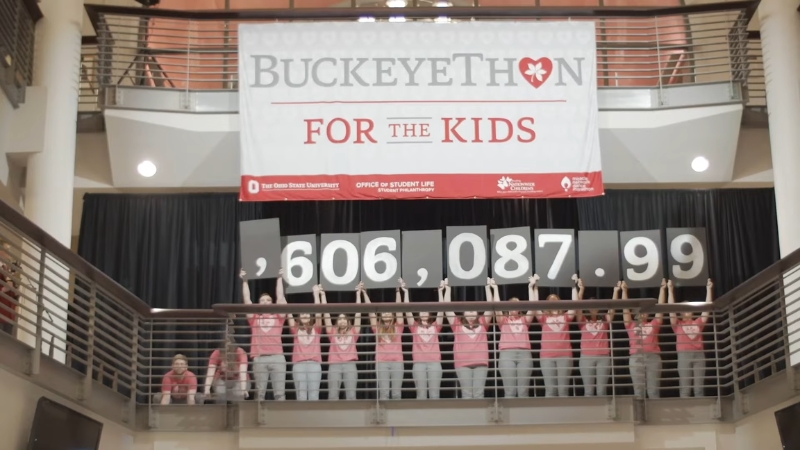
Student initiatives like hackathons, BuckeyeThon (a major dance marathon benefiting children’s hospitals), and the Denman Undergraduate Research Forum foster engagement and leadership. The campus also supports living‑learning communities and honors/scholars programs, enabling students to pursue specialized academic and social experiences.
Diversity and Demographics
Ohio State’s commitment to access and diversity is evident in its enrollment profile. The 2025‑26 Statistical Summary shows that students identifying as Asian American (10.7 %), Black or African American (8.04 %), Hispanic (6.22 %), and two or more races (4.77 %) study alongside a majority White population (57.19 %).
International students, classified as non‑residents for reporting purposes, account for 9.73 % of Columbus‑campus enrollment. Ohioans represent 71.6 % of total university enrollment, with non‑Ohio U.S. residents at 19.5 %.
The University Enrollment Report notes that Ohio State enrolled students from all 88 Ohio counties, 56 U.S. states and territories, and 121 countries in Autumn 2025. The top feeder states outside Ohio were New York, Illinois, New Jersey, Pennsylvania, and California, while the largest international populations came from China, India, South Korea, and Taiwan.
Athletics and Campus Spirit
No discussion of Ohio State would be complete without mentioning athletics. The university fields 36 varsity teams (16 men’s, 17 women’s, and three mixed) and supports roughly 1,000 student‑athletes.
The Ohio State Department of Athletics is self‑funded; it receives no tuition or tax dollars but generates significant revenue through ticket sales, media rights, and donations.
In fiscal year 2025, the department posted US $336 million in revenue, an NCAA record for OSU, and distributed US $24.9 million in athletic student aid. That same year, the Buckeyes won the national championship in football, fueling record ticket sales and donations.
This success, combined with storied traditions like Script Ohio, “O‑H‑I‑O” cheers, and the ever‑popular Brutus Buckeye mascot, keeps campus spirit vibrant and contributes heavily to Ohio State’s popularity.
Why Ohio State Is Popular in 2026
@theohiostateuniversityA university of many names. ⭕️?♬ Scott street – ↻ ◁ II ▷ ↺
The Ohio State University’s enduring popularity stems from a powerful combination of academic excellence, affordability, student support, and community spirit. With hundreds of majors, nationally ranked programs in nursing, business, and engineering, and a research enterprise exceeding US $1.58 billion, OSU offers intellectual breadth and depth.
Admissions are selective yet inclusive, accepting around 60 % of applicants, and early action deadlines provide opportunities for merit scholarships and program guarantees. Tuition remains comparatively controlled, and generous financial aid ensures that more than half of students graduate without debt.
Students enjoy a holistic experience: orientation programs and peer leaders ease the transition to college, the STEP program funds transformational projects, and initiatives like Digital Flagship integrate cutting‑edge technology into learning.
Columbus offers the amenities of a major city with the affordability of a college town, while Ohio State’s athletics and traditions inspire lifelong Buckeye pride. For prospective students in 2026, Ohio State delivers an exceptional blend of academic quality, opportunity, community, and spirit, making it one of America’s most popular universities.