

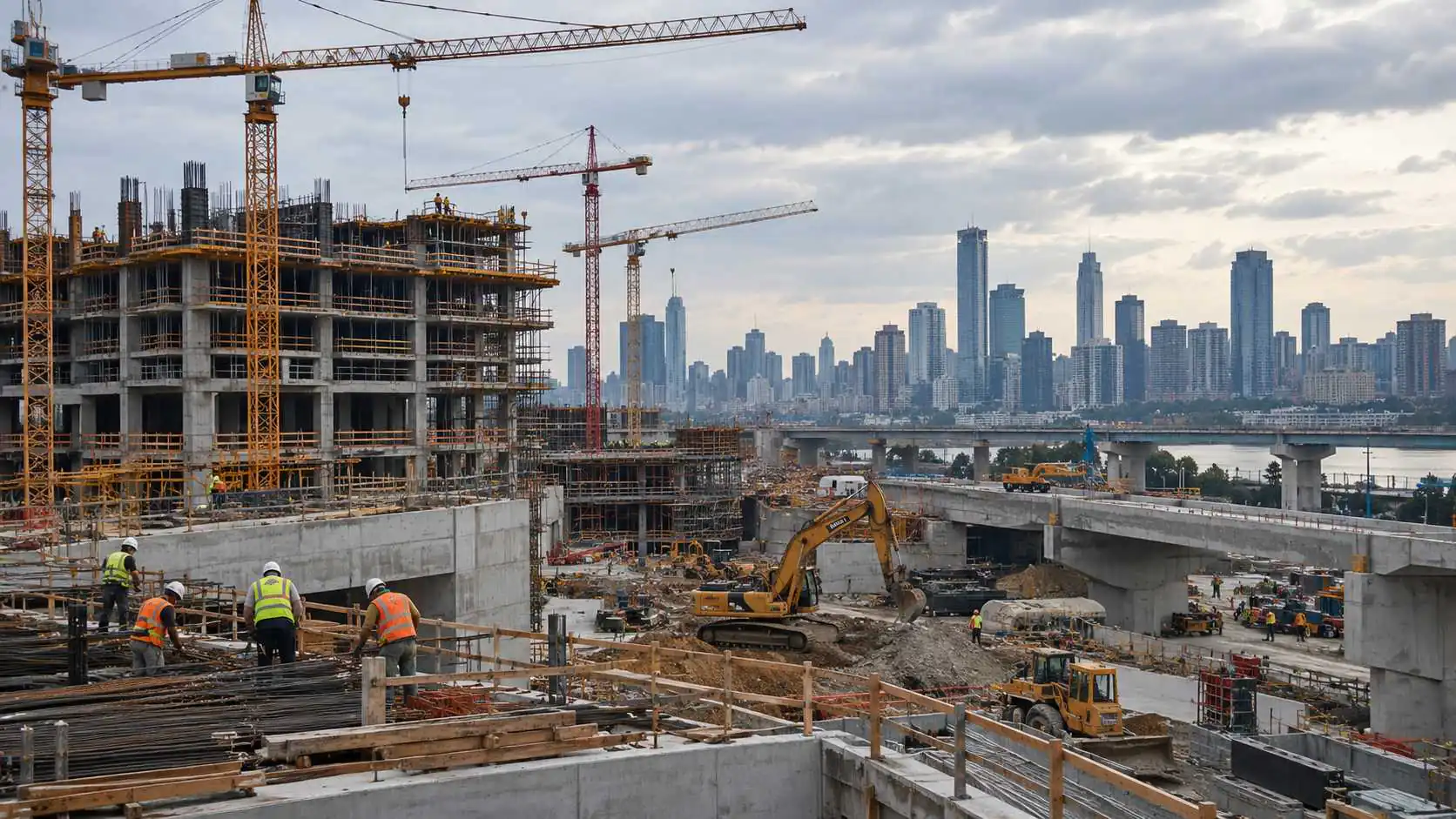
The global construction market is valued at an estimated $9.6 trillion in 2026, with output forecast to increase by 3.8%. Civil engineering is expected to grow much faster, at 6.5%, as governments and businesses continue investing in infrastructure.
Employment is holding up in some major markets, although contractors still face problems finding experienced workers. The United States had 8.36 million construction payroll jobs in September 2026, and demand for several skilled trades is expected to increase over the next decade.
Behind those numbers, construction activity is moving in different directions. Some countries are struggling to revive homebuilding, while others are investing heavily in transport networks, industrial facilities and electricity infrastructure.
Global Construction Market Size in 2026
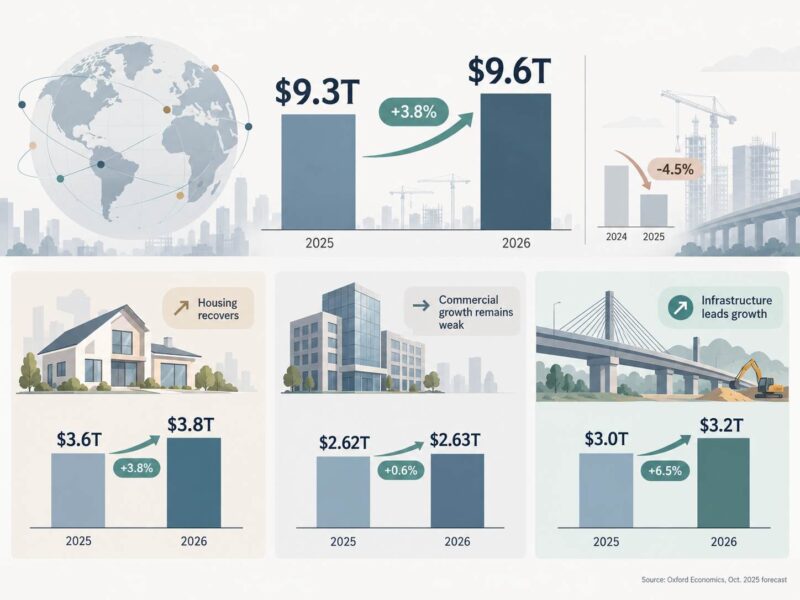
Global construction output is expected to reach $9.6 trillion in 2026, recovering from an estimated $9.3 trillion in 2025.
The construction market forecast published in October 2025 projected growth of 3.8% after a 4.5% contraction the previous year.
Infrastructure is doing much of the work. Civil engineering projects are expected to generate $3.2 trillion in activity, compared with $3 trillion in 2025.
Residential construction should recover to $3.8 trillion, although the improvement follows a particularly difficult period for housing developers.
| Construction Sector | 2025 Estimated Value | 2026 Forecast | 2026 Growth |
| Residential construction | $3.6 trillion | $3.8 trillion | 3.8% |
| Nonresidential buildings | $2.62 trillion | $2.63 trillion | 0.6% |
| Civil engineering | $3.0 trillion | $3.2 trillion | 6.5% |
| Total construction | $9.3 trillion | $9.6 trillion | 3.8% |
Source: Oxford Economics, October 2025 forecast. Values are expressed in constant 2023 US dollars and rounded for presentation.
Commercial and industrial buildings have a weaker outlook. Growth of just 0.6% suggests that developers remain cautious about financing offices, factories and other nonresidential properties.
The residential recovery also depends heavily on China and the United States, where property markets have faced prolonged pressure. New housing activity in those countries can influence global construction demand because of the enormous size of their building industries.
Construction Spending in the United States
American contractors entered the second half of 2026 with spending still below the previous year, despite an improvement during August.
Total construction spending reached a seasonally adjusted annual rate of $2.203 trillion in August 2026, up 0.9% from July but down 1.7% from August 2025, according to the latest construction spending figures.
Private projects represented most of the market, with annualized spending of $1.655 trillion. Public construction contributed another $547.8 billion.
Housing accounted for $882.3 billion in private construction spending. Private nonresidential projects, including commercial and industrial development, reached $773 billion.
Public spending included $150.6 billion for highway construction and $113.1 billion for educational facilities. Roads and schools continue to provide work for contractors even when private developers delay projects.
The housing market remains particularly sensitive to financing costs. Builders need buyers who can afford mortgage payments, and developers must secure construction loans before major projects begin.
In August, housing starts reached an annualized rate of 1.275 million units, down 2.6% from July. Building permits stood at 1.394 million units, according to new residential construction data.
Permits provide an early indication of planned building activity, but approved projects do not always begin immediately. Financing problems, material costs and changing buyer demand can delay construction after permission has been granted.
Where Construction Activity Is Growing

China Faces a Difficult Housing Recovery
China remains one of the world’s largest construction markets, but its residential property sector continues to struggle with weak sales and financial problems among developers.
Years of rapid apartment construction left some cities with substantial unsold housing. Falling confidence among buyers has made developers reluctant to begin additional projects.
Government infrastructure investment provides some support, although authorities have also reduced spending expectations in certain areas. Fewer residential projects have consequences for cement producers, steel manufacturers and equipment suppliers throughout Asia.
Infrastructure Is Supporting Construction in Europe
European governments are investing in transport improvements, electricity networks and public facilities, but national construction markets remain uneven.
Great Britain recorded construction output growth of 1.8% during 2025, according to official construction industry statistics. Activity weakened toward the end of the year, with output falling 2.1% in the final quarter.
Housing developers face financing pressures in several European countries. Renovation and infrastructure projects are providing additional work, particularly where governments are investing in energy efficiency and public services.
Southeast Asia Is Attracting Industrial Investment
Vietnam, Indonesia and other Southeast Asian economies are attracting manufacturers seeking additional production locations.
Industrial investment creates demand for factories, warehouses, roads and supporting infrastructure. Growing urban populations also need housing and public facilities.
A regional construction outlook identifies Southeast Asia among the faster-growing construction markets, supported by foreign investment and demographic trends.
Large industrial projects can benefit local contractors, but they also increase competition for skilled workers, construction materials and suitable development sites.
Global Construction Employment Trends

Construction employs millions of people across developed and emerging economies. Jobs include building trades, equipment operation, engineering and site supervision, along with specialist work in electrical systems, plumbing and structural installation.
Employment levels depend heavily on local conditions. A country investing in highways may need more civil engineering workers, while an expanding housing market creates additional demand for carpenters, roofers and residential contractors.
US Construction Employment Reached 8.36 Million
The United States had 8,364,000 construction payroll jobs in September 2026, up 11,000 from August, according to the monthly employment figures.
Specialty trade contractors employed 5.28 million people, representing the largest share of the industry. Building construction employed 1.87 million, while heavy and civil engineering employed 1.21 million.
| Construction Employment | September 2026 Jobs |
| Specialty trade contractors | 5,279,900 |
| Building construction | 1,873,400 |
| Heavy and civil engineering | 1,210,800 |
| Total construction employment | 8,364,000 |
Source: Bureau of Labo[/su_table]r Statistics, September 2026 preliminary seasonally adjusted estimates.
Specialty contractors include electricians, plumbers, roofers and other workers responsible for specific parts of a project. Their employment substantially exceeds the number of workers directly employed by general building contractors.
Residential specialty contractors lost 7,900 jobs during September, while nonresidential specialty contractors added 12,300. Hiring was therefore stronger among businesses serving commercial, industrial and other nonresidential projects.
Construction Workers Can Expect More Job Openings
Employment opportunities should continue expanding in several construction occupations, although not every trade will grow at the same rate.
The number of construction laborers and helpers is projected to increase by 6% between 2025 and 2035, adding 108,600 positions.
The employment outlook for construction workers also projects 137,000 openings annually as employers hire additional workers and replace those leaving the occupation.
Median annual earnings for construction laborers and helpers reached $46,680 in May 2025. Workers in more specialized positions can earn more, depending on qualifications and location.
Across construction and extraction occupations, the median annual wage reached $59,540, compared with $50,980 for all occupations.
The occupational projections anticipate 587,000 annual openings across the group during the coming decade.
Experienced electricians, equipment operators and supervisors remain important to employers because delays in one trade can hold up the work of several others.
Equipment and Material Costs Continue to Affect Projects
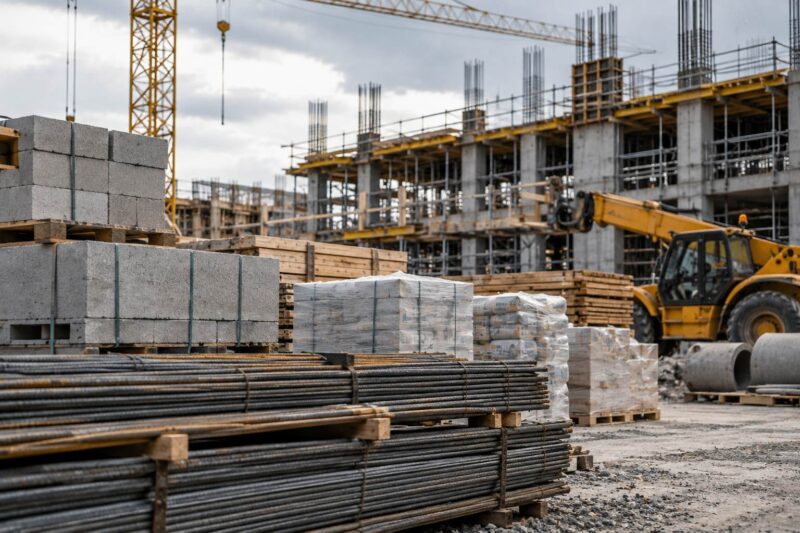
Construction budgets extend far past wages. Contractors also pay for machinery, materials, fuel, insurance and transportation, sometimes months before receiving final payment for completed work.
Heavy equipment presents a particular challenge. Excavators, cranes and loaders are expensive to purchase, and mechanical failures can interrupt projects when replacement equipment is unavailable.
Companies involved in large construction and industrial projects work with equipment manufacturers, logistics providers and international suppliers such as STS-Global for vehicles and genuine parts.
Material costs can be just as disruptive. A project priced before a sudden increase in steel or concrete costs may generate less profit than the contractor originally expected.
Long construction schedules increase exposure to price changes. Public infrastructure projects can face additional delays when higher costs force authorities to reconsider spending or seek new financing.
Population Growth and Urban Development Are Driving Demand
Growing cities need additional housing, roads, water infrastructure and public buildings. Population growth is therefore an important influence on construction demand, particularly in metropolitan areas receiving large numbers of new residents.
For example, Texas has experienced substantial population growth, increasing demand for new homes, commercial buildings and transportation infrastructure.
Its expanding population and metropolitan areas have supported demand for residential development, commercial properties and transportation investment.
Economic activity also influences where major projects are concentrated. California and Texas are the two largest state economies, and both support extensive construction markets across manufacturing, housing and public infrastructure.
In emerging economies, urban growth can create additional pressure on housing supply. Expanding transportation networks and utilities becomes increasingly expensive when cities grow faster than their existing infrastructure can accommodate.
Construction Safety Remains a Major Industry Concern
Construction workers face hazards involving heights, electricity, moving vehicles and heavy equipment. Serious accidents can injure workers and stop projects for extended periods.
Falls remain a major cause of fatalities on American construction sites. The construction safety requirements maintained by OSHA cover fall protection, excavation safety, equipment operation and other workplace hazards.
Training and site supervision remain necessary as workers move between different stages of construction. Excavation, structural work and electrical installation each introduce hazards that employers must manage.
Experienced workers also help identify dangerous conditions before accidents occur, making workforce retention important for both productivity and safety.
Construction Industry Outlook Through 2030
Infrastructure investment is expected to remain a major source of construction demand in the coming years. Electricity networks, water systems and transportation facilities require substantial spending as existing infrastructure ages and cities expand.
Housing construction faces a less certain recovery. Mortgage costs and property prices continue influencing developers, particularly in the United States and China.
Industrial construction also depends on decisions by manufacturers. Investment in factories can support local employment and contractors, but expensive financing or weaker demand can lead companies to postpone projects.
The global construction industry is expected to return to growth in 2026, with civil engineering leading the recovery. US employment data shows that contractors are continuing to hire, although residential building remains under pressure.
For construction companies, the coming years will bring opportunities in infrastructure and industrial development, alongside continuing pressure from labor shortages and project costs. Markets with reliable financing, available workers and sustained investment will be better positioned to turn planned developments into completed construction.