

Even as artificial intelligence systems grow more powerful, the human brain still outperforms machines in one critical area: the ability to transfer knowledge from one task to another.
New research offers a clearer explanation of how the brain manages this flexibility and why AI continues to struggle with it.
The study, led by researchers at Princeton University, did not involve human participants directly. Instead, the team studied rhesus macaques, a primate species whose brain structure and cognitive functions closely resemble those of humans.
The goal was to understand how biological brains reuse existing knowledge when learning related but distinct tasks.
How the Experiment Worked
The macaques were trained to complete a series of visual tasks involving shapes and colors displayed on a screen. To indicate their answers, the animals were required to move their eyes in specific directions.
While the monkeys performed these tasks, researchers monitored brain activity using neural imaging techniques.
Rather than activating entirely new neural pathways for each task, the scans revealed overlapping patterns of brain activity. The same groups of neurons were repeatedly engaged, even as task demands changed.
Cognitive Building Blocks in the Brain
New research reveals that the brain’s flexibility comes from its ability to reuse “cognitive building blocks” across many tasks, allowing rapid adaptation with minimal relearning.… pic.twitter.com/CNVQY2Wdtz
— Katherine Stiles (@_K_Stiles) November 27, 2025
Researchers from Nature described these reusable neural units as “cognitive Legos.” Each block represents a functional component of thinking, such as recognizing color, identifying shape, or linking perception to action.
These blocks can be recombined in different ways depending on the task.
According to neuroscientist Tim Buschman of Princeton University, this modular structure explains why biological brains adapt so efficiently.
While advanced AI models can reach or exceed human performance on single, narrowly defined tasks, they often fail when required to learn multiple tasks in sequence.
The brain’s ability to reuse existing components allows it to build new behaviors without starting from scratch each time.
The Role of the Prefrontal Cortex
View this post on Instagram
The neural building blocks identified in the study were primarily located in the prefrontal cortex, a region associated with planning, decision-making, and problem-solving. This area appears to coordinate which cognitive components are active at any given time.
When certain blocks were unnecessary for a specific task, their activity decreased. This suggests the brain can temporarily suppress unused processes, helping it focus more efficiently on what matters most in the moment.
Buschman compares this structure to computer programming, where individual functions perform specific operations that can be linked together to complete more complex programs.
Why AI Still Falls Short
One of the biggest limitations of current AI systems is a problem known as catastrophic forgetting. When neural networks learn a new task, they often lose the ability to perform previously learned tasks unless extensively retrained.
Biological brains avoid this issue by reusing representations and computations across tasks. This allows animals and humans to adapt quickly to new situations using prior experience, rather than relearning everything from the beginning.
Implications Beyond Neuroscience
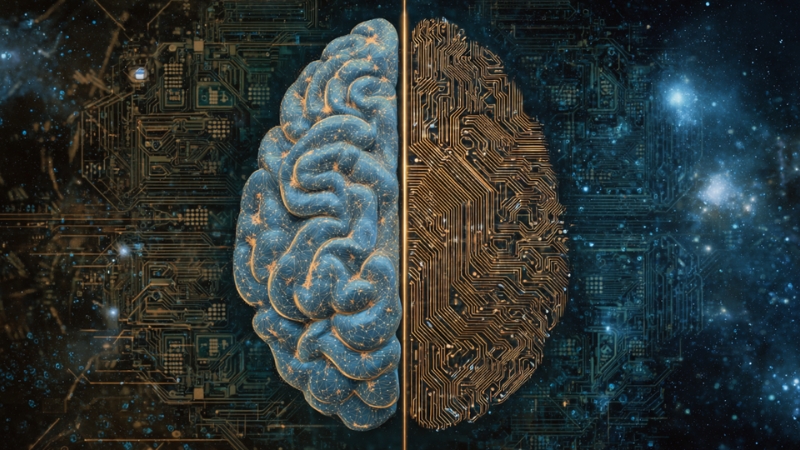
The findings may help guide the development of more adaptable AI systems in the future, particularly models designed to learn continuously rather than in isolated stages.
The research could also inform treatments for neurological and psychiatric conditions where patients struggle to apply learned skills in new contexts.
Although constantly switching tasks is not always optimal for the brain, transferring knowledge between related tasks provides a powerful shortcut for learning and adaptation.
The researchers conclude that the brain’s ability to recombine existing cognitive components enables rapid responses to environmental changes, either through immediate feedback or by recalling stored knowledge from long-term memory.