


Heart rate variability, or HRV, measures the time variation between consecutive heartbeats in milliseconds. It does not measure how fast the heart beats. It measures how much the spacing between heartbeats changes from one beat to the next.
That variation reflects how the autonomic nervous system is working. The parasympathetic system is linked with rest and recovery. The sympathetic system is linked with stress, effort, illness and alertness.
For most reasonably healthy adults, resting HRV often falls somewhere between 40 and 80 ms. Some studies use 60 to 100 ms as a healthy reference range, but the right number depends heavily on age, fitness, sleep, health status, medication use and the way HRV is measured.
For example, a 25-year-old endurance athlete may regularly see HRV values in the 70s or 80s. A healthy 55-year-old may average closer to 30 to 40 ms, and that can still be normal for that age group.
The most useful way to read HRV is to compare it against your own baseline. A single low number can happen after poor sleep, alcohol, travel, stress, dehydration, illness or a hard workout. A long-term drop matters more than one bad morning.
What Is Genuinely a Good HRV?
Vera K. Jandackova and colleagues examined HRV changes in middle-aged and older adults and showed why age, health status and baseline trends matter when reading HRV.
If your wearable shows 32 ms every morning, that can look low next to an athlete posting an 80 ms score. That comparison is not always useful.
For a 55-year-old who sleeps reasonably well, moves regularly and has no major symptoms, 32 ms can be a normal personal baseline. For a 25-year-old runner who usually averages 75 ms, a sudden drop to 32 ms would mean something different.
HRV is personal. Age, sex, genetics, training history, hormones, medication, heart rhythm, chronic disease and measurement method all change the number. A stable 35 ms baseline may be more reassuring than a high number that drops sharply every few days.
Average HRV by Age Group
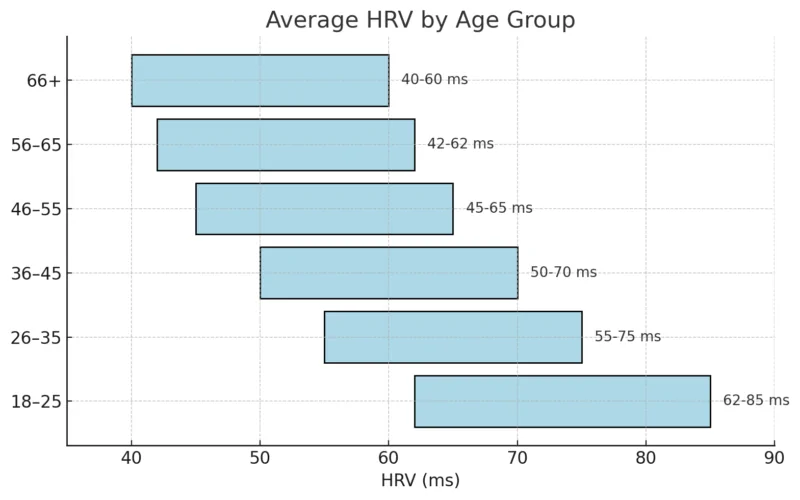
HRV usually decreases with age. A major reason is reduced parasympathetic activity, which makes the heart rhythm less flexible over time.
The decline can be sharper in people with chronic conditions, poor sleep, long-term stress or inactive habits. People who stay physically active often keep a steadier HRV profile for longer.
| Age Pattern | What It Usually Means |
| Higher HRV in younger adults | Greater autonomic flexibility and stronger recovery response |
| Gradual HRV decline with age | Normal aging effect, especially after early adulthood |
| Very low HRV for age | Can reflect stress, poor sleep, illness, low fitness or cardiovascular strain |
| Stable HRV over months | More useful than one high or low daily reading |
Fitness Level and HRV
View this post on Instagram
Fitness strongly affects HRV because regular training improves cardiovascular efficiency and recovery. People who exercise several times a week, especially with a mix of aerobic work and strength training, often develop steadier HRV numbers over time.
That does not mean every athlete has a huge HRV number. It means trained people often show a better recovery pattern. Their HRV drops after hard sessions, then rebounds when recovery is adequate.
A sedentary person may see lower HRV, higher resting heart rate and sharper stress responses. The nervous system has less practice shifting between effort and recovery.
Health issues can push HRV lower as well. Diabetes, cardiovascular disease, chronic inflammation, poor sleep, smoking, heavy alcohol use and long-term stress are all linked with lower HRV patterns.
We also covered causes of cardiovascular diseases, which matter because heart and metabolic conditions can affect autonomic function.
Daily Fluctuations vs Long-Term Trends
HRV is not stable day to day. It can swing 10 to 20 ms or more depending on stress, sleep, alcohol, illness, dehydration, travel, meal timing or the time of day.
One study found that healthy young adults had HRV variability of up to 30% across a week, even without major lifestyle changes.
Do not panic if HRV dips for one day. A hard workout or a bad night of sleep can temporarily lower it. The stronger signal is the trend over several weeks.
| Short-Term HRV Drop | Common Explanation |
| One low morning | Poor sleep, alcohol, late meal, stress or hard workout |
| Two to three low days | Accumulated fatigue, mild illness, poor recovery or travel |
| One week or more below baseline | Worth reviewing sleep, training load, stress, hydration and symptoms |
| Low HRV with chest pain, fainting, shortness of breath or irregular heartbeat | Medical evaluation should come before wearable interpretation |
Genetics and HRV Variability
| Factor | Influence on HRV | Explanation |
| Genetic baseline | Meaningful influence | Twin studies suggest HRV has moderate heritability. |
| Ethnicity | Small but measurable | Population differences appear in some studies, though lifestyle, stress and environment also matter. |
| Sex hormones | Strong influence | Estrogen, menstrual cycle phase, pregnancy and menopause can all shift HRV. |
| Family cardiac history | Relevant context | Family history does not determine HRV alone, but it can make long-term trends more important. |
People often compare HRV scores with friends, coworkers or training partners. That can be misleading because part of HRV is personal biology.
Some people start with naturally higher or lower HRV. Twin research points to moderate heritability, which means genetics can shape the baseline before lifestyle is even considered.
Hormones add another layer. HRV can rise and fall across the menstrual cycle, shift during pregnancy and change after menopause. For many women, monthly HRV movement is normal and should not be read as a health problem by itself.
Family history also matters. People with close relatives who have heart disease should not treat HRV as a diagnosis, but a falling baseline can be one more reason to pay attention to blood pressure, cholesterol, glucose, sleep and exercise habits.
HRV Chart for Men and Women Based on Age
HRV is highly personal. A healthy number is always relative to age, sex, baseline, device, sleep, fitness and health status.
Below are commonly cited HRV averages for men and women. They should be read as rough reference points, not medical cutoffs.
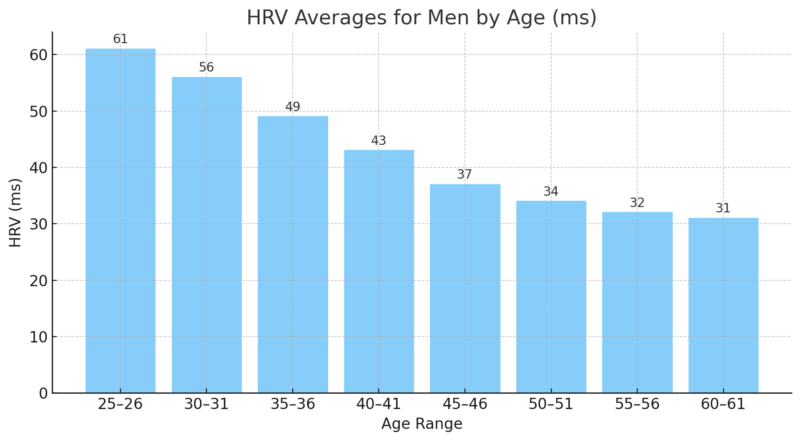
Heart Rate Variability Chart Male
| Age Years | Average HRV ms |
|---|---|
| 25 to 26 | 61 |
| 30 to 31 | 56 |
| 35 to 36 | 49 |
| 40 to 41 | 43 |
| 45 to 46 | 37 |
| 50 to 51 | 34 |
| 55 to 56 | 32 |
| 60 to 61 | 31 |
The male chart shows a steady decline from the twenties into the early sixties. Average HRV starts around 61 ms in the mid-twenties and moves into the low 30s by the late fifties and early sixties.
A large part of this drop is biological aging. Lifestyle also matters. Many men in their thirties and forties sleep less, exercise less consistently, drink more often or carry more work and family stress.
A reading slightly above or below the table does not automatically mean something is wrong. Hydration, recovery, illness and emotional stress can all move HRV from week to week.
The main question is whether your HRV is stable for your age and lifestyle. A steady trend is more useful than chasing a single high score.
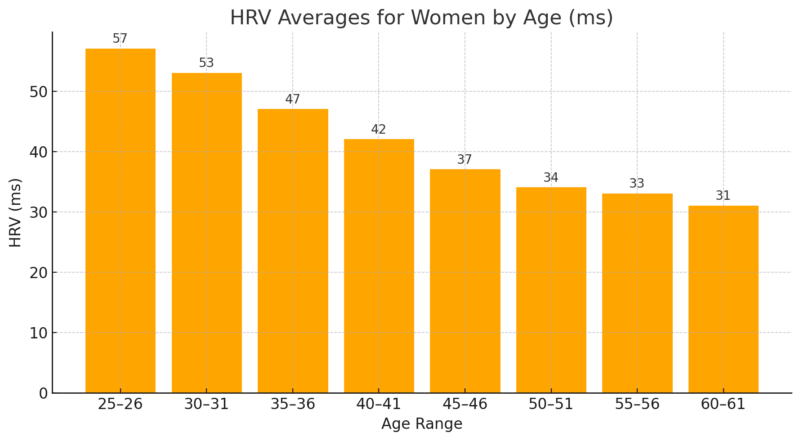
Heart Rate Variability Chart Female
| Age Years | Average HRV ms |
|---|---|
| 25 to 26 | 57 |
| 30 to 31 | 53 |
| 35 to 36 | 47 |
| 40 to 41 | 42 |
| 45 to 46 | 37 |
| 50 to 51 | 34 |
| 55 to 56 | 33 |
| 60 to 61 | 31 |
For women, the age pattern looks similar to the male chart but starts slightly lower in the mid-twenties. Average HRV begins around 57 ms in the late twenties, then gradually drops through the thirties and forties.
Monthly swings are common. Menstrual cycle phase, sleep, stress, pregnancy, perimenopause and menopause can all affect the number.
By the mid-forties and early fifties, women and men move toward similar HRV levels. Hormonal shifts play a role, but lifestyle and overall health become more important over time.
A woman whose HRV falls near these ranges is usually within normal expectations. The more important pattern is whether the number holds steady or improves over time.
Rapid Decline in Early Adulthood
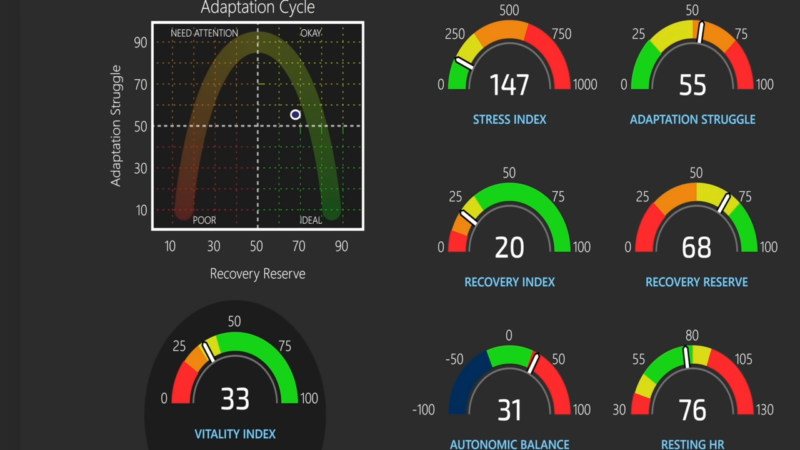
NIH-indexed research found that HRV decreases rapidly between the ages of 20 and 40. The decline is more pronounced in men, who typically have higher HRV than women until around age 50.
Early adulthood is also when many people sleep less, sit more, take on more stress and stop training as consistently. Those changes can make the age-related decline look sharper.
This period also coincides with a natural reduction in physical activity and changes in sleep patterns, which can negatively affect HRV.
Leveling Out in Middle Age
After 40, the rate of HRV decline often slows, and differences between men and women become smaller. By age 50, both sexes tend to have similar HRV values.
This does not mean HRV stops changing. It means the steep early-adult drop often gives way to a slower pattern. Sleep quality, blood pressure, glucose control, fitness, alcohol use and stress management become major drivers.
Many people in this age group become more health-conscious, add regular exercise and pay closer attention to recovery. Those habits can help protect HRV even as the average age trend moves downward.
Athlete HRV Ranges vs Sedentary Individuals
Elite endurance athletes often have HRV values above 100 ms. Sedentary adults of the same age may average closer to 30 to 40 ms.
Athletes tend to have higher average HRV and more predictable daily fluctuations. That suggests better adaptability. Their nervous system can respond to training stress and return toward baseline when recovery is adequate.
Sedentary adults often show lower HRV, higher resting heart rate and more irregular stress responses. Low activity, poor sleep and chronic stress can all push the baseline down.
Practical point: HRV can help show whether training and recovery are balanced. Athletes use HRV to adjust workouts. Less active people can use it as a signal to move more, sleep better and reduce repeated stress.
What Higher HRV Actually Means for Your Body

Higher HRV usually means the body can shift between effort and recovery more easily. It is a sign of flexibility in the autonomic nervous system.
That does not mean higher is always better in every situation. Extremely unusual readings, irregular rhythms or symptoms should be evaluated medically. In everyday tracking, however, a higher personal baseline often points to better recovery, better fitness and lower accumulated stress.
Your Nervous System Works Smoother
When the parasympathetic and sympathetic systems are in better balance, the body adapts faster. Heart rhythm changes smoothly, digestion is less disrupted, sleep may improve and stress reactions can become less intense.
People often notice this when they wake up rested. HRV rises, resting heart rate falls and the body feels less strained.
A Sign That Fitness and Recovery Are On Track
Higher HRV often appears in people who move regularly and recover well. In athletes, HRV usually rises when training is balanced and drops when sleep, nutrition or recovery falls behind.
For non-athletes, regular walking, cycling, swimming, lifting and mobility work can improve the baseline over time. The goal is not to force HRV up overnight. The goal is to build habits that make recovery more consistent.
A Helpful Signal for Long-Term Health
Consistently low HRV can be an early sign that the body is under pressure. Chronic stress, inflammation, poor sleep, anxiety, depression, cardiovascular disease and metabolic problems are all linked with lower HRV patterns.
HRV should not be used as a diagnosis. It is a signal. Symptoms, medical history, blood pressure, labs, sleep and resting heart rate all matter alongside the number.
Resting Heart Rate and HRV Correlation
Resting heart rate and HRV often move in opposite directions.
- Lower resting heart rate often appears with higher HRV.
- Higher resting heart rate often appears with lower HRV, especially during stress, illness or poor recovery.
| Metric | Common Pattern | What It Suggests |
| Resting heart rate under 60 bpm | Often higher HRV | Fit cardiovascular system, especially in active people |
| Resting heart rate 60 to 75 bpm | Moderate HRV | Common adult range with average fitness and stress balance |
| Resting heart rate above 75 bpm | Often lower HRV | Possible stress, illness, poor sleep, low fitness or dehydration |
If resting heart rate rises and HRV falls at the same time, the body is often under strain. The cause may be a hard workout, illness, poor sleep, dehydration, alcohol, emotional stress or under-recovery.
Factors Influencing HRV
Several factors can significantly affect heart rate variability. Some are fixed, such as age and genetics. Others can change quickly, including sleep, alcohol, stress, hydration and training load.
Genetics
Your genetic makeup plays a meaningful role in determining HRV. Some people naturally have higher or lower HRV.
Genetic predisposition can influence how the body responds to stress and recovers from it. Knowing that helps prevent bad comparisons. A lower baseline is not always a failure, and a higher baseline is not always a sign of perfect health.
Age and Sex
HRV naturally trends downward with age. Men often start slightly higher than women in their twenties and thirties. That gap usually narrows by around age 50.
Hormones explain part of the difference. Estrogen can support vagal tone, and menstrual cycle changes can move HRV across the month. After menopause, lifestyle, sleep and overall health tend to matter more than sex differences.
Health Conditions

Conditions such as cardiac arrhythmia can affect HRV readings. Diabetes, hypertension, cardiovascular disease and chronic inflammation can also lower HRV over time.
HRV can help show how the body is responding to lifestyle changes, but it cannot confirm or rule out disease. A person with symptoms such as chest pain, fainting, shortness of breath, palpitations or unexplained dizziness should seek medical advice rather than relying on a wearable score.
Hormonal Changes
Hormones have a clear effect on HRV, especially for women.
Menstruation, pregnancy, perimenopause and menopause can all shift HRV up or down. HRV often dips in the late luteal phase, rises again after a new cycle starts and becomes less predictable during pregnancy.
Those swings are often normal. Tracking the pattern over several cycles is more useful than reacting to one low reading.
Stress and Mental Health
When stress rises, the fight-or-flight response becomes more active. Parasympathetic activity often drops, and HRV usually moves lower.
A meta-analysis on stress and HRV found that HRV is widely used as an objective marker in stress research.
Mindfulness, breathing exercises, consistent sleep and regular exercise can support HRV because they lower repeated nervous system strain.
Best Science-Backed Ways to Improve HRV
The best HRV strategy is not complicated. Build a body that sleeps, moves, recovers and handles stress better.
| Category | Evidence-Based Strategy | Practical Example |
| Physical activity | Aerobic training plus resistance training | Walk, cycle, swim or run weekly, and add strength training two days per week |
| Stress management | Mindfulness, slow breathing, meditation | Use 5 to 10 minutes of slow nasal breathing before bed |
| Sleep hygiene | Consistent bedtime, dark room, stable wake time | Keep sleep and wake times similar across the week |
| Nutrition | Whole foods and enough protein, fiber and healthy fats | Base meals around plants, lean protein, whole grains and unsaturated fats |
| Alcohol reduction | Limit alcohol, especially close to bedtime | Avoid late alcohol when tracking recovery or training hard |
| Hydration | Maintain fluid and electrolyte balance | Replace fluids after sweating, heat exposure or long workouts |
How to Improve HRV?
- Get 7 to 9 hours of quality sleep when possible.
- Follow a regular exercise routine, but avoid constant overtraining.
- Use simple breathing exercises to lower stress and support oxygen levels.
- Practice mindfulness, prayer, journaling or quiet time if stress is driving HRV down.
- Eat a balanced, whole-food diet with enough protein, fiber and micronutrients.
- Limit alcohol, nicotine and late caffeine.
- Stay hydrated, especially during exercise, heat or illness.
- Build supportive social connections because isolation and chronic stress can affect recovery.
- Use HRV with other signals, including sleep quality, mood, resting heart rate and energy level.
How to Measure HRV Correctly?
Measurement method changes the number. A chest strap using electrical heart signals is usually more precise for short HRV readings. Most watches and rings use photoplethysmography, or PPG, which estimates pulse changes through light sensors.
PPG-based wearables are useful for long-term trends, especially overnight, but they can be affected by movement, loose fit, skin temperature, device placement and algorithm differences.
| Measurement Method | Best Use | Main Limitation |
| ECG or chest strap | More precise beat-to-beat HRV | Less convenient for nightly use |
| Wearable ring | Overnight HRV trends | Device algorithm affects results |
| Smartwatch | Convenient daily tracking | Short spot readings can be noisy |
| Phone app with sensor or strap | Morning baseline checks | Needs consistent technique |
For the cleanest trend, measure HRV at the same time each day or use the same overnight device consistently. Do not compare numbers from different devices as if they were identical.
Best HRV Trackers and Apps
Not all wearables measure HRV in the same way. The most useful device is the one that gives consistent measurements under similar conditions.
| Device/App | HRV Method | Strengths | Notes |
| Whoop Strap | PPG during sleep | Detailed recovery and strain insights | Subscription required |
| Oura Ring | PPG overnight | Strong sleep and HRV trend tracking | Best for trends, not instant readings |
| Apple Watch | PPG through Health app | Accessible and easy to use | Spot readings can vary |
| Garmin | Optical sensor or chest strap depending on model and use | Useful for athletes and training integration | Chest strap improves precision |
| Elite HRV app | Chest strap required | Strong option for serious tracking | Less convenient than passive wearables |
For most people, overnight HRV is more useful than random daytime checks. Daytime readings are affected by food, caffeine, movement, work stress, posture and temperature.
Rings and recovery-focused straps tend to give smoother baseline data because they measure during sleep. Watches are easier to use, but the data can be noisier if measurements are short or inconsistent.
When HRV Should Not Be Ignored
HRV is not a diagnosis, but some patterns deserve attention.
| Pattern | What To Do |
| HRV drops for one day after hard training | Prioritize recovery, sleep and hydration |
| HRV stays low for a week | Review illness, stress, alcohol, workload and training volume |
| HRV drops with rising resting heart rate | Watch for illness, under-recovery or dehydration |
| HRV changes with chest pain, fainting, palpitations or shortness of breath | Seek medical evaluation |
| Wearable reports irregular rhythm | Confirm with a clinician or medical-grade test |
Wearables are helpful for patterns. They are not a replacement for a medical evaluation when symptoms are present.
Final Words
Heart rate variability is a useful metric for tracking stress, recovery and autonomic nervous system balance.
A higher HRV is generally linked with better recovery, cardiovascular fitness and resilience. A consistently low HRV can point to chronic stress, poor recovery, low fitness, illness or underlying health issues.
If you want to improve HRV, focus on the basics first.
- Get 7 to 9 hours of quality sleep consistently.
- Combine regular aerobic exercise with strength training.
- Avoid overtraining and plan recovery days.
- Use slow breathing, mindfulness or meditation for stress control.
- Eat mostly whole foods and limit processed sugar.
- Limit alcohol, caffeine and nicotine when recovery matters.
- Stay hydrated and replace electrolytes after heavy sweating.
- Track HRV with sleep, energy, mood and resting heart rate.
Track HRV trends over time rather than focusing on daily fluctuations. Use it as one part of a broader health strategy, alongside sleep quality, energy levels, resting heart rate, blood pressure and how you actually feel.
Small, consistent changes in sleep, exercise, stress, alcohol use and recovery can lead to measurable improvements in HRV. More importantly, they can improve long-term health.
FAQs
What is a good HRV for adults?
Many healthy adults fall somewhere between 40 and 80 ms, but age and fitness change the range. Some studies cite 60 to 100 ms as healthy. Personal baseline matters more than a universal number.
Is 30 ms HRV bad?
Not always. A 30 ms HRV can be normal for an older adult, someone under heavy stress or someone using a device that measures differently. A sudden drop from your normal baseline matters more than the number alone.
Why does HRV drop after exercise?
Hard exercise creates short-term stress. HRV often drops after intense training and rises again when recovery is adequate. A repeated drop without rebound can signal under-recovery.
Why does alcohol lower HRV?
Alcohol can disrupt sleep, increase heart rate and shift the nervous system toward stress activation. Many people see lower HRV the morning after drinking, especially after late or heavy alcohol intake.
Can HRV diagnose heart disease?
No. HRV can show autonomic stress and recovery patterns, but it cannot diagnose heart disease. Symptoms such as chest pain, fainting, palpitations or shortness of breath need medical evaluation.
Is higher HRV always better?
Usually, a higher personal baseline is a good sign. Very unusual readings or sudden changes should be interpreted with symptoms, resting heart rate, device accuracy and medical history.
Should HRV be measured in the morning or at night?
Both can work if the method is consistent. Overnight readings are often smoother. Morning readings can also be useful if taken at the same time, in the same position, before caffeine or activity.
Why do different devices give different HRV numbers?
Devices use different sensors, algorithms and measurement windows. A ring, watch, chest strap and app may not match. The best approach is to use one device consistently and follow the trend.
References:
- Kim HG, Cheon EJ, Bai DS, Lee YH, Koo BH. Stress and Heart Rate Variability: A Meta-Analysis and Review of the Literature. Psychiatry Investig. 2018 Mar;15(3):235-245. doi: 10.30773/pi.2017.08.17. PMID: 29486547; PMCID: PMC5900369.
- Chalmers T, Hickey BA, Newton P, Lin CT, Sibbritt D, McLachlan CS, Clifton-Bligh R, Morley JW, Lal S. Associations between Sleep Quality and Heart Rate Variability: Implications for a Biological Model of Stress Detection Using Wearable Technology. Int J Environ Res Public Health. 2022 May 9;19(9):5770. doi: 10.3390/ijerph19095770. PMID: 35565165; PMCID: PMC9103972.
- Jandackova VK, Scholes S, Britton A, Steptoe A. Are Changes in Heart Rate Variability in Middle-Aged and Older People Normative or Caused by Pathological Conditions? Findings From a Large Population-Based Longitudinal Cohort Study. J Am Heart Assoc. 2016 Feb 12;5(2):e002365. doi: 10.1161/JAHA.115.002365. PMID: 26873682; PMCID: PMC4802439.
- Bonnemeier H, Richardt G, Potratz J, Wiegand UK, Brandes A, Kluge N, Katus HA. Circadian profile of cardiac autonomic nervous modulation in healthy subjects: differing effects of aging and gender on heart rate variability. J Cardiovasc Electrophysiol. 2003 Aug;14(8):791-799. doi: 10.1046/j.1540-8167.2003.03078.x. PMID: 12890036.
- Task Force of the European Society of Cardiology and the North American Society of Pacing and Electrophysiology. Heart rate variability: Standards of measurement, physiological interpretation, and clinical use. European Heart Journal. 1996;17(3):354-381.
- World Health Organization. Physical activity guidance for adults, including aerobic activity and muscle-strengthening recommendations.