


These are short terms hospitals use to quickly alert the right staff to a medical, fire, security, or disaster situation. The key fact many articles miss is that there is no single national system, so code meanings can vary between hospitals.
Code Blue is the most consistent and usually means cardiac or respiratory arrest, while Code Red often means fire or smoke and Code Silver usually signals an armed threat.
Code Pink can mean infant abduction in one hospital but a pediatric emergency in another. Hospitals use these codes for speed, but variation has created confusion for staff, contractors, patients, and visitors.
That is why many hospitals are moving toward plain-language alerts like “medical emergency” or “security alert” instead of relying only on color codes.
The Most Common Hospital Codes
| Code | Usual meaning | What typically happens |
| Code Blue | Cardiac or respiratory arrest, major medical emergency | Resuscitation team responds immediately |
| Code Red | Fire or smoke | Fire response procedures begin, possible evacuation |
| Code Silver | Armed person, active shooter, or weapon threat | Security and law enforcement response |
| Code Pink | Often infant/child abduction, but sometimes pediatric emergency depending on hospital, or child cardiac arrest | Security lockdown or pediatric rapid response |
| Code Orange | Hazardous materials event or external disaster/mass casualty in many systems | Decontamination or disaster response activation |
| Code Green | Evacuation in many systems, though some hospitals use it differently | Unit relocation, evacuation, command coordination |
| Code Black | Bomb threat in many hospitals | Security sweep and emergency procedures |
| Code White / Gray / Grey | Violent person or security threat in many systems, but meanings vary by facility | Security response, staff safety procedures |
| Code Yellow | Missing patient, lockdown, or other operational warning in some systems | Search, access control, care-team coordination |
This table reflects common patterns seen in hospital guidance and emergency code toolkits, but the exact meanings still vary by organization. That variation is precisely why newer guidance increasingly favors plain-language alerts.
Code Blue: The Hospital Code Most People Know
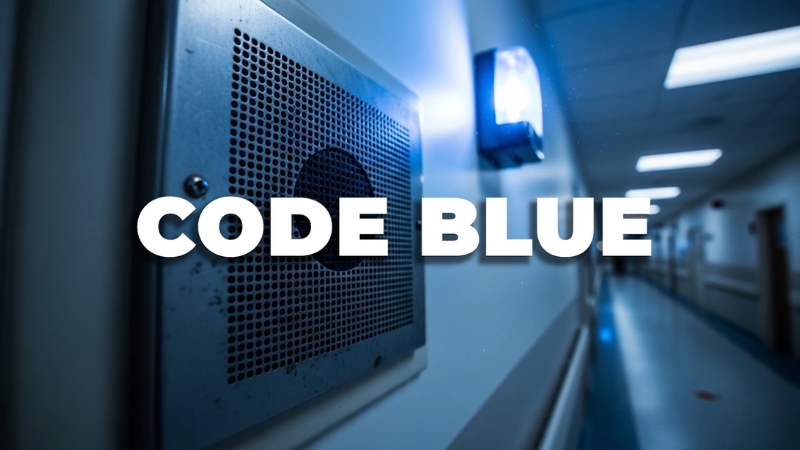
Code Blue is the most recognized hospital code because it is tied to one of the most time-sensitive emergencies in medicine and it says cardiac arrest.
In practical terms, Code Blue is the signal that launches the hospital’s resuscitation response. Staff trained in advanced life support move quickly to the location, bringing equipment, medications, airway support, and defibrillation capability.
The American Heart Association’s 2025 CPR guidance noted that survival to hospital discharge after in-hospital cardiac arrest is still only about 23.6 percent for adults and 45.2 percent for children, which shows why these alerts need to be fast, rehearsed, and precise.
That survival figure also explains why hospitals invest so heavily in rapid response systems, code teams, and drills. Code Blue is not just an announcement. It is a trigger for a rehearsed chain of events: immediate assessment, CPR, monitoring, shock if indicated, medication delivery, airway management, and post-arrest care if the patient is revived.
The American Heart Association describes its resuscitation quality program as a way “to save more lives by preventing in-hospital cardiac arrest and optimizing outcomes,” which captures the real goal behind the code.
Code Red: Fire, Smoke, and Immediate Life Safety
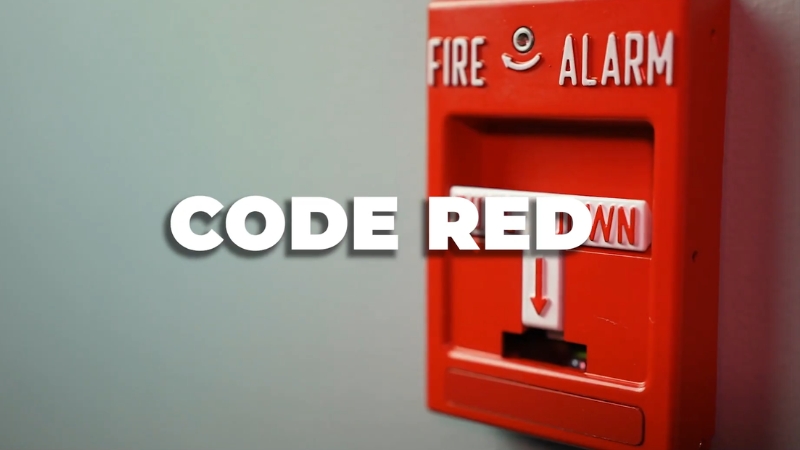
Code Red is widely used to mean fire or smoke in the hospital. That makes sense because fire is one of the most dangerous events in a healthcare facility. Hospitals contain oxygen, electrical equipment, vulnerable patients, medication storage, surgical suites, labs, and non-ambulatory people who cannot simply walk out.
A hospital fire alert does much more than call the fire department. It activates internal life-safety steps, often based on long-established fire response protocols. Staff may rescue patients in immediate danger, activate alarms, contain smoke by closing doors, and prepare to extinguish or evacuate depending on the situation.
Hospitals usually evacuate horizontally first, moving patients away from danger behind fire doors before considering a larger building evacuation. That is different from what most people imagine when they think of a fire alarm.
This is one reason hospital codes matter so much: they compress a full operational plan into two short words. Saying “Code Red” inside a hospital is not just naming a fire. It signals a practiced response that protects patients who may be sedated, intubated, attached to monitors, or unable to move without assistance.
Code Silver: Weapon Threat or Active Shooter
@steveioe Thoughts from the ER @dr.karanr #code #silver #gun #duck #sword #alert #hospital #dangerous #drop #safety #hide #silence #phone #ranger ♬ original sound – Steveioe
Code Silver usually refers to an active shooter, armed person, hostage event, or weapon-related security threat.
This code reflects how hospitals have expanded emergency planning beyond traditional medical events. A modern hospital is a public-facing environment with emergency departments, behavioral health units, high visitor traffic, and round-the-clock operations.
Security threats are not theoretical. Federal preparedness resources for healthcare systems include active shooter and explosives planning as part of hospital emergency readiness.
Unlike Code Blue, which calls people toward the emergency, Code Silver often changes movement patterns across the building. Staff may be told to run, hide, barricade, secure a unit, or follow law-enforcement instructions depending on the facility’s procedures.
That difference matters. Hospital codes are not all designed to summon more responders into a room. Some are designed to lock down access, protect patients, and reduce exposure.
Code Pink: One of The Most Misunderstood Hospital Codes

Code Pink is one of the biggest reasons people get confused when they search for “hospital color codes.” In some hospitals, Code Pink means infant or child abduction. In others, it means a pediatric medical emergency such as infant or child cardiac or respiratory arrest.
That is exactly the problem with non-standardized color-code systems. A nurse or physician moving between facilities could hear the same code and initially picture the wrong type of emergency.
For a pediatric arrest, that delay matters. For an abduction response, it also matters. This is one of the clearest real-world examples of why hospitals and professional organizations have moved toward clearer language.
When Code Pink is used for abduction, the response typically focuses on doors, elevators, exits, access control, surveillance, and immediate search procedures. When it is used for a pediatric medical emergency, it functions more like a child-specific Code Blue. The words may sound simple, but the operational difference is enormous.
Other Hospital Codes That People Know Less
Search behavior around “hospital codes meaning,” “code red,” “code blue hospital,” and “silver alert” usually points to the same broader curiosity: people want the plain-English version of what hospitals mean in a crisis.
Here are several common codes that appear across hospital manuals and emergency-alert toolkits, with the caution that local definitions may differ.
Code
Common meaning across many hospitals
Important caution
Code Orange
Hazardous material spill, decontamination event, or external disaster/mass casualty
Can mean hazmat in one hospital and disaster influx in another
Code Black
Bomb threat or suspicious object
Some facilities have alternate security terminology
Code Green
Evacuation in many systems; in some hospitals it can mean other operational or disaster events
Not fully standardized
Code White
Violent person, pediatric emergency, or hostage situation depending on system
High variation
Code Gray/Grey
Security threat, combative person, infrastructure failure, or sheltering depending on system
One of the most variable codes
Code Yellow
Missing patient, lockdown, disaster warning, or search response depending on facility
Often organization-specific
The exact differences are not trivial. In some hospital manuals, Code Gray refers to violence or a security alert. In some broader toolkits, gray/grey can relate to infrastructure failure or shelter-in-place conditions.
In some systems, Code White means violence or aggressive behavior; elsewhere, it can mean hostage or other emergency categories. That variability is why a generic online list should never be treated as the final authority inside a real hospital. The hospital’s own policy is the authority.
Why Hospitals Are Moving Away From Color Codes

The biggest current trend in this topic is the move from color codes toward plain-language emergency alerts.
The Emergency Nurses Association states that emergency alert codes are widely used, but the lack of standardization has created a wide range of meanings across healthcare settings, and its position is that plain language should be adopted by all hospitals.
Texas Hospital Association guidance says the state endorsed voluntary adoption of plain-language alerts to improve communication and safety. Washington State Hospital Association has also strongly recommended plain language for emergency code events.
This shift is not just administrative fashion. It comes from a patient-safety argument. Staff now move between more facilities than in the past. Hospitals employ travelers, agency nurses, rotating residents, students, vendors, and contract workers.
Patients and visitors are also more likely to hear overhead announcements directly. A plain-language phrase such as “Security Alert: Armed Person, Emergency Department Entrance” is clearer than a color that may mean something else in the next hospital across town.
One American Hospital Association report even quoted a hospital leader describing why their system changed, saying staff “would have to look up the color system to remember what color code stands for.” That is a strong indictment of color-only systems in a high-risk environment where hesitation is expensive.
Do All Hospitals Use the Same Emergency Codes?
No. That is the single most important fact to understand if you are reading about hospital codes online. There is no universal U.S. hospital color code standard that every hospital must use, although many states, associations, and health systems have issued standardization recommendations or shifted to plain-language formats.
Some hospitals preserve older color systems. Some use hybrids. Some keep a few famous codes, especially Code Blue, while converting the rest to direct language.
That means an employee, traveler, student, or contractor should never assume that a code means the same thing everywhere. The correct response is to learn the local emergency-alert policy for that facility. Hospitals usually include this in orientation materials, badge cards, annual training, and emergency management programs.
The Difference Between Hospital Emergency Codes and Hospital Billing or Diagnosis Codes

There is another reason this topic confuses readers: “hospital codes” can also mean medical coding systems such as ICD-10 diagnosis codes or inpatient procedure codes. Those are used for documentation, reimbursement, reporting, and quality tracking.
The American Hospital Association notes that ICD-10-CM is used for diagnosis reporting and ICD-10-PCS for inpatient hospital procedures. That is a completely different topic from overhead emergency announcements like Code Blue or Code Red.
So if someone asks, “What are the codes in a hospital?” there are really two possible answers. One is operational emergency codes used over the speaker system.
The other is administrative coding used in charts and billing. Based on the keywords most people search, and the code terms like blue, red, and silver, emergency codes are usually what they mean.
What Patients and Visitors Should Know when They Hear a Hospital Code
For patients and families, the most useful thing to know is that a hospital code does not automatically mean chaos. It means the hospital is using a structured internal system to coordinate response.
If you hear a Code Blue, there is a trained team handling a medical emergency. If you hear a Code Red, staff are following fire procedures. If you hear a security-related code or plain-language alert, follow staff instructions immediately. Hospitals rehearse these events because speed and order matter more than volume and panic.
The rise of plain language is partly about helping patients and visitors react appropriately too. A clearer announcement can reduce hesitation, especially in mixed public-private spaces like lobbies, clinics, waiting rooms, and emergency departments. That makes modern emergency communication not only a staff issue but also a public-safety issue.
Bottom Line
View this post on Instagram
The most accurate way to explain hospital codes is this: they are rapid emergency communication tools, and the most common ones people search for are Code Blue, Code Red, Code Silver, and Code Pink.