

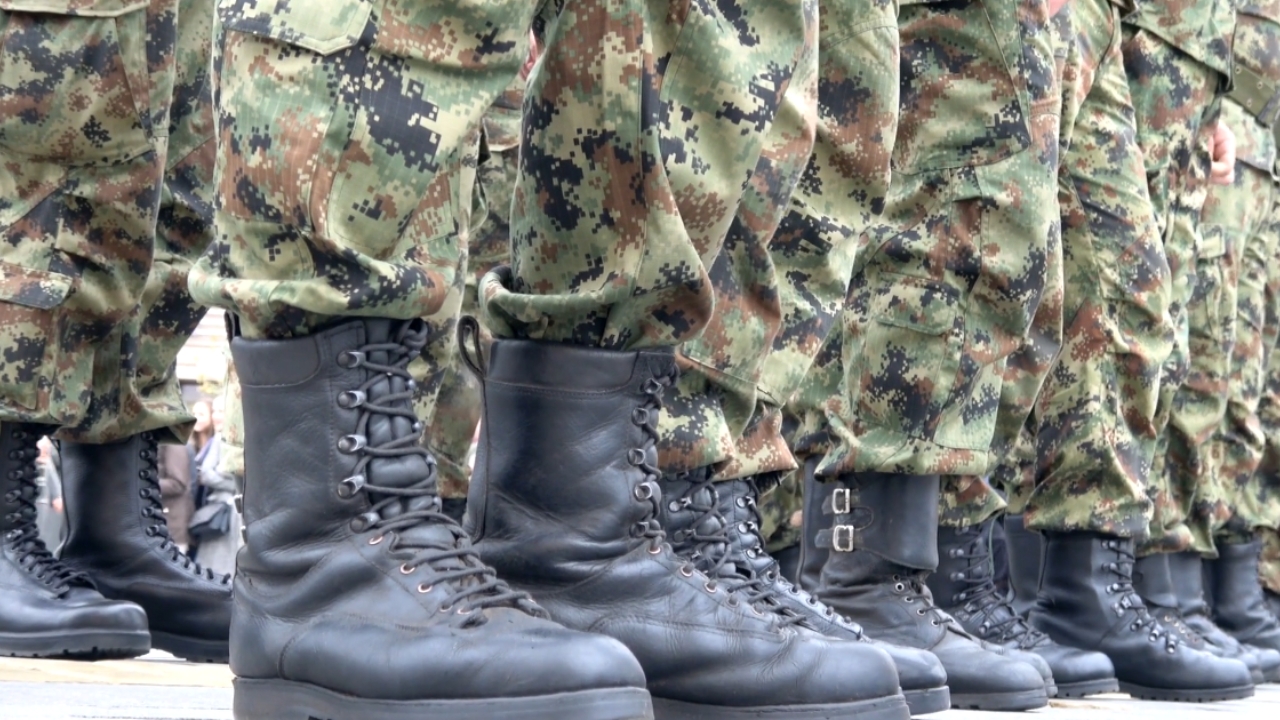
The United States has 1,349,597 active-duty military members across its six armed services.
That figure includes full-time members of the Army, Navy, Marine Corps, Air Force, Space Force, and Coast Guard. It is the clearest answer to the question of how many people are serving full-time in the U.S. military in 2026.
The number becomes much larger when the National Guard and federal reserve components are added. Congress approved an FY2026 force structure of around 2.13 million active and Selected Reserve positions across all six services.
Those two totals measure different things. The 1.35 million figure is an actual headcount recorded on a specific date. The 2.13 million figure combines congressional end-strength targets for active personnel, the National Guard, and regularly training reservists.
Neither total includes every person connected to national defense. Department of Defense civilian employees, contractors, military families, veterans, and most members of the Individual Ready Reserve belong to separate categories.
The latest Defense Manpower Data Center strength report provides the March 2026 active-duty count used in the table below.
U.S. Active-Duty Military Personnel in 2026
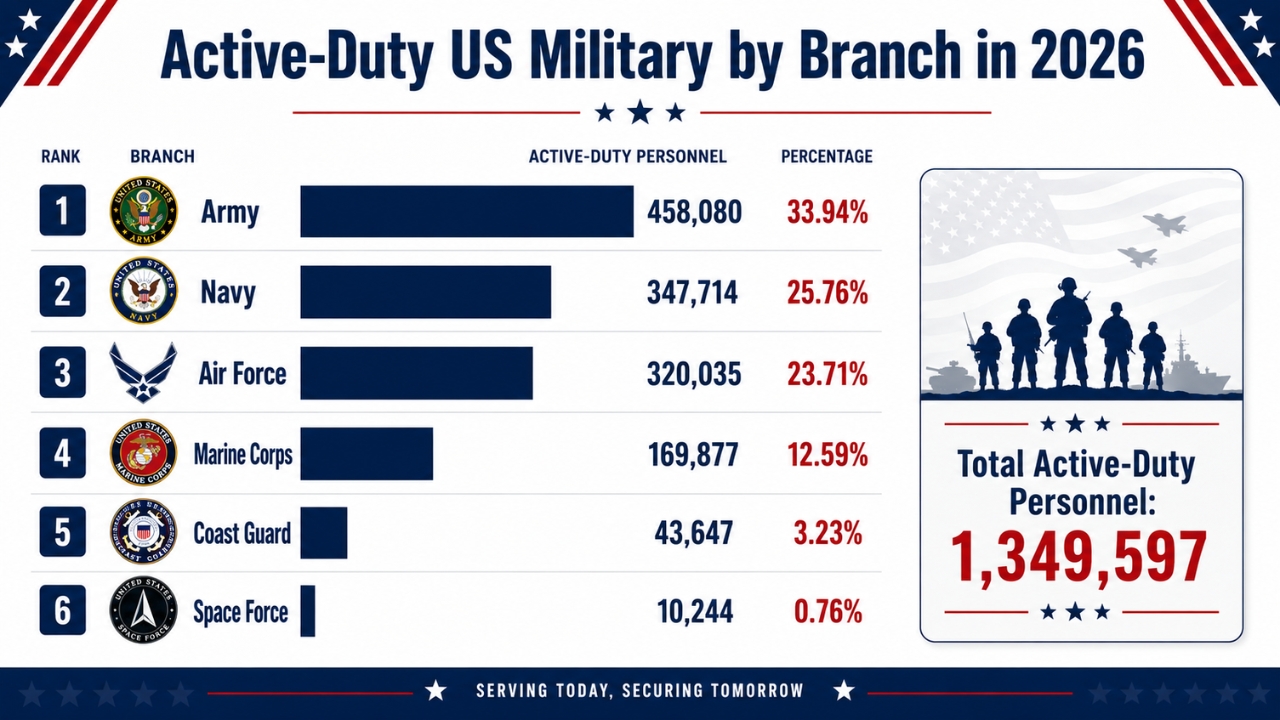
The Army remained the largest service, with slightly more than one-third of all active-duty personnel. The Navy and Air Force followed, with each accounting for roughly one-quarter of the force.
The Space Force remained the smallest branch by a wide margin. Its 10,244 members represented less than 1% of the active-duty military.
The Coast Guard is part of the U.S. Armed Forces even though it operates under the Department of Homeland Security during peacetime. That administrative difference explains why many Department of Defense tables omit Coast Guard personnel from their headline total.
DMDC counted 1,305,950 active members in the five Department of Defense services. Adding 43,647 Coast Guard members produced the complete six-service total of 1,349,597.
Key Insights
- The United States had 1,349,597 active-duty military members on March 31, 2026.
- The five Department of Defense services accounted for 1,305,950 members.
- The Coast Guard added another 43,647 active-duty members.
- The Army was the largest branch, with 458,080 active-duty soldiers.
- The Space Force was the smallest branch, with 10,244 Guardians.
- Active-duty strength increased by 28,102 people from March 2025 to March 2026.
- Congress approved 1,302,800 active positions for the five Department of Defense services at the end of FY2026.
- The FY2026 Selected Reserve authorization covered 764,900 National Guard and reserve positions under the Department of Defense.
- Adding Coast Guard active and reserve targets brings the planned six-service force to approximately 2.13 million active and Selected Reserve personnel.
- Military civilian workers and contractors are not included in military personnel totals.
Total Number Depends on What Counts as Military
Different military totals can all be accurate because they count different groups.
A report that lists about 1.35 million people usually describes active-duty personnel. A source showing approximately 2.1 million is probably combining active-duty members with the National Guard and Selected Reserve.
Figures above 3 million may include the Individual Ready Reserve, retired reservists, or civilian employees. Totals exceeding 4 million often count military spouses, children, and other registered dependents.
Population Being Counted
Approximate 2026 Size
What the Figure Represents
Active-duty armed forces
1.35 million
People serving full time across all six armed services
FY2026 active and Selected Reserve structure
About 2.13 million
Active, National Guard and regularly training reserve positions
Department of Defense civilian employees
About 715,000
Federal civilian workers supporting defense operations
Military personnel and registered family community
More than 4.3 million in the latest complete profile
Service members plus spouses, children and other registered dependents
Veterans
More than 16 million
Former service members, not the current military force
The term end strength creates another source of confusion. Congress uses it for the number of personnel a service is authorized to have on the final day of a fiscal year.
FY2026 ends on September 30, 2026. An authorized end-strength figure is therefore a staffing target for that date, not proof that the service employed exactly that number throughout the year.
Recruiting, retirements, separations, training graduations, and medical discharges change the actual force every month. A service can sit above or below its authorized target during part of the year.
FY2026 Active-Duty End-Strength Targets
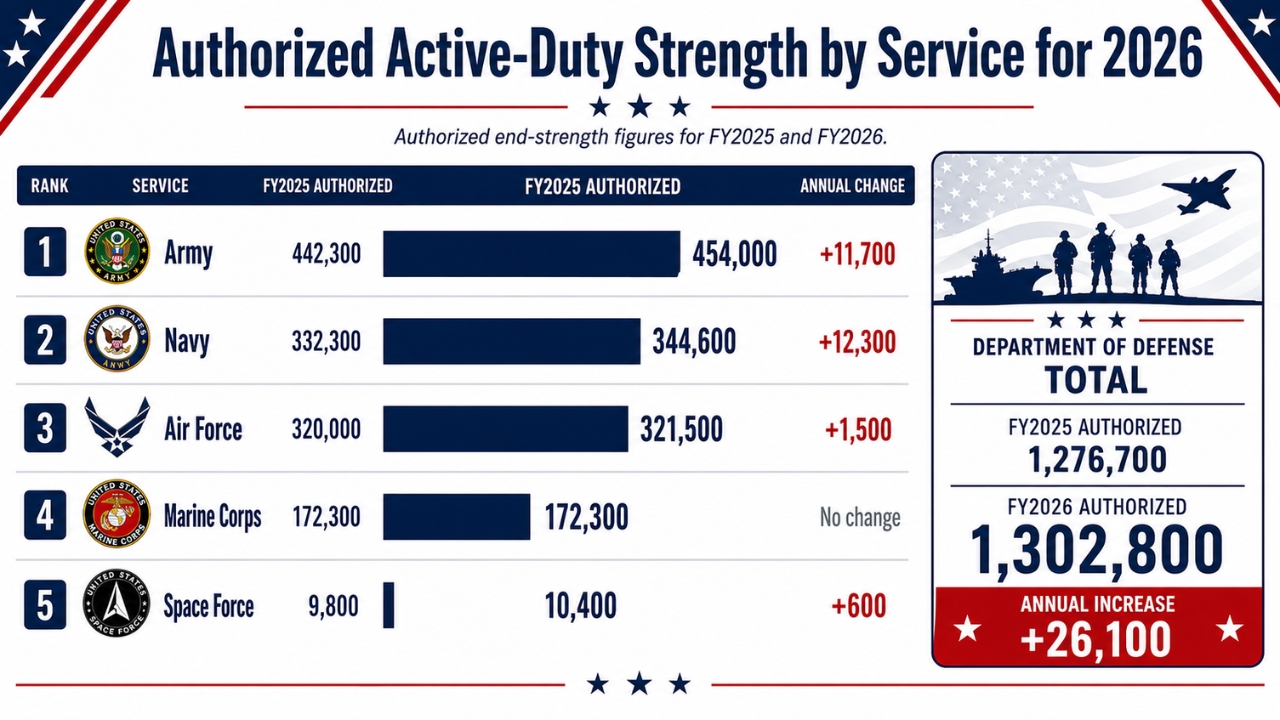
Congress increased the authorized active strength of the five Department of Defense services from 1,276,700 in FY2025 to 1,302,800 in FY2026.
The increase of 26,100 positions was concentrated in the Army and Navy. The Marine Corps authorization remained unchanged, while the Air Force and Space Force received smaller increases.
The Congressional Research Service end-strength analysis explains that the enacted figures apply to September 30, 2026.
The Coast Guard is authorized separately because it falls under the Department of Homeland Security in peacetime. Federal law set its FY2026 active-duty end strength at 50,000 personnel.
Combining the Department of Defense figure with the Coast Guard produces an authorized active force of 1,352,800 positions for the end of FY2026.
Actual Strength and Authorized Strength Are Not Identical
The six services had an actual active-duty headcount of 1,349,597 on March 31. That was 3,203 below the combined FY2026 authorization of 1,352,800.
The small overall gap hides larger differences at branch level.
Service
Actual Strength on March 31, 2026
FY2026 End-Strength Target
Difference
Army
458,080
454,000
4,080 above target
Navy
347,714
344,600
3,114 above target
Air Force
320,035
321,500
1,465 below target
Marine Corps
169,877
172,300
2,423 below target
Space Force
10,244
10,400
156 below target
Coast Guard
43,647
50,000
6,353 below target
Being above the September target in March does not necessarily mean the Army or Navy had too many people. Personnel planners may expect retirements, contract completions and other losses before the fiscal year ends.
A branch below target still has time to add recruits, retain current members or adjust accessions. Monthly strength also includes people at different stages of training and transition.
How Many National Guard and Reserve Members Are There?
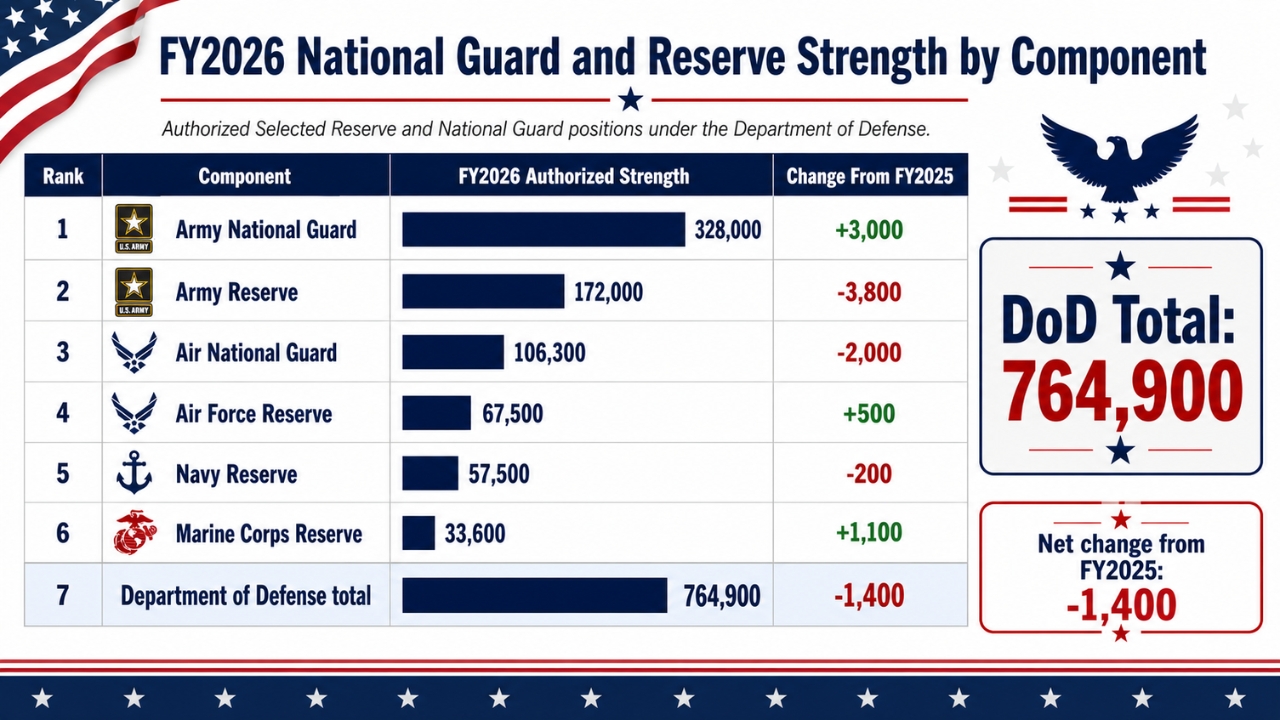
Congress authorized 764,900 Selected Reserve positions in the six reserve components managed by the Department of Defense for FY2026.
The Army National Guard was by far the largest component, with 328,000 authorized members. It alone accounted for nearly 43% of the Department of Defense Selected Reserve target.
The FY2026 reserve end-strength report provides the enacted numbers for each component.
The Coast Guard Reserve sits outside that table. Its FY2026 target rose to around 8,500 members, according to reporting on the new military personnel authorizations.
Adding the Coast Guard Reserve brings the planned Selected Reserve and National Guard force to approximately 773,400.
Combining that figure with 1,352,800 authorized active positions produces a planned six-service active and Selected Reserve force of approximately 2,126,200 people.
That number should not be presented as an exact headcount for a particular day. It combines end-of-year authorizations and force targets. Actual participation changes as people join units, transfer, retire or leave service.
Active Duty, National Guard and Reserve Are Different Categories
A useful military count begins with clear definitions. Active-duty personnel, Guard members and reservists do not have the same work schedules, command relationships or legal status.
Active-Duty Personnel
Active-duty members serve full time. Military service is their primary occupation, and they can be assigned within the United States or overseas.
The category includes people working in operational units, headquarters, hospitals, schools, maintenance facilities, ships, aircraft units, cyber organizations and thousands of other assignments.
Personnel attending a service academy or certain military schools can also appear in active-duty personnel files, depending on the report and statutory definition being used.
Army and Air National Guard
View this post on Instagram
The National Guard has a dual state and federal role.
Governors can activate Guard units for floods, hurricanes, wildfires, civil emergencies and other state missions. The federal government can also mobilize them for national defense operations.
Army National Guard soldiers and Air National Guard airmen normally belong to units connected with a state, territory or the District of Columbia. Their status can change based on the mission and legal authority used for activation.
Federal Reserve Components
The Army Reserve, Navy Reserve, Marine Corps Reserve, Air Force Reserve and Coast Guard Reserve are federal organizations.
Many members train part time but may be activated for deployments, emergencies, exercises or specialized missions. Medical professionals, pilots, intelligence specialists, logistics personnel and cyber experts are among the occupations supported through reserve components.
The familiar phrase “one weekend a month and two weeks a year” is only a rough description. Real obligations vary by job, unit, readiness requirements and operational demands. Some reservists serve far more days.
Selected Reserve
The Selected Reserve contains units and individuals who participate regularly in training and are positioned for relatively rapid mobilization.
Congressional end-strength tables usually focus on that group because it forms the most active part of the reserve structure.
National Guard drilling units, federal reserve units, individual mobilization augmentees and certain full-time support personnel can fall within the Selected Reserve.
Individual Ready Reserve

The Individual Ready Reserve consists largely of people who completed active or drilling service but still have a remaining military obligation.
Most do not attend regular monthly drills. They can be recalled under specific legal authorities if additional personnel are required.
IRR members are military reservists, but they are usually excluded from the active plus Selected Reserve total used in public force-size comparisons.
Retired and Standby Reserve
Retired reservists and members of the Standby Reserve form additional manpower pools. Their availability and obligations differ from those of drilling reservists.
Adding every reserve status can produce a much larger theoretical number. It does not mean all of those people are working for the military, training each month or immediately available for deployment.
How the Active-Duty Force Changed Over the Past Year
Active-duty military strength increased from 1,321,495 in March 2025 to 1,349,597 in March 2026.
The annual increase was 28,102 people, or approximately 2.1%.
Every branch recorded a larger headcount than one year earlier. The Navy produced the largest numerical gain, while the Space Force recorded the fastest percentage growth from a much smaller starting point.
Service
March 2025
March 2026
Change
Percentage Change
Army
449,875
458,080
+8,205
+1.82%
Navy
334,372
347,714
+13,342
+3.99%
Marine Corps
168,298
169,877
+1,579
+0.94%
Air Force
317,583
320,035
+2,452
+0.77%
Space Force
9,671
10,244
+573
+5.92%
Coast Guard
41,696
43,647
+1,951
+4.68%
Total
1,321,495
1,349,597
+28,102
+2.13%
The increase followed several difficult recruiting years during the early 2020s. A stronger recruiting environment in FY2025 and early FY2026 made growth targets more achievable.
Military size can still move in either direction even when recruiting improves. Retention, retirement eligibility, medical separation, force restructuring and changes in required occupations all affect the final result.
U.S. Military Personnel by Branch

Army
The Army had 458,080 active-duty soldiers in 2026, making it the largest branch.
Its size reflects the broad range of land-based missions it supports. Infantry and armored formations receive much of the public attention, but the Army also maintains aviation, medical, engineering, intelligence, logistics, communications, air defense and cyber units.
The Army becomes much larger when its reserve components are included. Its FY2026 structure included 328,000 Army National Guard positions and 172,000 Army Reserve positions.
Adding those targets to 454,000 authorized active positions produces an Army active and Selected Reserve structure of approximately 954,000. No other branch comes close to that combined total.
Navy
@naval_steel US Navy 🇺🇸 #militarylife #navy #usnavy #usarmy #navylife ♬ оригінальний звук – user99381957524
The Navy have 347,714 active-duty sailors, making it the second-largest active branch.
Personnel serve aboard ships and submarines, at aviation commands, shipyards, medical facilities, intelligence centers, training organizations and shore installations.
A modern warship requires far more than the crew visible on deployment. Maintenance workers, instructors, supply specialists, nuclear technicians, cyber personnel and shore support organizations all contribute to keeping the fleet operating.
The Navy also had 57,500 authorized reserve positions for FY2026. Its active authorization increased by 12,300 from the prior year, the largest increase after the Army when measured against FY2025 enacted levels.
Air Force
The Air Force counted 320,035 active-duty airmen.
The branch operates combat aircraft, tankers, transport fleets, intelligence platforms, surveillance systems, nuclear forces and extensive command and support networks.
Air Force personnel also work in maintenance, security, engineering, medicine, weather, logistics, software, communications and remotely piloted aircraft operations.
The reserve side included 106,300 authorized Air National Guard members and 67,500 Air Force Reserve members. Combined with active personnel, the Air Force family of components accounts for close to half a million positions.
Marine Corps

The Marine Corps have 169,877 active-duty Marines.
It is smaller than the Army, Navy and Air Force by design. The service is organized around expeditionary forces that can deploy quickly and operate with aviation, logistics and ground combat elements under one command structure.
The Marine Corps also depends heavily on the Navy for several forms of transportation, medical support and maritime operations.
Congress kept the active Marine Corps authorization unchanged at 172,300 for FY2026. The Marine Corps Reserve authorization increased to 33,600.
Space Force
The Space Force have 10,244 active-duty Guardians.
Its small size can be misleading because military space systems support operations across every branch. Guardians work with satellites, missile warning systems, communications networks, navigation services, space surveillance and related cyber infrastructure.
The Space Force does not maintain a traditional reserve component. Congress established a single-component personnel model that allows members to serve under different full-time and part-time arrangements within one service.
Growth from 9,671 members in March 2025 to 10,244 in March 2026 represented a 5.92% increase, the fastest percentage growth among the six branches.
Coast Guard
The men and women of the @USCG have demonstrated unparalleled heroism this year as the service transforms to meet the demands of the 21st Century and Make America Safe Again.
Under President Trump’s leadership, the U.S. Coast Guard has been defending our maritime borders,… pic.twitter.com/g0bh9sZl0N
— Special Envoy Kristi Noem (@EnvoyNoem) December 18, 2025
The Coast Guard have 43,647 active-duty members.
Its missions include maritime safety, search and rescue, drug interdiction, port security, environmental response, navigation support and enforcement of federal laws at sea.
The Coast Guard serves under the Department of Homeland Security during peacetime but remains one of the six armed services. It can operate as a service within the Navy when directed during war or under other statutory authority.
Its placement outside the Department of Defense is the main reason some military totals list only five branches or stop near 1.306 million rather than the full 1.350 million.
Who Is Not Included?
The active-duty count covers full-time uniformed personnel. It does not include several large groups that work with, depend on or previously served in the military.
Civilian Employees
Federal civilians perform essential work in engineering, health care, intelligence, logistics, finance, contracting, research, maintenance and base administration.
They are government employees, but they are not military service members. They do not hold military rank merely because they work for the Army, Navy, Air Force or another defense organization.
Defense Contractors
Private companies employ large numbers of people who support military programs, bases, weapons development, information technology, construction and logistics.
Contractors are not federal employees and are not counted as military personnel. No single simple headcount captures every contractor because contracts differ in duration, scope and staffing.
Military Families

Spouses, children and adult dependents are part of the military community, but they are not service members unless they separately serve in uniform.
The latest complete demographic profile counted more than 2.37 million registered family members connected with the Department of Defense active and Selected Reserve force.
Veterans and Retirees
Veterans are former service members. Military retirees may remain eligible for pay, health care and other benefits, but they are not normally included in active-duty totals.
The Census Bureau estimated more than 16 million veterans in the civilian population for the 2020 to 2024 period. Adding them to the current military would answer a different question about people with past service.
NOAA and Public Health Service Officers
The National Oceanic and Atmospheric Administration Commissioned Officer Corps and the U.S. Public Health Service Commissioned Corps are uniformed services.
They are not armed services, so their officers are not included in the Army, Navy, Marine Corps, Air Force, Space Force and Coast Guard total.
The Civilian Workforce Behind the Military
The Department of Defense employed 714,780 appropriated-fund civilian workers on January 1, 2026, according to a Government Accountability Office review.
That figure was down from 793,155 one year earlier. The decline of 78,375 employees represented a 9.9% reduction.
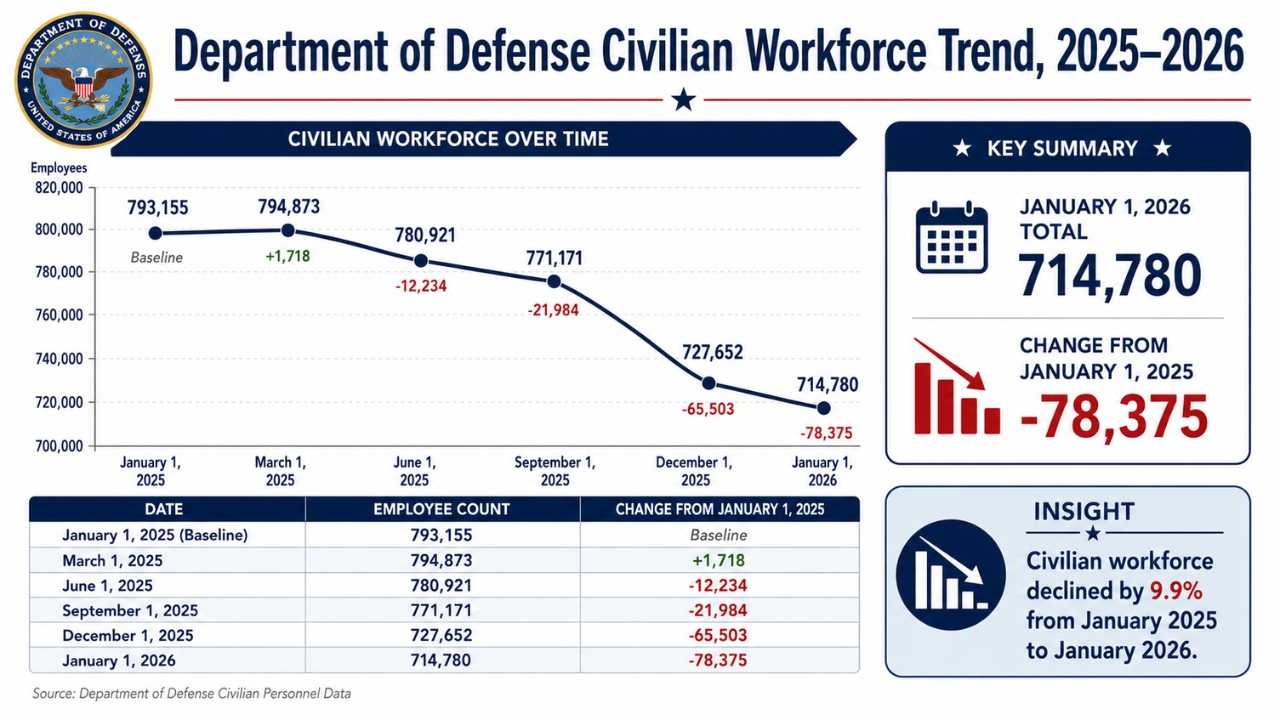
Adding those civilians to the March active-duty force produces more than 2.06 million uniformed and civilian workers. Even that sum excludes contractors and does not line up perfectly by date or agency because the Coast Guard is outside the Department of Defense.
Readers comparing military employment with the rest of government can find additional context in our report on the number of federal employees in the United States.
Civilian workforce reductions do not automatically produce an equal reduction in military capability. The effect depends on which jobs disappear, how vacancies are distributed and whether duties move to service members, contractors or remaining civilians.
Who Serves in the U.S. Military?
The latest complete Department of Defense demographic profile available in 2026 covers fiscal year 2024. Monthly personnel reports provide newer headcounts, but the annual profile supplies the clearest complete picture of age, rank, sex, race, ethnicity, education and family status.
The profile counted 1,267,738 active-duty members in the five Department of Defense services and 754,403 Selected Reserve members.
Those figures are older than the March 2026 strength total, so they should be used to describe the makeup of the force rather than its current exact size.
Enlisted Members and Officers
The active-duty demographic profile found that 81.6% of members were enlisted and 18.4% were officers. The most recent confirmed information is from 2024.
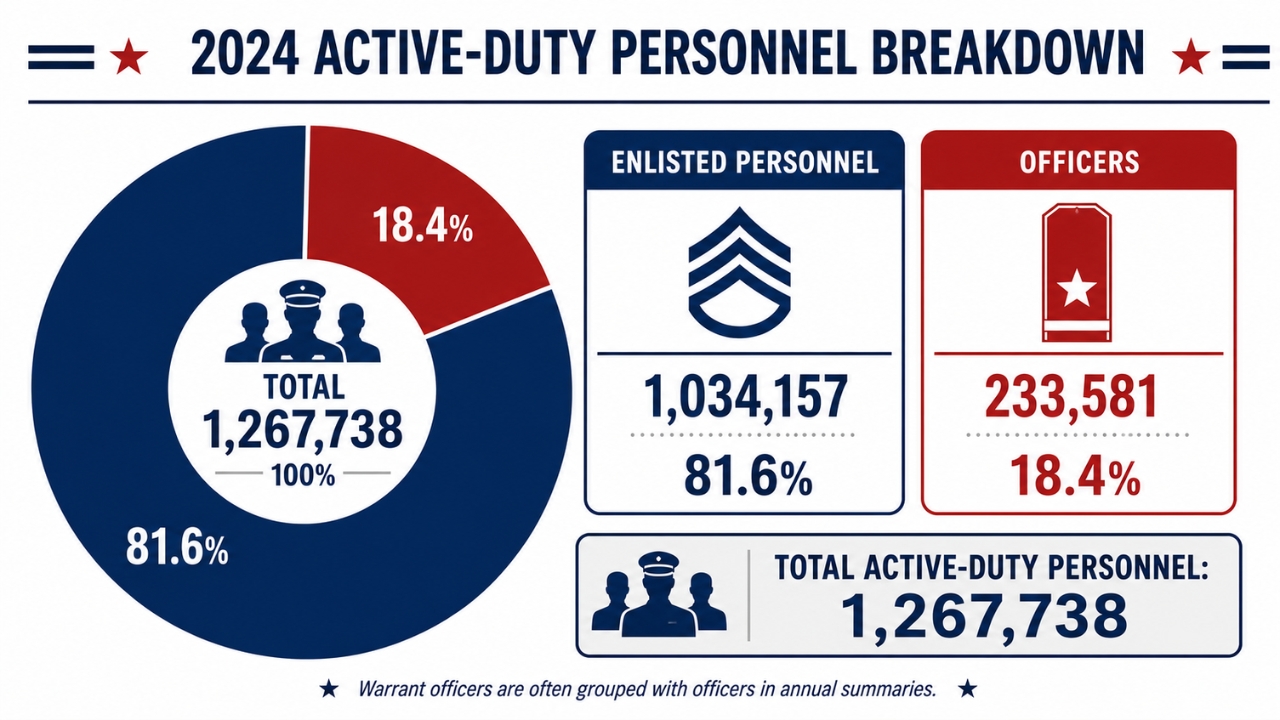
Enlisted members carry out the majority of operational, technical, maintenance, and support work. Commissioned officers hold leadership, management, and professional roles.
Warrant officers occupy a specialized category between the traditional enlisted and commissioned structures. Annual demographic summaries often group them with officers unless a table states otherwise.
Average Age
The average active-duty member was 28.7 years old in 2024.
Enlisted personnel averaged 27.4 years, while officers averaged 34.3. The difference reflects longer education and commissioning paths for many officers, as well as career progression requirements.
Selected Reserve members were older, with an average age of 31.9. Reserve officers averaged 39.1 years, compared with 30.4 among enlisted reservists.
Men and Women in the Force
Women represented 17.9% of the active-duty Department of Defense force. Men represented 82.1%.
The female share was higher in the Selected Reserve. Women accounted for 22.3%, while men made up 77.7%, according to the reserve demographic data.
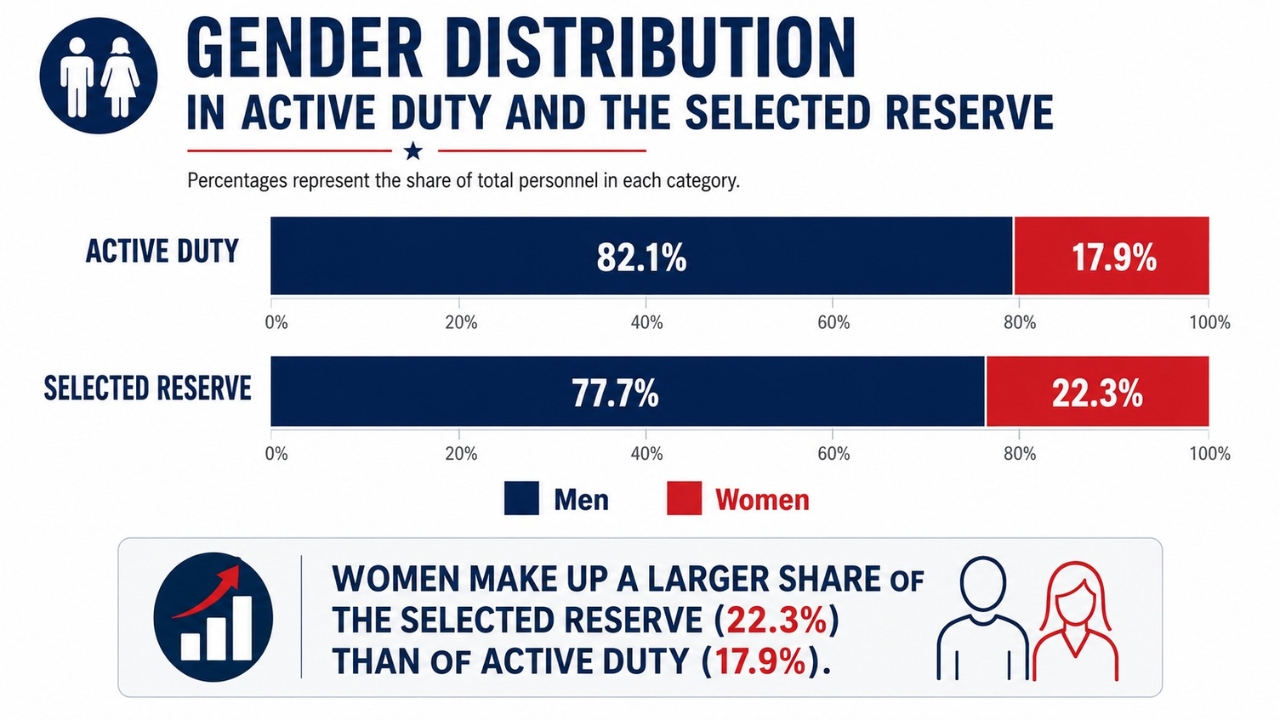
Representation differs considerably by branch, career field, and rank. A force-wide percentage cannot show whether women are concentrated in particular occupations or how representation changes at senior levels.
Race and Ethnicity
About 32.5% of active-duty members identified with racial minority groups in the 2024 report. Hispanic or Latino members represented 20.4% of the active force.
Among Selected Reserve members, 28.4% identified with racial minority groups, and 17.3% were Hispanic or Latino.
Military administrative categories can change, making year-to-year comparisons difficult. A recent example involved the removal of more than 180 detailed entries from a personnel system, a change explained in our report about military religious-affiliation records.
Military Families
The latest complete military community profile counted 2,022,141 Department of Defense military personnel and 2,372,286 registered family members.
Combined, the community exceeded 4.39 million people.
Group
2024 Profile Count
Share of the Community
Military personnel
2,022,141
46.0%
Registered family members
2,372,286
54.0%
Total community
4,394,427
100%
Family members included spouses, children, and a small number of adult or other dependents registered in the Defense Enrollment Eligibility Reporting System.
Family counts depend on accurate enrollment. A dependent who was never added to the system may not appear in the profile.
Where Are U.S. Military Members Located?
Most active-duty members are assigned within the United States and its territories.
The 2024 demographic profile placed 87.5% of Department of Defense active-duty personnel in the United States or U.S. territories. About 12.5% were assigned elsewhere.
California held the largest state share, with 14.3% of active-duty members. Virginia followed with 10.7%, Texas with 9.9% and North Carolina with 8.4%.
State
Share of U.S.-Based Active-Duty Members in the Profile
Major Reason for the Concentration
California
14.3%
Large Navy, Marine Corps, Air Force and Army presence
Virginia
10.7%
Major Navy, Marine Corps, Army and defense headquarters facilities
Texas
9.9%
Large Army and Air Force installations
North Carolina
8.4%
Major Army, Marine Corps and Air Force installations
Selected Reserve personnel were even more concentrated domestically. The profile placed 96.6% in the United States and its territories.
Texas had the largest reserve share at 7.6%, followed by California at 7.2%, Florida at 5.3% and New York at 3.9%.
Assigned Overseas Does Not Always Mean Deployed
Permanent overseas assignments and operational deployments are not the same.
A service member stationed at a base in Germany, Japan or South Korea may live there for several years with family members. A deployed member may travel temporarily from a home station to support an operation or exercise.
DMDC warns that its regional and country personnel tables do not capture every person on temporary duty or every contingency deployment.
A figure described as “troops overseas” can therefore differ based on whether the source counts permanent assignments, temporary deployments, embassy personnel, personnel aboard ships or forces whose locations are withheld.
How Large Is the Military Compared With the U.S. Population?

The Census Bureau estimated that the United States had 341,784,857 residents on July 1, 2025.
Using that latest national population estimate for context, the 1,349,597 active-duty members recorded in March 2026 were equal to approximately 0.395% of the population.
That works out to roughly one active-duty service member for every 253 U.S. residents.
Comparison
Personnel
Approximate Share of U.S. Population
Approximate Ratio
Active-duty members
1,349,597
0.395%
1 for every 253 residents
FY2026 active and Selected Reserve structure
About 2,126,200
0.622%
1 for every 161 residents
The calculation is intended only as a broad comparison. Census residence rules and military personnel accounting do not use identical definitions, especially for service members stationed overseas.
Even after the National Guard and Selected Reserve are added, fewer than one in 160 residents occupies an authorized military position.
Recruiting and Retention Shape the Final Number
Congress can authorize a larger military, but the services still need to recruit and retain enough qualified people to fill the positions.
Recruiting goals measure how many new members a service intends to bring in during a year. End strength measures the total force after accessions and departures are combined.
A branch can meet its recruiting goal and still lose personnel if retirements and separations are higher. Another branch can miss an accession target but maintain strength through unusually strong retention.
FY2025 produced the strongest overall recruiting results in approximately 15 years. The five active Department of Defense services collectively reached an average of 103% of their recruiting goals, according to the official recruiting summary.
Momentum continued into FY2026. By the March reporting period, the Army had brought in 31,211 recruits against a year-to-date goal of 30,250. The Navy recorded 21,469 against a goal of 20,588.
Early success does not guarantee the September outcome. Recruiting tends to fluctuate through the year, and each service must also meet medical, educational, conduct and aptitude standards.
Why Recruiting Became Difficult

Several factors contributed to recruiting pressure during the early 2020s.
- A smaller share of young adults met physical, medical, educational, and conduct requirements without a waiver.
- Low unemployment gave potential recruits more civilian options.
- Fewer families had direct experience with military service.
- Some applicants faced long medical record reviews.
- Public confidence and attitudes toward military service changed.
- Each branch competed with other services for many of the same qualified applicants.
Services responded with preparatory courses, bonuses, changes to recruiting operations, expanded advertising, and faster processing.
Retention Matters as Much as Recruiting
Experienced personnel take years to train. Losing technicians, pilots, maintainers, health professionals, or cyber specialists creates a problem that entry-level recruiting cannot immediately solve.
Retention incentives may include bonuses, assignment choices, education benefits, and changes to career policies.
Quality of life also affects decisions. Housing, child care, spouse employment, medical access, deployment schedules, and leadership can influence whether a member signs another contract.
How the 2026 Force Compares With Earlier Years
The U.S. military is growing from its FY2025 authorized level, but it remains smaller than during the height of post-September 11 operations.
The five Department of Defense active services had an authorized strength of approximately 1.38 million in FY2001. The total rose to about 1.43 million by FY2011 as the Army and Marine Corps supported large operations in Iraq and Afghanistan.
FY2026 authorization stands at 1.303 million, excluding the Coast Guard.
Fiscal Year
Authorized Active DoD Personnel
Historical Context
2001
About 1.38 million
Beginning of the post-September 11 period
2011
About 1.43 million
Army and Marine Corps remained enlarged for prolonged land operations
2025
1.277 million
Recruiting recovery followed several years of pressure
2026
1.303 million
Army and Navy authorizations increased
A smaller personnel count does not necessarily mean less capability. Technology, automation, precision weapons, unmanned systems, and improved communications can change how many people a mission requires.
The opposite can also be true. More advanced equipment often needs highly trained operators, programmers, maintainers, and analysts. A smaller force can face serious pressure if too many jobs remain unfilled.
Does the United States Have a Draft in 2026?

The United States did not have active conscription in 2026. The military continues to operate as an all-volunteer force.
Selective Service registration remains in place for men covered by federal registration requirements. Registration does not mean that a person has joined the military or that a draft is underway.
Restarting conscription would require action by Congress and the president. The Selective Service mobilization process would involve a national lottery, examinations and classification procedures.
People registered with the Selective Service are not included in active, Guard, or reserve personnel totals.
Why Military Headcounts Change Every Month
A military force is never static. Thousands of personnel enter and leave its records throughout the year.
New Accessions
Recruits enter basic training, officer candidates receive commissions, and graduates move into active status. The timing of school graduations can create visible monthly increases.
Separations and Retirements
Members complete contracts, retire, transfer to reserve status, or leave for medical and administrative reasons. Large groups often separate near predictable points in the fiscal or academic calendar.
Transfers Between Components
A person can move from active duty to the Selected Reserve, from a drilling unit to the Individual Ready Reserve, or from one service to another.
The individual may remain connected with the military even though one published category declines.
Mobilized Reservists
Reservists placed on active orders can appear in reports differently depending on the length and legal authority of the order.
Adding a current active-duty table to a reserve table without checking the definitions can result in double-counting.
Personnel-System Corrections
Administrative systems receive delayed transactions, corrections, and transfers. Revised data may differ slightly from an earlier report covering the same period.
Did the U.S. War With Iran Increase the Size of the Military?

The U.S. war with Iran changed where American forces were stationed and how they were being used, but it did not immediately create a larger military.
Operation Epic Fury began on February 28, 2026. The United States moved additional aircraft, ships, air defense units, Marines, and Army personnel into the Middle East as the conflict expanded. By late March, about 50,000 U.S. troops were reported to be serving across the region.
The buildup included at least 1,000 soldiers from the 82nd Airborne Division, as well as approximately 5,000 Marines and sailors assigned to ships and rapid-response units. Those deployments increased the number of American personnel available for operations involving Iran, but most of the troops were transferred from existing units rather than newly recruited for the war.
The distinction is important. Moving 5,000 soldiers or Marines from the United States, Europe, or another command to the Middle East increases the force in that region. It does not increase the total number of people serving in the U.S. military.
The March 31 active-duty total of 1,349,597 already came one month after the start of Operation Epic Fury. It counted military personnel across the entire world, including those deployed or reassigned to support the Iran operation.
There is also no evidence that the higher FY2026 military end-strength targets were created in response to the war. The FY2026 National Defense Authorization Act was signed on December 18, 2025, more than two months before the operation began. The planned increase in Army, Navy, Air Force, and Space Force personnel was therefore already approved.
The war could still affect future military numbers. A longer conflict may lead Congress to fund more active-duty positions, activate additional reservists, improve retention bonuses, or increase recruiting targets for 2027. No draft has been activated, and no permanent war-related expansion of the total force has been announced by July 2026.
FAQs
Methodology
The current active-duty count in this report comes from the Defense Manpower Data Center report dated March 31, 2026.
FY2026 active and reserve authorizations come from congressional end-strength figures enacted for the fiscal year ending September 30, 2026. Coast Guard figures were added separately because the service operates under the Department of Homeland Security during peacetime.
Demographic percentages come from the 2024 Department of Defense Demographics Profile, the latest complete annual profile available during 2026. Those figures describe an older personnel population than the March 2026 headcount and should not be treated as current branch totals.
Civilian workforce data refer to appropriated-fund Department of Defense employees recorded by the Government Accountability Office. Other publications can show different totals if they include nonappropriated-fund workers, employees in different pay statuses, or another reporting date.
The population comparison uses the July 1, 2025, Census Bureau estimate. Ratios are rounded and are intended to provide scale rather than a legal or administrative measure of military participation.
Contractors were excluded because no single current government figure covers every worker employed under defense contracts. Veterans, military families, the Individual Ready Reserve, retired reservists, and the two non-armed uniformed services were also excluded from the active-duty total.
Bottom Line
The United States entered 2026 with about 1.35 million active-duty service members, while the total rises to roughly 2.13 million when the National Guard and Selected Reserve are included.
The force is growing again after several difficult recruiting years, but it remains smaller than during the height of the wars in Iraq and Afghanistan.
Sources
- Defense Manpower Data Center
- Congressional Research Service, Active-Duty End Strength for FY2026
- Congressional Research Service, Selected Reserve End Strength for FY2026
- U.S. Code, Coast Guard End Strength
- Military OneSource, 2024 Active-Duty Demographics
- Military OneSource, 2024 Selected Reserve Demographics
- Military OneSource, 2024 Total Military Community
- Government Accountability Office, Department of Defense Civilian Workforce
- U.S. Census Bureau, National Population Estimate
- Department of Defense, FY2025 Recruiting Results
- Selective Service System, Return to a Draft