
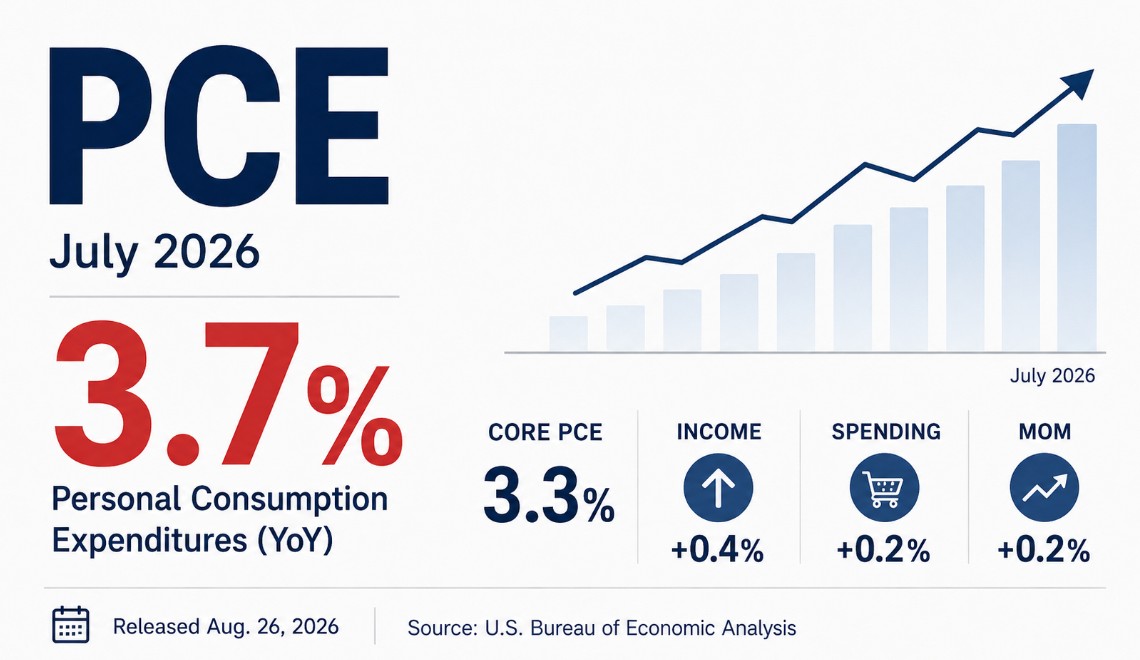
The Federal Reserve’s preferred inflation measure gave policymakers another uncomfortable reading today. U.S. prices rose 0.2% in July under the Personal Consumption Expenditures price index, leaving the annual inflation rate at 3.7%.
The July PCE report, released August 26 by the U.S. Bureau of Economic Analysis, was firmer than economists expected. Headline inflation had been expected to increase about 0.1% during the month and ease slightly on an annual basis. Instead, the yearly rate remained exactly where it was in June.
Core PCE, which removes food and energy prices, also increased 0.2% from June. Core inflation stood at 3.3% from a year earlier. Economists had broadly expected the monthly increase, but forecasts pointed to the annual rate slipping to about 3.2%.
That did not happen.
July 2026 PCE Inflation Numbers
| Measure | July 2026 | June 2026 |
|---|---|---|
| PCE price index, monthly | +0.2% | -0.1% |
| PCE price index, annual | +3.7% | +3.7% |
| Core PCE, monthly | +0.2% | +0.1% |
| Core PCE, annual | +3.3% | +3.3% |
| Personal income, monthly | +0.4% | +0.2% |
| Personal spending, monthly | +0.2% | +0.3% |
The biggest change from June is visible in the monthly headline figure. PCE prices fell 0.1% in June as energy prices dropped. July reversed that decline with a 0.2% increase.
Core inflation also accelerated from a 0.1% monthly increase in June to 0.2% in July.
Core PCE Refused to Fall Below 3.3%
Core PCE is the part of Wednesday’s report that deserves the most attention.
The annual rate remained at 3.3%, the same level recorded in June. That leaves underlying inflation well above the Federal Reserve’s 2% goal and removes some of the reassurance provided by softer price readings earlier in the summer.
Our previous PCE report showed core inflation at 3.4% in May. It fell only one tenth of a percentage point in June and then stopped falling in July.
The recent path now looks like this:
| Month | Headline PCE | Core PCE |
|---|---|---|
| April 2026 | 3.8% | 3.3% |
| May 2026 | 4.1% | 3.4% |
| June 2026 | 3.7% | 3.3% |
| July 2026 | 3.7% | 3.3% |
Inflation has come down from the sharp May increase, but the underlying rate has barely moved for several months.
Why the PCE Report Matters More to the Federal Reserve
PCE and the Consumer Price Index both measure changes in consumer prices, but they use different data and different weighting methods.
The Bureau of Economic Analysis describes the PCE price index as a measure of changes in prices paid for goods and services purchased by people in the United States or on their behalf.
The Federal Reserve uses PCE inflation when referring to its 2% longer-run inflation goal. Core PCE receives additional attention because removing food and energy gives policymakers another view of underlying price pressure.
July’s result therefore carries more weight than simply showing another month of higher prices. A 3.3% core rate remains a considerable distance from 2%.
July Looks Very Different From the June Inflation Report
June had provided a much cleaner inflation story.
Headline PCE fell 0.1% during that month as lower energy prices pulled the overall index down. The annual rate also dropped from 4.1% in May to 3.7%.
The Consumer Price Index told a similar story. As we reported after the June 2026 CPI release, CPI fell 0.4% during the month, its largest monthly decline since April 2020.
July has interrupted that pattern. Headline PCE returned to monthly growth and core PCE accelerated slightly on a monthly basis.
The result does not represent another sudden inflation surge like the one recorded earlier in 2026. It does show that the move toward lower inflation has stalled.
Americans Kept Spending as Income Grew Faster
The PCE report contains much more than an inflation number.
Personal income increased 0.4% in July, according to data reported after the BEA release. Consumer spending increased 0.2%.
That combination is important because income grew twice as quickly as nominal spending during the month.
June had looked different. Personal income increased 0.2% and personal consumption expenditures increased 0.3%, according to the BEA’s June Personal Income and Outlays report.
Consumer spending therefore continued to grow in July, but at a slower rate than in June. Household income accelerated at the same time.
The Fed Now Has Sticky Inflation and a Weaker Job Market
The Federal Reserve’s problem is becoming easier to see when the inflation and employment reports are placed next to each other.
Inflation remains too high, but the labor market has weakened.
The July 2026 jobs report showed that U.S. payroll employment fell by 23,000 jobs. The unemployment rate stood at 4.1%.
Higher interest rates can put additional pressure on employment and economic activity. Lower rates can support borrowing and demand, but cutting rates becomes harder to justify when the Fed’s preferred core inflation measure remains at 3.3%.
July’s PCE reading therefore does little to settle the debate.
A clear drop in core inflation would have strengthened the argument that price pressure was moving steadily toward the Fed’s target. Instead, core PCE remained unchanged from a year earlier and headline inflation stayed at 3.7%.
Inflation Is Still Well Above the Fed’s 2% Goal
The distance from the Federal Reserve’s target remains substantial.
Headline PCE at 3.7% is 1.7 percentage points above 2%. Core PCE at 3.3% is 1.3 percentage points above it.
The broader U.S. inflation picture in 2026 has already been unusually volatile. Energy prices pushed inflation sharply higher during the spring before falling prices provided relief in June.
July now offers a better test of the underlying trend because core prices also increased.
One monthly increase does not determine the direction of inflation by itself. The problem for policymakers is the lack of meaningful progress in the annual core figure. Core PCE was 3.3% in April, 3.4% in May, 3.3% in June and 3.3% again in July.
Four months of data have produced almost no net improvement.
Bottom Line
The next Personal Income and Outlays report is scheduled for September 30 and will cover August 2026.
Before then, policymakers and investors will receive another round of employment and consumer price data. Those reports will show whether July’s firm PCE reading was temporary or part of a longer period of stubborn inflation.
For households, this report carries a simple message. Prices are still rising considerably faster than the Federal Reserve wants, and the rapid improvement seen in some June inflation figures did not continue into July.
Headline PCE inflation remains at 3.7%. Core inflation remains at 3.3%. Until those numbers begin moving lower again, the claim that U.S. inflation is steadily returning to 2% remains difficult to make.
Related Posts:
- Core Inflation Hit 3.4% In May, According To New PCE Report
- 72.2 Million Americans Expected To Travel For July…
- 2027 Social Security COLA Projection - Why The Next…
- Nearly 2 in 3 Women Over 50 Are Struggling Mentally,…
- US Inflation Fell 0.4% in June as Gas Prices Tumbled…
- The Final July Social Security Payment Arrives July…