


Casino players who win $2,000 on a slot machine in 2026 are subject to a different federal reporting threshold than players who won the same amount in previous years. Starting in 2027, the IRS will begin adjusting that $2,000 threshold for inflation, ending the long-standing practice of keeping several gambling reporting limits fixed for decades.
The change follows legislation enacted on July 4, 2025, which raised the federal information reporting threshold for certain gambling winnings to $2,000 beginning January 1, 2026. The law also requires annual inflation adjustments for calendar years after 2026.
The IRS instructions for Form W-2G confirm the new $2,000 reporting threshold and explain that future amounts will be adjusted for inflation. The exact 2027 threshold has not yet been confirmed in the official guidance reviewed for this article.
For gamblers, a higher reporting limit means some winnings will no longer automatically trigger a Form W-2G. It does not mean winnings below the threshold become tax-free.
Why the IRS Raised the Gambling Reporting Threshold to $2,000
View this post on Instagram
For years, casinos were required to report slot machine and bingo winnings of $1,200 or more on Form W-2G. Keno winnings had a separate $1,500 threshold after subtracting the cost of the winning wager.
Those amounts remained unchanged even as inflation reduced the purchasing power of the dollar. A $1,200 jackpot that represented a substantial payout decades ago eventually became a more common reporting event at modern casinos.
Federal legislation changed the reporting rules. Section 70433 of Public Law 119-21 increased the underlying reporting threshold to $2,000 for qualifying payments made after December 31, 2025.
The IRS regulatory proposal published in May 2026 explains how the legislation affects gambling winnings and proposes corresponding changes to regulations governing slot machines, bingo and keno.
The statutory increase took effect in 2026. The regulatory amendments described in the proposal should not be confused with a separate legislative change or treated as finalized solely because they were published.
How the Reporting Threshold Changes in 2027
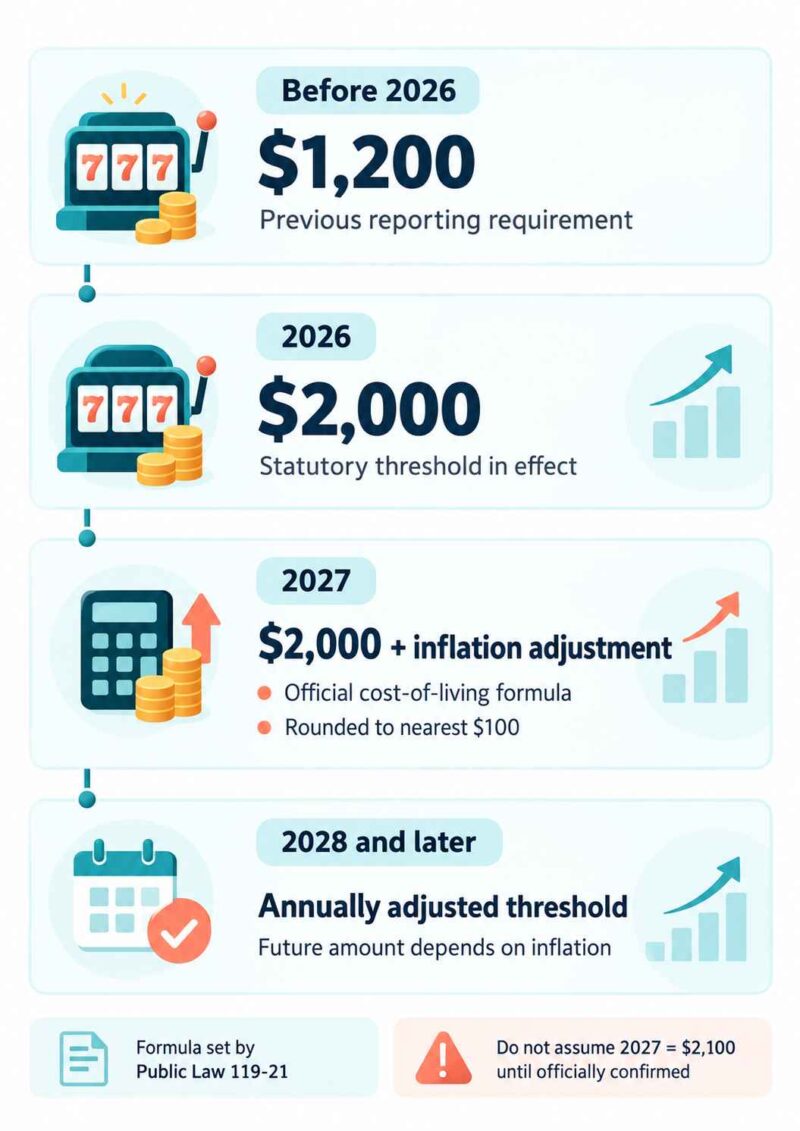
The $2,000 threshold is the starting point for future adjustments. From January 1, 2027, the law provides for an annual increase based on a specified federal cost-of-living calculation.
Under the statutory formula, the inflation adjustment is rounded to the nearest $100. The actual amount therefore depends on the inflation calculation established by law, rather than a fixed annual increase chosen by the IRS.
| Period | Slot Machine Reporting Threshold | Status |
| Before 2026 | $1,200 | Previous reporting requirement |
| 2026 | $2,000 | Statutory threshold in effect |
| 2027 | $2,000 base plus applicable inflation adjustment | Subject to the official inflation calculation |
| 2028 and later | Annually adjusted threshold | Future amounts depend on inflation |
Congress established the adjustment formula through Public Law 119-21. The same legislation also changed information reporting rules for several other types of payments.
Players should not assume that the 2027 threshold will be $2,100 or another specific figure until the applicable amount is confirmed. The statutory formula and rounding rules determine the result.
Which Gambling Winnings Are Covered by the New Rules?
The $2,000 threshold does not apply identically to every gambling activity. Federal reporting requirements depend on the game, the amount won and, for certain wagers, the relationship between the payout and the original stake.
Under the 2026 reporting framework, the main categories include the following.
| Gambling Activity | Reporting Rule |
| Slot machines | Winnings reaching the applicable reporting threshold |
| Bingo | Winnings reaching the applicable reporting threshold |
| Keno | Winnings reaching the threshold after deducting the cost of the winning game |
| Sports betting | Applicable reporting threshold and winnings of at least 300 times the wager |
| Horse racing and certain other wagers | Applicable reporting threshold and qualifying payout-to-wager ratio |
| Lotteries and wagering pools | Applicable threshold and additional reporting conditions |
| Poker tournaments | Separate tournament reporting rules |
For example, a $2,000 slot machine win in 2026 reaches the applicable reporting threshold. A sports bet paying $2,000 does not necessarily result in the same reporting treatment because the 300-times-the-wager requirement also applies.
The Form W-2G reporting requirements identify the type of gambling, winnings and applicable payout ratio as factors that determine when a payer must report a transaction.
A higher general threshold therefore should not be interpreted as a universal exemption for every gambling payout below $2,000.
Will Casino Players Receive Fewer W-2G Forms?
For slot machine players, the increased threshold removes the previous reporting requirement for individual wins between $1,200 and $1,999.99 that would otherwise have triggered Form W-2G under the former rule.
Consider a player who receives a $1,500 slot jackpot. Before 2026, the payout reached the reporting threshold. Under the 2026 threshold, that individual win falls below $2,000 and does not trigger the same reporting requirement solely because of its size.
Casinos may therefore issue fewer W-2G forms for payouts in that range. The actual reduction will depend on how many qualifying wins occur and the types of games offered.
The change also affects casino procedures. A reportable jackpot may require the gaming establishment to collect identification information and prepare tax documentation. Raising the threshold reduces the number of smaller payouts that cross the reporting limit.
Still, casinos must follow other applicable reporting and withholding requirements. A higher threshold does not eliminate documentation for larger wins.
Online Gambling and Sweepstakes Prizes Need Separate Attention

Digital gaming has introduced more ways for Americans to receive prizes, including regulated sportsbooks, online casinos and promotional sweepstakes platforms. The tax treatment of a payout depends on the actual transaction and its legal classification, not simply on the appearance of the game.
How Realprize works, and other online platforms, is that they offer promotional social slots casino and sweepstakes-style games with prize redemption rules, thus making it important to distinguish promotional prizes from conventional casino winnings when reviewing reporting obligations.
For example, a platform that distributes sweepstakes prizes may have reporting responsibilities that depend on the structure of its promotions and the applicable federal tax provisions. Its internal prize redemption minimum is not the same as the federal reporting threshold.
Players should retain records of cash prizes, noncash prizes and any relevant payment documentation. An online platform describing its games as promotional entertainment does not, by itself, establish that every prize is exempt from federal income tax.
State gaming laws also remain separate from federal tax rules. The federal reporting change does not authorize gambling or sweepstakes activities in states where particular services are restricted.
A Higher Reporting Threshold Does Not Make Gambling Winnings Tax-Free
One of the most important consequences of the new law is also one of the easiest to misunderstand. The reporting threshold determines when a payer must provide certain tax information. It does not establish the minimum amount of gambling income that an individual must report.
A player who wins $800 at a slot machine may not receive Form W-2G for that payout. The winnings can still constitute taxable income.
Under IRS Topic 419 on gambling income and losses, taxpayers generally must report gambling winnings even when no Form W-2G is issued. Winnings can include lottery prizes, casino payouts, sports betting income and the fair market value of noncash prizes.
For example, receiving three separate gambling payouts of $900 does not automatically make the resulting $2,700 exempt from federal tax simply because none of the individual payments generated a reporting form.
The taxpayer remains responsible for reporting taxable winnings according to the applicable rules.
The reporting change also does not mean casinos must withhold federal income tax from every payout of $2,000 or more. Regular gambling withholding follows separate rules and generally applies to certain qualifying winnings exceeding $5,000 after subtracting the wager.

The 2026 Gambling Loss Deduction Change Creates Another Tax Concern
The reporting threshold increase arrives alongside a separate change that can affect gamblers who deduct losses.
Beginning with the 2026 tax year, federal law generally limits the itemized deduction for gambling losses to 90% of those losses, with the deduction also limited by reported gambling winnings.
The IRS Publication 505 for 2026 explains the new limitation, which applies to taxpayers claiming qualifying gambling losses as itemized deductions.
Consider a simplified example involving $10,000 in gambling winnings and $10,000 in gambling losses during the year.
| Item | Under Previous Rules | Under 2026 Rules |
| Gambling winnings | $10,000 | $10,000 |
| Gambling losses | $10,000 | $10,000 |
| Maximum loss deduction under the stated assumptions | $10,000 | $9,000 |
| Winnings remaining after the gambling loss deduction | $0 | $1,000 |
The example assumes that the taxpayer qualifies to itemize deductions and that no other limitation changes the calculation. The $1,000 represents the difference between reported winnings and the allowable gambling loss deduction, not the final federal tax bill.
A taxpayer can therefore finish the year without a net gambling profit and still have gambling income that is not fully offset by deductible losses.
The 90% limitation is separate from the inflation adjustment to the reporting threshold. Raising the W-2G threshold does not reverse or reduce the new deduction restriction.
What Gambling Records Should Players Keep for 2027?

As reporting thresholds rise, some players will receive fewer information forms for individual payouts. Personal records remain necessary because taxable winnings do not disappear when a payer is not required to issue a form.
The IRS advises gamblers to keep an accurate record of wins and losses, supported by available documentation.
- Dates and locations of gambling activity
- Type of game or wager
- Amounts wagered and won
- Tickets and relevant payout receipts
- Casino or sportsbook transaction statements
- Forms W-2G received from payers
- Documentation supporting gambling losses
- Records showing the value of noncash prizes
Digital transaction histories can help, but players should preserve records before a platform removes older statements or limits access to historical activity.
Taxpayers should also be cautious about unexpected messages claiming that gambling winnings require immediate tax payments through an unfamiliar website. Fraudsters have used impersonation of federal agencies to collect money and personal information. Similar techniques appear in fake IRS messages and government payment scams.
The Bottom Line
The IRS has already established that the $2,000 reporting threshold applies in 2026 and that annual inflation indexing begins in 2027. The precise adjusted amount must follow the statutory calculation and applicable official guidance.
Once the 2027 threshold is confirmed, casinos, sportsbooks and other affected payers will need to apply the new amount to qualifying transactions under the reporting rules for their activities.
For players, the main changes are straightforward. More payouts may fall below the threshold for automatic information reporting, but all taxable winnings remain subject to federal income reporting requirements. Separate withholding rules and the new gambling loss deduction limitation also continue to apply.
The effect of the adjustment will become clearer when the IRS confirms the applicable 2027 dollar amount and gaming operators begin applying it to payouts made during the new calendar year.