

The maximum HSA contribution for 2027 is $4,500 for self-only coverage and $9,000 for family coverage, according to IRS Revenue Procedure 2026-24.
Eligible account holders who are 55 or older can add a $1,000 catch-up contribution. That brings the 2027 maximum to $5,500 for self-only coverage with catch-up, $10,000 for family coverage with one eligible catch-up, and $11,000 for family coverage when both spouses qualify and each uses a separate HSA for the catch-up amount.
Out team at NCH Stats has covered the broader cost picture in its report on U.S. healthcare spending by state, and the same pressure explains why HSA limits matter for workers, families, self-employed people and anyone choosing a high-deductible plan.
What is the Maximum HSA Contribution for 2027?
Coverage Or Situation
Maximum 2027 HSA Contribution
How The Limit Works
Self-only coverage
$4,500
Maximum annual HSA contribution for eligible self-only coverage
Family coverage
$9,000
Maximum annual HSA contribution for eligible family coverage
Age 55+ catch-up
$1,000
Additional contribution for an eligible account holder age 55 or older
Self-only coverage with catch-up
$5,500
$4,500 self-only limit plus $1,000 catch-up
Family coverage with one catch-up
$10,000
$9,000 family limit plus one $1,000 catch-up
Family coverage with two spouse catch-ups
$11,000
$9,000 family limit plus two separate $1,000 catch-ups
The contribution cap includes money from every source. Employee payroll deductions, direct deposits, employer seed money, employer wellness incentives and third-party deposits all count toward the same IRS annual limit.
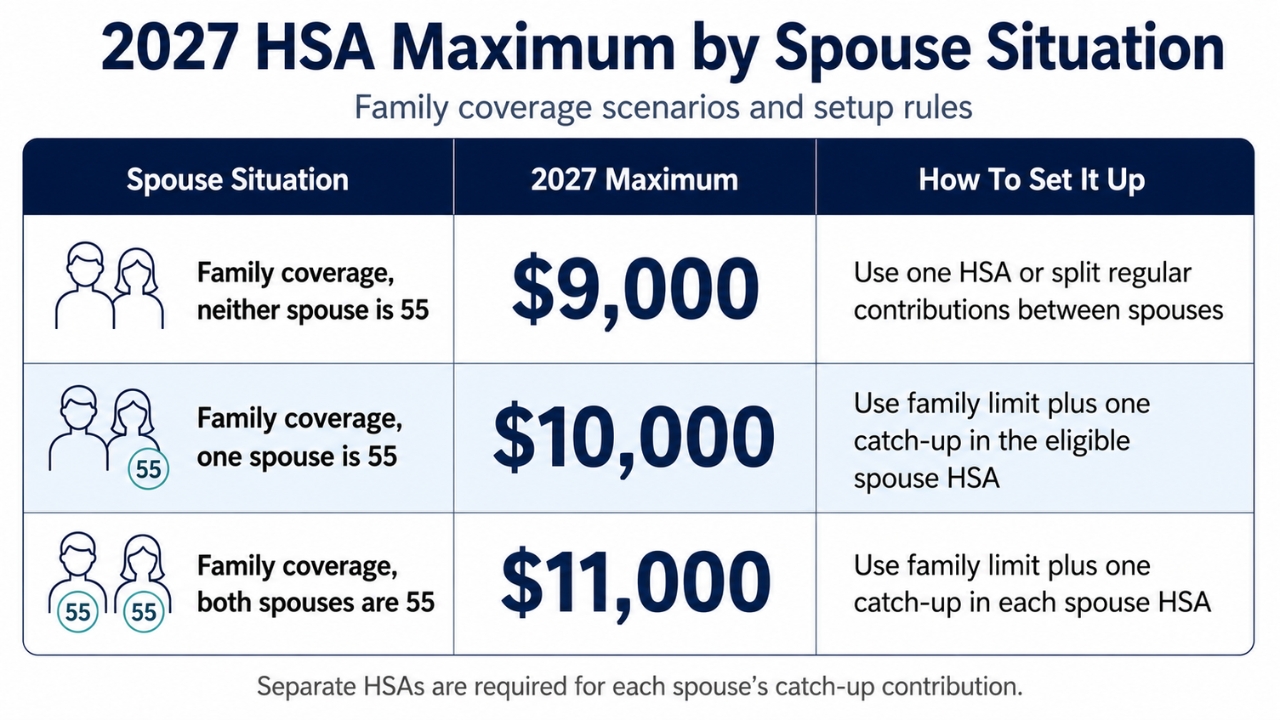
The catch-up contribution is tied to the individual account holder. A married couple with family coverage shares the $9,000 family limit. If both spouses are 55 or older and both remain HSA-eligible, each spouse can add $1,000, but each catch-up must go into an HSA in that spouse’s name.
Changes Compared to the Previous Year
The 2027 HSA limits are higher than the 2026 limits, and the plan-design thresholds rose as well. The increase affects payroll elections, employer plan design, open enrollment, Marketplace plan choices and tax planning.
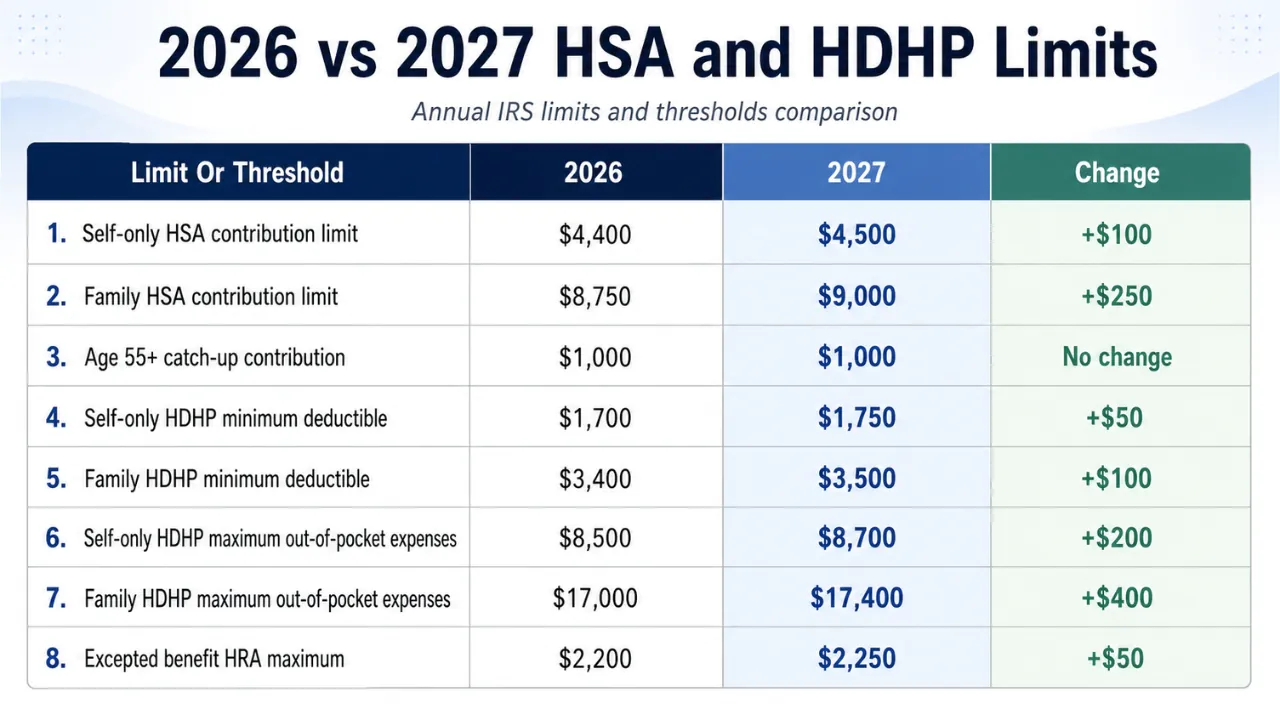
The contribution increase gives eligible households more room to set aside tax-advantaged money. The deductible and out-of-pocket increases show the other side of HSA planning: these accounts are tied to plans that can require higher cost-sharing when care is needed.
2027 HDHP Rules Behind HSA Eligibility
An HSA contribution requires eligible coverage. The account alone is not enough. A person generally needs a qualifying high-deductible health plan, no disqualifying other coverage, no Medicare enrollment, and no dependent status on another taxpayer return.
For 2027, the IRS defines a qualifying high-deductible health plan as one with a deductible of at least $1,750 for self-only coverage or $3,500 for family coverage. The plan also must keep annual out-of-pocket expenses, excluding premiums, below the IRS ceiling.
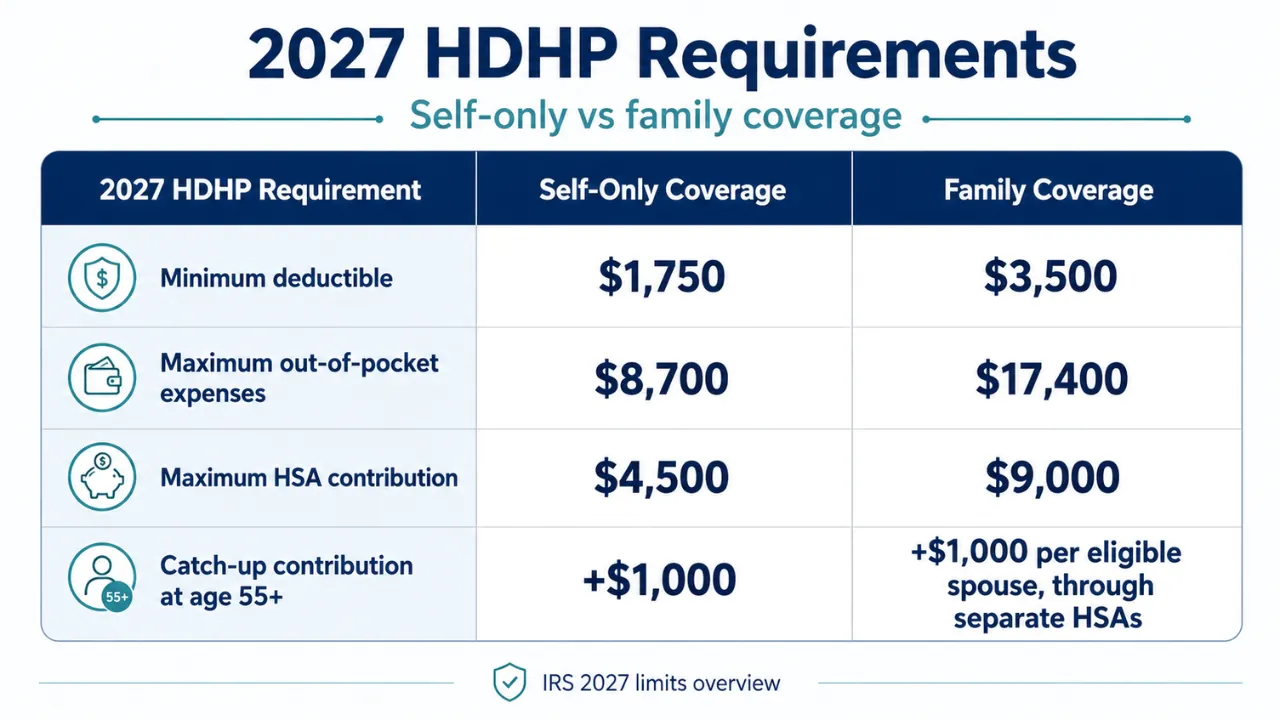
The out-of-pocket ceiling includes deductibles, copayments, and other covered cost-sharing. It does not include premiums. That means a lower monthly premium can still come with a larger bill when a surgery, hospitalization, specialist visit, or expensive prescription appears.
This is where the HSA limit connects with everyday medical spending. NCH Stats has also covered healthcare costs in the U.S., including how patient costs vary by state and why out-of-pocket expenses matter for insured households.
HSA Eligibility Is Broader Than It Used To Be
Recent federal changes make the 2027 HSA conversation different from older HSA planning. The limit increase is only one part of the story. The bigger planning issue is who can use the account.
The IRS guidance on new HSA tax benefits explains that certain Bronze and Catastrophic plans are treated as HSA-compatible. The IRS also addressed permanent telehealth relief and direct primary care arrangements.
HealthCare.gov says more Marketplace plans, including Bronze and Catastrophic plans, can work with Health Savings Accounts.
Rule Area
2027 Planning Impact
Who Should Pay Attention
Bronze plans
More Bronze coverage can pair with HSAs
Marketplace shoppers, self-employed workers, contractors and early retirees before Medicare
Catastrophic plans
More Catastrophic coverage can pair with HSAs
People eligible for Catastrophic coverage who want lower premiums and HSA access
Telehealth
Pre-deductible telehealth relief is permanent when requirements are met
Employers, workers and plan sponsors using remote care
Direct primary care
Certain arrangements no longer automatically block HSA eligibility
Patients using membership-based primary care
DPC fee thresholds
IRS Rev. Proc. 2026-24 keeps monthly aggregate DPCSA limits at $150 for one person and $300 for more than one person for 2027
Families combining direct primary care with HSA-compatible coverage
How To Calculate HSA Contribution Limit?
View this post on Instagram
The cleanest way to avoid HSA mistakes is to calculate the limit in order. Start with coverage type. Add catch-up eligibility. Subtract employer deposits. Then adjust for partial-year eligibility, Medicare, or coverage changes.
Step
Question To Ask
Why It Changes The Contribution
1
Is coverage self-only or family?
This decides whether the base limit is $4,500 or $9,000
2
Was the person HSA-eligible for the full year?
Partial-year eligibility may require proration
3
Is the account holder age 55 or older by the end of 2027?
The $1,000 catch-up may apply
4
Did an employer or another person contribute?
Those deposits count toward the same cap
5
Did Medicare enrollment begin?
Medicare generally stops new HSA contributions
6
Did family status or plan coverage change?
Switching coverage can change the allowed contribution
Contribution Examples
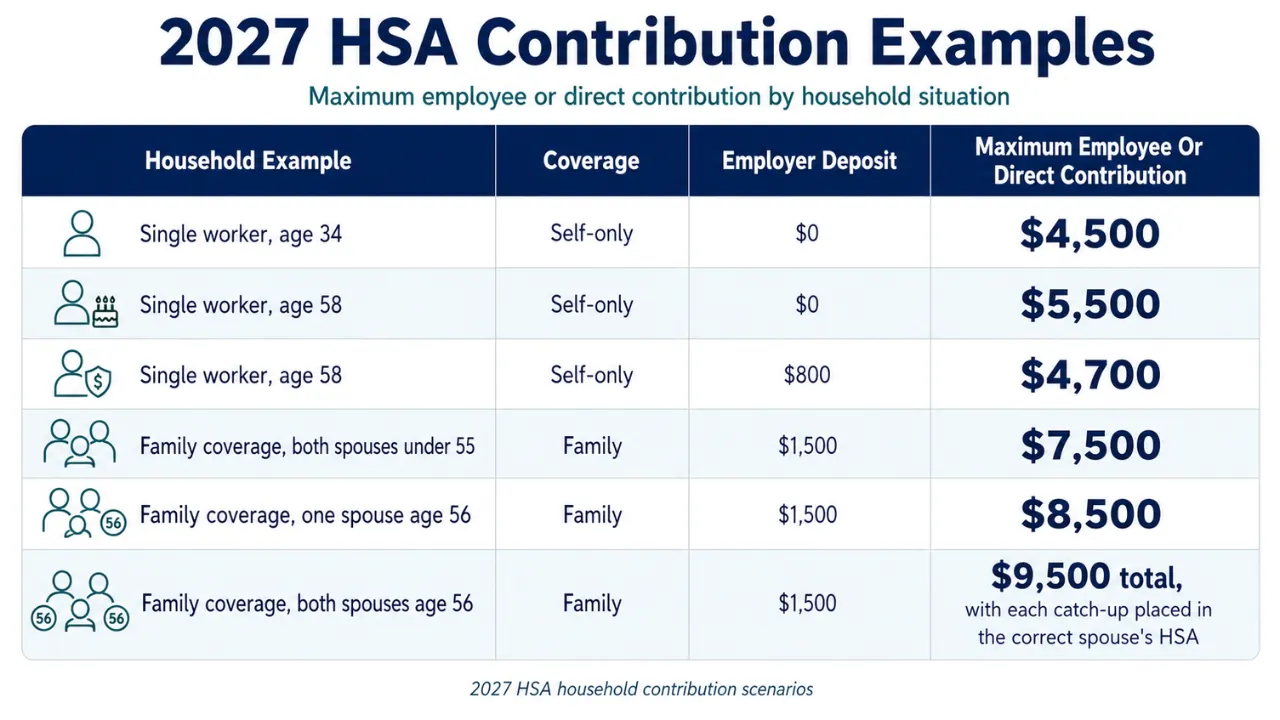
The following examples show how the 2027 maximum works in normal household situations. These examples assume full-year eligibility unless the description says otherwise.
Open Enrollment
The HSA limit matters after the household decides whether the plan itself fits.
Open Enrollment Question
Why It Belongs In The 2027 HSA Decision
How much is the monthly premium?
A lower premium can free cash for HSA contributions, but may come with higher cost sharing
What is the deductible?
The household may need to pay this amount before the plan covers more care
What is the out-of-pocket maximum?
This shows the worst-case in-network cost exposure, excluding premiums
Does the employer contribute to the HSA?
Employer money can make the HSA plan more attractive
Are expected prescriptions covered well?
Drug costs can change the true value of the plan
Can the household cover the deductible if care happens early in the year?
An HSA helps, but cash timing still counts
Hospital bills are one reason this calculation matters. We already explained how even insured patients can face high out-of-pocket exposure in a report about the average cost of a hospital stay in the U.S.
How Employer Contributions Change The Decision?
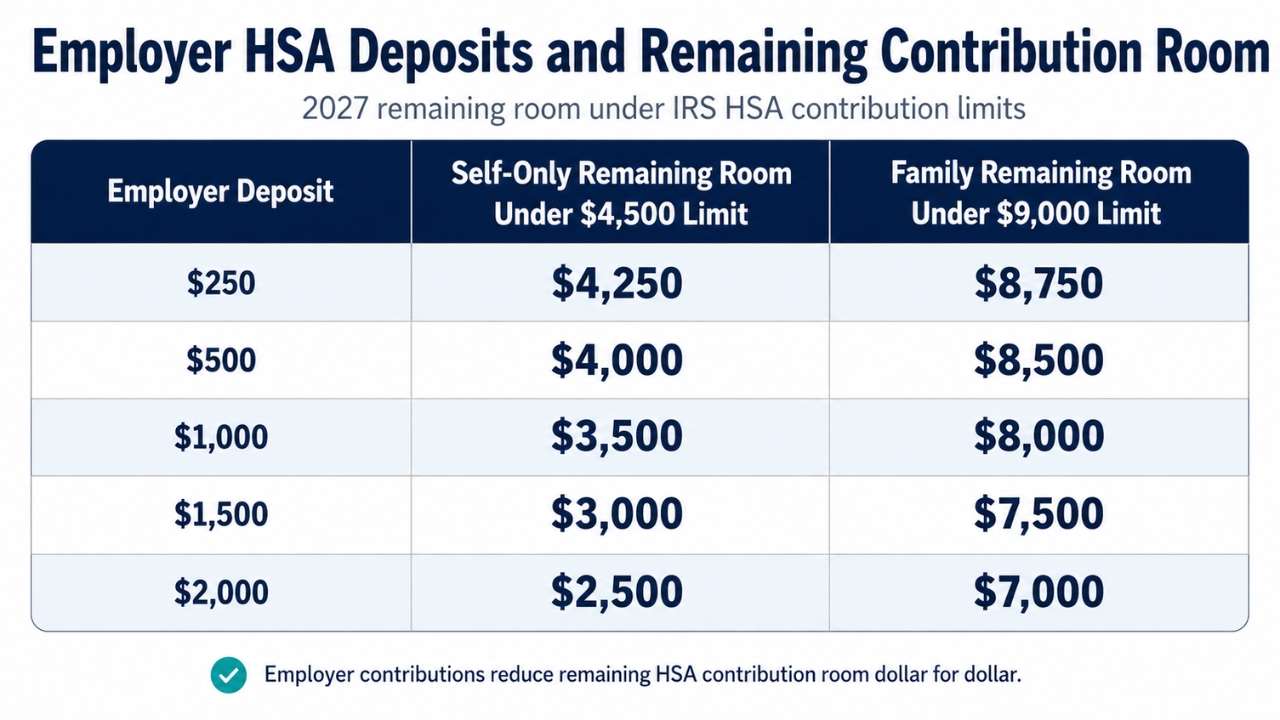
Employer HSA deposits can make a high-deductible plan more practical. They reduce the amount an employee needs to contribute from personal cash, but they also reduce the remaining room under the IRS limit.
Spouses And The $11,000 Maximum
The highest common 2027 HSA number is $11,000, but that figure only applies in a specific case: family coverage, both spouses eligible, both age 55 or older, and both catch-up contributions handled through separate HSAs.
Medicare Timing Can Reduce The 2027 Limit
Medicare enrollment generally ends the ability to make new HSA contributions. Existing HSA funds remain available for qualified medical expenses, but new deposits usually stop once Medicare coverage begins.
Medicare Situation
HSA Contribution Result
Practical Step
No Medicare enrollment and otherwise eligible
Contributions can continue
Use the normal 2027 limit calculation
Medicare starts in 2027
The contribution limit may need proration
Stop payroll deductions before the ineligible period
Medicare Part A applies retroactively
Prior contributions may need review
Check the Medicare effective date
Existing HSA after Medicare starts
Funds can still be used
Keep receipts for qualified medical expenses
Partial-Year Eligibility And The Last-Month Rule
When employees maximize their HSA contributions, they maximize the benefits. Starting in 2027, they can contribute $4,500 to your HSA for single coverage or $9,000 for family coverage! pic.twitter.com/h3IqT3uGCb
— HSA Bank (@hsabank) June 9, 2026
A person who is HSA-eligible for only part of 2027 may have a smaller contribution limit. The monthly limit is generally based on the number of eligible months.
The last-month rule can change that. A person who is HSA-eligible on December 1, 2027, may be allowed to contribute the full-year amount. The tradeoff is a testing period that generally requires continued eligibility through the end of the following year.
Coverage Timing
Possible Contribution Treatment
Main Risk
Eligible for all 12 months
Full annual limit generally applies
Low if no disqualifying coverage exists
Eligible for fewer than 12 months
Monthly proration may apply
Overfunding if the full limit is used without qualifying for the last-month rule
Eligible on December 1, 2027
Last-month rule may allow full annual limit
The testing period must be met
Loses eligibility during the testing period
An extra amount may become taxable and may face a penalty
Job changes, plan changes, or Medicare can create problems
2027 Contribution Deadline
HSA contributions for 2027 can generally be made until the federal tax filing deadline for the 2027 tax year. For most taxpayers, that means April 2028.
When The Deposit Is Made
Possible Tax Year Treatment
What To Check
Payroll contribution during 2027
Usually 2027
Check year-to-date payroll totals
Direct contribution during 2027
Usually 2027
Confirm account posting
Direct contribution before the filing deadline in 2028
Can usually be coded to 2027
Select the correct year before submitting
Deposit coded to the wrong year
May need correction
Contact the HSA custodian quickly
HSA Market Data Shows Two Different Account Users
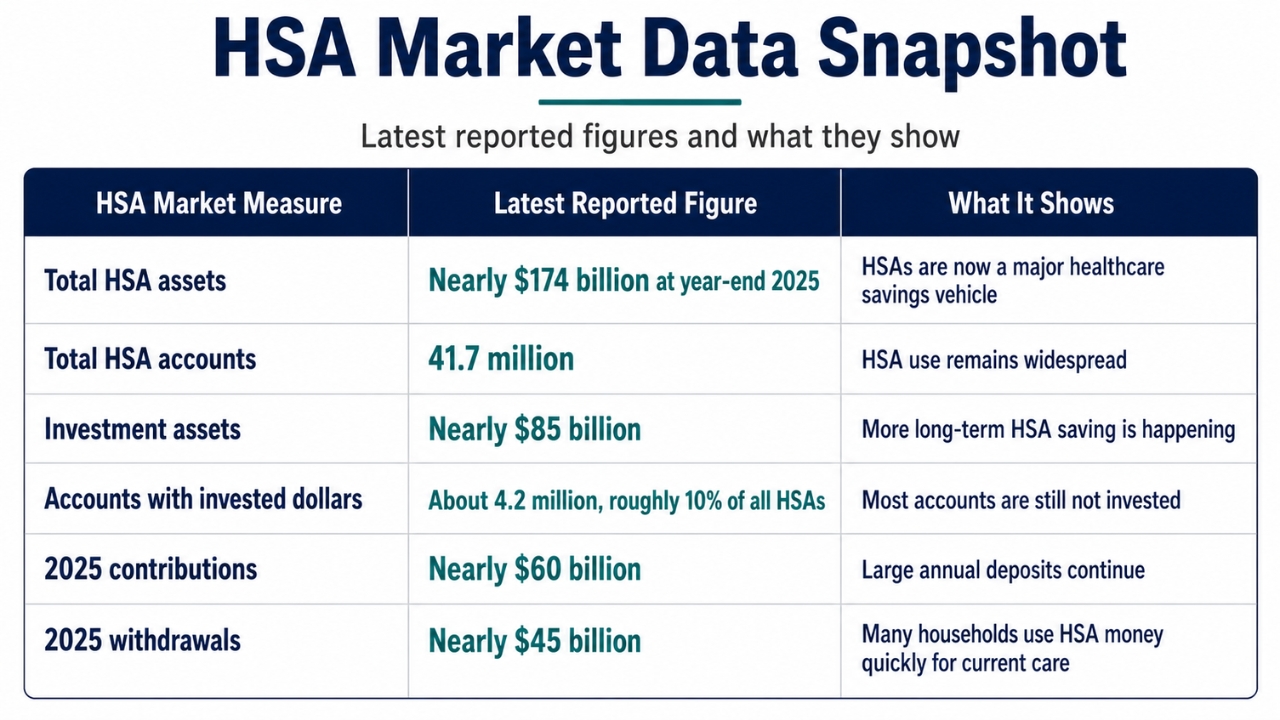
HSA planning looks different because account holders use HSAs in two very different ways. Some use the account for current bills. Others save and invest part of the balance for future healthcare costs.
Devenir reported that HSAs held nearly $174 billion in assets across 41.7 million accounts at year-end 2025. Assets rose 19% year over year. Investment assets reached nearly $85 billion, up 33%.
The Limit Is Useful But Uneven
HSAs have a rare tax structure. Contributions can reduce taxable income. Growth inside the account can avoid tax. Withdrawals for qualified medical expenses can also avoid tax.
The benefit is larger for people who can afford to contribute and leave money in the account. Households with tight monthly budgets may still benefit, but many use the HSA mostly as a pass-through account for current care.
A Government Accountability Office report described that policy concern. GAO noted that HSAs can earn interest, be invested, and be carried into retirement, while policymakers have questioned whether higher-income people gain more because they have more ability to save.
The uninsured and underinsured backdrop also matters. NCH Stats has tracked long-term coverage gaps in its report on the U.S. uninsured rate by year, and those gaps help explain why tax-advantaged medical savings remain part of the policy debate.
What Counts As A Qualified Medical Expense?

HSA funds can be used tax-free for qualified medical expenses. IRS Publication 969 explains the general HSA tax rules and account treatment.
Common HSA-Qualified Expense
Expense That Needs Caution
Deductibles
Most health insurance premiums
Copayments and coinsurance
Cosmetic care without medical need
Prescription drugs
Items reimbursed by another plan
Dental care
General wellness items without a medical purpose
Vision care
Nonmedical personal care products
Many over-the-counter medicines
Expenses outside the IRS qualified medical rules
Certain direct primary care fees are under federal rules
DPC fees above the allowed limits or outside the rules
How To Use The 2027 Limit Without Overfunding?
Many HSA errors can be avoided with a simple midyear check. The account holder should compare the IRS cap, employer deposits, payroll deductions already made, planned deposits, catch-up eligibility, and coverage changes.
Potential Mistake
Why It Happens
How To Avoid It
Ignoring employer contributions
Payroll deposits are tracked, but the employer’s seed money is forgotten
Subtract employer deposits from the annual cap
Continuing after Medicare starts
Payroll deductions keep running after eligibility ends
Stop contributions before Medicare blocks new deposits
Using two family limits
Spouses each assume family coverage gives them a full cap
Remember that the family limit is shared
Putting both catch-ups in one account
Both spouses use the same HSA
Each eligible spouse needs a separate HSA for catch-up
Missing partial-year rules
Coverage starts or ends midyear
Prorate unless the last-month rule applies and the testing period is met
Wrong contribution year
Early-year deposit is coded incorrectly
Confirm the tax year with the custodian
HSA, FSA, and HRA – Differences For the Next Year
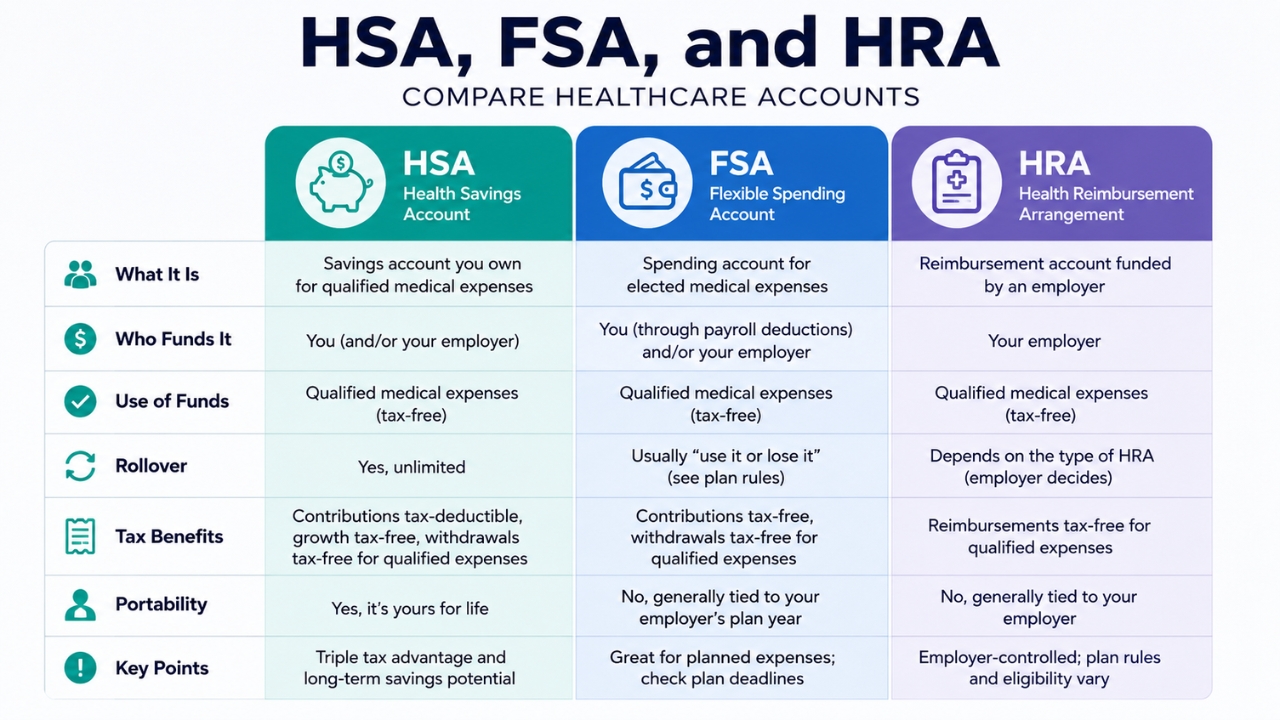
HSAs are often confused with flexible spending accounts and health reimbursement arrangements. They are not the same account.
Account Type
Who Controls It
Rollover Treatment
Main Planning Use
HSA
Individual account holder
Unused funds roll over year after year
Medical savings tied to HSA-compatible coverage
Health FSA
Employer plan
Use-it-or-lose-it rules usually apply, with limited carryover or grace-period options
Short-term medical spending through an employer benefit
HRA
Employer arrangement
Depends on employer plan design
Employer-funded medical reimbursement
Excepted benefit HRA
Employer arrangement
Depends on plan design
Limited benefits, with a 2027 maximum of $2,250
What Employers Should Update For 2027?
Employers and benefits teams need the 2027 figures for plan documents, payroll systems, open enrollment materials, and employee education.
The maximum is not automatically the right amount. The right contribution depends on medical costs, cash flow, debt, employer deposits, and how much risk the household can handle. This article uses IRS Revenue Procedure 2026-24 as the primary source for 2027 HSA contribution limits, HDHP minimum deductibles, HDHP maximum out-of-pocket amounts, direct primary care monthly fee thresholds, and the excepted benefit HRA amount. Plan-eligibility changes are based on IRS guidance on new HSA tax benefits and HealthCare.gov HSA plan information. General HSA tax rules and qualified medical expense treatment are based on IRS Publication 969. Policy background comes from the Congressional Research Service report on Health Savings Accounts and the Government Accountability Office report on HSA features and use. Market data comes from the Devenir 2025 year-end HSA research report. The maximum HSA contribution for 2027 is $4,500 for self-only coverage and $9,000 for family coverage. Eligible account holders age 55 or older can add $1,000. The largest regular household figure is $11,000, but only for family coverage when both spouses are eligible, both are at least 55, and both use separate HSAs for catch-up contributions. The 2027 limit is about more than a higher IRS number. It affects how households plan around HSA-compatible coverage, employer deposits, Medicare timing, spouse rules, Marketplace plan changes, and rising healthcare costs. Used carefully, an HSA can help with current medical bills and future healthcare savings. Used without tracking the rules, it can create avoidable tax problems.
How Much Should A Household Put In For 2027?
Household Situation
Practical 2027 HSA Approach
Employer gives HSA money
Use the employer deposit as the base, then decide how much more to add
Recurring prescriptions or appointments
Fund the account for expected medical spending first
High deductible and limited cash reserve
Build an HSA cash buffer before investing
Low current medical use and stable income
Consider saving above the expected spending
Age 55 or older
Use the catch-up contribution if eligibility and cash flow allow
Medicare enrollment is approaching
Review the last eligible month before continuing payroll deposits
Methodology And Sources
Bottom Line