

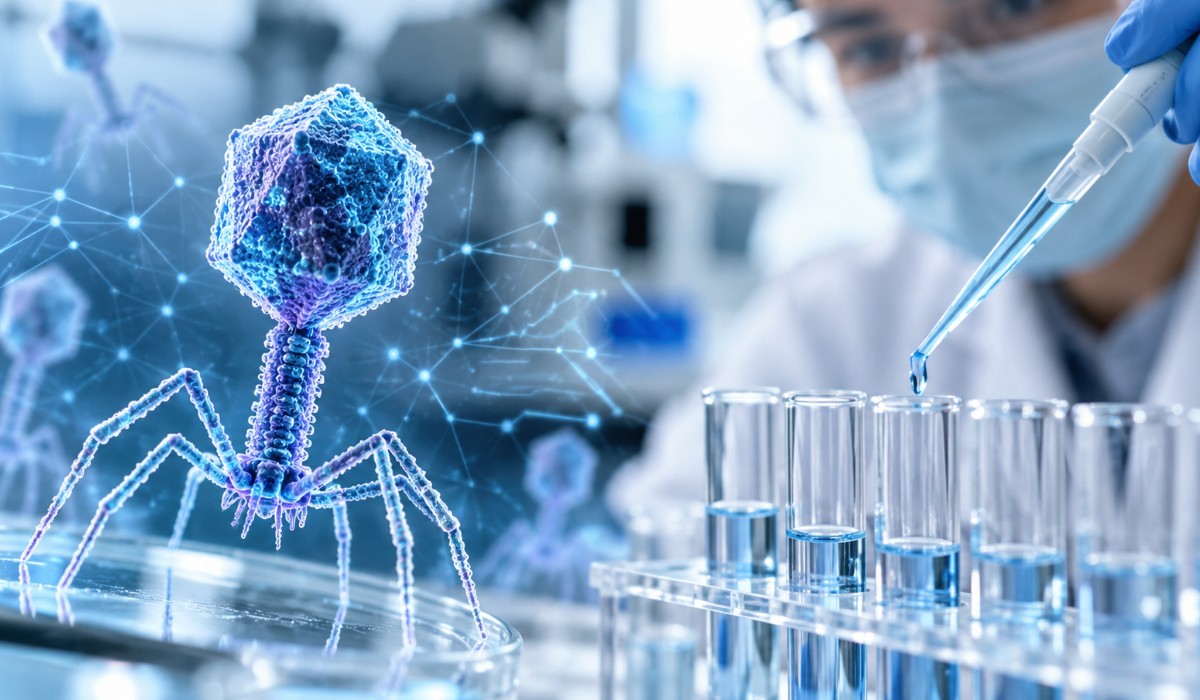
Scientists have given a human patient a virus developed with artificial intelligence for the first time, according to a biotechnology company in California. The unusual experiment was intended to fight a serious bacterial infection that had become resistant to antibiotics.
At first, giving someone a virus to treat an infection might sound dangerous. However, the virus used in this treatment was designed to attack bacteria, not human cells.
The company behind the experiment, Radical Numerics, announced the treatment on October 20, 2026. Its researchers say the AI virus successfully killed bacteria taken from the patient during laboratory testing.
Nobody outside the treatment team has been told if the patient recovered. The company has not released the medical results, citing patient privacy.
What Exactly Is the AI Virus Given to a Human?
The so-called AI virus is a bacteriophage, commonly called a phage. It is a virus that infects bacteria rather than human cells.
Phages exist naturally in water, soil and even the human digestive system. Scientists have known about them for more than a century.
Some phages can kill harmful bacteria. They attach themselves to a bacterial cell, enter it and make copies of themselves. Eventually, the bacterial cell breaks open and dies.
The World Health Organization explains that these viruses can target certain bacteria, including strains that no longer respond to antibiotics.
However, not every phage works against every bacterium. Finding one that attacks the exact bacteria causing a patient’s infection can be difficult.
How Did Scientists Create a Virus Using AI?
Researchers at Radical Numerics developed an artificial intelligence system called Omnii-1. The system was trained to recognize patterns in genetic information and help scientists design viruses that could attack particular bacteria.
Rather than inventing an entirely unfamiliar virus, the researchers used AI to suggest changes to the genetic instructions of existing phages.
Those changes can affect which bacteria a virus recognizes and how successfully it attacks them.
Scientists then produced the proposed viruses in a laboratory and tested them against bacterial samples.
That result was encouraging, but killing bacteria in a laboratory dish does not guarantee that the same treatment will work inside the human body.
Why Was Artificial Intelligence Needed?
Finding a suitable phage can take considerable time. Scientists may need to test many different viruses before identifying one that can attack a particular bacterial strain.
AI could help reduce that search by identifying promising candidates before laboratory testing begins.
Radical Numerics reported that its system identified active phages among its first two recommendations for 91.4% of eligible bacterial strains in one experiment involving previously unseen E. coli strains.
That percentage describes laboratory predictions, not successful treatment of human patients. Still, there is hope similar solutions might appear for treament of dangerous viruses, such as Nipah virus, or Hantavirus.
Why Would Doctors Inject Someone With a Virus?
Antibiotics have saved millions of lives by treating bacterial infections. Unfortunately, some bacteria have developed ways to survive medications that once killed them.
Doctors call this antibiotic resistance.
For example, an infection caused by resistant bacteria may continue even after a patient receives several different antibiotics. Treatment becomes more difficult when the available drugs stop working.
Phage therapy offers another possibility. Instead of relying entirely on antibiotics, doctors can use viruses that specifically attack the harmful bacteria.
The treatment is not entirely new. Researchers have studied phage therapy for decades, and some countries have used it to treat infections for many years.
What makes the October 2026 case unusual is that artificial intelligence helped develop the phages administered to the patient.
Could an AI Virus Be Dangerous to Humans?
Phages used in treatment are selected to attack bacteria. They do not reproduce by infecting human cells in the way that influenza or coronavirus does.
However, that does not mean every phage treatment is automatically safe.
When large numbers of bacteria are destroyed, substances released by the dying bacteria can sometimes cause inflammation. Patients may also experience unwanted reactions to experimental treatments.
Scientists need to study how different phages behave inside the body, how long they remain active and how bacteria respond over time.
Bacteria can also become resistant to phages, just as they can develop resistance to antibiotics.
The World Health Organization has called for more evidence from human studies before phage therapy can become widely available.
Why Are Scientists Interested in AI Viruses?
Antibiotic-resistant infections are becoming a serious problem worldwide.
A major study published in The Lancet estimated that nearly 40 million deaths could be directly caused by antibiotic resistance between 2025 and 2050.
Scientists are searching for new ways to fight bacteria that have stopped responding to existing medications.
AI-created phages could eventually help doctors develop treatments for particular infections rather than depending entirely on the same antibiotics used for millions of patients.
For example, doctors might collect bacteria from an infected patient, identify their genetic characteristics and use AI to help select a virus capable of attacking them.
Researchers would still need to produce the treatment, test it and confirm that it meets medical safety requirements.
Is This the Beginning of AI Virus Treatments?
The October announcement marks an early attempt to bring AI-assisted virus development into human medicine.
Researchers have already shown that artificial intelligence can help create working phages in laboratories. In 2026, scientists at Stanford University and the Arc Institute also reported producing new phages using AI.
However, the Radical Numerics case concerns a different stage of development. The company says its AI-created viruses were actually administered to a patient.
The results have not yet been independently confirmed through a peer-reviewed clinical publication.
Further research will need to establish how well these treatments work, what side effects they produce and how reliably scientists can develop them for different bacterial infections.
For now, the biggest unanswered question is also the most important one. Did the AI virus help the patient recover?
Until the medical results become available, the experiment demonstrates a new approach to developing treatments, rather than proof that AI-created viruses can cure antibiotic-resistant infections.
Related Posts:
- Scientists Just Found a Dangerous 1,000-Year Flaw in…
- Scientists Just Found a Way to Regrow Cartilage…
- Scientists Just Made Pancreatic Cancer Tumors Vanish…
- Scientists Just Reversed Vision Loss in Mice, Humans…
- A Groundbreaking Eye Treatment Just Restored Vision…
- What Is the Average Human Height, and How Has It…