
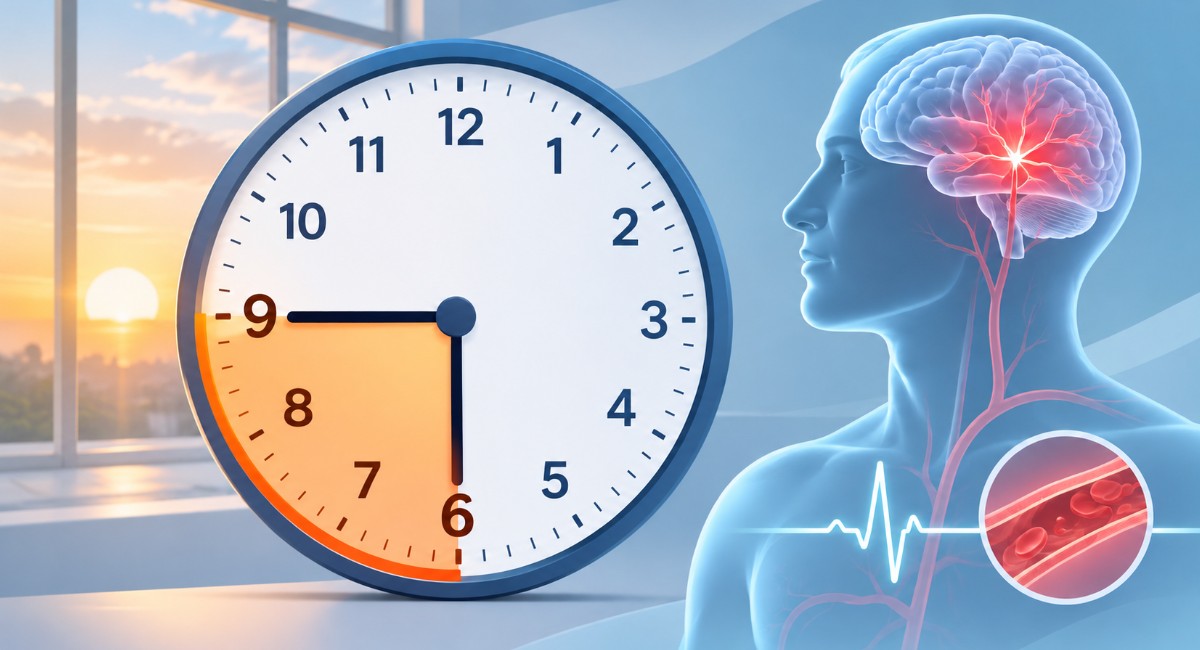
Strokes are more likely to happen in the morning, with research pointing to the hours between 6 AM and 9 AM as a time of increased risk.
Scientists believe several changes inside the body help explain the pattern. Blood pressure rises after waking, certain hormones become more active, and blood cells involved in clotting behave differently during the early morning.
Research involving thousands of stroke patients has found that strokes are not evenly distributed throughout the day. The findings do not mean someone has a high chance of suffering a stroke simply because they wake up at 7 AM. They show that the timing of stroke symptoms follows a measurable pattern.
Why Are Strokes More Common Between 6 AM and 9 AM?
One of the largest studies on the subject examined 31 earlier reports covering 11,816 stroke cases.
The analysis of stroke onset, published in the medical journal, found that strokes occurred more frequently between 6 AM and noon than during other periods of the day.
Researchers calculated that the rate was 79% higher during those six morning hours compared with the remaining 18 hours.
The increase appeared across different types of stroke, including strokes caused by blocked blood vessels and strokes caused by bleeding in the brain.
A separate review identified 6 AM to 9 AM as the period with the highest stroke occurrence. Another study involving 1,395 patients calculated a peak near 8:28 AM.
However, the exact peak varies between studies. The strongest evidence supports a general increase during the morning, rather than one precise three-hour period that applies to everyone.
Stroke Cases Are Not Evenly Distributed Throughout the Day
An earlier study involving 426 patients with ischemic stroke found a particularly strong morning pattern. More than half of the recorded strokes began between 6 AM and noon.
Share of recorded ischemic strokes among 426 patients.
| Time of Day | Share of Strokes |
|---|---|
| 12 AM to 6 AM |
15.5% |
| 6 AM to 12 PM |
56.1% |
| 12 PM to 6 PM |
20.2% |
| 6 PM to 12 AM |
8.2% |
Source: Stroke research involving 426 patients. Results describe the patients studied, not the probability of stroke for an individual.
The difference is striking. More strokes occurred during the six morning hours than during the other 18 hours combined.
However, the study involved patients treated for a particular type of stroke. Its percentages should not be treated as the exact distribution of all strokes across the United States.
Blood Pressure Rises Soon After Waking
Blood pressure normally decreases during sleep. As the body prepares to wake up, it begins rising again.
After getting out of bed, blood pressure generally increases further as the nervous system becomes more active and the body starts moving.
The change is normal, but a sharp increase can place additional pressure on blood vessels, especially in people who already have hypertension.
An American Heart Association scientific statement describes the morning blood pressure surge as a possible contributor to the increased number of strokes and heart attacks occurring after waking.
High blood pressure can damage arteries over time, making them more vulnerable to blockage or rupture. People with consistently elevated readings face a greater stroke risk than those whose blood pressure is controlled.
For context, normal blood pressure levels by age help explain how readings are classified and when hypertension becomes a concern.
Blood Clotting Also Changes in the Morning

Blood pressure is only part of the explanation.
Platelets are small blood components that help stop bleeding by forming clots. Their activity changes throughout the day under the influence of the internal body clock.
Researchers at Brigham and Women’s Hospital in Boston studied 12 healthy adults under controlled laboratory conditions. They found that several markers of platelet activation reached their highest levels around 8 AM to 9 AM.
The laboratory study on platelet activity suggested that the biological clock itself contributes to the morning change, even when researchers controlled sleeping schedules and physical activity.
Greater platelet activation may make clot formation more likely under certain conditions.
Most strokes occur when a clot blocks blood flow to part of the brain. Researchers suspect that the combination of higher blood pressure and changes in clotting helps explain the morning increase.
Heart attacks also show a morning pattern. Similar changes in circulation and clotting are relevant to the risk of heart disease, although the exact causes of each event differ.
Does Waking Up Early Increase Your Stroke Risk?
There is no evidence that waking up at 6 AM automatically makes someone more likely to suffer a stroke than waking up at 9 AM.
The research examines when strokes occur across groups of patients. It does not establish that changing a wake-up time would prevent them.
Age, high blood pressure, smoking, diabetes, heart conditions and previous strokes have a much greater influence on a person’s overall risk.
People who work night shifts also have different sleeping and waking patterns. Their biological morning may not match the clock hours used in studies involving people who sleep at night.
Researchers are still examining how sleep schedules, blood pressure changes and the internal body clock interact.
What Are the Warning Signs of a Stroke?
Someone experiencing a stroke may wake up with symptoms already present or develop them shortly after getting out of bed.
The warning signs can appear suddenly, and some are easily mistaken for ordinary morning problems such as tiredness or dizziness.
The American Stroke Association recommends remembering B.E. F.A.S.T.
- B for Balance. Sudden loss of balance, coordination or difficulty walking.
- E for Eyes. Sudden blurred vision, double vision or loss of sight.
- F for Face. One side of the face droops or becomes numb.
- A for Arms. Sudden weakness or numbness, especially on one side.
- S for Speech. Slurred speech or difficulty speaking or following a conversation.
- T for Time. Call 911 immediately if stroke symptoms appear.
A sudden severe headache without an obvious cause can also be a warning sign, particularly when accompanied by other neurological symptoms.
If someone wakes up with possible stroke symptoms, emergency medical staff need to know when that person was last known to be well. The information helps doctors determine which treatments are available.
Even symptoms that disappear after several minutes require emergency medical assessment. They may indicate a transient ischemic attack, sometimes called a mini-stroke, which can warn of a future stroke.
Is There a Way to Reduce the Risk of a Stroke?
Controlling high blood pressure is one of the most effective ways to reduce stroke risk.
People prescribed blood pressure medication should take it consistently and follow their doctor’s instructions. Changing medication timing without medical advice is not recommended.
Regular physical activity, avoiding smoking, limiting excess salt and managing diabetes or high cholesterol can also reduce the risk of stroke.
For people with hypertension, doctors may recommend home blood pressure measurements, including readings in the morning. Those readings can help identify blood pressure that remains elevated despite treatment.
The clock may help explain when strokes occur, but it does not determine who will experience one. A stroke can happen at any hour, and sudden warning signs always require immediate medical attention.