


Suicide is claiming more lives among Generation Z young adults than it did a decade ago when millennials were the same age, according to a detailed analysis of U.S. federal death statistics. The trend is particularly pronounced among Black and Hispanic men, who account for roughly 85 percent of the recent increase.
Researchers point to a complex mix of untreated depression, economic pressure, social media exposure, stigma around mental health care, and reduced access to support programs as contributing factors. However, no single explanation fully captures the surge.
Recent estimates from the NCBI suggest that U.S. suicide rates have stabilized at a concerning level, with the age-adjusted rate currently hovering between about 14.1 and 14.2 deaths per 100,000 people.
A Generational Shift in Risk
View this post on Instagram
The newest data shows suicide among adults ages 18 to 27 has risen steadily since around 2014. That period marked the transition when millennials began aging out of early adulthood, and Gen Z entered it. Despite progress in other public health areas, suicide has remained stubbornly high among young people.
Early 2025 numbers reinforce the trend. The U.S. Centers for Disease Control and Prevention recorded more than 1,100 suicides in just January and February combined among this age group, roughly matching the pace seen in 2024.
Researchers emphasize that while overall U.S. mortality from some causes has declined, youth mental health outcomes have not improved at the same rate.
Racial And Ethnic Disparities Are Growing
One of the most striking findings is how uneven the increase has been across demographic groups.
Group
Trend Since 2014
Black young men
Largest increase
Hispanic young men
Significant increase
Native American youth
The highest overall suicide rate
Asian youth
Suicide is now the leading cause of death
White youth
Slight decline in raw numbers, but rate stable
Among Hispanic young adults, suicide has surpassed homicide as the second leading cause of death. Among young Asian Americans, it has become the leading cause, overtaking accidents.
Researchers note that cultural stigma around mental health treatment, economic insecurity, discrimination experiences, and uneven healthcare access likely contribute to these disparities.
Geographic Hotspots Emerging
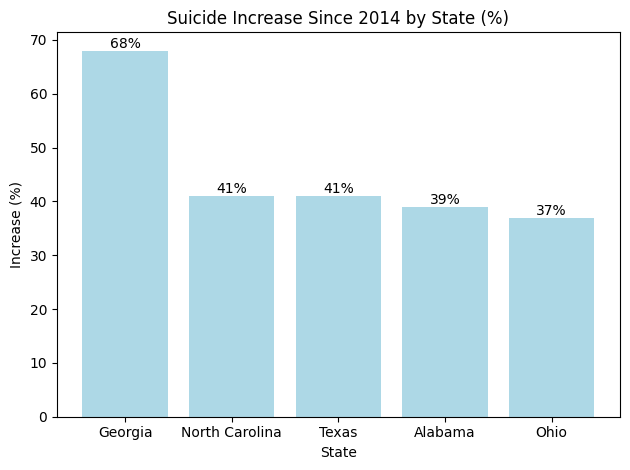
Alaska continues to have the highest overall suicide rate nationally, approaching 49 deaths per 100,000 residents, according to government sources. Meanwhile, states like New Jersey report some of the lowest rates, under 7 per 100,000.
Local initiatives are attempting targeted prevention efforts, including community outreach programs involving barbershops, churches, youth groups, and peer-led interventions.
Untreated Depression Remains Central

Mental health experts consistently highlight untreated depression as a major driver. Many young adults cycle in and out of treatment, sometimes discontinuing medication or therapy once symptoms temporarily improve.
Barriers include:
Clinicians also note that young adults often attempt to handle mental health struggles independently before seeking professional help, sometimes delaying intervention until crises escalate.
The Role Of Social Media And Digital Life
Generation Z is the first cohort to grow up fully immersed in smartphones and social media. Some researchers argue that this has fundamentally altered adolescent development.
Key concerns raised in studies include:
Factor
Potential Impact
Online bullying
Increased anxiety and depression
Constant comparison
Lower self-esteem
Reduced face-to-face interaction
Weaker social coping skills
Excessive screen time
Sleep disruption and mood effects
Psychologists emphasize that social media alone does not cause suicide but may intensify vulnerabilities, particularly when combined with economic stress or isolation.
Economic And Social Pressures Add Weight
Economic uncertainty is another frequently cited factor. Younger adults today often face:
Some researchers believe this contributes to a sense of stalled progress compared with previous generations, potentially increasing despair.
There is also evidence that workplace dissatisfaction, lack of career stability, and financial pressure linked to family responsibilities can exacerbate mental health strain among young adults.
Community-Based Prevention Efforts Expanding

Innovative prevention programs are emerging across the U.S. One example involves training barbers and community leaders in mental health first aid so they can recognize distress signs early.
Religious institutions, youth organizations, and universities are also being recruited to provide accessible support networks.
These programs aim to address the reality that many young people do not initially seek formal clinical help but may confide in trusted community members first.
Policy Changes And Funding Uncertainty
Federal funding shifts have complicated prevention efforts. Some mental health grants and targeted youth support initiatives have been reduced or reorganized in recent years, creating uncertainty for ongoing programs.
Advocates warn that:
could limit access precisely when demand for services is increasing.
No Single Cause, No Simple Solution

Researchers stress that youth suicide trends reflect a convergence of social, economic, technological, and psychological factors rather than one dominant cause.
Current evidence suggests a combination of:
Together, these factors appear to be reshaping mental health risks for the youngest adult generation.
If You Or Someone You Know Needs Help
@thedefensiveline If you need help, call 988, the Suicide and Crisis Lifeline, or text ‘HUDDLE’ to 741741 to speak with a trained crisis counselor. #dragpath #dragpathedits ♬ original sound – The Defensive Line
In the United States, the Suicide and Crisis Lifeline is available by calling or texting 988, or via online chat at 988lifeline.org. Similar services exist internationally through national health systems and crisis support organizations.
Seeking help early can significantly reduce risk and improve outcomes.