
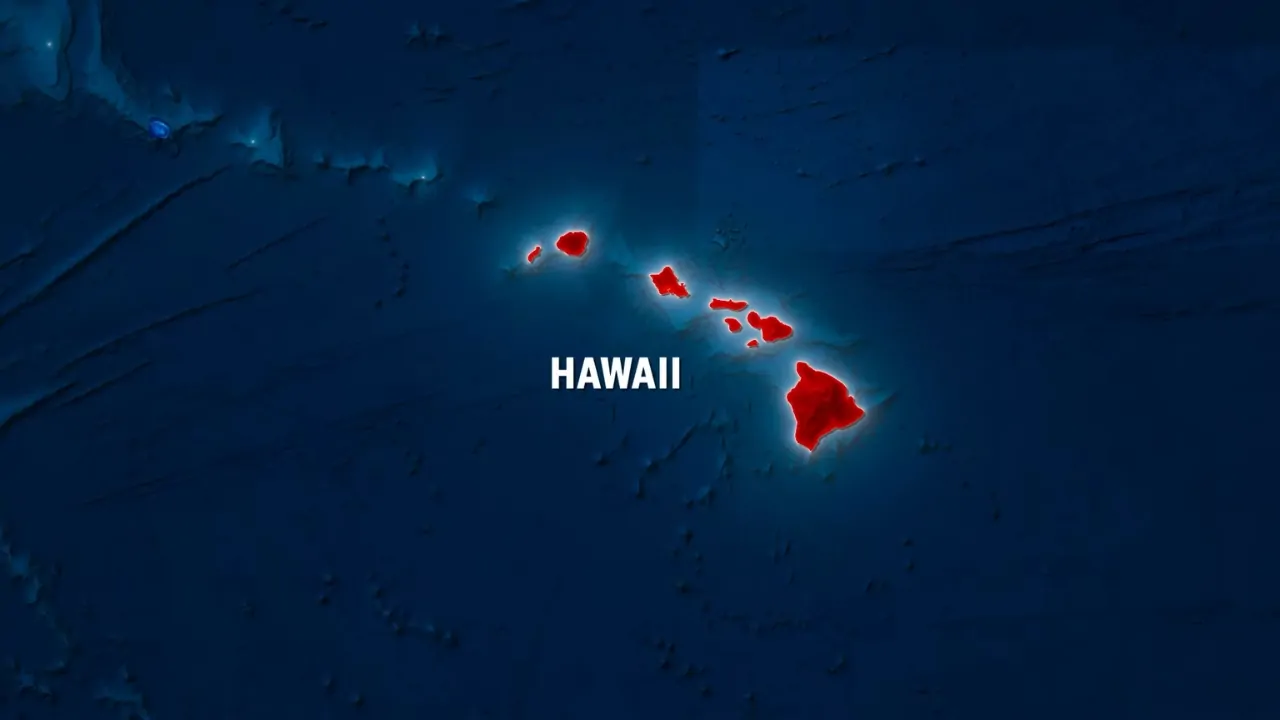
Hawaii enters 2026 with a smaller population than it had a year earlier. The latest state estimate, based on U.S. Census Bureau data, puts Hawaii at 1,432,820 residents as of July 1, 2025, down 2,132 people from 2024 and 22,447 people below the April 2020 census base.
The decline comes mainly from residents moving to other U.S. states. Hawaii still has more births than deaths, and international migration continues to add people. But those gains have not been enough to offset domestic migration losses, especially in Honolulu and Maui counties.
Latest Official Population Estimate
| Measure | Figure |
| Latest official population estimate | 1,432,820 |
| Estimate date | July 1, 2025 |
| Change from 2024 | -2,132 residents |
| Percent change from 2024 | -0.15% |
| Change from April 2020 census base | -22,447 residents |
| Percent change from April 2020 base | -1.5% |
How Much Hawaii Has Changed Since 2020?
Hawaii has remained below the 2020 census base throughout the latest estimate period. The state moved from 1,455,267 residents on April 1, 2020 to 1,432,820 residents on July 1, 2025.
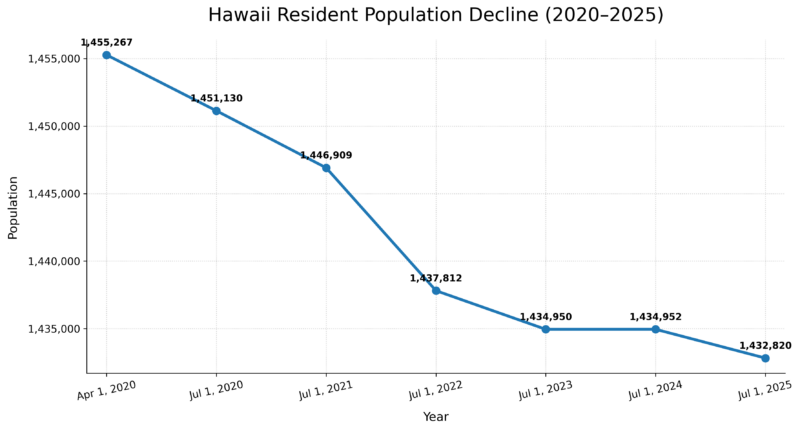
Hawaii continues to lose residents mainly because more people move to the mainland U.S. than move into the state
From July 2020 to July 2025, Hawaii recorded an average annual population decline of 0.3%. Honolulu County and Maui County declined faster, both averaging 0.5% annual losses, while Hawaii County grew by 0.9% per year and Kauai County grew by 0.1% per year.
Domestic migration is the main reason Hawaii continues to lose population. From 2020 to 2025, the state lost an average of 10,907 residents per year to the continental U.S., while gaining an average of 4,871 residents per year through international migration.
| Migration Measure | 2020 To 2025 Annual Average |
| Net international migration | +4,871 |
| Net domestic migration | -10,907 |
| Overall net migration | -6,036 |
Honolulu County recorded the largest average net migration loss from 2020 to 2025, at 6,794 people per year. Maui County followed with an average net loss of 1,054 people per year, while Kauai County averaged a net loss of 59 people per year.
Hawaii County was the only county with positive net migration, gaining an average of 1,871 people per year.
Hawaii Population By County
View this post on Instagram
Hawaii has five counties, and the population pattern is uneven. Honolulu County remains the main center, with almost seven in ten Hawaii residents.
Hawaii County is the only large county still growing, while Maui County shows the sharpest recent decline. The latest county estimates come from the U.S. Census Bureau Vintage 2025 county population release, published in March 2026.
| County | 2025 Population | Share Of State | 2024 Population | Change From 2024 | Change From April 2020 Base | Main Point |
| Honolulu County | 988,703 | 69.0% | 990,142 | -1,439 | -27,801 | The largest county is still declining |
| Hawaii County | 210,043 | 14.7% | 209,050 | +993 | +9,411 | Strongest population growth |
| Maui County | 160,592 | 11.2% | 162,238 | -1,646 | -4,164 | Sharpest recent loss |
| Kauai County | 73,400 | 5.1% | 73,440 | -40 | +105 | Mostly stable |
| Kalawao County | 82 | 0.01% | 82 | 0 | +2 | Very small population base |
| Hawaii Total | 1,432,820 | 100.0% | 1,434,952 | -2,132 | -22,447 | Statewide decline continues |
Data from the Census Bureau shows that Honolulu County had 988,703 residents in 2025, followed by Hawaii County with 210,043, Maui County with 160,592, Kauai County with 73,400, and Kalawao County with 82. The state total was 1,432,820.
Hawaii Demographics In 2026
Hawaii has one of the most unique demographic profiles in the United States.
The state is older than many fast-growing mainland states, has a large Asian population, a high share of multiracial residents, and a large foreign-born community.
Census QuickFacts lists 21.5% of Hawaii residents as age 65 or older, while 20.3% are under 18.
Age, Race, and Household Data
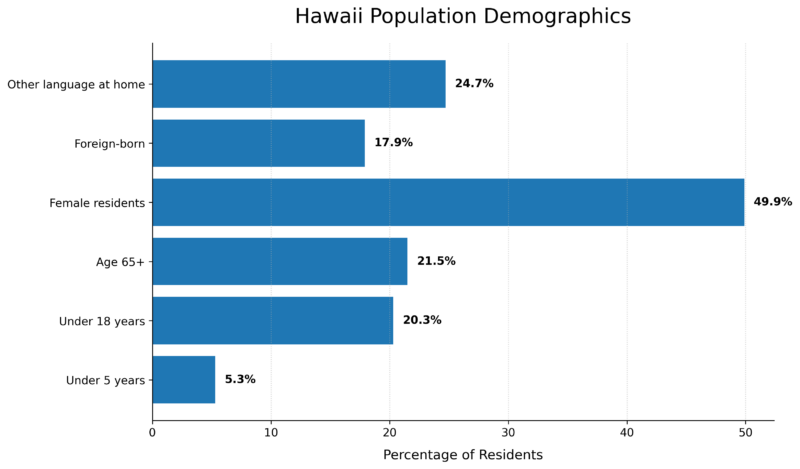
A higher senior population can place more pressure on healthcare, housing, caregiving, and local labor supply.
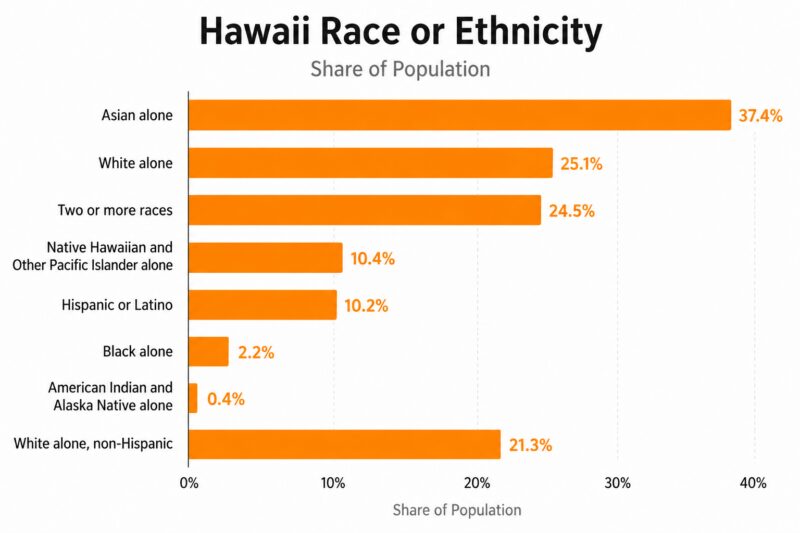
Asian residents make up the largest single-race group in Hawaii, while nearly one in four residents identify as two or more races.
Income, Housing, and Cost of Living
Hawaii has high household income on paper, but housing costs absorb a major share of local earnings. Census QuickFacts lists median household income at $100,389, per capita income at $46,005, and poverty at 10.0%.
| Measure | Latest Figure |
| Median household income | $100,389 |
| Per capita income | $46,005 |
| Poverty rate | 10.0% |
| Housing units | 572,781 |
| Owner-occupied housing rate | 63.0% |
| Median owner-occupied home value | $839,100 |
| Median monthly owner cost with mortgage | $2,904 |
| Median monthly owner cost without mortgage | $697 |
| Median gross rent | $1,971 |
| Building permits in 2024 | 3,879 |
UHERO said in its Hawaii Housing Factbook that housing affordability improved modestly in 2025, but the housing crisis remains severe.
The statewide median single-family home price was $950,000 in 2025, and buying a median single-family home still required more than 180% of the state median income, placing it within reach for only about one in five Hawaii households.
Home prices are no longer skyrocketing, but many local families still cannot afford to buy a home, according to a new report from the University of Hawaii Economic Research Organization. https://t.co/wU3BtmbT8N
— Island News (@KITV4) May 8, 2026
High housing costs also connect directly to population decline. UHERO said residents face limited options: leaving the state, accepting overcrowded or substandard housing, or falling into homelessness.
The same report links high housing costs to a shrinking labor force and weaker consumer spending because households cut back to afford rent and mortgages.
Jobs, Income, and The Local Economy
Hawaii has a tight labor market in 2026. DBEDT reported a 2.4% seasonally adjusted unemployment rate in March 2026, compared with 4.3% nationally. The state labor force stood at 687,350, with 671,150 employed residents and 16,200 unemployed residents.
| Labor Market Measure | March 2026 |
| Unemployment rate | 2.4% |
| Labor force | 687,350 |
| Employed residents | 671,150 |
| Unemployed residents | 16,200 |
| U.S. unemployment rate | 4.3% |
A low unemployment rate does not remove the population problem. Hawaii can have a strong job market and still lose residents when wages fail to match housing costs, local prices, and family expenses.
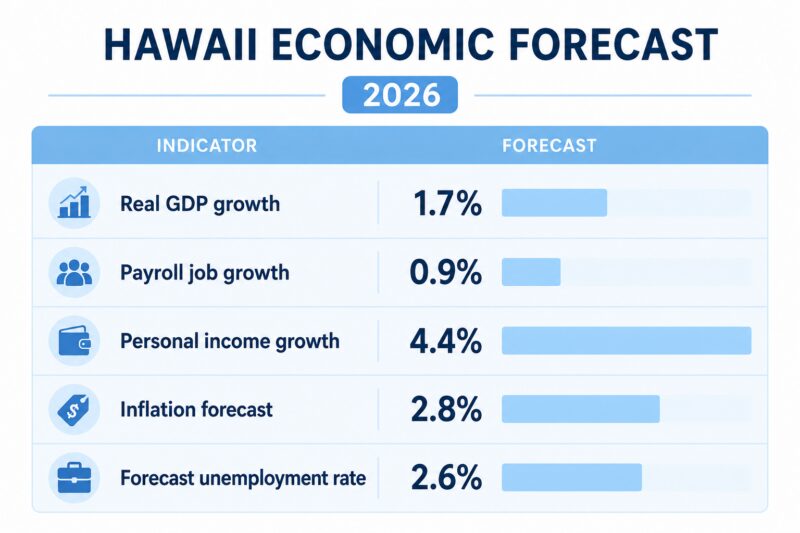
DBEDT expects the Hawaii economy to grow in 2026, but at a measured pace. The department forecasts 1.7% real GDP growth, 0.9% payroll job growth, 4.4% personal income growth, and 2.8% inflation for 2026.
Tourism and Population Pressure
Tourism remains central to the Hawaii economy, but it also adds pressure to housing, infrastructure, roads, services, and local prices.
DBEDT reported 888,349 visitors in March 2026 and $1.96 billion in visitor spending for the month. Visitor arrivals were down 1.7% from March 2025, while spending fell 1.6%.
| Tourism Measure | March 2026 |
| Visitor spending | $1.96 billion |
| Total visitors | 888,349 |
| Year-over-year visitor change | -1.7% |
| Year-over-year spending change | -1.6% |
| Average visitor stay | 8.14 days |
| Average daily visitor census | 233,203 visitors |
DBEDT said two Kona Low storm systems affected Hawaii in March 2026, causing flight delays, cancellations, closed attractions, and disrupted cruise schedules. Even with those disruptions, visitor volume remained large compared with the resident population.
FAQs
Conclusion
@geography_joe #greenscreen Re-examining #Hawaii’s population map! Hawaii, the 50th state, and the #Aloha #state, is 40th by #population with just over 1.4m residents. Over 1m of these residents live on #Oahu, home to the state #capital, #Honolulu, which is by far the largest city on the 8 islands that make up Hawaii. The #BigIsland is next, with about 200,000 people and the second-largest city, #Hilo, followed by #Maui, #Kauai, #Molokai, #Lanai, #Niihau, and #Kahoolawe (uninhabited), respectively. Weirdly, Hawaii is split up into 5 #counties, including #KalawaoCounty, perhaps the strangest county in the US, as its origins lie in it being a #quarantine colony for #leprosy. It is the smallest and second-least populous #county in the #UnitedStates, with just 82 residents. Additionally, Honolulu is the worlds most #isolated city of over 1m residents. What state should I cover next? #states #usa #us #america #unitedstatesofamerica #mahalo #populationmap #populationdensity #map #maps #geography #geographyjoe #history #education #statistics #island #islands #polynesia ♬ original sound – geography_joe
Hawaii population in 2026 is best understood as a slow decline rather than a sudden drop. The latest official estimate puts the state at 1,432,820 residents, below both the previous year and the April 2020 census base.
The state still gains people through births and international migration, but losses to other U.S. states remain large enough to pull the total population down.
References
- Hawaii State Data Center, 2025 State Population Estimates – https://census.hawaii.gov/main/2025-state-pe/
- Hawaii State Data Center, Latest Population Estimate Data – https://census.hawaii.gov/population-estimate/
- Hawaii State Data Center, 2025 County Population Estimates – https://census.hawaii.gov/main/2025-county-population-estimates/
- Hawaii State Data Center, Vintage 2025 County Population Estimates PDF – https://files.hawaii.gov/dbedt/census/popestimate/2025/county-pop/2025_county-pop-est_highlights.pdf
- U.S. Census Bureau, State Population Totals 2020 To 2025 – https://www.census.gov/data/tables/time-series/demo/popest/2020s-state-total.html
- U.S. Census Bureau, County Population Totals – https://www.census.gov/data/datasets/time-series/demo/popest/2020s-counties-total.html
- U.S. Census Bureau QuickFacts, Hawaii – https://www.census.gov/quickfacts/fact/table/HI/PST045224
- U.S. Census Bureau QuickFacts, Urban Honolulu CDP – https://www.census.gov/quickfacts/fact/table/urbanhonolulucdphawaii/PST045224
- Hawaii State Data Center, Urban Honolulu CDP Population Estimates – https://files.hawaii.gov/dbedt/census/archive/popestimate/2024_dbedt_subcounty_highlights.pdf
- U.S. Census Bureau, Population And Housing Unit Estimates Tables – https://www.census.gov/programs-surveys/popest/data/tables.html
- UHERO, Hawaii Housing Factbook 2026 – https://uhero.hawaii.edu/the-hawaii-housing-factbook-2026/
- University Of Hawaii News, Hawaii Housing Factbook 2026 – https://www.hawaii.edu/news/article.php?aId=14559
- Hawaii DBEDT, Outlook For The Economy – https://dbedt.hawaii.gov/economic/qser/outlook-economy/
- Hawaii Governor, March 2026 Unemployment Rate – https://governor.hawaii.gov/newsroom/news-release-hawaii-march-unemployment-rate-at-2-4/