

Hazel eyes are uncommon worldwide, but they are much easier to find in the United States than the familiar global estimate suggests.
Medical News Today estimates that about 5% of people worldwide have hazel eyes. That figure is best treated as a secondary global estimate rather than a census. Eye color is not recorded consistently across countries, and hazel is especially difficult to classify because it sits between brown, green and amber.
The strongest recent U.S. evidence gives us a firmer number. A 2025 study based on more than 235 million active driver license records from 31 states found that 10.3% were recorded as hazel.
An older U.S. survey produced a much higher figure. The American Academy of Ophthalmology reported that a weighted 2014 Harris Poll of more than 2,000 Americans found 18% describing their eyes as hazel. The gap between 18% and 10.3% is a useful reminder that the answer changes with the sample and with the way eye color is recorded.
How Common Hazel Eyes Are Compared With Other Eye Colors
| Eye Color | Estimated Share | What the Number Represents |
|---|---|---|
| Brown | 70% to 79% globally | Secondary worldwide estimate |
| Blue | 8% to 10% globally | Secondary worldwide estimate |
| Hazel | About 5% globally | Medical News Today worldwide estimate |
| Green | About 2% globally | Secondary worldwide estimate |
Brown remains the dominant eye color worldwide. Hazel sits in a much smaller group, but the exact share is harder to measure because researchers do not always use the same categories.
Some studies combine green and hazel into one intermediate group. Others separate hazel, green, amber and light brown. A person with a brown center and green outer iris may also describe the same eyes differently from the person entering the color on an official record.
That classification problem is one reason a global 5% estimate and a U.S. figure above 10% should not be treated as contradictory.
The Best U.S. Dataset Puts Hazel Eyes at 10.3%
The strongest recent U.S. dataset comes from the 2025 PLOS One study by Faris Hashem, Cristina Menicacci and David B. Granet. The researchers contacted driver licensing agencies in all 50 states and obtained usable iris-color data from 31 states.
The final dataset contained 235,423,085 active driver license records. Eye color was self-reported on the license records and grouped into brown or black, blue, hazel, green, gray and other.
| Eye Color | Share of Records | Number of Records |
|---|---|---|
| Brown or black | 53.0% | 124,811,254 |
| Blue | 23.7% | 55,797,458 |
| Hazel | 10.3% | 24,152,854 |
| Green | 9.0% | 21,258,873 |
| Gray | 0.7% | 1,597,675 |
| Other | 3.3% | 7,804,971 |
The underlying state data represented active licenses reported by the participating agencies and reflected records current to the state datasets collected for the study. The researchers also published a state-by-state table and U.S. maps showing the distribution of hazel, blue, green and brown or black eyes.
The study has limits. Nineteen states did not contribute usable data, and eye color came from self-report rather than a standardized clinical assessment. The authors also note that migration between states and differences in how people describe their own eyes can affect the results.
The Older 18% U.S. Figure Came From a 2014 Harris Poll
The widely repeated 18% U.S. figure is not an invented number. It came from a survey rather than a national administrative dataset.
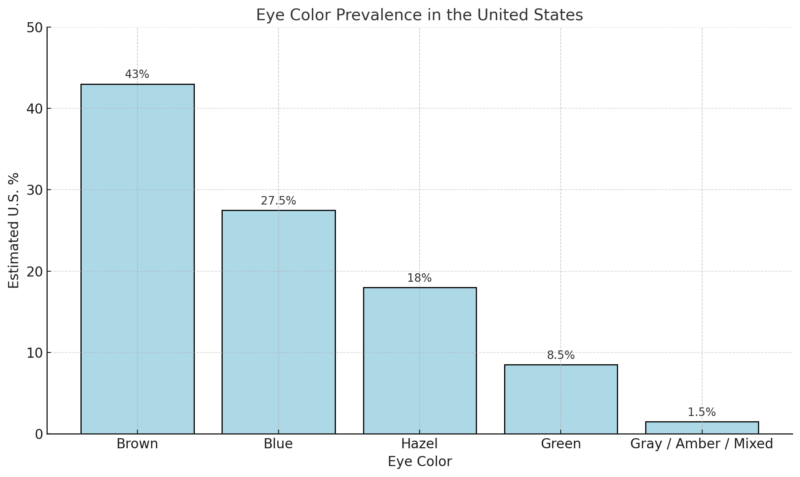
The American Academy of Ophthalmology reported results from a 2014 Harris Poll of more than 2,000 Americans, weighted to represent the U.S. population at that time. The survey found brown eyes at 45%, blue at 27%, hazel at 18%, green at 9% and other colors at 1%.
The newer 10.3% driver license figure should not be read as proof that hazel eyes suddenly became less common. The two sources measured eye color differently and sampled people differently.
A survey asks respondents how they describe their eyes. Driver license records depend on the categories available on state forms and on the color selected when the license information is recorded.
Hazel Is One of the Hardest Eye Colors to Classify
Hazel does not describe one flat shade. A hazel iris can contain brown near the pupil, green farther out and visible gold or amber tones between them.
That mixed appearance also explains why the same eyes can look different under different lighting. Changes in illumination alter how much of the iris structure and pigment contrast we see. The pigment itself is not switching from brown to green during the day.
Hazel also sits inside what genetic studies often call the intermediate eye-color category. That can combine green and hazel, or include other mixed colors, depending on the study.
A 2022 study of a Turkish population illustrates the problem. Researchers classified 149 participants as brown, blue or intermediate green or hazel. Intermediate eyes accounted for 25.5% of that study group, but the study did not provide a separate national hazel percentage.
Where Are Hazel Eyes More Common?
Regional claims need more caution than many eye-color articles give them. Reliable national hazel percentages are unavailable for much of the world, and studies frequently combine hazel with green or other intermediate colors.
| Region | What the Evidence Supports | Source |
|---|---|---|
| United States | 10.3% hazel in 235.4 million active driver license records from 31 states | PLOS One, Hashem et al., 2025 |
| Middle East | No reliable single regional hazel percentage. A Turkish sample recorded 25.5% as intermediate green or hazel. | Genes, Turkish population study, 2022 |
| Brazil and Argentina | No reliable national hazel percentage identified. Latin American pigmentation studies show substantial ancestry-related eye-color variation but do not support a single hazel estimate for both countries. | Population genetics literature |
| Western Europe | Hazel appears in European datasets, but available studies do not support one regional percentage. A four-country study recorded 14 self-reported hazel cases among 446 participants with usable single-color classifications. | PLoS Genetics European pigmentation study, 2012 |
| North Africa | No reliable regional hazel percentage identified. Reviews describe more eye-color variation in North Africa than in many populations farther south in Africa. | Human pigmentation review, 2017 |
The table deliberately avoids replacing weak evidence with polished-looking percentages. A figure such as “10% to 15% in the Middle East” sounds precise, but the available studies do not justify a regional number that broad.
Even within one country, study samples can differ sharply. An Iranian rural-population study, for example, separated dark brown, dark, light brown, green and blue rather than using a hazel category. Another Iranian study of children did record hazel separately and found 124 hazel eyes among 5,394 children, or 2.3%. Those results describe the studied populations, not the entire Middle East.
European Studies Also Show Why One Hazel Percentage Is Difficult
A study of pigmentation in samples from Ireland, Poland, Italy and Portugal recorded self-reported eye color alongside quantitative iris measurements.
Among participants who reported a single eye color, the researchers recorded 123 blue, 97 green, 14 hazel and 212 brown eyes. The study was designed to investigate genetic associations rather than estimate the population prevalence of hazel eyes across Europe.
That distinction is important. A small research sample from four countries cannot support a claim that “8% to 12% of Western Europeans have hazel eyes.” It can show that hazel appears in those populations and that eye pigmentation varies substantially across Europe.
Hazel Eye Color Comes From Several Genes, Not One Hazel Gene
Eye color does not follow a simple one-gene brown-versus-blue rule.
MedlinePlus Genetics explains that OCA2 and HERC2 on chromosome 15 have major effects on iris pigmentation. Several other genes, including SLC24A4, SLC24A5, SLC45A2, TYR, TYRP1 and IRF4, also contribute.
Those genes affect the production, transport and storage of melanin. People with darker brown eyes generally have more melanin in the front layers of the iris. Lighter and intermediate colors involve lower pigment levels and different combinations of genetic variants.
A 2022 Canadian study involving 5,641 people of European ancestry found that HERC2 and OCA2 had the largest effects on eye-color variation, but several other genomic regions also contributed. The researchers treated blue, green, hazel and brown as parts of a continuum rather than four completely separate biological boxes.
That helps explain why two people with hazel eyes can look quite different and why two hazel-eyed parents do not automatically have a hazel-eyed child.
Why Hazel Eyes Appear to Change Color
The iris contains pigment and physical structures that affect the way light is absorbed and scattered. Hazel eyes have enough variation within the iris for changes in lighting to make different areas more noticeable.
Bright daylight can make green and gold tones easier to see. Lower indoor light can make the same iris appear darker and more brown.
Pupil size can also change how much of the iris is visible and how the surrounding colors are perceived. Clothing and nearby colors can influence perception too, but they do not alter the underlying pigmentation.
We explain the same light-and-pigment mechanism in more detail in our article on why blue eyes are not produced by blue pigment.
Hazel, Green, Amber and Light Brown Are Easy to Confuse
| Eye Color | Typical Appearance | Why It Gets Confused With Hazel |
|---|---|---|
| Hazel | Mixed brown, green, gold or amber areas | The balance can shift visually with lighting |
| Green | Green is the main visible color, sometimes with brown or yellow areas | Brown near the pupil can create a hazel-like appearance |
| Amber | More even gold, copper or yellow-brown tone | Golden hazel eyes can look amber from a distance |
| Light brown | Brown remains the dominant color with less pigment than darker brown eyes | Gold tones or uneven pigmentation can make the iris look hazel |
There is no universal consumer test that can settle every borderline case. Researchers themselves use different classification systems, and forensic eye-color models have historically performed better with clearly blue or brown eyes than with intermediate colors.
The Turkish study mentioned earlier is a useful example. Its prediction system performed well for blue and brown eyes but much worse for the intermediate green-hazel category.
Hazel Eyes Are Uncommon, But More Than 5% of Americans Have Them
The best current U.S. evidence gives a clear answer for the population represented by the DMV study. Hazel accounted for 10.3% of more than 235 million active driver license records from 31 states.
The older 18% figure came from a real 2014 U.S. poll, but it used a much smaller self-reported survey. The familiar 5% figure refers to a secondary worldwide estimate and does not come from a global eye-color census.
So there is no single percentage that works everywhere. For the United States, 10.3% is the strongest large-scale estimate currently available. For the world as a whole, about 5% remains a commonly cited estimate, but the evidence is far less direct.
Methodology
We gave the most weight to sources that either measured eye color directly in a defined study population or reported very large administrative datasets.
The U.S. estimate comes from the 2025 PLOS One analysis of 235.4 million active driver license records from 31 states. We used the 2014 Harris Poll reported by the American Academy of Ophthalmology only as an older survey comparison.
For global prevalence, we identify the 5% figure as a secondary estimate from Medical News Today rather than presenting it as a measured global statistic. Regional percentages were removed where no reliable population dataset supports them.
Genetics sections rely on MedlinePlus and peer-reviewed studies of eye pigmentation. Regional research samples are described as samples rather than national prevalence estimates.
Editorial note: Prevalence figures are linked to the source that reports them. Research samples are not presented as national population estimates unless the study design supports that use.https://fitnessstatsreport.com/