


Effective July 1, 2026, Illinois immediate family members can report relatives whose cognitive decline, physical limitations, vision problems, or medical conditions may affect safe driving.
House Bill 1226, known as the Road Safety and Fairness Act, created the reporting process. Lawmakers passed it in May 2025, and Gov. JB Pritzker signed it in August 2025.
About 70% of Illinois lawmakers reportedly joined as cosponsors, and both chambers approved it unanimously.
New rules ended mandatory behind-the-wheel renewal tests for most drivers ages 79 through 86 while allowing relatives to report specific medical or functional concerns.
Before the change, Illinois was reportedly one of only five states without a family-reporting process for potentially unsafe drivers.
Who Can Report an Unsafe Driver?

Immediate family members may submit a written report asking the Illinois Secretary of State to assess a relative’s fitness to drive.
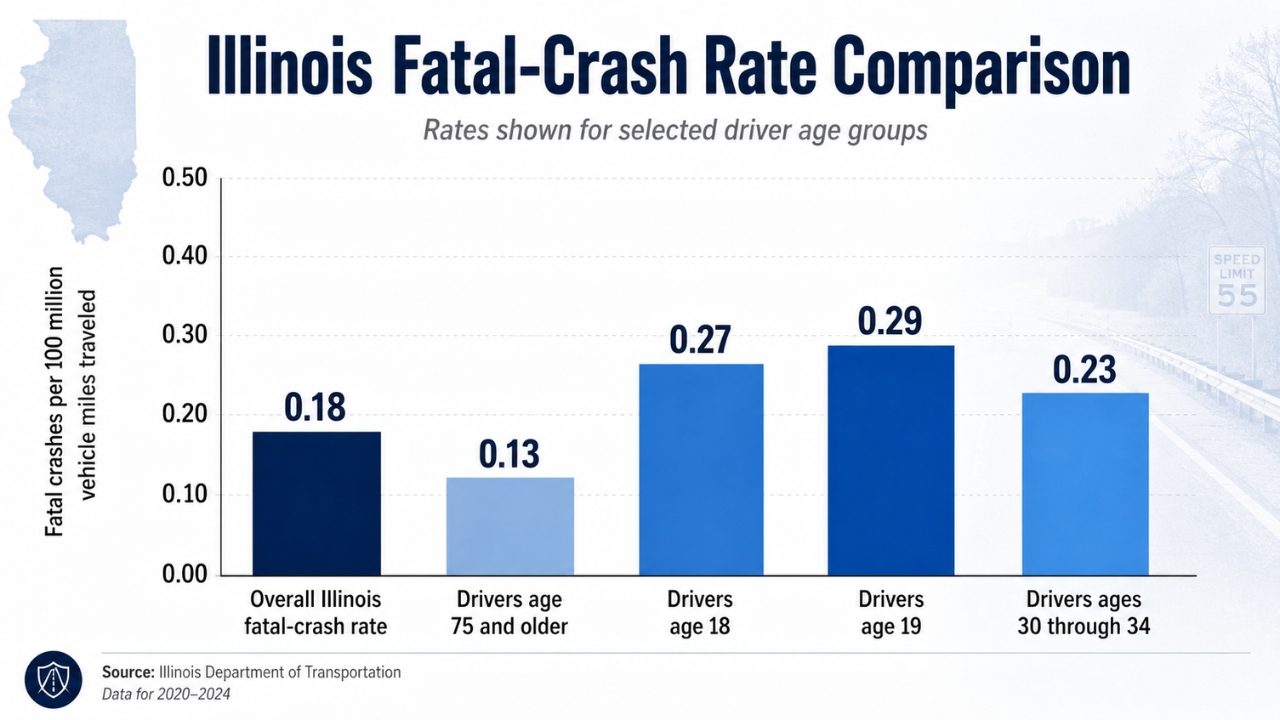
Physicians, police officers, and judges already had the authority to alert state officials about potentially unsafe motorists. Family members now join those reporting sources because relatives often notice changes in behavior, memory, coordination, vision, or physical ability before public officials become aware of a problem. Relatives do not decide if a license should be restricted, suspended, or revoked. Their role is to provide information that may justify a closer state review. Illinois Secretary of State officials then evaluate the report and determine if testing or medical documentation is needed. Reports should describe a health-related or functional concern that may prevent safe vehicle operation. A general disagreement about someone’s age, independence, or personal choices would not establish a valid driving concern on its own. Specific observations can help officials assess the seriousness of a report. Useful details might include repeated crashes, unexplained vehicle damage, getting lost on familiar roads, confusing pedals, ignoring signals, drifting between lanes, or failing to notice pedestrians and other vehicles. Serious warning signs should not be ignored, especially when unsafe driving has already caused a collision. Families dealing with injuries, insurance claims, or legal questions after an Illinois crash may also consult a car accident law firm such as Ankin Law LLC. Age alone is not intended to prove that a person is unsafe. Individual ability, health, behavior, and performance matter more under the revised system. Family reporting also supports the removal of automatic road tests for many older motorists. Without mandatory testing for every driver aged 79 through 86, reports can help identify individuals who may still need a personal examination. Submitted information should connect the concern to the driver’s medical condition, cognition, vision, physical ability, or behavior behind the wheel. Filing a report does not automatically cancel, revoke, or suspend a license. State officials first review the information and decide if enough reason exists to question the driver’s fitness. Additional documentation may be requested when a report raises a credible concern. Officials may also require examinations designed to measure vision, traffic-rule knowledge, physical control, judgment, or practical driving ability. State authorities retain responsibility for each licensing decision. Family members provide an initial warning, but they do not control the investigation or its outcome. Consistency will play an important role in the program’s effectiveness. Reports must be assessed fairly, and follow-up procedures must identify serious risks without punishing capable motorists based only on family conflict or age. Illinois Secretary of State officials can order additional examinations when available information creates a reasonable concern about a driver’s ability. Test results and medical information can help officials decide if the person can continue driving safely. A motorist who demonstrates adequate ability may keep a valid license. Licensing action may occur when a driver cannot satisfy state safety standards or provide the required medical clearance. Restrictions may also be considered in some cases instead of a complete loss of driving privileges. Depending on applicable rules and the person’s condition, restrictions could address driving times, geographic areas, corrective lenses, vehicle equipment, or other safety measures. Individual review allows capable older adults to keep driving while giving state officials a focused method for investigating genuine risks. Future state data may show how many family reports lead to testing, restrictions, suspensions, or revocations. Public reporting could also reveal if cases are handled consistently across different communities, age groups, and demographic categories. Illinois raised the age for mandatory behind-the-wheel renewal testing to 87. Motorists aged 79 through 86 no longer need to pass a road test solely because they have reached a certain age. Drivers age 79 and older must still complete a vision test. A qualifying traffic violation may also trigger a written examination or another review requirement. Motorists age 87 and older continue to face stricter rules. Mandatory in-person renewal now begins at age 75 instead of age 79. Renewal frequency for motorists ages 79 through 86 has been described differently in published accounts. One description states that people ages 81 through 86 must renew in person every two years. Another states that motorists ages 79 through 86 renew in person every four years. Current Illinois Secretary of State instructions should be checked before a driver relies on either schedule. Safety data played a major role in support for changing the testing rules. A 2023 state report found that motorists age 75 and older were involved in fewer crashes than any other age category. Illinois transportation data for 2023 also indicated that drivers aged 75 and older had lower crash rates than every group between ages 16 and 74. Reported 2024 fatal-crash figures showed a similar pattern: Such figures supported the argument that age does not automatically indicate unsafe driving. Younger categories recorded higher rates in several comparisons, while older motorists still faced mandatory testing based mainly on age. Illinois continues to impose some of the nation’s strictest renewal requirements on older drivers. Annual renewal and road testing still apply once a motorist reaches age 87, while vision testing and in-person requirements begin earlier. Starting today, Illinois no longer requires drivers ages 79-86 to take a behind-the-wheel test simply because of their age. The Road Safety & Fairness Act replaces an outdated requirement with a smarter approach that prioritizes both fairness and road safety. pic.twitter.com/3OVZK7tXa6 — Secretary Alexi Giannoulias (@ILSecOfState) July 1, 2026 Illinois no longer requires automatic road testing for most drivers ages 79 through 86. Drivers age 87 and older must still renew annually and pass vision and road tests. Spouses, parents, children, siblings, and grandparents can now report medical, cognitive, physical, or visual concerns to the Illinois Secretary of State. A report does not automatically affect a license. State officials review the information and decide if testing, medical documentation, restrictions, suspension, or revocation is appropriate. Future crash and licensing data will show how effectively the system identifies unsafe drivers while allowing capable older adults to continue driving.
What Families May Report

How the Reporting Process Works
A qualifying relative begins the process by submitting a written report to the Illinois Secretary of State.What Can Happen After a Report?

Changes to Mandatory Testing for Older Drivers
Summary