

Over 35.6 million people ended up in U.S. hospitals last year. If you make a normal wage, the bills from those visits are rough.
A recent study found that the average worker has to put in 384 hours of actual on-the-clock work just to pay for a single stay.
Right now, a hospital bed costs about $3,130 a day. Data from the Kaiser Family Foundation puts that number even higher, at $3,297 a day.
These prices are all over the place. What you pay depends entirely on what state you are in, meaning a medical emergency in one town can cost weeks of extra work compared to a hospital just across the state line.
State-by-State Analysis

| State | Average Cost per Inpatient Day |
| United States | $3,130 |
| Alabama | $1,899 |
| Alaska | $2,230 |
| Arizona | $3,243 |
| Arkansas | $2,266 |
| California | $4,337 |
| Colorado | $3,567 |
| Connecticut | $3,266 |
| Delaware | $3,359 |
| District of Columbia | $4,068 |
| Florida | $2,826 |
| Georgia | $2,282 |
| Hawaii | $3,117 |
| Idaho | $3,666 |
| Illinois | $3,181 |
| Indiana | $3,175 |
| Iowa | $1,880 |
| Kansas | $2,340 |
| Kentucky | $2,612 |
| Louisiana | $2,632 |
| Maine | $2,887 |
| Maryland | $3,609 |
| Massachusetts | $3,529 |
| Michigan | $2,475 |
| Minnesota | $2,745 |
| Mississippi | $1,425 |
| Missouri | $2,743 |
| Montana | $2,198 |
| Nebraska | $2,729 |
| Nevada | $2,410 |
| New Hampshire | $3,000 |
| New Jersey | $3,296 |
| New Mexico | $3,054 |
| New York | $3,714 |
| North Carolina | $2,677 |
| North Dakota | $2,329 |
| Ohio | $3,392 |
| Oklahoma | $2,379 |
| Oregon | $4,003 |
| Pennsylvania | $2,989 |
| Rhode Island | $3,102 |
| South Carolina | $2,390 |
| South Dakota | $1,719 |
| Tennessee | $2,590 |
| Texas | $3,060 |
| Utah | $3,500 |
| Vermont | $3,079 |
| Virginia | $2,871 |
| Washington | $3,843 |
| West Virginia | $2,240 |
| Wisconsin | $2,804 |
| Wyoming | $1,761 |
California and Oregon are the most expensive, with costs crossing $4,000 a day due to high overhead and expensive local wages.
On the other end, Mississippi and South Dakota stay under $1,800 because running a facility and paying staff costs less there.
Even trash and utility bills play a role. In Alabama, for instance, hospitals use local vendors like Trihaz Solutions just to keep a tighter grip on waste management costs and protect their bottom line.
Hospital Stay Costs in the U.S. (1999 – 2022)
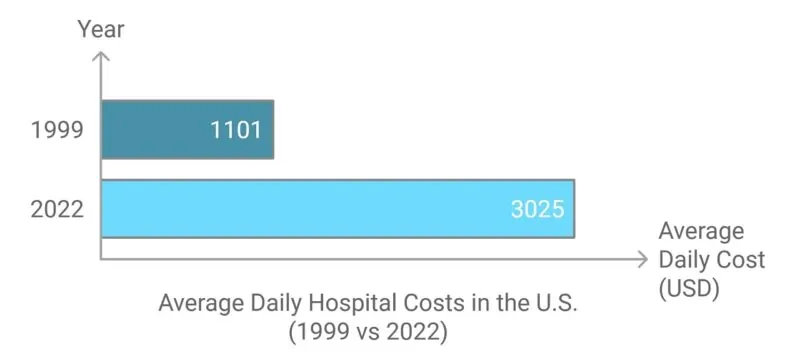
Hospital costs in the U.S. have skyrocketed over the last twenty years.
Data from ConsumerShield shows the average daily rate jumped from $1,101 back in 1999 to $3,130 in 2023. That is a massive 175% increase in just over two decades.
A mix of general inflation, expensive new medical tech, and shifting healthcare regulations keeps pushing these numbers up year after year.
Changes in Hospital Costs Over Time

Here is how the daily cost has climbed over the years:
| Year | Cost per Day (USD) | Yearly Percentage Increase (%) |
| 1999 | $1,101.80 | – |
| 2000 | $1,148.47 | 4.24% |
| 2005 | $1,522.42 | 6.80% |
| 2010 | $1,909.64 | 3.08% |
| 2015 | $2,270.51 | 4.05% |
| 2020 | $2,873.01 | 6.11% |
| 2022 | $3,025.23 | 5.30% |
Key Trends
- Between 1999 and 2005, daily rates climbed steadily to $1,522, averaging a 5.8% jump each year.
- From 2010 to 2020, the pace picked up, with costs rising about 5% annually.
- The biggest spike hit between 2020 and 2022, when daily costs shot up by over $150.
Factors That Affect Hospital Stay Costs
Why hospital costs are so high comes down to a few basic things:
- Who runs the place: It matters if the hospital is a non-profit, state-owned, or a for-profit business.
- Location: City hospitals always have much higher overhead than small rural clinics.
- What’s actually wrong with you: Complicated medical issues requiring specialist gear or extra testing run up the tab fast.
- The calendar: Every extra night in that bed adds up.
Hospital Costs by Ownership Type
The type of organization running the hospital directly impacts the final bill.
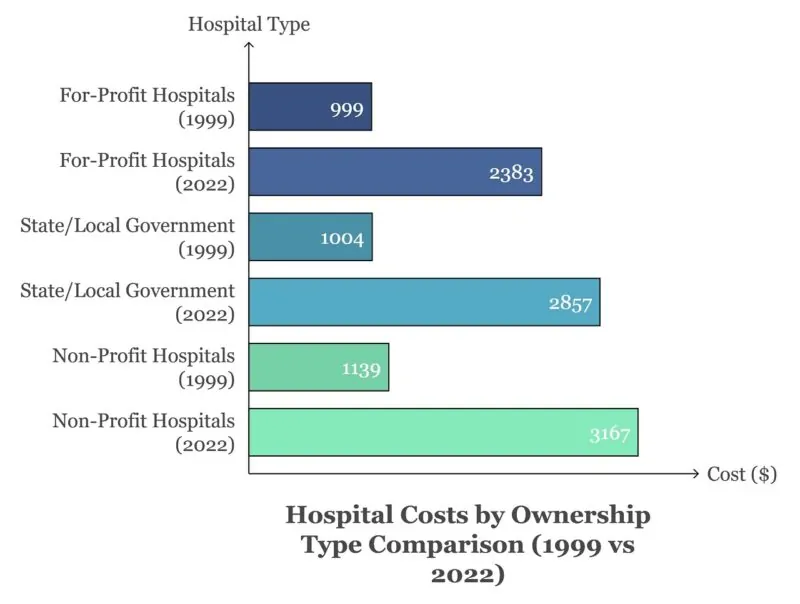
- For-profit hospitals: Often keep costs slightly lower by cutting down on operational waste and running more like a tight business.
- Government hospitals: State and local facilities offer decent baseline pricing, though they constantly juggle budget cuts with patient care.
- Non-profit hospitals: Usually end up being the most expensive because they offer a wider range of services and pour money back into local health programs.
Rising Costs

An NCBI study highlights just how heavy this financial burden has become for regular patients. For example:
- In 1999, a patient might pay around $1,100 per day for hospital care.
- In 2022, the same patient would face a cost of over $3,000, nearly three times more.
Here is how patients are trying to deal with the damage:
- Checking the fine print: Knowing exactly what an insurance policy covers before setting foot in a hospital.
- Haggling the final bill: Asking for itemized receipts, negotiating discounts, or setting up payment plans.
- Asking for quotes upfront: Getting a cost estimate from the doctor or hospital before scheduling any non-emergency surgery.
The Cost of Hospital Infections
Catching an infection while inside a hospital ruins budgets just as fast as it ruins patient recovery.
Data from the Agency for Healthcare Research and Quality (AHRQ) highlights this exact issue. Looking at stays from 2019 and 2021, patients who picked up a hospital-acquired infection faced much longer recovery times, higher mortality rates, and significantly larger final bills compared to those who did not get sick on-site.
Most Common Reasons for Hospital Admission in the US
The Agency for Healthcare Research and Quality (AHRQ), part of the U.S. Department of Health and Human Services, tracked the most frequent diagnoses that led to inpatient hospital stays in 2020, excluding births and newborns.
The following table shows how the number of hospital stays for each condition changed between 2018 and 2020, as well as the average cost per hospital stay.
Notably, the overall number of admissions fell for most conditions in 2020, a trend largely linked to the impact of COVID-19, as fewer people sought hospital care for non-COVID health issues.
In most countries the number of hospital discharges fell between 2019 and 2023, a decline associated with COVID‑19 disruptions.
| Diagnosis | Hospital Stays (2018) | Hospital Stays (2020) | Average Cost per Stay |
|---|---|---|---|
| Septicemia | 2,218,800 | 2,396,400 | $18,244 |
| COVID-19 | N/A | 1,058,815 | $11,275 |
| Heart failure | 1,135,900 | 1,003,270 | $13,418 |
| Diabetes (with complications) | 678,600 | 659,950 | $8,439 |
| Osteoarthritis | 1,128,100 | 606,741 | $16,000 |
| Acute myocardial infarction (heart attack) | 658,600 | 570,440 | $18,931 |
| Pneumonia (non-tuberculosis) | 740,700 | 560,450 | $6,042 |
| Cardiac dysrhythmias (irregular heartbeat) | 620,000 | 526,635 | $12,100 |
| Cerebral infarction (stroke) | 533,400 | 515,400 | $14,900 |
| Acute/unspecified renal failure | 565,800 | 470,635 | $9,600 |
How Much Does an Average Overnight Hospital Stay Cost?

Data from KFF and ConsumerShield shows that in 2023, the U.S. national average for a single night in a hospital bed sat right around $3,130.
But that baseline changes completely depending on the state line:
- In places like California and Oregon, a single night frequently costs more than $4,000.
- On the other side of the spectrum, states like Mississippi and South Dakota keep their averages well under $1,800 a night.
Other variables play a huge role too, like whether the hospital is in a major city or a rural town, if it is run for profit or as a non-profit, and what specific medical attention you need. Without a good insurance plan, even staying twenty-four hours just for a doctor to monitor you can easily turn into a massive financial headache.
3-Day Hospital Stay Cost With Insurance
On average, with standard health insurance coverage, patients still face substantial out-of-pocket costs due to deductibles, copays, and uncovered services.
- Typical billed charge (without insurance) for a 3-day hospital stay without insurance: around $9,000 ($3,130 × 3 days).
- Average out-of-pocket cost with insurance: $1,300 – $3300 depending on the plan.
For example:
- A bronze-tier Affordable Care Act (ACA) plan may cover only 60% after the deductible is met.
- High-deductible health plans (HDHPs) often leave patients responsible for the first $2,000–$7,000 before insurance coverage even kicks in.
In 2024, the average U.S. employee had to spend a $1,787 out of pocket before their insurance deductible was met, while the typical daily cost of a hospital stay in 2023 reached a $ 3,130. As a result, even a standard three-day hospitalization can quickly add up to $10,000.
According to the Healthcare Cost Institute (HCCI), insured Americans still paid an average of $1,982 out of pocket for inpatient stays in 2022, up 11% from five years earlier.
Overnight Hospital Stay Cost With Insurance

Here’s what patients typically face:
- Average billed charge: About $3,130 for one night.
- After insurance: depending on plan
- Copays for hospitalization: $250-$500 per stay.
- Coinsurance: often 20% of the total bill after meeting the deductible.
- Typical overnight hospital stay out-of-pocket cost: around $500 to $1,200.
Insurance plans may have different structures:
- PPOs (Preferred Provider Organizations) often have better negotiated hospital rates.
- HMOs (Health Maintenance Organizations) may require pre-authorization or referrals.
- HDHPs (High-Deductible Health Plans) result in higher upfront payments before coverage kicks in.
Patients are advised to:
- Verify hospital network status before treatment.
- Review insurance plan details (copay vs. coinsurance).
- Ask for cost estimates and negotiate where possible.
Price Transparency Reforms and Why They Matter
Lately, the Centers for Medicare & Medicaid Services (CMS) has been tightening its hospital price transparency rules, which first rolled out back in 2021. The whole point is to force hospitals to make their pricing data actually readable and easy to compare.
Under Section 2718(e) of the Public Health Service Act, every hospital in the country has to post its standard rates for all services. They have to do this in two ways: a giant, machine-readable data file (MRF) for tech use, and a separate, user-friendly list of “shoppable” services that normal people can browse.
To stop hospitals from hiding these pages, CMS updated the rules for the 2024 Outpatient Prospective Payment System. Now, hospitals are required to put a clear “Price Transparency” link right in their homepage footer. They also have to drop a plain text (.txt) file into their website’s root folder that links straight to that giant data file.
By July 1, 2024, those data files had to match a strict, standardized CMS template. Hospitals must list exact insurance-negotiated rates, itemized descriptions, and billing codes, plus officially sign off that the data is 100% accurate. Following that, on January 1, 2025, a bunch of extra details became mandatory, like estimated allowed amounts, drug units, and billing modifiers. To keep everyone honest, CMS is also publicly posting which hospitals are actually complying and who is getting fined. The big goal here is to give patients, employers, and insurance companies the data they need to shop around, which might finally force hospitals to lower their prices.
Of course, all this data does not mean much if you cannot read it. Patients who do not speak fluent English usually need certified medical translation just to decipher these cost estimates, consent forms, discharge papers, and hospital bills. For the hospitals themselves, hiring professional translators is the only real way to make sure costs, care plans, and insurance coverage are actually clear before, during, and after a patient stays the night.
| Effective Date | Main Rule | What Hospitals Have to Do | Source |
| Jan 1, 2024 | Easier to find | Hospitals have to put a “Price Transparency” link in their homepage footer. They also need to drop a simple .txt file into their website’s root folder that links directly to their master pricing file. | CMS 2024 Rule |
| Jul 1, 2024 | Standard layout and extra details | Every pricing file has to use a strict CMS template (CSV or JSON layout). It must include exact insurance-negotiated rates, clear descriptions, and standard billing codes. Hospitals also have to officially sign off that the data is accurate. | CMS 2024 Rule |
| Jan 1, 2025 | More fields required | Hospitals must add even deeper data to the files, including estimated payout amounts for complex insurance algorithms, specific drug units, measurement types, and billing modifiers. | CMS 2024 Rule |
| Ongoing | Fines and public call-outs | CMS is naming and shaming non-compliant hospitals publicly and issuing cash fines. If a hospital gets caught breaking the rules, they have 45 days to hand over a fix-it plan or face financial penalties. | CMS Fact Sheet |
FAQs
Methodology
- We gathered the latest national and state-specific hospital cost data from reputable sources such as KFF, AHRQ, and ConsumerShield.
- We analyzed trends from 1999 to 2022 to highlight long-term cost increases and inflation-adjusted pricing shifts.
- A state-by-state cost comparison table was created to show regional disparities in average inpatient day costs.
- We included key factors influencing hospital pricing, such as ownership type, geography, and type of care.
- Real-world cost examples with and without insurance were integrated to help readers understand potential out-of-pocket expenses.
- Practical tips and FAQ sections were added to guide readers in managing, estimating, and reducing hospital-related financial burdens.
Conclusion
View this post on Instagram
Hospital bills in the US went through the roof over the last twenty years. Inflation, expensive equipment, and basic greed drove the prices up.
If you want to protect your savings, you have to know how these places set their rates and whether they operate for profit. Showing up with a plan, knowing your policy inside out, and demanding financial aid options is your only real defense against a massive bill.