
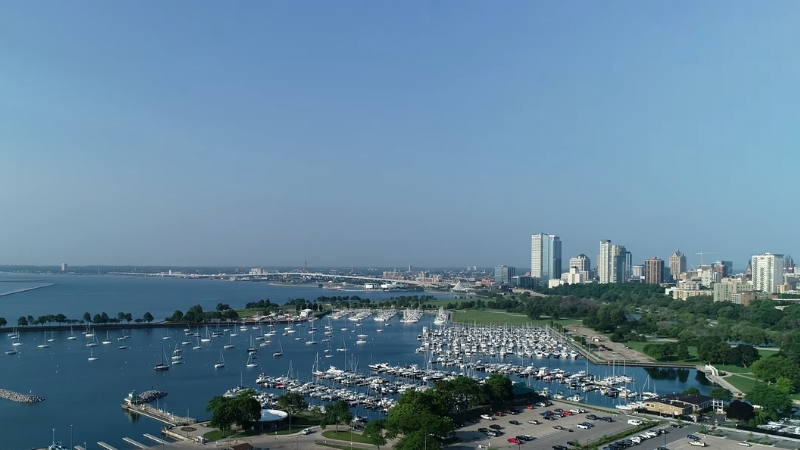
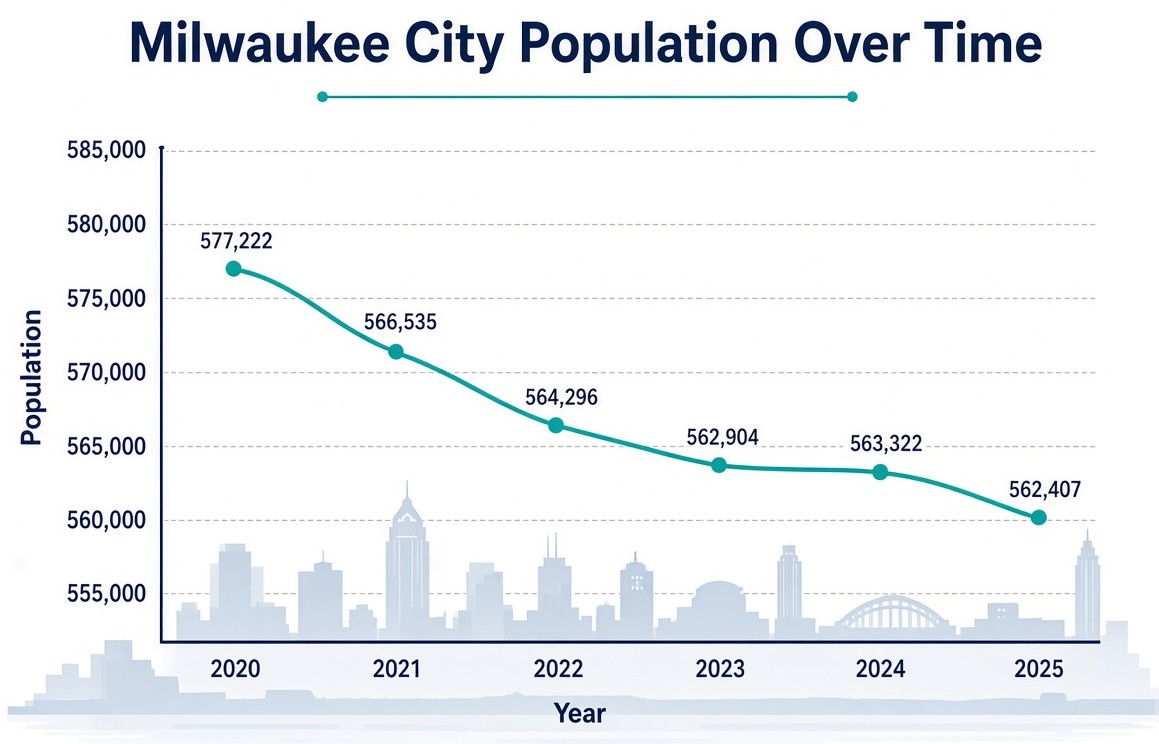
Milwaukee has 562,407 residents, according to the U.S. Census Bureau. Wisconsin’s largest city has lost 14,815 people since the 2020 Census, although its population has remained close to 563,000 for three consecutive years.
The surrounding metropolitan area is growing. Milwaukee City lost 915 residents between 2024 and 2025, but the Milwaukee-Waukesha region gained 2,512. We checked the population records for both areas because combining city and suburban growth gives a misleading picture of Milwaukee itself.
Housing presents another problem. The median home sale price reached $245,000 in August 2026, while median household income was $54,234 in the latest five-year Census survey. More than 22% of city residents live below the poverty threshold.
Our analysis uses the latest available population estimates, employment reports, housing transactions and city records. Each dataset is identified by its reporting period, since a 2025 population estimate and a 2026 housing price do not describe the same point in time.
Latest Milwaukee Population Statistics
The latest official population estimate is 562,407 as of July 1, 2025. The Census Bureau has not yet released its July 2026 estimate for Milwaukee.
Milwaukee had 577,222 residents at the 2020 Census. The annual figures available through the Federal Reserve’s Census population series show how the city has changed since then.
| Year | Milwaukee City Population |
|---|---|
| 2020 Census | 577,222 |
| 2021 | 566,535 |
| 2022 | 564,296 |
| 2023 | 562,904 |
| 2024 | 563,322 |
| 2025 | 562,407 |
Milwaukee lost more than 10,000 residents by 2021. The decline slowed afterward, and the city gained 418 residents in 2024 before losing 915 in 2025.
The Census Bureau reports a 2.7% decline from April 2020 because its annual estimates use a revised starting population of 577,894. The original 2020 Census count was 577,222. Both are official figures, but they serve separate statistical purposes.
Milwaukee Has Lost Nearly 179,000 Residents Since 1960
Milwaukee reached its population peak in 1960, when 741,324 people lived in the city.
Machinery, industrial equipment, metal production and brewing supported a large manufacturing workforce. As industrial employment declined and suburban development expanded, Milwaukee lost residents.
| Census Year | Population |
|---|---|
| 1960 | 741,324 |
| 1970 | 717,099 |
| 1980 | 636,212 |
| 1990 | 628,088 |
| 2000 | 596,974 |
| 2010 | 594,833 |
| 2020 | 577,222 |
| 2025 estimate | 562,407 |
Milwaukee now has 178,917 fewer residents than it did in 1960, a decline of 24.1%.
The city continues to build housing despite its smaller population. Its 2026 budget documents include support for home repairs, homeownership and development on vacant properties. New construction has been concentrated in some neighborhoods, including downtown, rather than spread evenly across the city.
Milwaukee City vs. Milwaukee Metro Area
Milwaukee City has 562,407 residents. The Milwaukee-Waukesha metropolitan area has 1,575,010.
The metro area includes Milwaukee, Ozaukee, Washington and Waukesha counties. People living in those surrounding counties are counted in the regional total even when they commute into Milwaukee for work.
According to the Census metropolitan population series, the region gained 2,512 residents between 2024 and 2025.
| Year | Metro Population |
|---|---|
| 2020 | 1,574,549 |
| 2022 | 1,563,459 |
| 2023 | 1,567,195 |
| 2024 | 1,572,498 |
| 2025 | 1,575,010 |
Since 2022, the metropolitan area has gained 11,551 residents. Milwaukee County, by comparison, had 924,216 residents in 2025, down 107 from the previous year.
Regional growth has therefore occurred without corresponding growth in Milwaukee City or Milwaukee County.
Population by Race and Ethnicity
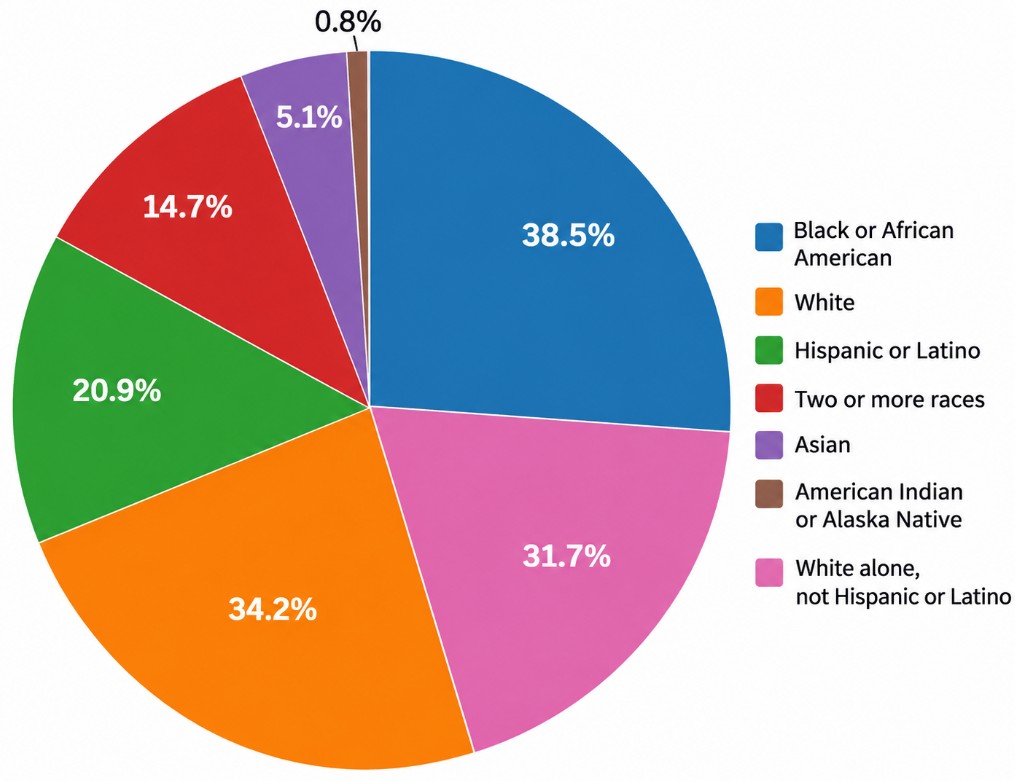
No single racial group accounts for a majority of Milwaukee’s residents. According to the Census Bureau’s racial and ethnic statistics, Black or African American residents represent 38.5%, followed by White residents at 34.2%.
| Race or Ethnicity | Population Share |
|---|---|
| Black or African American alone | 38.5% |
| White alone | 34.2% |
| Hispanic or Latino | 20.9% |
| Two or more races | 14.7% |
| Asian alone | 5.1% |
| American Indian or Alaska Native alone | 0.8% |
| White alone, not Hispanic or Latino | 31.7% |
Hispanic or Latino is recorded as an ethnicity rather than a separate race. People can appear in both classifications, so the percentages exceed 100% when added together.
Milwaukee has substantial Black communities on the North Side and Hispanic communities on the South Side. Its Asian population includes an established Hmong community.
The Census also estimates that 11.1% of residents were born outside the United States during 2020-2024.
Age Distribution
Children under 18 account for 25.4% of Milwaukee residents, compared with 12.0% who are at least 65.
| Population Group | Milwaukee |
|---|---|
| Children younger than 5 | 6.8% |
| Residents younger than 18 | 25.4% |
| Residents aged 18 to 64 | 62.6% |
| Residents aged 65 and older | 12.0% |
| Female residents | 51.6% |
Milwaukee has more than twice as many children as seniors when measured as shares of the total population.
According to the Census household statistics, Milwaukee had 232,520 households, averaging 2.37 people per household during 2020-2024.
Another 85.7% of residents age one or older lived at the same address a year earlier. The annual mobility measure records moves within a single year, whereas Milwaukee’s population decline covers several years. Residents also move between addresses within the city without changing its total population.
Income and Poverty
Milwaukee’s median household income is $54,234, based on the 2020-2024 American Community Survey. Per capita income is $30,994, and the poverty rate is 22.8%.
The figures come from the Census Bureau’s Milwaukee income and poverty profile.
| Statistic | Milwaukee |
|---|---|
| Median household income | $54,234 |
| Per capita income | $30,994 |
| Poverty rate | 22.8% |
| Labor force participation, age 16+ | 64.4% |
| Female labor force participation | 62.6% |
More than one in five residents lives below the federal poverty threshold. That is a substantial share for a city with major employers in healthcare, manufacturing and professional services.
Median household income is not the average salary of an individual worker. It includes income received by household members and places the middle household at $54,234.
We have also examined Wisconsin’s population and demographics, which provide statewide context for Milwaukee’s income and employment figures.
Minimum Wage and Housing Costs
Wisconsin’s minimum wage remains $7.25 per hour for most covered employees. Qualifying tipped employees have a separate $2.33 cash wage, provided their wages and tips together meet the applicable legal minimum.
A worker earning $7.25 for 40 hours a week receives $290 before taxes. Over 52 weeks, that amounts to $15,080 in gross earnings.
Milwaukee’s median gross monthly rent was $1,059 in the 2020-2024 Census survey. Twelve months at that rate costs $12,708, equivalent to 84.3% of annual earnings at the standard minimum wage.
The calculation assumes a single worker pays the full rent. It leaves $2,372 before taxes for food, utilities, transportation and other annual expenses.
The U.S. Department of Labor’s 2026 wage comparison confirms that Wisconsin remains at the federal minimum.
Video: The following Living in Milwaukee presentation discusses local housing and living expenses. It is included as a local market perspective, not as the source for the Census rent or minimum-wage figures.
Channel information: Living in Milwaukee, associated with On Point Realty Group. The video presents a real estate perspective and may reflect commercial interests in the Milwaukee housing market.
Employment and Unemployment Rates
The Milwaukee-Waukesha metropolitan area recorded a 3.8% unemployment rate in August 2026, compared with a national non-seasonally adjusted rate of 4.3%.
The Bureau of Labor Statistics metropolitan data recorded 820,600 people in the civilian labor force, including 789,200 employed residents.
| Employment Metric | Milwaukee Metro, August 2026 |
|---|---|
| Civilian labor force | 820,600 |
| Employed residents | 789,200 |
| Unemployed residents | 31,400 |
| Unemployment rate | 3.8% |
| Nonfarm payroll jobs | 865,000 |
| Annual payroll employment change | -0.3% |
Milwaukee’s 3.8% metropolitan unemployment rate was below the 4.3% U.S. figure in the September 30, 2026 BLS metropolitan release.
The figures cover Milwaukee, Ozaukee, Washington and Waukesha counties. They should not be treated as unemployment statistics for Milwaukee City alone.
We previously covered unemployment trends across the United States, including how national labor market figures are measured.
Average Hourly Wages
Workers in the Milwaukee-Waukesha area earned an average of $32.42 per hour in May 2025, compared with $33.54 nationally.
The BLS occupational wage report released August 3, 2026 gives the following pay rates.
| Occupation | Milwaukee Metro | U.S. |
|---|---|---|
| All occupations | $32.42 | $33.54 |
| Management | $69.13 | $69.84 |
| Legal | $69.39 | $67.07 |
| Healthcare practitioners and technical | $56.62 | $52.26 |
| Healthcare support | $19.27 | $19.62 |
| Personal care and service | $19.27 | $19.74 |
| Food preparation and serving | $16.11 | $17.86 |
Management workers averaged $69.13 an hour, compared with $16.11 in food preparation and serving occupations. Both healthcare support and personal care occupations recorded $19.27, as confirmed by the BLS table.
Healthcare practitioners earned more in Milwaukee than the national average, whereas food service employees earned $1.75 less per hour.
Milwaukee Housing Market in 2026
Milwaukee’s median home sale price reached $245,000 in August 2026, according to Redfin, an increase of 2.7% from a year earlier.
| Housing Metric | August 2026 |
|---|---|
| Median sale price | $245,000 |
| Annual price increase | 2.7% |
| Median price per square foot | $162 |
| Median days on market | 42 |
| Sale-to-list price ratio | 99.9% |
| Homes sold above asking | 45.8% |
| Listings with price reductions | 24.7% |
Nearly 46% of homes sold above their asking prices, even as almost one-quarter of listings experienced price reductions.
Neighborhood prices are not close to the citywide median everywhere. Downtown Milwaukee recorded a $494,861 median in September 2026, compared with $93,974 in Franklin Heights.
The downtown figure was more than five times the Franklin Heights median. Because each neighborhood had its own mix of sales and property types, the figures do not mean equivalent homes would sell at the same price ratio.
Rent, Homeownership and City Housing Programs
Only 41.8% of Milwaukee’s occupied housing units are owner-occupied, according to Census estimates. The median owner-occupied home value is $184,000, while median gross rent is $1,059.
Homeowners with mortgages reported median monthly ownership costs of $1,533, compared with $673 for owners without mortgages.
Milwaukee’s 2026 proposed development budget included $3.9 million for homeownership programs, including down payment assistance, home repairs and construction support.
The Raze and Revive initiative combines demolition of deteriorated buildings with development assistance for new housing on vacant properties.
Education
According to the Census Bureau, 27.4% of Milwaukee residents age 25 or older have a bachelor’s degree or higher, compared with 85.5% who have completed high school or an equivalent qualification.
| Educational Attainment | Milwaukee, Age 25+ |
|---|---|
| High school graduate or higher | 85.5% |
| Bachelor’s degree or higher | 27.4% |
| Without a high school qualification | 14.5% |
The city has several higher-education institutions, including the University of Wisconsin-Milwaukee, Marquette University and Milwaukee Area Technical College.
Technical education supports manufacturing, construction, logistics and healthcare jobs that do not always require a four-year degree. Census attainment figures refer to city residents, not everyone enrolled at Milwaukee institutions.
Immigration and Languages Spoken in Milwaukee
Foreign-born residents account for 11.1% of Milwaukee’s population. Another 22.0% of residents age five or older speak a language other than English at home, according to the 2020-2024 American Community Survey.
Milwaukee has established Hispanic, Hmong and other immigrant communities, including businesses and cultural organizations that have operated for generations.
The two Census percentages measure separate characteristics. A person born in the United States may speak Spanish or Hmong at home, and a foreign-born resident may speak English at home.
Health Insurance and Health Conditions
Milwaukee’s Census profile reports that 10.1% of residents younger than 65 lack health insurance. Another 10.5% of residents in the same age group report a disability.
In January 2026, the Milwaukee Health Department released its Community Health Assessment, drawing on health records and feedback from more than 3,400 residents.
The department identified five priorities, covering chronic disease, maternal and child health, mental health, substance use, and violence and injury.
The assessment also documented inequalities in housing, education, infant mortality and life expectancy. Injury and violence were identified as leading contributors to premature death and disability.
The complete assessment and related city health reports are available through the Milwaukee Health Department’s research portal.
Our previous analysis of U.S. life expectancy trends provides national figures for comparison.
Crime and Public Safety Statistics
Milwaukee recorded 5,644 violent crimes between January and September 2025, down from 7,229 during the same nine months of 2024.
The Milwaukee Police Department’s report to city officials recorded a 22% reduction in violent crime, alongside a decrease in nonfatal shootings.
| Crime Measure, January to September | 2024 | 2025 | Change |
|---|---|---|---|
| Violent crime incidents | 7,229 | 5,644 | -22% |
| Nonfatal shooting victims | 522 | 407 | -22% |
| Homicide victims | 102 | 110 | +8% |
Homicides increased despite the reduction in overall violent crime. The department recorded 110 homicide victims, compared with 102 in the same period of 2024.
The numbers cover January 1 through September 30 in each year. The shooting and homicide figures count victims, whereas the violent crime total uses reported incidents. They are not interchangeable measures.
City Budget and Housing Priorities
Milwaukee’s 2026 municipal budget exceeded $2 billion, according to the mayor’s presentation to the Common Council.
The administration faced a projected gap exceeding $100 million between revenues and the cost of continuing existing services. The proposal included a 3% property tax levy increase, higher user fees and an additional $10 vehicle registration fee.
Housing support remained part of the budget, including home repairs, down payment assistance and development on vacant properties.
Milwaukee also faces budget decisions for 2027. The following news clip covers the city’s proposed spending plan. It is a media report, not the source for the 2026 budget figures above.
Video: Fox News coverage of Milwaukee’s proposed 2027 budget and its potential spending total of more than $2.2 billion. The proposal should not be confused with an adopted budget.
Methodology
We compiled Milwaukee’s population figures from the U.S. Census Bureau’s Vintage 2025 Population Estimates Program. The latest annual estimate refers to July 1, 2025. Figures for 2010 and 2020 are decennial census counts, which use separate collection methods from annual estimates.
Race, ethnicity, age, income, education, language, housing tenure and health insurance statistics primarily come from the 2020-2024 American Community Survey. Household income is expressed in 2024 dollars. Hispanic or Latino origin is measured separately from racial identity.
Employment figures come from the Bureau of Labor Statistics. Metropolitan unemployment refers to August 2026, whereas occupational wages refer to May 2025 and were published in August 2026. Payroll job totals and employment reported through the household labor force survey measure separate things.
Housing prices come from Redfin’s August and September 2026 sales reports. Monthly sale medians are based on completed transactions and may change substantially with the number and type of properties sold. They should not be compared directly with Census estimates of the value of owner-occupied homes.
Public health information comes from the Milwaukee Health Department’s 2025 Community Health Assessment, released in January 2026. Crime comparisons use the Milwaukee Police Department’s January through September 2024 and 2025 records. Budget figures come from Milwaukee’s municipal documents.
The two images and two videos are retained as supporting media. They are not treated as statistical sources, and their publication dates may precede the datasets cited in the article.
Milwaukee City, Milwaukee County and Milwaukee-Waukesha metropolitan statistics are identified separately throughout. Each source URL appears once, beside the information it supports.