


Columbus keeps growing, and the latest numbers we found show that the change is not limited to the city itself.
The latest figure we found for the population of Columbus is 938,396 residents as of July 1, 2025, according to the U.S. Census Bureau. It is the most recet official city estimate available in 2026.
The wider metro area has grown as well, passing 2.24 million residents.
Columbus continues to add housing as its population grows. The metro unemployment rate was 3.2% in July 2026, while about 15% of city residents were born outside the United States.
In this article, we will look at how much Columbus has grown, what is driving the change, where housing and rents are heading, how migration is affecting the city and what the latest employment figures tell us about Columbus in 2026.
Columbus Population Reached 938,396 and Is Still Growing
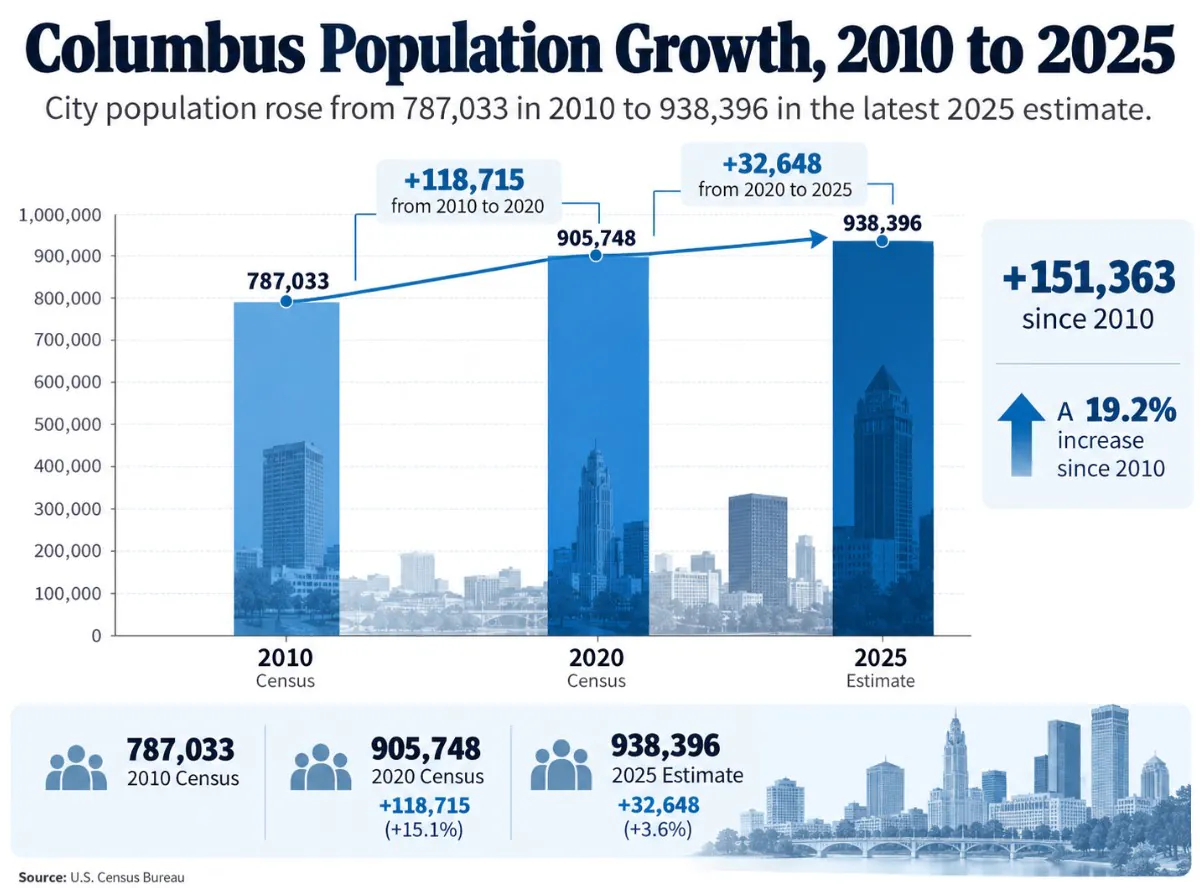
Columbus had 938,396 residents on July 1, 2025. The latest Census update also places it as the 15th-largest city in the United States and the largest city in Ohio.
The more interesting part is how Columbus reached that number. Growth did not begin with the latest estimate. Columbus counted 787,033 residents in the 2010 Census and 905,748 in the 2020 Census. By 2025, the city had gained another 32,648 residents compared with the official 2020 count.
Columbus Added More Than 150,000 Residents Since 2010
| Year | Population | Change From Previous Point |
|---|---|---|
| 2010 Census | 787,033 | – |
| 2020 Census | 905,748 | +118,715 |
| 2021 estimate | 902,800 | -3,875 from 2020 estimate series |
| 2022 estimate | 910,713 | +7,913 |
| 2023 estimate | 919,569 | +8,856 |
| 2024 estimate | 930,700 | +11,131 |
| 2025 estimate | 938,396 | +7,696 |
The 2010 Census recorded 787,033 people in Columbus. Compared with the latest estimate, the city has added 151,363 residents since then, an increase of just over 19%.
The years after 2020 are also worth looking at separately. Columbus slipped below its 2020 estimates base in 2021, then population growth returned in 2022 and continued through 2025. The city added 11,131 residents between 2023 and 2024, followed by another 7,696 between 2024 and 2025.
It Was Among the Biggest Population Gainers in 2025
The latest Census city and town estimates ranked Columbus 14th nationally for numeric population growth between July 2024 and July 2025. Its gain of 7,696 residents put it in the same national table as Charlotte, Fort Worth, San Antonio, Seattle, Houston and Atlanta.
That ranking gives the latest number some context. Columbus is not growing only because it starts from a large population base. It is still adding several thousand residents per year, even after passing 900,000 people.
The Columbus Metro Area Has Passed 2.24 Million Residents
We checked the latest metro figures as well.
The Columbus metro area reached 2,242,028 residents in 2025, according to the latest U.S. Census Bureau metro population series. That was up from 2,220,716 in 2024 and 2,141,983 in 2020.
| Year | Columbus Metro Population | Change From Previous Point |
|---|---|---|
| 2020 | 2,141,983 | – |
| 2024 | 2,220,716 | +78,733 |
| 2025 | 2,242,028 | +21,312 |
That means the metro added more than 100,000 residents between 2020 and 2025. The increase from 2024 to 2025 alone was more than 21,000 people.
The latest Census release also shows that the Columbus metro grew at about twice the national rate during the year. A March 2026 Columbus Partnership analysis placed the region among the faster-growing large metro areas in the country.
Growth Is Spreading Outside Columbus
Video: Talking about most popular suburb areas in Columbus.
The regional numbers show that population growth is not staying inside the city.
Franklin County reached 1,361,536 residents in 2025, up 2.9% from its 2020 estimates base.
Delaware County has been growing even faster. Its population reached about 242,000 in 2025, up from fewer than 214,000 residents in 2020.
Seeing growth in these areas is important because northern suburbs and nearby communities are absorbing part of the housing demand created by the expanding Columbus region.
Columbus Has a Younger Population Than Many Large U.S. Cities
We also checked the age breakdown because it helps explain why Columbus continues to attract new households and workers.
22.0% of Columbus residents are under 18, while only 11.3% are age 65 or older. Another 6.5% are under age five.
| Age Group | Share of Columbus Population |
|---|---|
| Under age 5 | 6.5% |
| Under age 18 | 22.0% |
| Age 18 to 64 | 66.7% |
| Age 65 and older | 11.3% |
Those figures come from the latest Census age profile for Columbus.
Columbus has far more children than seniors, so the city still needs plenty of schools, childcare, family housing and jobs for younger workers.
The large number of younger adults and families also keeps pressure on the housing market. If the population keeps growing, Columbus will need more apartments and homes to keep up with demand.
International Migration Is Changing the Columbus Population
As we already mentioned, about 15% of Columbus residents were born outside the United States. That share is large enough to play a real role in the city’s population growth, workforce and housing demand.
Compared to total population, we can see that the number of international immigrants is around 143,000 residents. Another 19.1% of people age five and older speak a language other than English at home, which gives a better idea of how much immigration has changed everyday life across the city.
Those numbers do not mean immigration explains all of the recent growth. Columbus is also gaining residents through moves from other parts of Ohio and the United States, while births and deaths affect the total as well.
The important point is that Columbus is growing through several channels at the same time. International migration adds new residents, the wider metro continues to attract households from other parts of the country, and younger families are keeping the local population from aging as quickly as in many other large cities.
Columbus Housing Prices and Rents in 2026
Video: More about the benefits and potential downsides of moving to Columbus, including details on prices of real estate and rents.
We checked the housing numbers next because population growth only tells part of the story. Columbus is still adding residents, but the housing market looks calmer than it did a few years ago.
Redfin reports a median sale price of $299,802 in August 2026, up just 0.6% from a year earlier. Homes took about 42 days to sell, and 2,950 sales closed during the month.
| Housing Metric | Latest Figure | Annual Change |
|---|---|---|
| Median sale price | $299,802 | +0.6% |
| Homes sold | 2,950 | +5.8% |
| Median days on market | 42 days | +1 day |
More homes are selling, but prices are barely moving. That is useful for a growing city because it means demand is still there without the same price jumps seen earlier in the decade.
More Homes Are Coming Onto the Market
Realtor.com shows the same pattern from another angle. In September 2026, Columbus had a median listing price of $269,950, down 3.39% from a year earlier. Active listings were up 4.21%, giving buyers more choice.
The city is also permitting more new housing. Columbus reported that construction of about 9,100 new homes was authorized in 2025, a 50% increase from 2024 and the highest total in 25 years. The wider metro area started work on more than 15,800 homes during the same year, according to the 2026 State of the City report.
That extra supply explains why prices are not rising as fast as the population.
Rents Are Falling Even as Columbus Keeps Growing
Renters are also seeing a change. The median city rent at $1,649 per month in September 2026, down 5.72% from a year earlier.
That is an interesting result for a city that is still adding residents. More apartments and rental units are reaching the market, so landlords face more competition than they did when supply was tighter.
Housing Supply Is Starting to Catch Up
Columbus still needs more homes if population growth continues, but the latest numbers show that construction is already changing the market. More listings, more permits and slower price growth give both buyers and renters more room than they had during the earlier housing squeeze.
The next question is whether incomes and jobs are keeping pace with those housing costs. That is where the labor market becomes important.
Columbus Jobs and Unemployment in 2026
After looking at housing, we checked the job market to see if employment is keeping pace with the growing population.
The Columbus metro had a labor force of 1,174,030 people in July 2026. Of those, 1,136,538 were employed and 37,492 were unemployed, according to the Bureau of Labor Statistics. That puts the unemployment rate at 3.2%.
| Labor Market Metric | July 2026 |
|---|---|
| Labor force | 1,174,030 |
| Employed | 1,136,538 |
| Unemployed | 37,492 |
| Unemployment rate | 3.2% |
The national unemployment rate was 4.1% in July, so Columbus was below the U.S. rate at the same point in the year.
Construction Is Growing Much Faster Than the Rest of the Job Market
The most interesting part of the latest jobs report is construction.
Employment in mining, logging and construction reached 71,100 jobs in July 2026, up 13.6% from a year earlier, according to a analysis by Pique Media based on federal labor data.
Total nonfarm employment across the metro stood at about 1.199 million jobs in July, but that total was unchanged from July 2025. Construction was therefore growing much faster than the job market as a whole.
Other Industries Were Much More Mixed
The same July data shows why the Columbus job market cannot be described simply as booming.
| Industry | Annual Change |
|---|---|
| Mining, logging and construction | +13.6% |
| Leisure and hospitality | +1.6% |
| Manufacturing | +0.5% |
| Financial activities | +0.4% |
| Trade, transportation and utilities | 0.0% |
| Government | -0.6% |
| Education and health services | -1.6% |
| Professional and business services | -3.0% |
| Information | -3.8% |
Trade, transportation and utilities remained the largest industry group listed in the report with 225,800 jobs, but employment there was flat from a year earlier.
So the picture in 2026 is mixed. Columbus has low unemployment and a growing labor force, but most of the latest job growth is concentrated in a few industries, with construction standing far ahead of the rest.
Pay Depends Heavily on the Type of Work
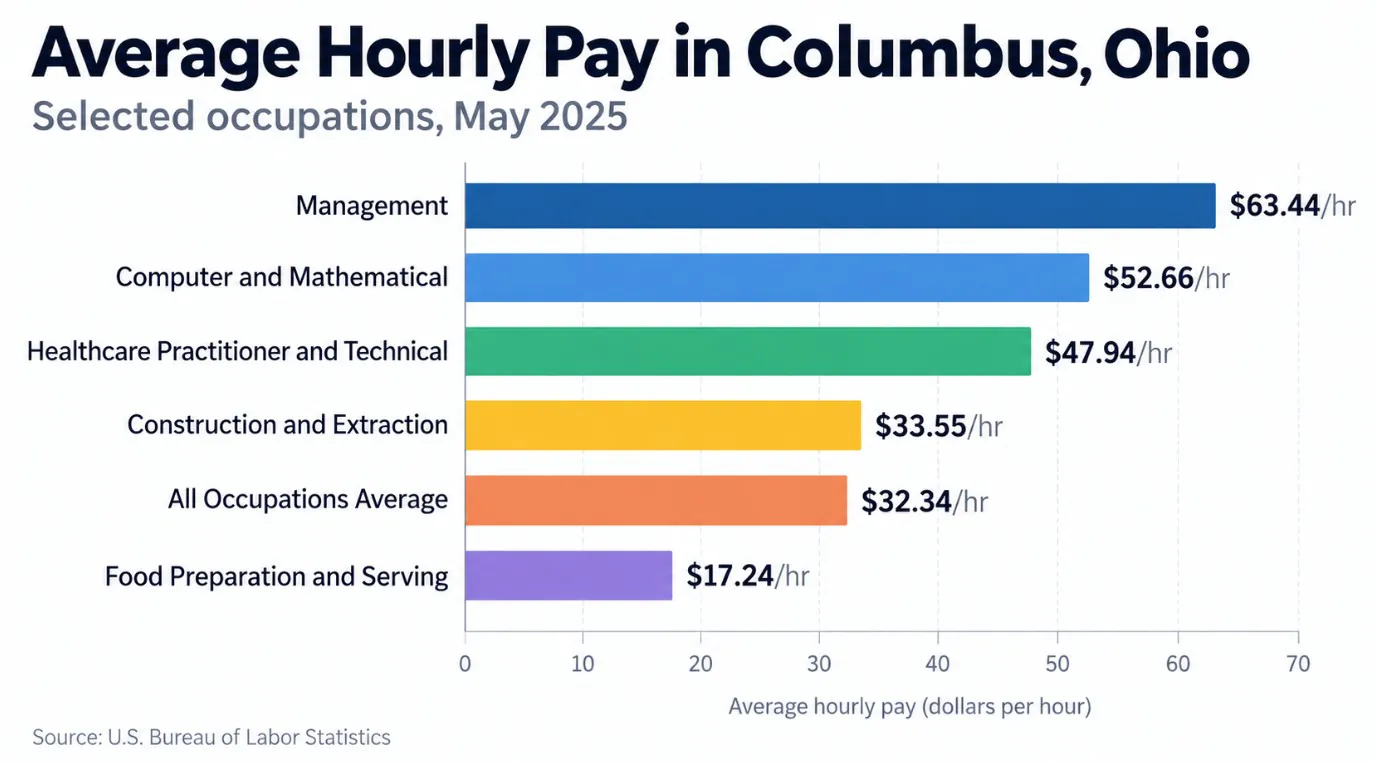
The latest BLS occupational wage report for Columbus puts the average wage across all occupations at $32.34 per hour in May 2025.
Management jobs averaged $63.44 per hour, computer and mathematical jobs $52.66, and healthcare practitioner and technical jobs $47.94. At the lower end, food preparation and serving jobs averaged $17.24 per hour.
Construction and extraction jobs averaged $33.55 per hour, slightly above the overall Columbus average. That gives some context to the recent construction hiring increase: the sector is adding workers and paying close to the metro-wide average for all occupations.
Columbus has plenty of jobs, but the type of job makes a large difference to household income. That is important when we compare wages with housing costs in a city that continues to add residents.
Columbus Income and Poverty in 2026
Income figures for Columbus lag behind the faster population and employment reports. The latest income data available in 2026 still comes from the 2024 American Community Survey, because the Census Bureau has delayed the 2025 ACS release.
That survey puts the median household income in Columbus at $67,084. Per capita income was $37,923.
| Median household income | $67,084 |
| Per capita income | $37,923 |
| Residents below the poverty line | 17.2% |
| People below the poverty line | About 155,300 |
| Households earning under $50,000 | 37% |
| Households earning $50,000 to $100,000 | 33% |
| Households earning $100,000 to $200,000 | 23% |
| Households earning more than $200,000 | 7% |
The poverty figure stands out the most. Around 17.2% of Columbus residents, or about 155,300 people, were below the poverty line. The wider metro was at 11.3%, so poverty was considerably more common inside the city.
Household income is also spread across a wide range. About 37% of Columbus households earned less than $50,000 a year. Another third earned between $50,000 and $100,000, while 30% were above $100,000.
Median household income across the metro was $82,938, compared with $67,084 inside the city. Per capita income was also higher across the metro at $45,178.
Housing Still Takes a Large Share of Income
A median household income of $67,084 works out to about $5,590 a month before taxes. The August 2026 median home sale price of just under $300,000 was about 4.5 times that annual income.
The gap is much harder for households below the city median. More than one third of Columbus households earn less than $50,000 a year, so the same home price or monthly rent takes a much larger share of their income.
Columbus therefore has plenty of economic activity, but incomes are not evenly distributed across the population. The city has a growing workforce and low metro unemployment, yet more than one in six residents still lives below the poverty line.
Crime and Public Safety
Crime has moved in a better direction in Columbus over the past two years, especially when it comes to homicides.
Columbus finished 2025 with 84 homicides, the lowest annual total since 2007. That was down about one third from 2024. City officials confirmed the drop in the 2026 State of the City address, noting that Columbus now has about 25% more residents than it did in 2007.
The decline continued into the first half of 2026. Columbus recorded 34 homicides through the end of June, according to the latest midyear count published by All Columbus Data. That remained among the lowest first-half totals the city has recorded since the 1980s.
| Period | Homicides |
|---|---|
| 2024 | About 125 |
| 2025 | 84 |
| January-June 2026 | 34 |
Police reports published through September show that killings have not stopped. Columbus recorded homicide cases on Karl Road on September 3 and Bannon Court on September 14, among other incidents listed in the Columbus Police homicide database. A final 2026 total will not be available until the year ends.
Columbus Is Putting More Attention on Non-Fatal Shootings
One useful change in the city’s public safety data concerns shootings where the victim survives.
Columbus reported a citywide clearance rate of about 51% for non-fatal shootings in 2025. A pilot program in Linden, where detectives handled non-fatal shootings with a similar investigative approach to homicide cases, reached a clearance rate of nearly 92%. The city said it would expand the program to another police zone in 2026.
The homicide decline is significant, but it does not mean violent crime has disappeared. September police reports still include shootings, felonious assaults and homicide investigations.
Columbus Schools and Education
Columbus City Schools is educating about 45,000 students during the 2025-2026 school year, across more than 100 schools.
The latest completed federal district data lists 46,515 students and 2,998 full-time equivalent classroom teachers for 2024-2025, equal to about 15.5 students per teacher, according to the National Center for Education Statistics.
More recent district results give a clearer picture of what changed during the 2025-2026 school year.
The Class of 2026 reached a four-year graduation rate of 84.6%, the highest on-time graduation rate Columbus City Schools has reported. That was up from 81.4% for the previous class. The district published the new figure in September 2026.
| Education Measure | Latest Figure |
|---|---|
| CCS students | About 45,000 |
| Schools | More than 100 |
| 2024-2025 NCES enrollment | 46,515 |
| Classroom teachers | 2,998 |
| Students per teacher | 15.5 |
| Class of 2026 graduation rate | 84.6% |
Career and Technical Education Is Growing Fast
One of the biggest changes is happening outside the traditional college-prep track.
Enrollment in Columbus City Schools career and technical education programs rose from 7,794 students in 2023-2024 to 12,109 in 2025-2026. That is a 64% increase in two years, according to 2026 CTE update.
Those programs cover fields tied closely to the local job market, including construction, healthcare, technology and skilled trades. The increase comes at the same time that construction employment has been one of the strongest parts of the Columbus economy.
School Results Improved in 2026
Preliminary state report card data released in September gave Columbus City Schools an overall rating of 2.5 stars for 2025-2026, up from 2 stars. The district also reported that 46 schools earned at least three stars on the latest Ohio report card.
The district still has work to do, but the 2026 results are stronger than the previous year. Graduation improved, more schools reached three stars or higher, and career education enrollment continued to grow.
Columbus Demographics in 2026
Columbus is more diverse than Ohio overall, and the difference is easy to see in the latest race, ethnicity, immigration and education data.
The newest detailed demographic figures available in 2026 still come from 2024 datasets. Data USA counts about 463,000 White non-Hispanic residents, 266,000 Black non-Hispanic residents and 54,300 Asian non-Hispanic residents in Columbus. About 75,600 residents identified as Hispanic or Latino, according to the 2024 Data USA profile for Columbus.
| Population Group | Residents | Share |
|---|---|---|
| White, non-Hispanic | About 463,000 | About 50.6% |
| Black, non-Hispanic | About 266,000 | About 29.1% |
| Asian, non-Hispanic | About 54,300 | About 5.9% |
| Hispanic or Latino | About 75,600 | 8.3% |
That profile looks very different from Ohio as a whole. Statewide, 76.1% of residents were White non-Hispanic in 2024, while Black residents accounted for 13.1% and Hispanic residents 5.2%. The comparison is available in the latest USAFacts demographic profile for Ohio.
More Than 140,000 Columbus Residents Were Born Outside the United States
Immigration is already part of the population story we covered earlier, but the demographic data shows how large that population has become.
The latest detailed profile counts 142,918 foreign-born residents, equal to 15.3% of the Columbus population. About 34% of foreign-born residents were born in Africa, 32% in Asia, 27% in Latin America and 6% in Europe, according to the latest Columbus profile on Census Reporter.
The city therefore has no single dominant region of origin. African and Asian migration account for especially large shares, alongside a sizeable Latin American population.
Language Use Also Shows How Much Columbus Has Changed
About one in five Columbus residents age five and older speaks a language other than English at home. The share is much higher in some parts of the city.
In Columbus North and Westerville, for example, 24.8% of residents speak another language at home and 21.8% were born abroad. The 2024 profile for Columbus North and Westerville shows both figures well above the Ohio average.
Southeast Columbus looks different. In the Columbus Southeast, Canal Winchester and Groveport area, 10.5% of residents speak another language at home and 8.1% were born outside the United States, according to the latest Southeast Columbus profile.
The contrast shows why one citywide percentage only tells part of the story. Immigration and language use vary considerably from one side of Columbus to another.
Columbus Remains Younger Than Much of Ohio
The age structure also helps separate Columbus from the state around it. The city median age was 33.2 years in 2024.
The wider Columbus metro had a median age of 36.7 years, while the city itself remained younger. The 2024 Data USA metro profile also shows that the region continues to have a large working-age population.
USAFacts found that 29.5% of metro residents were between ages 25 and 44 in 2024, compared with 26.9% nationally. Only 15.0% were age 65 or older, below the national share of 18.0%. Those figures come from its 2026 Columbus metro population update.
Education Levels Change Considerably Across Columbus
Columbus also has a large college-educated population, but the share varies a lot by neighborhood.
In Columbus Central and Grandview Heights, 67.1% of adults age 25 and older have at least a bachelor’s degree. That is more than double the Ohio rate of 32.4%, according to the 2024 Central Columbus profile.
Northeast Columbus looks very different. There, 24.3% of adults have at least a bachelor’s degree, while 85.9% have completed high school. The same area also has a foreign-born share of 12.8% and a non-English language share of 21.8%, based on the latest Northeast Columbus profile.
North Columbus and Worthington sit between those extremes. About 58.4% of adults there have at least a bachelor’s degree, according to the 2024 North Columbus and Worthington profile.
The demographic picture therefore changes considerably across Columbus. Race, immigration, language, age and education all look different depending on the part of the city, which helps explain some of the income and housing differences we covered earlier.
Frequently Asked Questions
How large is Columbus by land area?
Columbus covers about 219 square miles of land. The city has expanded well past its older core, which helps explain why population growth does not look the same in every neighborhood. The latest geographic profile is available through the Census Bureau’s Columbus city profile.
How long is the average commute in Columbus?
The average commute is about 21.5 minutes. Most workers still travel by car, but remote work remains a significant part of the local economy. A 2024 commute breakdown shows 67.7% drove to work alone, 18.3% worked from home and 7.8% carpooled, according to GeoStat’s Columbus commute data.
How important is Ohio State University to the Columbus population?
Ohio State is large enough to have a visible effect on the city’s age profile, rental market and workforce. The Columbus campus reached a record 62,010 students in autumn 2026, including 47,308 undergraduates. Enrollment increased 1.1% from the previous year, according to Ohio State’s September 2026 enrollment report.
How many college students are there across Columbus?
Ohio State is only part of the higher education picture. Columbus colleges and universities had more than 109,000 enrolled students in 2024. Ohio State, Columbus State Community College and Franklin University were among the largest institutions, based on Data USA’s higher education data for Columbus.
How many households are there in Columbus?
Columbus had about 390,500 households in the latest multi-year estimates, with an average of 2.28 people per household. About 80.3% of residents age one or older had lived in the same home a year earlier. The figures are listed in the latest Columbus household and housing dataset.
How many homes are there in Columbus?
The latest American Community Survey counted 436,552 housing units in Columbus. Comparing that figure with about 397,000 households shows why vacancy, new construction and household formation all affect the local housing market. The housing count is available in the 2024 Columbus ACS profile.
How many veterans live in Columbus?
About 34,500 veterans lived in Columbus in the latest 2020-2024 estimates. That is another group that does not stand out in the headline population figure but still represents a sizeable part of the city. The figure comes from the latest Columbus veterans estimate.
The Bottom Line
Columbus is still growing, but the latest data shows that growth is spreading across several parts of the city and metro economy at the same time.
The city population reached 938,396 in the latest official estimate, the metro passed 2.24 million residents, housing construction increased, and unemployment remained low in 2026. At the same time, incomes vary widely, poverty is still high inside the city, and housing costs remain a real burden for many households.
Migration, a younger population and a large workforce are helping Columbus expand. The next few years will depend heavily on how quickly housing supply, infrastructure and local services keep up with that population growth.