

About 51 million Americans work from home at least occasionally, according to new federal data released on September 24, 2026. That represents 33.6% of employees covered by the latest Bureau of Labor Statistics survey, or roughly one in three.
The number includes people with fully remote jobs as well as employees who spend only part of the week working from home. The new BLS report uses responses collected throughout 2024 and 2025 and looks at an employee’s main job. Self-employed people are not included.
Another 5 million people had jobs that allowed them to work from home but did not report actually doing so. In total, 55.9 million employees had the option.
About 15 Million More People Work From Home Than Before 2020
The same BLS survey was conducted in 2017 and 2018, giving us a useful comparison from before the pandemic changed where many Americans worked.
Back then, about 36 million people worked from home at least occasionally. The latest estimate is 50.9 million. The share of employees working from home has risen from 24.8% to 33.6%.
| Work From Home Measure | 2017-18 | 2024-25 |
|---|---|---|
| Could work from home | 28.8% | 36.9% |
| Worked from home at least occasionally | 24.8% | 33.6% |
| Had full days working only from home | 14.7% | 27.8% |
| Number working from home occasionally | About 36 million | 50.9 million |
| Number with full work-from-home days | About 21 million | 42.2 million |
The change is even larger when entire days at home are counted. BLS recorded about 21 million people with full work-from-home days in 2017-18. The latest figure is 42.2 million, almost twice as many.
The earlier figures come from the BLS 2017-18 work flexibility survey, which used the same American Time Use Survey program.
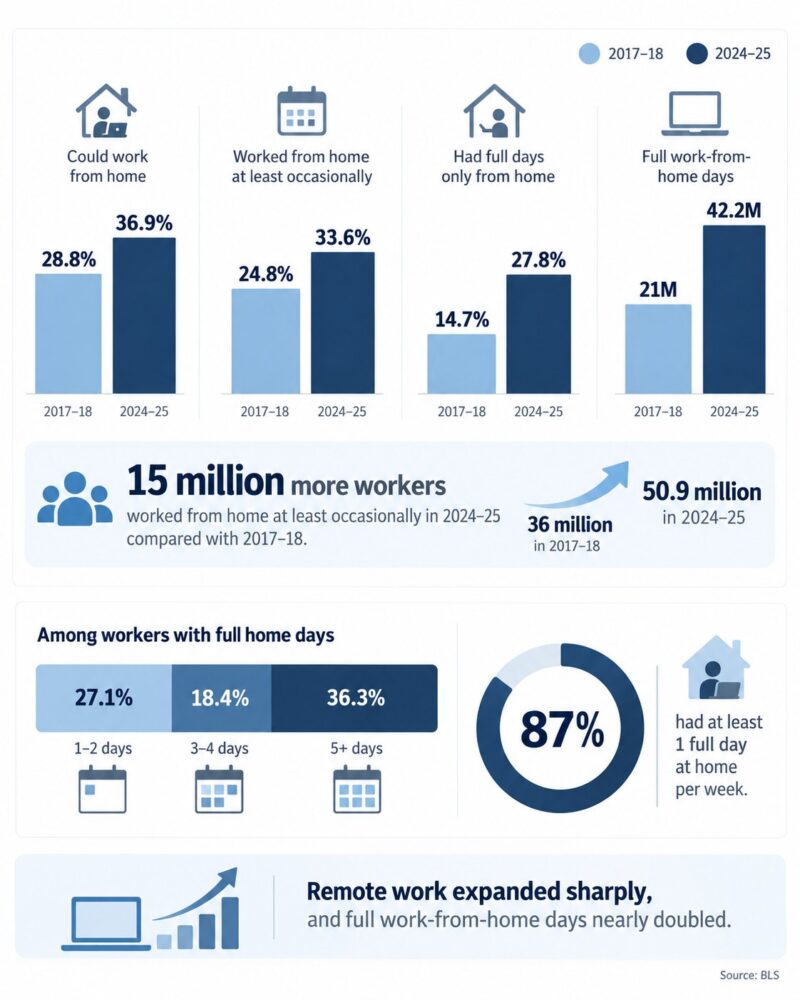
More Than 42 Million Have Entire Workdays at Home
The 51 million total does not tell us how frequently people stay home. The detailed BLS work-from-home schedule data gives us a better idea of how hybrid and fully remote arrangements divide up.
About 42.2 million people reported having days when they worked entirely from home. Among that group, 87% had at least one full work-from-home day per week.
| Frequency of Full Days at Home | Share of Workers With Full Home Days |
|---|---|
| 1 to 2 days per week | 27.1% |
| 3 to 4 days per week | 18.4% |
| 5 or more days per week | 36.3% |
The first two groups give us the clearest picture of hybrid work. A large part of the workforce is dividing the week between home and another workplace rather than choosing one location for every working day.
BLS does not classify all 51 million people as “hybrid workers.” Some only work from home occasionally, and others are fully remote. The 51 million figure is best understood as the number of employees for whom working from home is part of their job at least some of the time.
Finance and Information Jobs Have the Highest Work-From-Home Rates
Remote access depends heavily on industry. In financial activities, 76.2% of employees worked from home at least occasionally. Information followed at 69%, while professional and business services reached 62.8%.
The industry breakdown from BLS falls sharply once work requires a person, machine, customer or physical location to be present.
| Industry | Worked From Home at Least Occasionally |
|---|---|
| Financial activities | 76.2% |
| Information | 69.0% |
| Professional and business services | 62.8% |
| Manufacturing | 33.3% |
| Education and health services | 28.1% |
| Construction | 20.1% |
| Wholesale and retail trade | 17.7% |
| Leisure and hospitality | 7.2% |
The occupation data makes the difference even clearer. About 67.8% of people in management, business and financial occupations worked from home at least occasionally. The rate was 48.3% for professional occupations.
At the other end, only 1.8% of transportation and material-moving workers did some work from home. Production occupations were at 5.6%, service jobs at 6.5%, and construction and extraction at 6.6%.

Higher-Paid Workers Have Much More Access to Remote Work
The gap by earnings is one of the strongest findings in the report.
Among full-time employees in the highest earnings quartile, 66.7% worked from home at least occasionally. Only 12% of people in the lowest earnings quartile did the same.
| Earnings Group | Worked From Home |
|---|---|
| Lowest 25% | 12.0% |
| 25th to 50th percentile | 29.6% |
| 50th to 75th percentile | 44.6% |
| Highest 25% | 66.7% |
Education shows a similar divide. Among workers age 25 and older, 57.1% of people with a bachelor’s degree or higher worked from home at least occasionally. The rate fell to 27.1% for people with some college education or an associate degree and 15.3% for high school graduates with no college.
Remote work therefore reaches far more people in higher-paid professional jobs than in many of the occupations where employees have to be physically present.
Parents Are More Likely to Work From Home
Parents living with children under 18 had a work-from-home rate of 38.1%, compared with 31.5% among workers who did not have children under 18 living at home.
The reason also differs. According to the BLS breakdown of why people work from home, 19% of parents who worked from home cited coordinating work with personal or family needs. The figure was 8% among workers without children under 18 at home.
Across all workers who spent time working from home, the largest reasons were job requirements at 32.7% and personal preference at 31.3%. Another 11.8% cited personal or family scheduling, while 10% said reducing commuting time or expense was the main reason.

Working From Home Also Comes With More Control Over Work Hours
Remote access and schedule control tend to appear together. About 78.1% of employees whose jobs could be done from home had flexible start and finish times. Among people who could not work from home, the figure was 44%.
The BLS schedule flexibility data also shows that 86% of employees with access to home working said taking an hour or two off during the working day would not be difficult. The share fell to 59.2% among people without the option to work from home.
One result has changed surprisingly little. About 57% of employees had flexible schedules in 2024-25. BLS also recorded roughly 57% in 2017-18. Working from home expanded substantially over that period, but the overall share of workers who could change their starting and finishing times barely moved.
The 51 Million Figure Is Different From Daily Work-From-Home Data
Another BLS release from June found that 35% of employed Americans did some or all of their work at home on days when they worked during 2025. The numbers look similar, but they measure different things.
The 2025 American Time Use Survey asks where people worked on a particular day. The new 51 million estimate asks if employees worked from home at least occasionally in their main job across the 2024-25 survey period.
The distinction is useful when reading headlines about remote work. One figure measures access and usual arrangements. Another measures what people actually did on a particular working day.
View this post on Instagram
Remote Access Is Now One of the Big Dividing Lines in the US Labor Market
The latest numbers show a workplace split that has little to do with a single national remote-work rate. Finance employees, managers and higher earners have extensive access to home working. Transportation, hospitality, production and many service workers largely do not.
That difference sits alongside other signs of an uneven labor market. Our latest US jobs report found payroll employment falling by 23,000 in July even as unemployment remained relatively low. Readers comparing conditions across the country can also follow our updated unemployment rates by state.
The clearest change in the new remote-work data is measurable over time. Around 36 million employees worked from home at least occasionally in 2017-18. The latest comparable estimate is 51 million, and the number with entire workdays at home has grown from about 21 million to more than 42 million.