
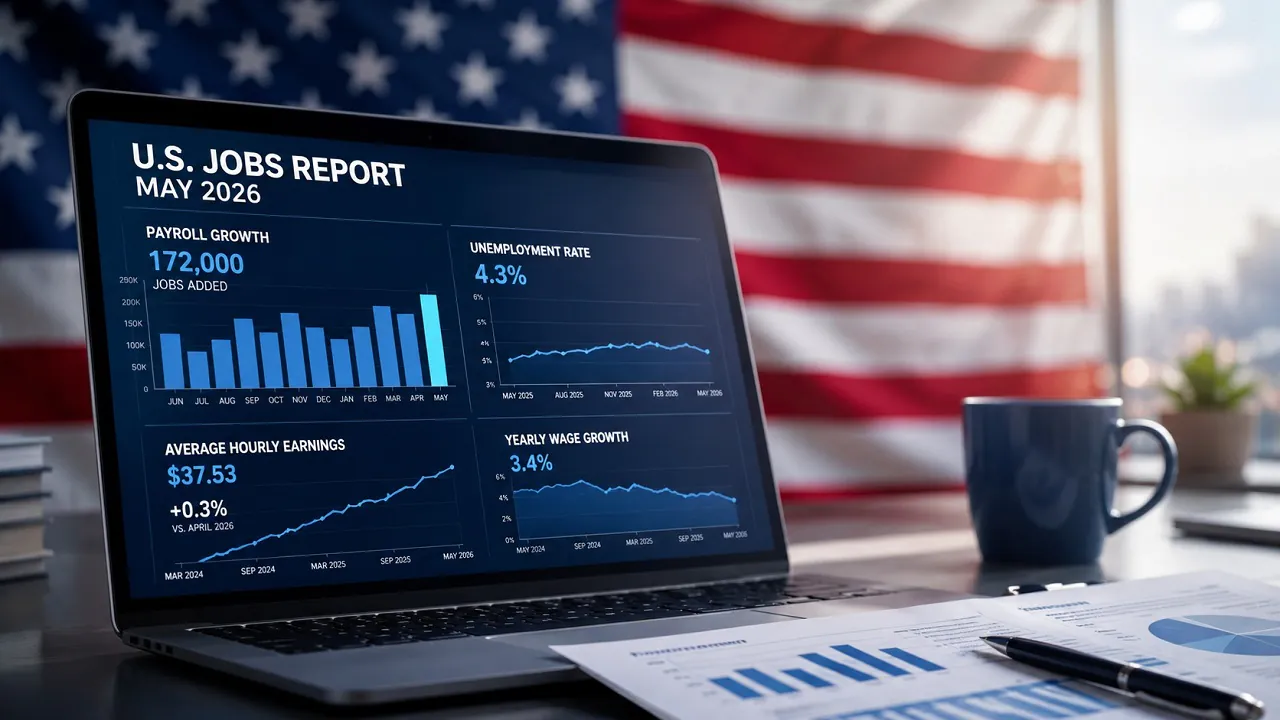
The U.S. economy added 172,000 jobs in May, beating pre-report expectations and showing that employers kept hiring even as the labor market cooled from earlier post-pandemic highs.
The unemployment rate held at 4.3%, according to the Bureau of Labor Statistics released Friday morning. The rate has stayed within a narrow 4.3% to 4.5% range since July 2025.
The Number Was Much Higher Than Forecasts
Economists had expected a much softer number, with several pre-release estimates around 80,000 to 85,000 new jobs. Instead, BLS reported 172,000 jobs, more than double the low end of those forecasts.
| Measure | May 2026 Result | Why It Matters |
|---|---|---|
| Nonfarm payrolls | +172,000 | Hiring was stronger than expected. |
| Unemployment rate | 4.3% | The jobless rate stayed stable for another month. |
| Unemployed people | 7.3 million | Little changed from April. |
| Labor force participation | 61.8% | Held steady in May. |
| Average hourly earnings | $37.53 | Up 12 cents, or 0.3%, from April. |
| Yearly wage growth | 3.4% | Pay is still rising, but not at the pace seen during the hottest labor market period. |
The headline number gives the report its punch. The deeper story is that hiring did not collapse, unemployment did not jump, and prior months looked better after revisions.
March And April Were Revised Higher
BLS also revised March and April payrolls up by a combined 93,000 jobs. March was raised from 185,000 to 214,000, while April was raised from 115,000 to 179,000.
View this post on Instagram
A post shared by Acting Secretary Sonderling (@sonderling47)
That matters because one monthly jobs report can be noisy. Upward revisions make the spring labor market look more stable than the first estimates suggested.
For readers following the broader employment picture, that fits with our earlier look at job market trends and hiring plans, where the central question was whether employers were pulling back or simply hiring more carefully.
Where The Jobs Were Added
Job gains came mainly from leisure and hospitality, local government and health care. Financial activities lost jobs.
| Sector | May Change | What Stood Out |
|---|---|---|
| Leisure and hospitality | +70,000 | Food services and drinking places added 48,000 jobs. |
| Local government | +55,000 | Most of the gain came outside local government education. |
| Health care | +35,000 | Ambulatory health care services added 26,000 jobs. |
| Social assistance | +12,000 | Individual and family services led the gain. |
| Financial activities | -22,000 | Insurance carriers and commercial banking lost jobs. |
Health care remains one of the most reliable hiring engines in the economy. We previously covered that pressure in our report on how many people work in the U.S. health industry, and the May numbers show that demand for care workers is still feeding payroll growth.
The Unemployment Rate Looks Stable, But Not Perfect
The 4.3% unemployment rate is not alarming by historical standards. It also does not mean every worker is seeing an easy job market.
BLS reported 2.0 million long-term unemployed people in May, meaning people out of work for 27 weeks or more. That group was little changed from April but was up by 524,000 over the year. Long-term unemployed workers made up 27.5% of all unemployed people.
Part-time employment for economic reasons was also little changed at 4.8 million. Those are people who wanted full-time jobs but were working part time because hours were cut or full-time work was unavailable.
That is why the report reads as stable, not perfect. The economy added jobs, yet some workers are still dealing with longer job searches and weaker bargaining power than they had a few years ago.
Wages Rose, But The Fed Will Still Watch Inflation
Average hourly earnings for private-sector workers rose 0.3% in May to $37.53. Over the past year, wages rose 3.4%.
For workers, that means pay is still moving up. For the Federal Reserve, it means the labor market is not weak enough to make rate cuts an obvious call on its own.
A stronger-than-expected jobs report can reduce pressure on the Fed to cut rates quickly. The next argument will turn on inflation, consumer spending and whether hiring keeps holding up through summer.
What The Report Means For Workers
For job seekers, the May report sends a mixed but usable message. Hiring is still happening, especially in services, health care, local government and food-related businesses. At the same time, the long-term unemployment number shows that finding work is not easy for everyone.
Workers in finance, transportation and some office-heavy sectors may feel a different labor market than workers in health care or hospitality. BLS said financial activities employment fell by 22,000 in May and is down by 107,000 since a recent peak in May 2025.
People in industries affected by immigration policy and labor shortages should also watch the next few months closely. We previously looked at that issue in our report on how deportation policy could affect jobs and construction.
What Comes Next
The June jobs report is scheduled for release on July 2 at 8:30 a.m. ET. That report will show whether May was a one-month upside surprise or part of a more durable hiring pattern.
The next few readings will matter because the economy is sitting between two signals. Employers are still adding jobs, but unemployment is above the very low levels seen during the hottest part of the labor market. Wage growth is positive, but workers are no longer seeing the same rush of leverage that defined earlier years.
Bottom Line
The May jobs report came in better than expected: 172,000 jobs added, unemployment steady at 4.3%, wages up 0.3%, and March-April hiring revised higher by 93,000 jobs.
That is good news for the economy, but it is not a clean victory lap. Long-term unemployment is higher than a year ago, financial activities lost jobs, and workers in different industries are feeling very different versions of the same labor market.
The simplest read is this: the U.S. job market is still growing, and it is holding up better than forecasts suggested. The next test is whether that strength survives into summer.
Related Posts:
- June 2026 Jobs Report Shows Hiring Slowed To 57,000…
- July 2026 Jobs Report Shows US Lost 23,000 Jobs as…
- Hospitals Added 15,000 Jobs in March, but Nurse…
- Most Gen Z Workers Cannot Afford to Live Alone, New…
- Core Inflation Hit 3.4% In May, According To New PCE Report
- Unemployment Rate by State in 2026 - Latest Us…