


Morgan State University will launch a Bachelor of Science in Artificial Intelligence in fall 2026 through its School of Computer, Mathematical and Natural Sciences.
Students will receive preparation in the development, deployment, and responsible management of artificial intelligence systems.
Workforce demand for graduates with advanced AI skills spans several major sectors:
- Healthcare
- Business
- Government
- Cybersecurity
- Scientific research
Morgan State designed the program to address that demand while connecting computer science fundamentals with emerging AI technologies.
Coursework will prepare students to create intelligent systems, evaluate their performance, and manage their use responsibly.
@cbsbaltimore Morgan State University is launching a new Bachelor of Science in Artificial Intelligence this fall to help prepare students for the next era of innovation. The new undergraduate program, offered through the School of Computer, Mathematical and Natural Sciences, is designed to prepare students to design, develop and responsibly deploy artificial intelligence systems across a wide range of industries. #MorganState #MorganStateUniversity #ArtificialIntelligence #AI #Baltimore #Maryland #HigherEducation #Technology #WJZ #ForYouPage #FYP #ExplorePage ♬ original sound WJZ
Program Development
A complete redesign of Morgan State’s former Bachelor of Science in Cloud Computing created the new degree.
Program planners did not simply add several artificial intelligence electives to the existing curriculum. Instead, they developed a comprehensive undergraduate program centered on AI theory, technical development, practical applications, and responsible use.
- Morgan State University Board of Regents
- Maryland Higher Education Commission
Morgan State already offers 18 artificial intelligence courses.
Organizing those courses into a dedicated bachelor’s degree will give students a structured academic path through foundational and advanced subjects.
Cloud computing will continue to play an important role in the curriculum.
Modern AI systems often rely on cloud infrastructure for model training, deployment, storage, development, and large-scale computing.

Hands-On Learning
Every artificial intelligence and machine-learning course will include hands-on projects created by Morgan faculty and students.
Practical assignments will let learners apply classroom concepts through software development, model training, experimentation, testing, and analysis.
Undergraduate research will give students opportunities to apply AI to real-world problems.
Research participation can also strengthen analytical skills and provide experience with technical collaboration.
Completed projects and research activities will help students build portfolios for internships, graduate school, and employment.
Portfolios may demonstrate programming ability, technical knowledge, research experience, and problem-solving skills to prospective employers or academic programs.
Academic and research support will include three key resources:
- Faculty mentors who provide subject guidance and research supervision
- Graduate students who assist with projects and advanced technical work
- An AI-powered advising platform developed by Morgan State’s Department of Computer Science
Technical education also requires clear reports, research papers, and project documentation.
Students balancing those assignments can find write my essay support through DoMyEssay while managing programming projects and research tasks.
Key Courses
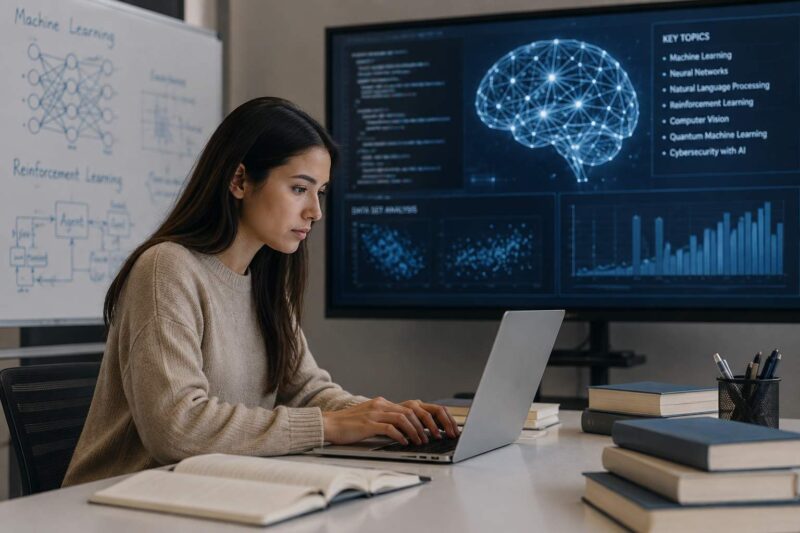
- Artificial intelligence models and intelligent agents that process information, make decisions, and complete assigned tasks
- Machine learning methods that identify patterns and improve system performance through data
- Reinforcement learning systems that learn through actions, feedback, rewards, and penalties
- Natural language processing for text analysis, language generation, information retrieval, and conversational systems
- AI-powered cybersecurity, including agentic AI for cyberthreat detection and analysis
- Quantum machine learning connecting quantum computing concepts with machine-learning methods
Supporting coursework will include programming, mathematics, data science, computational theory, and cloud computing applications.
Combined instruction across these subjects will help students analyze, design, test, and operate AI systems.
Exposure to quantum machine learning at the undergraduate level may prepare students for advanced research involving emerging computational technologies.
Agentic cybersecurity instruction will also introduce methods that use autonomous or partially autonomous systems to identify suspicious behavior and support security operations.
Ethics and Responsible AI
Responsible artificial intelligence will hold a central place in the curriculum.
Students will learn how technical decisions can affect individuals, organizations, and communities.
Classroom analysis will address several ethical and operational concerns:
- Fairness in automated decisions
- Algorithmic bias and harmful outcomes
- Privacy and sensitive data protection
- Transparency in model behavior
- Security controls for AI systems
- Trustworthy development and human oversight
AI systems increasingly influence employment, education, healthcare, finance, and public policy.
Errors, security failures, or biased outcomes in those areas can create serious consequences.
Coursework will ask students to consider how data is collected, how models are trained, how automated decisions are evaluated, and how organizations communicate system limitations.
Graduates will learn to create and manage AI technologies responsibly, not simply operate existing tools.
Career and Social Impact
- Artificial intelligence
- Machine learning
- Robotics
- Cybersecurity
- Cloud computing
- Data science
Professional responsibilities could include software development, model design, security analysis, research, infrastructure management, data analysis, or intelligent-system deployment.
Preparation in mathematics, programming, computational theory, and data science will support work across these technical specialties.
Advanced coursework can also open access to emerging research and career opportunities.
Quantum machine learning may lead students toward new computational methods, while agentic cybersecurity may prepare them to work with automated threat detection and analysis.
Morgan State’s status as a historically Black university gives the program added social significance.
Black professionals are underrepresented in many artificial intelligence and advanced technology fields.
A dedicated undergraduate AI degree can expand access to technical education, research experience, mentorship, and career preparation for Black students.
Integrated Technical Preparation

Morgan State’s curriculum will connect theoretical instruction with the computing skills required to build functional AI systems.
Programming, mathematics, data science, and computational theory will give students a technical base for advanced coursework.
Cloud computing applications will help students work with the infrastructure used to train, store, and deploy artificial intelligence models.
Quantum machine learning will introduce computational methods that could support later research or graduate-level study.
Students will also examine connections among intelligent agents, language technologies, machine learning, and cybersecurity. Coordinated study across these subjects will prepare graduates to approach complex technical problems using multiple AI methods.
FAQs
Summary
Morgan State University’s Bachelor of Science in Artificial Intelligence will combine advanced subjects such as quantum machine learning and agentic cybersecurity with solid instruction in mathematics, programming, data science, cloud computing, and computational theory.
Hands-on projects, undergraduate research, faculty mentorship, graduate-student support, and AI-powered advising will connect academic instruction with career preparation.
Students will gain practical experience and portfolio materials that can support employment, internships, or graduate study.