

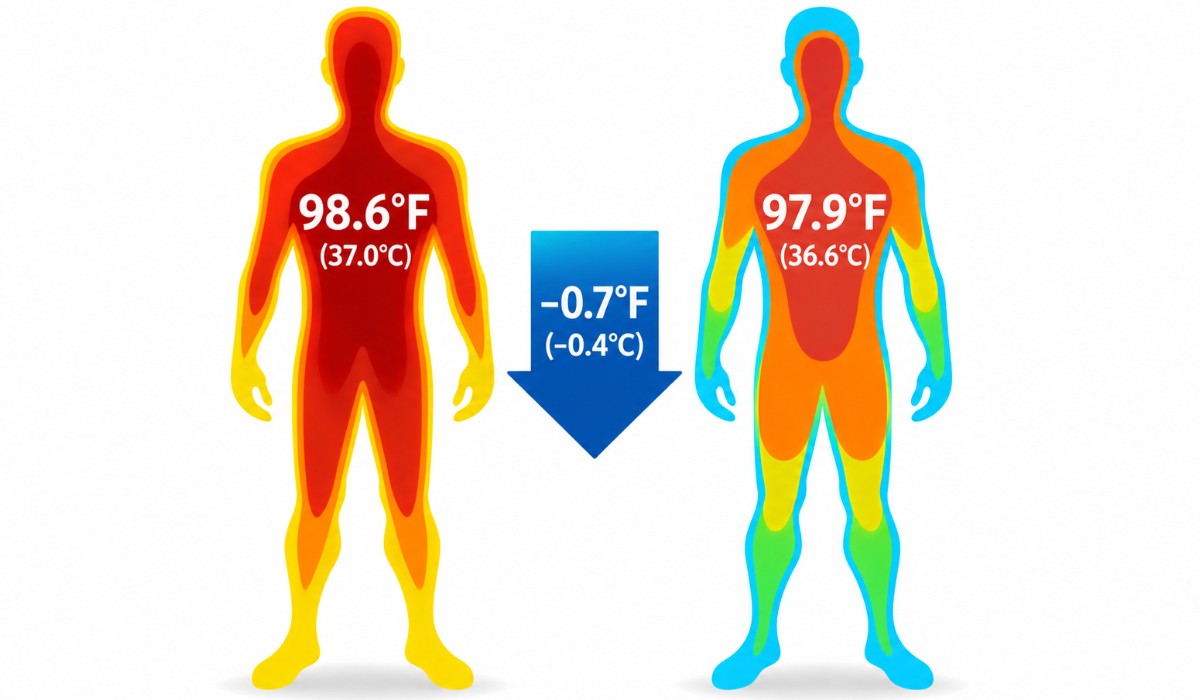
For more than a century, 98.6°F was the number everyone knew. Doctors used it as a reference, parents remembered it, and generations grew up believing that a healthy human body should register exactly 37°C.
But scientists have found something unexpected. Average human body temperature appears to have fallen over the past 150 years.
Research involving hundreds of thousands of temperature readings suggests that people today run slightly cooler than their ancestors. The difference is small, but it raises an interesting question. What changed inside our bodies?
Researchers have several possible explanations, including fewer infections, better healthcare and the comfortable temperatures of modern homes. They also have evidence that the familiar 98.6°F benchmark was never particularly accurate for everyone.
How Much Has Human Body Temperature Dropped?
A major Stanford University study, published in 2020, compared American body temperature records collected between the 1860s and 2017.
The researchers analyzed 677,423 measurements across three datasets, including records of Civil War veterans and patients receiving modern medical care.
Men born in the early 1800s had average temperatures about 0.59°C, or 1.06°F, higher than men born in recent decades. Among women, researchers identified a decline of 0.32°C, or 0.58°F, across the shorter historical period available.
The results showed a decline of about 0.03°C per birth decade.
| Research Finding | Result |
|---|---|
| Traditional reference temperature | 98.6°F (37°C) |
| Average in a 2023 Stanford study | 97.95°F (36.64°C) |
| Historical decline among American men | 0.59°C |
| Historical decline among American women | 0.32°C |
| Estimated decline per birth decade | 0.03°C |
The figures come from different studies and populations. They show the scale of the findings rather than a single continuous measurement of the same group of people.
Is 98.6°F Still a Normal Body Temperature?
Yes, but it isn’t the only normal temperature.
In 2023, Stanford researchers published another study involving 618,306 outpatient visits. After filtering out readings associated with conditions likely to affect temperature, they calculated an average oral temperature of 36.64°C, or 97.95°F.
No subgroup in the study had an average temperature reaching 37°C.
The 2023 temperature research also identified differences associated with age, sex, height, weight and time of day.
98.6°F Compared With the Newer Research Average
Human Body Temperature Comparison
Source: Stanford University research published in JAMA Internal Medicine, 2023.
For someone whose usual temperature is 97.5°F, a reading of 99.5°F could represent a noticeable increase. Another healthy person might regularly register closer to 98.6°F.
A person’s normal temperature can also rise and fall throughout the day without indicating illness.
The Same Cooling Trend Appeared in the Amazon Rainforest
Researchers might have attributed the American findings to modern hospitals, office jobs and air conditioning. Then scientists studying Indigenous communities in Bolivia found a similar pattern.
The Tsimane people live in the Bolivian Amazon, where many communities depend on farming, fishing and hunting.
Researchers collected 17,958 temperature readings involving 5,481 adults between 2002 and 2018.
In the early years, average temperatures were close to 37°C. By the end of the study, they had fallen to about 36.5°C.
The Bolivian temperature study was published in Science Advances in 2020.
The decline happened much faster than the historical trend reported in the United States. Researchers considered changes in infections, physical activity, body composition and medical treatment, but none fully explained the drop.
Why Are Humans Getting Colder?
Scientists have proposed several explanations. The available research hasn’t established a single cause.
1. Fewer Infections May Mean Less Body Heat
In the 1800s, tuberculosis, untreated dental infections and other inflammatory illnesses were common.
Fighting infections uses energy. Persistent inflammation can increase metabolic activity and raise body temperature.
Vaccination, antibiotics, clean water and improved sanitation have reduced many of those infections. A population spending less time fighting disease could consequently have a lower average temperature.
2. Heating and Air Conditioning Changed Daily Life
Imagine spending a winter in a poorly heated house during the 1800s. Maintaining body temperature would involve greater exposure to cold than many people experience inside modern homes.
Central heating and air conditioning now keep indoor temperatures relatively stable.
Researchers have proposed that comfortable indoor conditions reduce the energy the body needs for temperature regulation. However, the findings in Bolivia show that air conditioning alone cannot explain the wider trend.
3. Human Metabolism May Have Changed
Body temperature is connected to metabolism, the process through which the body uses energy.
Changes in physical activity, body composition, diet and health could influence how much heat people produce at rest.
Scientists haven’t established how much each factor contributes to the historical decline.
Normal Body Temperature Changes Throughout the Day
Someone taking their temperature at 6 AM may get a different result at 5 PM, even without becoming ill.
Body temperature follows a daily rhythm. It generally reaches lower levels during the early morning and rises toward the late afternoon or evening.
Age, activity and individual physiology also affect the reading.
| Factor | Typical Effect |
|---|---|
| Older age | Lower average temperature |
| Time of day | Lower in the morning, higher later |
| Physical activity | Can temporarily increase temperature |
| Menstrual cycle | Temperature can rise after ovulation |
| Measurement method | Oral, ear, forehead and armpit readings may differ |
A single reading therefore provides less information than the temperature combined with symptoms, measurement method and the person’s usual pattern.
Does a Lower Normal Temperature Change What Counts as a Fever?
The research doesn’t mean people should ignore a fever or replace established medical thresholds with one new number.
The U.S. National Library of Medicine explains that fever thresholds depend partly on the measurement method and time of day.
Adults may have a fever when an oral temperature rises above 99°F to 99.5°F.
Other clinical guidance commonly uses 100.4°F (38°C) as a fever threshold.
A person feeling seriously unwell can need medical attention even without reaching that temperature. Older adults and people with weakened immune systems may show less pronounced fever responses.
Temperature readings that are dangerously high or abnormally low require prompt attention, especially when accompanied by confusion, difficulty breathing or other serious symptoms.
Could the Original 98.6°F Reading Have Been Wrong?
The familiar number dates to work by German physician Carl Wunderlich in the 19th century.
Wunderlich studied an enormous collection of temperature readings, primarily measured under patients’ arms. His findings helped establish 37°C as the traditional reference.
But older mercury thermometers differed from modern instruments. Measurement methods, calibration and the populations being studied could all have influenced the result.
Stanford researchers considered the possibility of measurement differences when analyzing historical records.
They found that people born earlier tended to have higher temperatures even when readings came from the same historical dataset. That makes changes in instruments an unlikely explanation for the entire decline.
What the Research Reveals About Human Health?
Our ancestors lived with infections that modern medicine can often prevent or treat. Many also spent more time in buildings without reliable heating or cooling.
Scientists suspect those changes have influenced the amount of heat produced by the human body, although the exact contribution of each remains uncertain.
The decline is measurable across different populations, but it doesn’t mean every person today is cooler than someone living 150 years ago.
For everyday health, knowing your usual temperature may be more useful than trying to reach exactly 98.6°F. A thermometer reading becomes more informative when considered alongside symptoms, time of day and the way it was measured.
The traditional number hasn’t disappeared from medicine. Researchers have simply found that healthy human temperatures cover a wider range than generations were taught.