
The population of Denver is estimated at 739,635 in 2026, making it the largest city in Colorado and one of the 25 most populous cities in the United States.
The estimate is based on the latest official figure from the U.S. Census Bureau, which placed the population at 740,613 on July 1, 2025. Denver lost 978 residents between the 2024 and 2025 estimates, a decline of 0.13%. Extending that most recent annual change into 2026 produces an estimate of 739,635.
One year of modest decline does not erase the longer pattern. The population of Denver has grown by 25,104 residents since the April 2020 estimates base and by more than 140,000 since the 2010 Census. Growth has slowed considerably from the pace recorded during the 2010s, but Denver remains larger than it was before the pandemic and continues to anchor a metropolitan area of more than 3.09 million people.
Key Takeaways
- The population of Denver is estimated at 739,635 in 2026.
- The latest official Census estimate counted 740,613 residents on July 1, 2025.
- The population declined by 978 between 2024 and 2025 but remained 3.5% above the April 2020 estimates base.
- The Denver-Aurora-Centennial metropolitan area had 3,092,037 residents in 2025.
- Adults between 18 and 64 account for 69.5% of the population.
- The median household income is $94,718, while 11.2% of residents live below the poverty line.
- The typical home value was $538,992 in June 2026, down 3.4% over the previous year.
- The unemployment rate in the Denver metropolitan area was 3.6% in May 2026.
How Many People Live in Denver in 2026?
The best current estimate places the population of Denver at 739,635 in 2026. An official Census estimate for July 2026 will not be available until a later population-estimates release, so the figure should be understood as a projection based on the latest annual change rather than a completed head count.
The latest official data show that the population reached 741,591 in 2024 before slipping to 740,613 in 2025. Denver therefore remained close to its recent peak, even though the rapid gains that defined much of the previous decade have eased.
| Year | Population | Annual Change |
|---|---|---|
| 2010 Census | 600,158 | Not applicable |
| 2020 Census | 715,522 | Not applicable |
| 2020 estimate | 717,680 | Not applicable |
| 2021 | 712,156 | -5,524 |
| 2022 | 716,800 | +4,644 |
| 2023 | 726,763 | +9,963 |
| 2024 | 741,591 | +14,828 |
| 2025 | 740,613 | -978 |
| 2026 estimate | 739,635 | -978 |
The figures from 2020 through 2025 belong to the Census Bureau’s Vintage 2025 estimate series. Keeping the data within one vintage matters because the agency revises previous annual estimates whenever it publishes a new series. A 2024 number taken from the Vintage 2024 release should not be compared directly with the revised 2025 series.
The latest Census figures for Denver also correct a common geographic mistake. Denver is not located in Adams County. It is a consolidated city and county called the City and County of Denver. Adams County borders Denver and includes communities north and northeast of the city.
Denver Grew Rapidly During the 2010s
The 2010s changed the size and physical character of Denver. The population rose from 600,158 in the 2010 Census to 715,522 in 2020, an increase of 115,364 people or 19.2% in ten years.
New residents arrived during a period of strong job creation, apartment construction and redevelopment near downtown and along major transportation corridors. Central Park, formerly known as Stapleton, expanded on the former airport site, while neighborhoods around Union Station, River North, Five Points and West Colfax added substantial amounts of housing.
The pandemic interrupted that pattern. The annual estimate fell in 2021 as residents moved, household preferences changed and high housing costs pushed some people toward surrounding counties. Denver resumed growing in 2022 and recorded larger gains in 2023 and 2024 before the small decline in 2025.
The latest figures therefore point to slower and less predictable growth, not a return to the population levels of an earlier decade. The city still had 3.5% more residents in 2025 than at the April 2020 estimates base.
Denver City and the Denver Metro Area Are Different
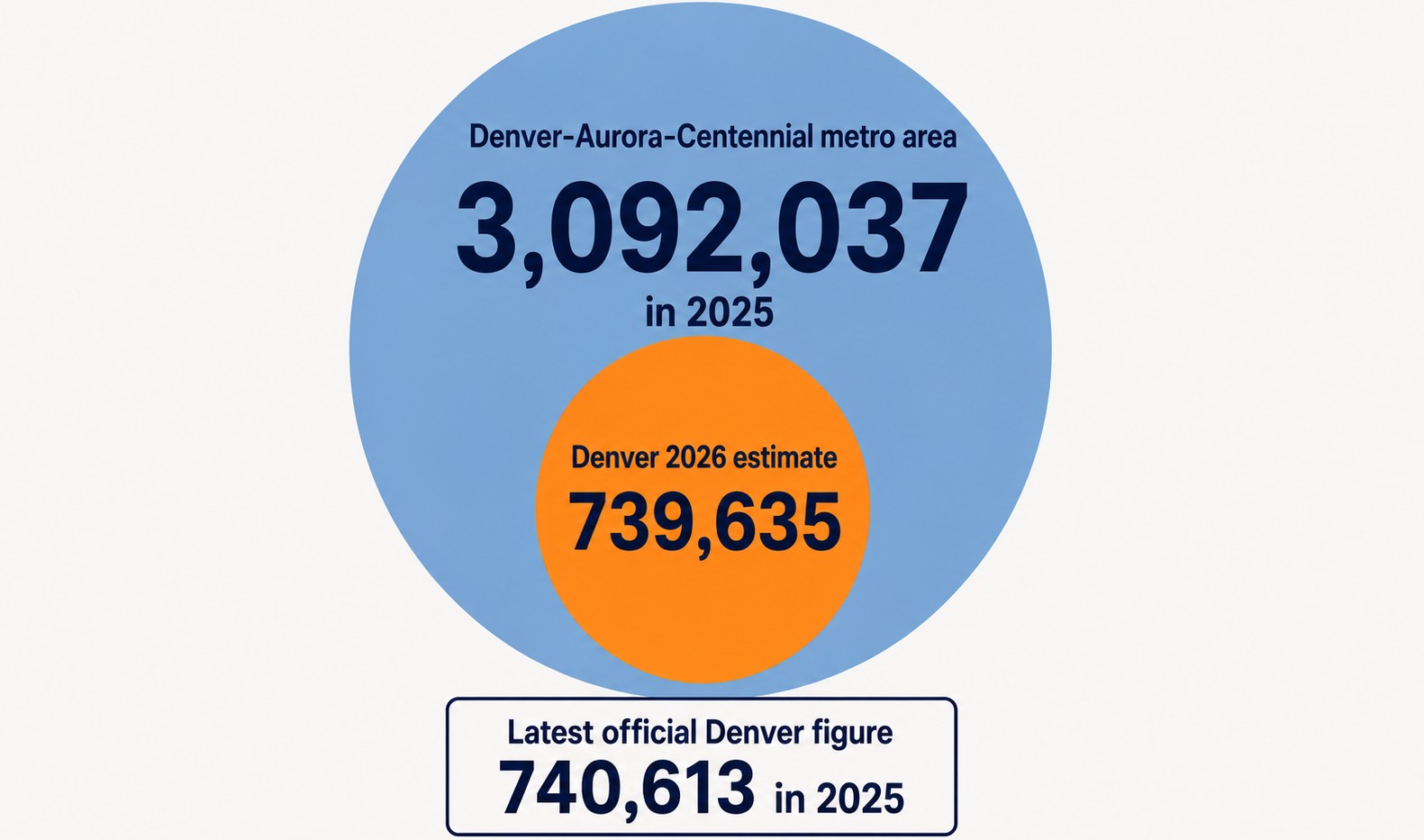
Population figures for Denver often appear to contradict one another because different sources use different geographic boundaries. A city estimate covers only the City and County of Denver. A metropolitan estimate includes Denver and surrounding communities connected through employment and commuting patterns.
| Geographic Area | Latest Population | What It Covers |
|---|---|---|
| City and County of Denver | 740,613 in 2025 | The consolidated municipal and county government of Denver |
| Denver 2026 estimate | 739,635 | A projection based on the latest annual city population change |
| Denver-Aurora-Centennial metro area | 3,092,037 in 2025 | Denver and surrounding counties linked by commuting and economic activity |
The metropolitan area includes major population centers such as Aurora, Lakewood, Thornton, Arvada, Westminster, Centennial and parts of the broader suburban ring. Someone who says that Denver has more than 3 million residents is usually referring to the metro area, not the city itself.
The distinction matters when comparing Denver with other cities. Municipal boundaries vary enormously across the United States, and a city with a large incorporated land area may appear more populous even when its wider urban region is similar in size.
Age and Gender in Denver
Denver has a large working-age population. Adults between 18 and 64 account for 69.5% of residents, while children under 18 represent 18.0%. Residents aged 65 and older account for 12.5%.
| Age Group | Share of Population |
|---|---|
| Under age 5 | 5.3% |
| Under age 18 | 18.0% |
| Ages 18 to 64 | 69.5% |
| Age 65 and older | 12.5% |
The age profile helps explain the high labor-force participation rate and the demand for apartments, smaller households and housing near employment centers. At the same time, the number of older residents is becoming more important for health care, accessible housing and transportation planning.
Women account for 49.5% of the population, while men account for 50.5%. The difference is small enough that the population is effectively balanced by sex.
Race, Ethnicity and Immigration
Denver has become more racially and culturally diverse as it has grown. White residents account for 59.3% of the population when counted as a racial category, while Black residents account for 9.0% and Asian residents account for 3.7%. People identifying with two or more races represent 18.1%.
| Race or Ethnicity | Share of Population |
|---|---|
| White alone | 59.3% |
| Black or African American alone | 9.0% |
| Asian alone | 3.7% |
| American Indian and Alaska Native alone | 1.0% |
| Native Hawaiian and Other Pacific Islander alone | 0.2% |
| Two or more races | 18.1% |
| Hispanic or Latino | 28.0% |
| White alone, not Hispanic or Latino | 54.0% |
Hispanic or Latino origin is recorded separately from race, so the Hispanic share overlaps with several racial categories and should not be added to them. More than one in four Denver residents identifies as Hispanic or Latino.
Foreign-born residents account for 14.5% of the population, and 23.9% of people aged five and older speak a language other than English at home. Immigration has influenced the labor force, schools, neighborhood businesses and demand for local services, particularly in western and northeastern parts of the city.
Households and Housing
Denver has 335,428 households, with an average of 2.10 people per household. The relatively small household size reflects the city’s large population of single adults, couples without children and residents living in apartments or other compact housing.
Homeownership remains below the national rate. Owner-occupied homes account for 48.8% of occupied housing, meaning renters form a slight majority of Denver households. The Census median value of an owner-occupied home was $616,000 during the 2020–2024 survey period, while median monthly housing costs for owners with a mortgage were $2,466. Median gross rent was $1,831.
| Housing Measure | Denver Figure |
|---|---|
| Households | 335,428 |
| People per household | 2.10 |
| Owner-occupied housing rate | 48.8% |
| Median owner-occupied home value | $616,000 |
| Median monthly owner costs with a mortgage | $2,466 |
| Median gross rent | $1,831 |
More recent market data show that prices have softened from their earlier highs. According to Denver housing data through June 2026, the typical home value was $538,992, down 3.4% over the previous year. Homes took a median of 18 days to move into pending status, while the average asking rent was $1,877, down 1.4% from a year earlier.
The Census value and the Zillow figure measure different things. The Census number is a survey-based median reported by owner-occupants over a five-year period, while Zillow’s index estimates the typical market value of homes at a specific point in time. Neither figure means that a typical household can comfortably afford to purchase a home at the stated price.
Housing supply remains central to the population outlook. Denver issued 4,727 building permits in 2025 and had 375,287 housing units by July of that year. New construction allows the city to accommodate more residents, but the type, price and location of those homes determine who can remain in Denver as costs change.
Income, Education and Poverty
The median household income in Denver is $94,718, measured in 2024 dollars using the latest five-year Census figures. Per-capita income is $64,163, and 11.2% of residents live below the federal poverty line.
| Economic Measure | Denver Figure |
|---|---|
| Median household income | $94,718 |
| Per-capita income | $64,163 |
| Residents below the poverty line | 11.2% |
| High school graduates among adults 25 and older | 91.2% |
| Adults 25 and older with a bachelor’s degree or higher | 56.5% |
| Civilian labor-force participation rate | 74.2% |
Denver combines high earnings with high living costs. A household income that would provide considerable purchasing power in many parts of the country may be stretched by local rent, home prices, child care, transportation and insurance costs.
The city also has a highly educated workforce. More than half of adults aged 25 and older hold at least a bachelor’s degree, supporting employment in professional services, technology, health care, finance, government and other fields that require specialized training. Educational attainment is not evenly distributed across neighborhoods, however, and the city continues to contain wide differences in income and economic security.
The Denver Labor Market in 2026
The Denver-Aurora-Centennial metropolitan labor market contained 1.73 million people in May 2026. Employment stood at 1.67 million, while 63,200 people were unemployed. The resulting unemployment rate was 3.6%, according to the latest Bureau of Labor Statistics metropolitan data.
| Labor Measure | May 2026 |
|---|---|
| Civilian labor force | 1,733,200 |
| Employment | 1,670,100 |
| Unemployment | 63,200 |
| Unemployment rate | 3.6% |
| Total nonfarm employment | 1,639,800 |
| Annual change in nonfarm employment | -0.6% |
The unemployment rate was lower than the national rate, although total nonfarm employment was 0.6% below its level from a year earlier. That combination suggests employers were not adding jobs at the pace seen during stronger growth periods, even though most people seeking work were still employed.
Where Population Growth Is Occurring
Growth within Denver has not been spread evenly across the city. Northeastern areas such as Central Park, Gateway-Green Valley Ranch and Montbello have absorbed new housing and residents, while redevelopment has added apartments and condominiums to parts of Five Points, Union Station, River North and West Colfax.
Older central neighborhoods such as Capitol Hill, North Capitol Hill and Speer remain densely populated despite having limited land for large new subdivisions. Growth in such areas generally comes from replacing low-density buildings, redeveloping commercial properties or adding smaller residential projects.
Neighborhood population lists should be treated carefully. Many published rankings rely on the 2020 Census or multiyear American Community Survey data, not direct 2026 counts. Older lists also sometimes include North Aurora, Delmar Parkway or Windsor as Denver neighborhoods even though those areas are associated with Aurora. Presenting them as part of Denver inflates the city total and confuses municipal boundaries.
Denver Compared With Other Cities
Denver remains the largest city in Colorado. The official 2025 estimate of 740,613 was well ahead of Colorado Springs at 494,743 and Aurora at 410,053. Readers can see the wider state trend in the latest figures for the population of Colorado.
National comparisons require more care. Denver has far fewer residents within its city limits than the population of New York City, but it occupies a central position in a metropolitan region with more than 3 million residents. The population of Phoenix is much larger at the municipal level partly because Phoenix incorporates a much broader land area.
Metro-area comparisons are often more useful for understanding regional labor markets, transportation systems and housing demand. City figures are better suited to questions involving municipal services, local elections, land-use decisions and the tax base.
Population growth has slowed, but long-term regional forecasts still point upward. The Denver Regional Council of Governments expects the wider region to reach 4.2 million residents, 1.86 million households and 2.96 million jobs by 2050, according to its regional growth forecast released in July 2026.
Accommodating that growth will involve more than building housing. Local governments will have to decide where homes are permitted, how residents reach jobs, whether water and utility systems can serve new development and how older roads, parks and public facilities are maintained.
Denver also faces a regional problem that cannot be solved entirely within city limits. Many people who work in Denver live in Aurora, Lakewood, Thornton, Westminster or other surrounding communities. Housing shortages or transportation problems in one jurisdiction affect commuting, hiring and household costs across the metropolitan area.
The latest Census analysis of metropolitan growth found that population gains slowed across much of the country between 2024 and 2025. Denver fits that broader pattern: a large and economically important metro area that is still attracting residents over the long term but no longer growing at the exceptional pace seen during the previous decade.
Methodology
The 2026 figure is calculated from the U.S. Census Bureau Vintage 2025 population series. The official estimate fell from 741,591 in 2024 to 740,613 in 2025, a change of 978 residents. Applying the same numerical change to the latest official estimate produces the following result:
The resulting 739,635 figure is an estimate for 2026, not an official Census count. Population projections can differ because publishers use different methods, geographic areas and data vintages. Figures for the city, county, metropolitan area and larger regional planning area should not be treated as interchangeable.
Age, race, income, education and household statistics come from the 2020–2024 American Community Survey figures presented through Census QuickFacts. Those values describe a five-year survey period and are the latest comprehensive demographic measures available, rather than real-time counts taken in 2026.
Frequently Asked Questions
What is the population of Denver in 2026?
The population of Denver is estimated at 739,635 in 2026. The figure extends the latest annual Census change from the official 2025 estimate of 740,613.
Is the population of Denver growing or declining?
The latest official annual estimate shows a small decline of 978 residents between 2024 and 2025. Over the longer period from April 2020 to July 2025, the population grew by 25,104, or 3.5%.
How many people live in the Denver metro area?
The Denver-Aurora-Centennial metropolitan area had 3,092,037 residents in 2025. The metropolitan figure includes surrounding counties and cities, while the Denver city figure covers only the City and County of Denver.
Is Denver in Adams County?
No. Denver is a consolidated city and county officially known as the City and County of Denver. Adams County borders Denver to the north and northeast but is a separate local government.
Is Denver the largest city in Colorado?
Yes. Denver is the largest city in Colorado by population, followed by Colorado Springs and Aurora.
How densely populated is Denver?
Denver covers 153.08 square miles of land. Using the official 2025 estimate, the city had 4,838 residents per square mile.
Why do different websites report different Denver population figures?
Differences usually come from geography, timing or methodology. Some sources report the city, others report the metropolitan area, and some publish projections rather than official estimates. Census estimates are also revised when a new data vintage is released.