

U.S. airline fares were 26.5 percent higher in June 2026 than in June 2025, according to the Bureau of Labor Statistics Consumer Price Index. The increase far exceeded the 3.5 percent rise in overall consumer prices, making flying one of the fastest-rising household expenses during the period.
A fare that cost $300 a year earlier would equal $379.50 after a 26.5 percent increase, although actual prices vary sharply by route and travel date.
The figure measures nationwide price movement for comparable leisure trips. It does not mean that every available ticket rose by exactly 26.5 percent. June also offered a mixed near-term signal: the unadjusted airfare index fell 1.8 percent from May, while the seasonally adjusted measure rose 0.2 percent.
What Does the 26.5 Percent Increase Actually Measure?
Airline fares have jumped 26.5% year-over-year, according to the June consumer price index published by the Bureau of Labor Statistics. However, travelers can combat rising airfare costs by using travel rewards, credit card points and companion passes. https://t.co/MomdXGwTZb
— Forbes Advisor (@ForbesAdvisor) July 24, 2026
The 26.5 percent figure is a year-over-year change in the BLS airline fares index, not an average U.S. ticket price stated in dollars.
BLS tracks regularly scheduled domestic and international trips departing from cities in its Consumer Price Index sample.
Business travel is excluded, and most observations involve discount fares, including basic economy and lower-priced main-cabin tickets. The agency explains the sampling process in its airline fares methodology.
Researchers keep important trip details consistent, including advance-booking time and day of travel. Applicable taxes, fuel surcharges, airport charges, security fees and the first checked bag are included where assigned. Carry-on charges and extra checked bags are not tracked.
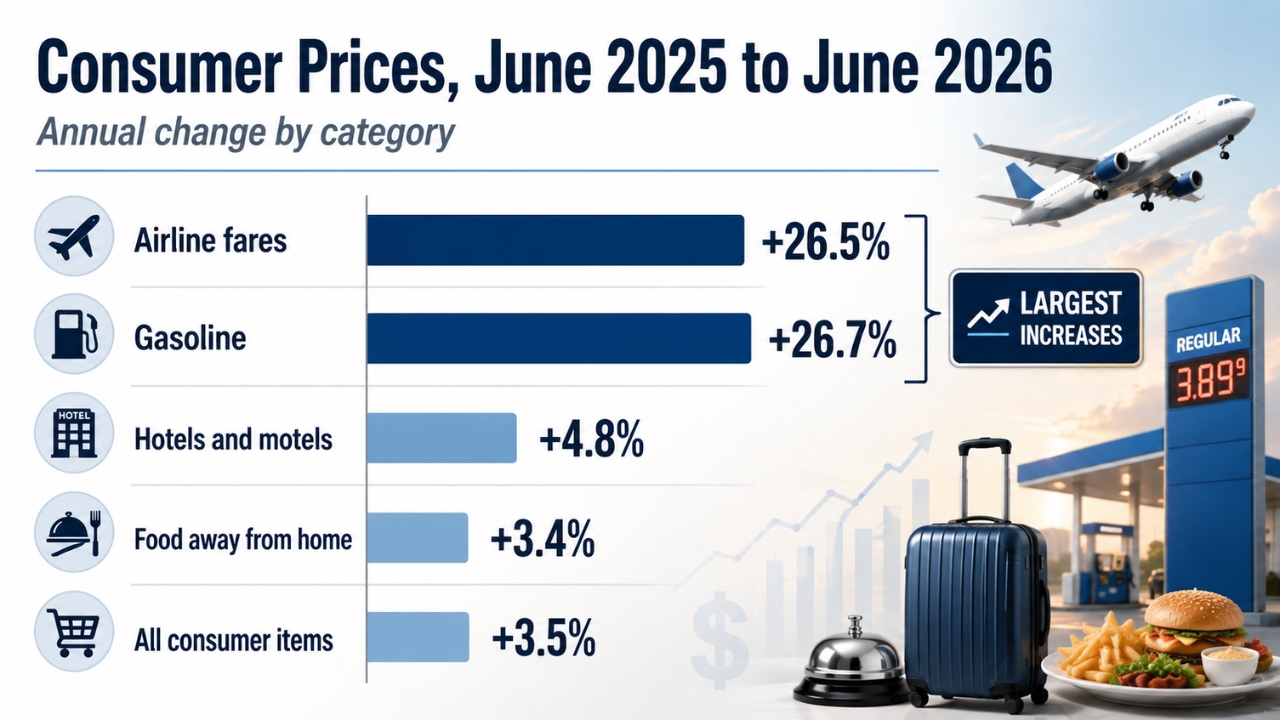
Airfare inflation therefore ran at more than seven times the overall inflation rate. Gasoline posted a nearly identical annual increase, pointing to the wider energy shock affecting transport costs.
Why Are Plane Tickets So Expensive in 2026?
@executivetravelinsider Your flights are more expensive and it’s not going away soon. Here’s what business travelers need to know 👇 #businesstravel #corporatetravel #airfare #executivetravel #travelhacks ♬ original sound – Executive Travel Insider
Higher jet fuel costs are the clearest immediate pressure. Strong demand and restrained capacity have also given airlines room to pass part of the increase to passengers.
Reuters reported that U.S. jet fuel spot prices climbed nearly 30 percent between July 2 and July 22, reaching $3.59 per gallon. American Airlines said its projected fuel bill for the remainder of 2026 rose by almost $1.6 billion in only 13 days.
Fuel can become more expensive quickly, but higher fare revenue arrives gradually because price changes mainly affect tickets sold later.
Carriers have recovered only part of the shock. American said fare gains covered nearly half of its year-over-year increase in second-quarter fuel expense. Delta recovered about 60 percent, while United recovered roughly half. Upward pressure may persist when fuel remains volatile.
Demand matters as well. Strong bookings combined with limited seat capacity allow carriers to raise prices without immediately losing enough customers to reverse course. A lightly served route with one dominant carrier may react differently from a busy corridor where several airlines compete.
Why Some Travelers Will Pay Far More Than Others
A national index cannot predict the price of one journey. Route competition and departure timing often matter more than the headline rate. Cabin choice and access to alternative airports can also change the final cost.
The U.S. Department of Transportation compares thousands of domestic city-pair markets and tracks low-cost carrier competition. Its domestic airfare report shows how prices vary by airline, nonstop availability and the airports serving a metropolitan area.
Booking Situation
Likely Pricing Effect
Several airlines on the same route
More chances for a competitive fare
One dominant carrier at a regional airport
Greater risk of a fare premium
Friday evening or Sunday return
Higher leisure-demand pressure
Midweek flight with a connection
Better chance of a lower price
Fixed holiday dates
Less flexibility and fewer cheap seats
A family flying from a smaller airport during a school holiday may face an increase well above 26.5 percent. A traveler comparing two large airports, accepting a connection and leaving midweek may still find a fare close to last year’s level.
Does a 26.5 Percent Increase Mean a $400 Ticket Now Costs $506?
A $400 fare becomes $506 after a 26.5 percent increase, but the calculation is only an illustration.
Airlines use dynamic pricing based on remaining seats, booking pace, route demand and competitor actions. Two passengers on the same flight can pay very different amounts. The final trip cost can also exceed the advertised fare after seat selection, carry-on charges or extra baggage.
BLS methodology captures taxes and selected baggage costs, making the index broader than a bare base fare. Even so, it does not include every fee a traveler might pay. Comparing the full checkout price remains more useful than comparing the first number shown in search results.
How Can Travelers Pay Less While Fares Are High?
Flexibility offers the strongest practical advantage. Historical Google Flights data covering trips departing from U.S. airports found that Monday through Wednesday departures were about 13 percent cheaper than weekend flights on average. Flights with a connection were about 22 percent cheaper than nonstop options.
Google’s historical data placed the lowest domestic prices around 39 days before departure, with a broader low-price range of 23 to 51 days. International fares were generally lowest at least 49 days before departure. Historical patterns are useful benchmarks, not guarantees during a fuel shock.
Google Flights can send price tracking alerts when tracked fares change significantly or appear likely to rise. An alert is more useful than repeatedly searching without a target price. Travelers who expect to monitor fares or manage reservations over airport and hotel Wi-Fi can also grab ExpressVPN here before departure to protect their connection on a phone or laptop. A broad decline is possible, but current data do not support a confident timetable. The unadjusted BLS index fell 1.8 percent from May to June, showing that prices can retreat while remaining far above year-earlier levels. Seasonal adjustment produced a 0.2 percent monthly rise, meaning part of the apparent decline reflected normal seasonal movement. Fuel remains the largest near-term uncertainty. Lower jet fuel prices, added airline capacity, or weaker demand could pull fares down. Another energy-price surge or further capacity restraint could keep tickets expensive. Recent airline forecasts have become less reliable within days because of rapid changes in fuel costs. Travelers should judge the fare available for their exact route rather than assume the national index guarantees another jump or an imminent correction. The 26.5 percent increase is real, unusually large, and directly relevant to 2026 travel budgets. It reflects a national leisure-airfare index, not a universal markup on every ticket. High fuel costs and firm demand are supporting fares, while route competition still creates meaningful differences. Travelers with fixed dates should focus on total trip cost and book when a defensible fare appears. Flexible passengers gain leverage by shifting departure days. Comparing nearby airports or accepting a connection can create further savings.
Will U.S. Airfares Fall Later in 2026?
The Bottom Line