


In the United States, registering to vote is a prerequisite for participating in federal, state, and local elections in all states except North Dakota. Registration systems vary by state – some ask voters to declare a party affiliation, while others do not track this information.
When voters are asked to choose a party, the affiliation is often used to determine primary-election eligibility, and it also allows researchers to study aggregate partisan trends.
Because state reporting practices differ, national estimates of party affiliation are based on data from states that report party registration.
Additionally, survey research from organizations such as the Pew Research Center measures how adults identify or lean toward political parties, which complements registration data by capturing political attitudes rather than formal enrollment.
National Figures on Party Registration

Registered Voters and Party Affiliation
USAFacts compiled voter registration statistics released by state election offices as of August 2025. These figures show that out of 189.5 million registered voters in the states that report party affiliation, only about 45 % have declared an affiliation with one of the two major parties. The remainder are either unaffiliated/independent or registered with minor parties.
Among declared partisans, 37.4 million voters were registered Republicans and 44.1 million were registered Democrats. USAFacts cautions that the totals include only states that track party affiliation and may change as states update their data.
Ballotpedia provides similar figures for June 2025. In the 30 states, the District of Columbia, and the U.S. Virgin Islands that reported party-registration data, there were 44.9 million registered Democrats (36.84 % of registrants), 38 million registered Republicans (31.01 %), 33.7 million independents or unaffiliated voters (27.7 %,) and 5.4 million voters registered with other parties (4.46 %).
The Ballotpedia summary shows that in these states, more than one quarter of registered voters identified as independents, underscoring the importance of unaffiliated voters in the U.S. electoral system.
The following bar chart uses Ballotpedia’s June 2025 numbers to illustrate the relative size of each affiliation category. Each bar represents the approximate number (in millions) of registered voters nationwide with that affiliation.
Party Registration versus Party Identification
More U.S. adults identify as Republican or say they lean toward the Republican Party (48%) than identify as or lean Democratic (45%).
Full story: https://t.co/g5sIDx6gl7 pic.twitter.com/UuSq1p76Wj
— Gallup (@Gallup) September 24, 2024
Party registration is distinct from party identification, which is a measure of how people think of themselves politically rather than how they are enrolled with election officials. In Pew Research Center’s 2025 National Public Opinion Reference Survey (NPORS), 48 % of U.S. adults identified with or leaned toward the Republican Party, and 45 % identified with or leaned toward the Democratic Party.
Only 31 % of adults considered themselves Republicans and 28 % called themselves Democrats, while 41 % said they were independents or “something else”. Among those independents, 15 % leaned toward the Republican Party, and 18 % leaned toward the Democratic Party. Pew’s survey highlights that many people who do not register with a party still lean toward one of the two major parties.
This difference explains why the share of registered voters with no party affiliation (about 27 % in states reporting party registration) is smaller than the share of adults who describe themselves as independents (41 %).
Some states require voters to choose a party in order to vote in primaries, prompting independents to register with a major party even if they consider themselves independent in surveys.
Party Affiliation by State
States with Democratic Majorities or Pluralities
Only a handful of states and territories report registered voters, of whom a majority are Democrats. According to Ballotpedia, the District of Columbia had the largest share of Democratic registrants in June 2025; of approximately 474,579 registered voters, 75.72 % were Democrats, 17.60 % were independents, and 5.11 % were Republicans.
Maryland (51.82 % Democratic, 23.96 % Republican, 22.33 % independent) and the U.S. Virgin Islands (66.98 % Democratic, 27.03 % independent, 3.41 % Republican) were the only other areas where Democrats constituted a majority of registrants.
Democrats also constituted the largest plurality of registered voters in several states. Notable examples include:
- California: Among 22.9 million registrants, 45.27 % were Democrats, 25.22 % were Republicans, 22.34 % were independent,s and 7.16 % were members of other parties. California accounts for the largest number of both Democratic and Republican registrants in absolute terms.
- New York: Out of 12.4 million registrants, 47.54 % were Democrats, 22.94 % were Republicans, 25.06 % were independents, and 4.46 % belonged to other parties.
- Pennsylvania: With 8.9 million registrants, 42.99 % were Democrats and 41.00 % were Republicans, making Pennsylvania a nearly even split; independents (12.38 %) and minor‑party voters (3.61 %) made up the rest.
States with Republican Majorities or Pluralities
Republicans formed a majority of registrants in several states, most of which are in the Mountain West and Great Plains. For instance:
- Wyoming: Among roughly 274,846 registrants, 77.23 % were registered Republicans, 11.60 % were Democrats, 9.44 % were independents, and 1.72 % were registered with other parties. USAFacts notes that Wyoming also had the highest percentage of registered Republicans nationally.
- Idaho: Out of 1,015,716 registrants, 61.75 % were Republicans, 11.83 % were Democrats, 24.99 % were independents, and 1.01 % were other parties.
- Oklahoma: With 2.36 million registrants, 53.48 % were Republicans, 25.83 % were Democrats, and 19.70 % were independents.
Republicans held pluralities in states such as Florida (40.55 % Republican, 30.92 % Democratic, 25.38 % independent) and Texas (data not shown but widely reported). Florida’s large population gives it the second‑highest number of registered Republicans (5.5 million) after California.
States Dominated by Independent or Unaffiliated Voters

In several states, voters registered without a party affiliation outnumber those registered with either major party. The most striking example is Massachusetts, where 64.75 % of registrants were independents, while only 25.84 % were Democrats and 8.42 % were Republicans.
Other states with high independent registration include Alaska (44.36 % independent, 24.39 % Republican, 12.16 % Democratic, and 19.07 % minor‑party) and Rhode Island (49.43 % independent, 38.44 % Democratic, 14.54 % Republican). USAFacts notes that Massachusetts, Alaska, and Rhode Island have the highest independent‑voter percentages.
Comparative State Chart
To visualize how party affiliation differs by state, the following grouped bar chart compares four illustrative states: the District of Columbia (dominant Democratic registration), Idaho (heavily Republican), Massachusetts (independent‑leaning), and Florida (a populous swing state).
Each cluster shows the percentage of registered voters in June 2025 who were Democrats, Republicans, independents or members of other parties.
Red States, Blue States and Swing States
The terms “red state” and “blue state” describe the partisan lean of states based on voting patterns in national elections. USAFacts analyzed presidential election results from 1988 to 2024 and found that 41 states voted for the same party’s candidate in at least eight of the ten elections.
Twenty of these states (plus Washington, DC) voted for the same party in all ten elections, demonstrating strong partisan loyalty. Nine states – Colorado, Florida, Iowa, Michigan, Nevada, Ohio, Pennsylvania, Virginia, and West Virginia – voted for each party at least three times in the last ten elections, placing them in the swing state category.
In the 2024 presidential election, the Republican candidate won large margins in states such as Wyoming (a 46‑point margin), West Virginia (+42), Idaho (+37), North Dakota (+36), and Oklahoma (+34). On the Democratic side, the bluest states were Vermont (+32), Maryland (+29), Massachusetts (+25,), and Hawaii (+23); Washington, DC, delivered an 84‑point Democratic margin.
Red and blue labels are also used to describe representation in Congress and governorships. As of December 2025, 25 states had two Republican Senators, 21 states had two Democratic Senatorsrs and four states had split delegations.
In governors’ offices, 26 states were led by Republicans and 24 by Democrats. These institutional indicators often align with voter registration patterns, but not always; for example, Massachusetts has a deep blue congressional delegation even though independents dominate registration.
Current Texas Primary Elections (2026) and What They Could Signal
View this post on Instagram
While long-term voter registration patterns help explain partisan geography in the United States, current elections provide a real-time test of those trends.
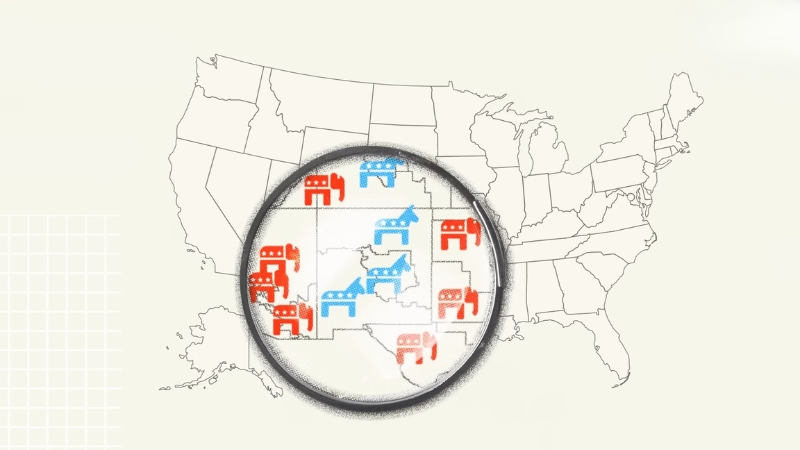
One of the most closely watched contests in early 2026 is the Texas primary election held on March 3, 2026, where voters are selecting party nominees for a wide range of offices, including U.S. Senate, all 38 seats in the U.S. House of Representatives from Texas, and numerous state and local positions.
These primaries determine which candidates will represent the Democratic and Republican parties in the November general election.
Texas remains one of the largest Republican-leaning states in the country, but demographic change and population growth have made several statewide races increasingly competitive.
Approximately 18.7 million Texans are registered to vote in the 2026 primary election, according to the Texas Secretary of State. However, primary turnout historically represents only a fraction of that electorate, meaning highly motivated partisan voters often have disproportionate influence on candidate selection.
Several major races are shaping the narrative of this election cycle. In the Democratic primary for U.S. Senate, state Representative James Talarico secured the nomination, defeating Congresswoman Jasmine Crockett with roughly 53% of the vote to 45% based on early reporting.
This result sets up a general-election contest in November against the eventual Republican nominee.
On the Republican side, the Senate race is heading to a runoff between incumbent Senator John Cornyn and Texas Attorney General Ken Paxton, after neither candidate received a majority of the primary vote. The runoff election scheduled for May 26, 2026, will determine which Republican advances to face the Democratic nominee.
The primaries have also produced several surprises. In one of the biggest upsets, Republican Congressman Dan Crenshaw lost his primary to state Representative Steve Toth, reflecting ongoing ideological tensions within the Republican Party between establishment conservatives and the more populist MAGA-aligned wing.
Trends and Implications

Growth of Independent Voters
Both registration data and public opinion surveys show a significant share of Americans who do not align strongly with either major party. Ballotpedia’s June 2025 data recorded 33.7 million registered independents or unaffiliated voters, accounting for nearly 28 % of registrants.
USAFacts estimated 34.3 million independent or unaffiliated voters (28.8 % of registrants) as of August 2025. Pew’s survey found that 41 % of adults described themselves as independents, though many lean toward one party. Independent voters thus represent a growing bloc that neither party can ignore.
Party Affiliation and Voter Turnout
The U.S. Census Bureau’s Voting and Registration Supplement to the Current Population Survey provides context for the size of the electorate. In the 2024 presidential election, 73.6 % of the citizen voting‑age population was registered to vote, and 65.3 % (about 154 million people) reported voting.
Turnout varied by demographic factors such as sex and education. These figures indicate that there are tens of millions of eligible voters who either are not registered or do not vote, meaning party‑registration statistics understate the true potential electorate.
Demographic Differences
Pew Research Center reports gender and racial gaps in party identification. In 2025, men were 12 percentage points more likely than women to affiliate with or lean toward the Republican Party, while women were 12 points more likely than men to affiliate with or lean toward the Democratic Party.
Among racial groups, Democratic affiliation remains higher than Republican affiliation for Black, Asian, and Hispanic adults, while White Americans continue to lean more toward the Republican Party. These demographic patterns influence party strategies and the composition of both red and blue states.
Conclusion

The question “how many voters have a party affiliation?” does not have a simple answer because it depends on whether we consider official party registration or self‑identified partisanship. In states that track party affiliation, about 45 % of registered voters are formally enrolled with a political party, while roughly 55 % are either unaffiliated or registered with minor parties.
Nationally, there were 44.9 million registered Democrats, 38 million registered Republicans, 33.7 million independents and 5.4 million minor‑party registrants in mid‑2025. Survey data paint a slightly different picture: although only about a quarter of registrants are independents, over 40 % of adults call themselves independent in polls.
Party affiliation varies widely across states. Democratic registration is dominant in the District of Columbia and strong in states like California and New York. Republican registration prevails in Wyoming, Idaho, and much of the Great Plains. Independent registration is the largest bloc in Massachusetts, Alaska and Rhode Island.
These patterns roughly correspond to the familiar map of red and blue states, though many states – such as Florida, Pennsylvania and Arizona – remain competitive, with neither party holding a clear majority.
Understanding the nuances of party affiliation helps explain electoral outcomes and underscores the importance of independent voters and swing states in American politics.