
About 204.6 million Americans are registered to vote in 2026, according to the latest state election office data compiled by USAFacts.
That is the main number for the current U.S. voter registration picture. It means more than seven in 10 U.S. residents age 18 and older appear on voter rolls, with the largest files concentrated in California, Texas and Florida.
The size of the voter roll says a lot about the 2026 political environment. The country enters the midterm cycle with a very large registered electorate, rising independent identification, wide state differences in registration rules and a voting system shaped heavily by online registration, automatic voter registration and address updates through state agencies.
How Many Registered Voters Are There in the United States in 2026?
The latest national estimate is 204.6 million registered voters. That figure comes from state election office records compiled in April 2026 and gives the clearest current count of Americans on voter rolls.
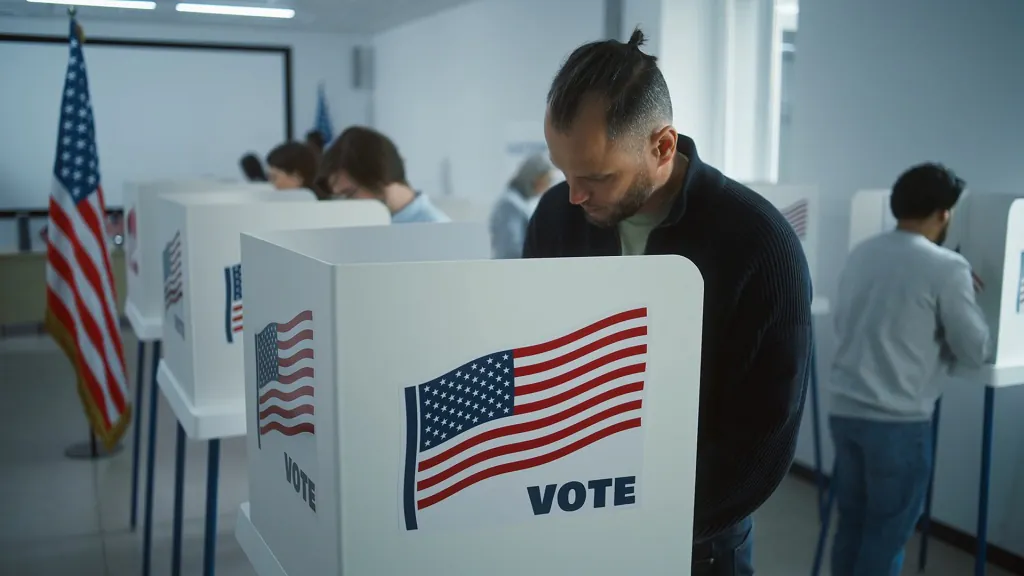
California has the largest voter file, with 23.1 million registered voters. Texas follows with 17.4 million, while Florida ranks third with 13.4 million.
| State Or Area | Registered Voters In 2026 | What It Shows |
|---|---|---|
| United States | 204.6 million | Latest national voter registration estimate from state election office data |
| California | 23.1 million | Largest voter file in the country |
| Texas | 17.4 million | Second-largest voter file and one of the largest growing state electorates |
| Florida | 13.4 million | Third-largest voter file and a major election state |
The state ranking follows population size. Large states have more registered voters because they have more adults, more large metro areas and larger election systems. We have covered that population base in our guide to U.S. population by state and city.
States With The Most Registered Voters
The biggest voter files are in the biggest states. California, Texas and Florida lead by total count because they have the largest adult populations and major population centers.
We have covered California separately in our report on California population growth. The states voter file is larger than the total population of many countries, which is why California has such a large role in national popular-vote totals.
Texas ranks second by registered voters. Its population size, large cities, suburban growth and continuing migration keep the voter file expanding.
Florida ranks third. The state remains central to national election analysis because of its size, older population, migration patterns and large number of registered voters.
States With The Highest Voter Registration Rates
Total registered voters and registration rate are different measures. California has the most registered voters because it has the largest population. Minnesota leads by registration rate.
Minnesota has the highest voter registration rate at 83.6%. Oregon follows at 83.0%, while New Jersey stands at 81.9%. Several other states are also above 80%, including Mississippi, Michigan, Iowa, Kentucky and Maryland.
| State | Registration Rate | Why It Stands Out |
|---|---|---|
| Minnesota | 83.6% | Highest registration rate in the country |
| Oregon | 83.0% | High registration and long use of mail voting |
| New Jersey | 81.9% | High registration in a dense state with a large suburban electorate |
| Mississippi | 81.0% | High rate despite a different political profile from many other high-registration states |
| Michigan | 80.8% | High registration in a major presidential battleground state |
| Iowa | 80.6% | One of the highest registration rates in the Midwest |
| Kentucky | 80.5% | High registration rate in a state with formal party registration |
| Maryland | 80.4% | Large registered electorate around the Baltimore and Washington metro areas |
The top of the list is not limited to one political region. High registration can happen in Democratic-leaning states, Republican-leaning states and competitive states. The common factor is usually election administration, registration access, voter habits and list maintenance.
States With The Lowest Voter Registration Rates

Arkansas has the lowest registration rate in the latest comparison, at 64.7%. Several other states remain below 70%.
The gap between high-registration and low-registration states is large. Minnesota is nearly 19 percentage points above Arkansas. That difference can shape turnout before campaigns begin, because people who are not registered cannot vote unless they register before the deadline or live in a state with same-day registration.
The smallest voter files by total count are in small-population states. Wyoming has 271,337 registered voters, Vermont has 496,378 and Alaska has 593,208. Washington, D.C. has 476,212 registered voters.
North Dakota is handled differently because it does not require voter registration. Hawaii, Indiana and Missouri had not released new 2026 statewide registration data in the USAFacts compilation, so readers should treat those states with care when comparing current totals.
Why Some States Register More Voters Than Others?
State rules shape voter registration. The main differences come from registration deadlines, online registration, automatic voter registration, same-day registration, mail voting rules and how state agencies update voter files.
Automatic voter registration adds or updates eligible voters when they interact with government agencies, usually motor vehicle offices, unless they opt out. The National Conference of State Legislatures explains how automatic voter registration works and why state systems vary.
Same-day registration changes the timeline. In most states, voters must register before a deadline that can fall days or weeks before Election Day. In states with same-day registration, eligible voters can register and vote during a defined voting period or on Election Day. NCSL tracks those rules in its guide to same-day voter registration.
Administrative design has a practical effect. A state with online registration, automatic updates and same-day registration gives voters more chances to stay on the rolls. A state with paper forms, earlier deadlines and fewer update points creates more chances for eligible voters to miss registration.
Party Registration In 2026

Party registration data shows how voters are listed in states that collect party affiliation. It does not cover every state, because many states do not register voters by party.
Among states that report party affiliation, 45.4 million voters are registered Democrats, 39.2 million are registered Republicans and 39.1 million are listed as independent, unaffiliated, undeclared or no party. Minor parties account for about 4.2 million voters in states that report those categories.
| Registration Group | 2026 Count In Reporting States | Important Detail |
|---|---|---|
| Democrats | 45.4 million | Largest reported party-registration group |
| Republicans | 39.2 million | Second-largest reported party-registration group |
| Independent, unaffiliated, undeclared or no party | 39.1 million | Large category, but definitions vary by state |
| Minor parties | 4.2 million | Includes smaller recognized parties where states report them |
Party registration needs careful reading. Alabama, Georgia, Michigan, Minnesota, Mississippi, Montana, South Carolina, Tennessee, Texas, Vermont, Virginia, Washington and Wisconsin are among the states where party affiliation is not handled the same way as in states with formal party registration. That means national party-registration totals do not equal national party membership.
We have a separate breakdown of voter registration and party affiliation in the United States, with more detail on how party labels vary by state.
Independent Voters Are A Large 2026 Factor
Independent voters are one of the most important parts of the 2026 registration story. In registration files, many voters appear as independent, unaffiliated, undeclared or no party. In public opinion surveys, even more Americans describe themselves as independent.
Gallup reported that a record-high 45% of U.S. adults identified as political independents in 2025, while Democrats and Republicans each stood at 27%. Gallup based that finding on more than 13,000 interviews through the year in its report on the new high in political independents.
Registration and identity are not identical. A voter can register without party affiliation and still vote mostly for one party. A voter can register with a party and still skip elections or split tickets. Still, the rise in independent identification shows why campaigns cannot read the voter roll as a simple two-party count.
Red States, Blue States And Voter Registration
Registration does not follow a clean red-state or blue-state pattern. Minnesota, Oregon and New Jersey have high registration rates, but Mississippi and Kentucky also rank above 80%. Arkansas sits at the bottom, while Texas remains below 70% despite having the second-largest voter file in the country.
We have covered the broader political map in our guide to red and blue states. Voter registration adds another layer because state rules can change who appears on the voter roll before any votes are counted.
A state can be politically predictable and still have low registration. Another state can have high registration and still produce uneven turnout. The registration system is only the first gate. Campaign intensity, ballot access, competitive races and voter habits decide how many registered voters actually cast ballots.
Registration And Turnout Are Connected, But They Are Not The Same
Registration tells us who appears on the voter roll. Turnout tells us who voted. A large voter file gives a state more possible voters, but it does not guarantee high participation.
The U.S. Election Assistance Commission reported that more than 158 million ballots were counted in the 2024 general election, with nearly 65% of the citizen voting-age population participating. The same report found that more than 70% of voters cast ballots in person, either before Election Day or on Election Day, while about 30% voted by mail in the 2024 Election Administration and Voting Survey.
| Voting Method In 2024 | Share Of Voters | What It Shows |
|---|---|---|
| In person before Election Day | 35.2% | Early in-person voting remained a major voting method |
| In person on Election Day | 37.4% | Election Day voting remained the single largest in-person category |
| By mail | About 30% | Mail voting remained important after pandemic-era election changes |
Those figures show why registration alone cannot explain election results. A person on the voter roll still needs to receive a ballot, understand the rules, meet deadlines and complete the voting process.
What The 2026 Midterm Cycle Means For Registration
The 2026 midterm cycle puts voter registration back in focus because midterms usually draw fewer voters than presidential elections. That makes the voter roll especially important.
Campaigns will spend heavily on finding registered voters who skipped recent elections, registering new voters who moved since 2024 and reaching independents who do not appear in simple party counts.
The largest registration gains will likely come from three groups: people who moved, young adults who recently became eligible and voters updated through state agency records. Those groups are important because address changes and missed deadlines are among the most common reasons eligible people run into registration problems.
What Voters Should Check Before Elections
Voters should check registration early, especially after moving, changing names, changing party registration or skipping recent elections.
The official federal starting point is Vote.gov voter registration, which sends voters to the correct state election system. State election offices set deadlines, registration methods, party-primary rules and voter ID requirements.
Primary elections deserve extra attention. In states with closed or semi-closed primaries, party registration can decide which ballot a voter can receive. Independent and unaffiliated voters should check rules before the deadline.
What Counts As Registered To Vote?

A registered voter is a person listed on a voter roll and eligible under state rules. Most states require registration before voting. North Dakota is the exception because it does not use voter registration in the same way.
Voter records can be active or inactive, depending on the state. Active voters usually have current records. Inactive voters may still be eligible, but may need to confirm address information before voting.
List maintenance is a normal part of election administration. People move, die, change names, update addresses or become ineligible. Election offices update voter files so polling places, mail ballots and eligibility checks work properly.
Methodology
The main number in this article is 204.6 million registered voters, from USAFacts state election office data as of April 2026.
State totals and party-registration figures come from that same 2026 data source. Party-registration numbers apply only to states that collect and report party affiliation.
Election method and turnout context comes from the U.S. Election Assistance Commission report on the 2024 general election. That source is used only to explain how registered voters cast ballots in the most recent presidential election cycle.
Independent voter identity comes from Gallup polling released in January 2026. That source measures how adults identify politically, which is different from formal party registration.
FAQs
Last Words
The latest voter registration data shows a very large U.S. electorate. About 204.6 million Americans are registered to vote, with California, Texas and Florida holding the biggest voter files.
Party registration also shows a more complicated electorate than a simple Democrat-versus-Republican count. In states that report party affiliation, Democrats lead Republicans by formal registration, while independent, unaffiliated and no-party voters form a group nearly as large as the Republican total.
The most important point for 2026 is practical: voter registration is shaped by state rules. States that make registration easy tend to keep more eligible voters on the rolls. States with earlier deadlines, fewer automatic systems and harder update rules leave more room for eligible voters to miss registration before Election Day.