
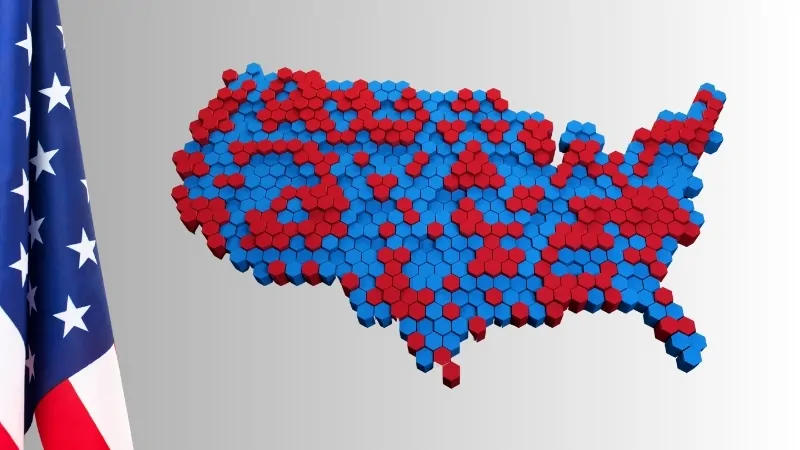
Republicans hold the stronger national position in 2026. Donald Trump is in the White House, the party controls the Senate, and its House majority remains extremely narrow.
The picture changes at the state level. Republicans hold 26 governorships and Democrats hold 24. Full control of state government is less evenly divided, with 23 Republican trifectas, 16 Democratic trifectas, and 11 states under divided government.
A state trifecta exists when one party controls the governor’s office and both chambers of the legislature. It provides a clearer measure of governing power than the presidential vote alone.
The 2024 election also redrew the presidential map. Reuters’ national election results show that Trump carried 31 states. Kamala Harris won 19 states and Washington, D.C.
Trump recovered Arizona, Georgia, Michigan, Nevada, Pennsylvania and Wisconsin. Joe Biden had carried all six in 2020. North Carolina remained Republican, giving Trump every major battleground contested by the two campaigns.
State count alone does not tell the full story. Democratic states include several of the country’s largest population and economic centers. Republican strength covers more land and more states, but those states vary greatly in population.
Check out our latest update on Donald Trump State Approval Map.
The Political Balance in 2026
- President Donald Trump, Republican
- U.S. Senate 53 Republicans, 45 Democrats and 2 independents who align with Democrats
- U.S. House Republican majority with only a small working margin
- Governors 26 Republicans and 24 Democrats
- State trifectas 23 Republican, 16 Democratic and 11 divided
- 2024 presidential map 31 Trump states and 19 Harris states, plus Washington, D.C.
The Long-Lasting Division to Red and Blue States
The labels are convenient, but they are often used too loosely. A state can support a Republican presidential candidate and still elect a Democratic governor. Another state can vote Democratic for president and keep a Republican governor.
Four separate measurements matter.
| Measurement | What It Tells Us |
|---|---|
| Presidential vote | Which candidate carried the state in the most recent presidential election |
| Governor | Which party controls the state’s executive branch |
| Legislature | Which party controls the state House and state Senate |
| State trifecta | Which party controls the governor’s office and both legislative chambers |
Calling Arizona a red state because Trump won it in 2024 leaves out its Democratic governor. Calling Vermont a blue state ignores its Republican governor. Voters often make different choices for federal and state offices.
The National Conference of State Legislatures draws the same distinction. State control depends on the governor and both legislative chambers, not one election result.
Red vs. Blue States – Comparisons for Elections in 2020 and 2024
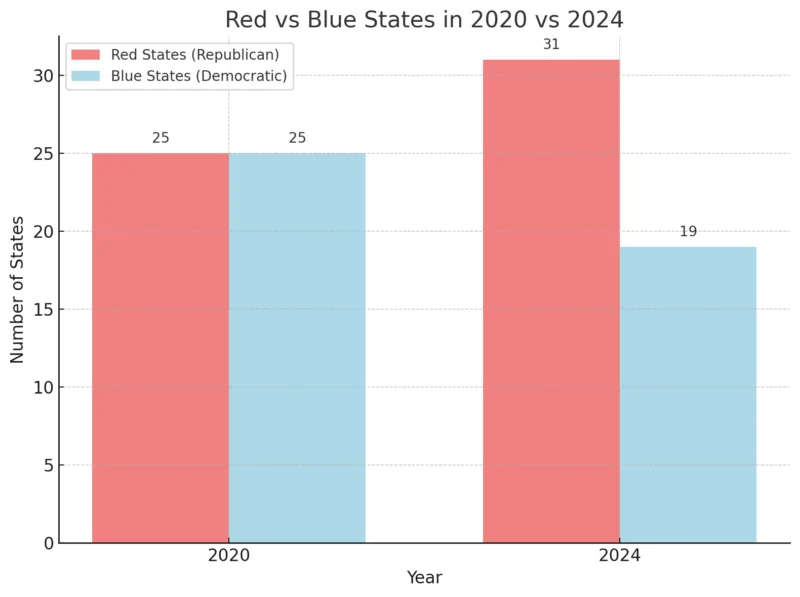
The presidential map changed substantially between the two elections.
Biden won 25 states and Washington, D.C., in 2020. Trump won 25 states. The state count was even, although Biden secured 306 electoral votes because of where his support was located.
Four years later, Trump won 31 states and 312 electoral votes. Harris finished with 226 electoral votes.
Republican gains ran through the Midwest and Sun Belt. Pennsylvania, Michigan and Wisconsin restored the Republican path through the former Democratic industrial belt. Arizona, Georgia and Nevada gave Trump additional routes through the South and West.
Democrats retained the West Coast. California, Oregon and Washington remained blue. The party also kept New York, New Jersey, Massachusetts, Maryland and most of New England.
The geographic pattern remained familiar. Democrats performed best in major cities, college centers and densely populated coastal areas. Republicans dominated rural counties, small towns and much of the interior.
A Brookings analysis of American growth centers documented the economic separation between large metropolitan areas and smaller communities. The same separation appears repeatedly in election results.
Red vs. Blue State Map 2026
The map can be read in several ways. Presidential results show the choices voters made in 2024. Governor and legislative control show who can pass state laws in 2026.
Republican Strongholds
| Region | Core Republican States |
|---|---|
| South | Alabama, Arkansas, Florida, Louisiana, Mississippi, South Carolina, Tennessee and Texas |
| Great Plains | Iowa, Nebraska, North Dakota, Oklahoma and South Dakota |
| Mountain West | Idaho, Montana, Utah and Wyoming |
| Midwest | Indiana, Missouri, Ohio and West Virginia |
Several states in those regions have a Republican governor and Republican legislative majorities. Party leaders can usually move tax, education, abortion, gun and election legislation without negotiating with a Democratic governor.
Democratic Strongholds
| Region | Core Democratic States |
|---|---|
| West Coast | California, Oregon and Washington |
| Northeast | Connecticut, Massachusetts, New Jersey, New York and Rhode Island |
| Mid-Atlantic | Delaware, Maryland and Virginia |
| Other Democratic Centers | Colorado, Hawaii, Illinois and New Mexico |
Democratic-controlled states generally support stronger labor rules, wider abortion access and stricter gun laws. Their governments also tend to take a more active role in climate policy and healthcare coverage.
States That Do Not Fit One Color
- Vermont and New Hampshire supported Harris in 2024 but have Republican governors.
- Arizona, Kansas, Kentucky, Michigan, North Carolina, Pennsylvania and Wisconsin supported Trump but have Democratic governors.
- Nevada supported Trump and has a Republican governor, but Democrats have remained competitive in the legislature and statewide races.
- Virginia supported Harris and returned to a Democratic governor after the 2025 election.
The crossover states matter because they prove that voters still distinguish between national party politics and local candidates. The practice has become less common, but it has not disappeared. A review of split-ticket states found several places where presidential and gubernatorial results moved in opposite directions.
State Governments Are More Republican Than the Governor Count Suggests
The 26 to 24 governor split looks nearly even. Full state control gives Republicans a clearer advantage.
In 2026, Republicans hold 23 state trifectas. Democrats hold 16. Eleven states have divided government.
Republicans also control more state legislative chambers and a larger share of all state legislative seats. That power matters because state lawmakers determine budgets, voting procedures, abortion rules, tax policy and congressional maps.
Virginia was the major change produced by the 2025 elections. Democrats already controlled the legislature and gained the governor’s office, creating another Democratic trifecta.
Economic and Policy Gaps Grew After 2020

Red and blue state governments took different approaches to reopening, taxes, business regulation and public health after 2020. The divide continued after the immediate pandemic period ended.
Florida and Texas attracted large numbers of domestic migrants. Lower taxes, housing supply and job growth helped drive the movement. High housing costs pushed some residents away from California and New York.
The pattern was never as simple as red states growing and blue states shrinking. Washington and California retained large technology economies. New York remained a leading financial center. Texas and Florida gained residents but also faced rising housing and insurance costs.
The Wall Street Journal reported on the post-pandemic shift toward red states, including stronger migration and employment growth in parts of the South.
| Issue | Common Democratic Approach | Common Republican Approach |
|---|---|---|
| Income and business taxes | More progressive rates and greater public spending | Lower rates and fewer business regulations |
| Abortion | Legal protections and wider access | Restrictions or bans with limited exceptions |
| Gun policy | Background checks, waiting periods and purchase restrictions | Permitless carry and fewer ownership restrictions |
| Energy | Renewable incentives and emissions rules | Support for oil, gas, coal and fewer environmental limits |
| Education | Greater public-school funding and support for unionized teachers | School choice, parental control and curriculum restrictions |
| Voting | Expanded early voting and mail voting | Stricter identification and ballot-handling rules |
Party labels do not produce identical laws in every state. Massachusetts and California are both Democratic, but they have different tax systems and housing problems. Texas and Florida are both Republican, but their economies and state budgets are not interchangeable.
The 2020 and 2024 Presidential Results
| Election | Democratic Candidate | Republican Candidate | Electoral Vote | Popular Vote Margin | Winner |
|---|---|---|---|---|---|
| 2020 | Joe Biden | Donald Trump | 306 Democratic to 232 Republican | Biden by about 4.5 points | Joe Biden |
| 2024 | Kamala Harris | Donald Trump | 226 Democratic to 312 Republican | Trump by about 1.5 points | Donald Trump |
Biden defeated Trump in 2020 by rebuilding the Democratic position in Michigan, Pennsylvania and Wisconsin. He also became the first Democratic presidential nominee in decades to carry Arizona and Georgia.
The national popular vote gave Biden an advantage of about 7 million ballots. Strong results in cities and suburbs offset Republican dominance in rural counties.
Georgia and Arizona drew particular attention. Both had supported Republican presidential nominees for years. Their movement toward Biden appeared to signal a lasting change, but Trump recovered both in 2024.
BREAKING: Donald Trump wins Arizona. With the final state called in the presidential election, Trump won 312 electoral votes and Kamala Harris won 226 electoral votes. https://t.co/kStgXCQZnR pic.twitter.com/rwsLfyDtOp
— The Associated Press (@AP) November 10, 2024
Trump returned in 2024 with victories in all seven main battlegrounds. Pennsylvania, Georgia, North Carolina, Michigan, Arizona, Wisconsin and Nevada provided 93 electoral votes, according to Al Jazeera’s state comparison.
Economic dissatisfaction played a major role. Inflation, housing costs, immigration and doubts about the Biden administration weakened the Democratic position. Trump also improved with several groups that had previously leaned more heavily toward Democrats.
He finished with about 49.8% of the popular vote. Harris received about 48.3%. The result made Trump the first Republican presidential nominee since George W. Bush in 2004 to win the national popular vote, as reported by Fox 9.
The Senate Moved from Democratic to Republican Control
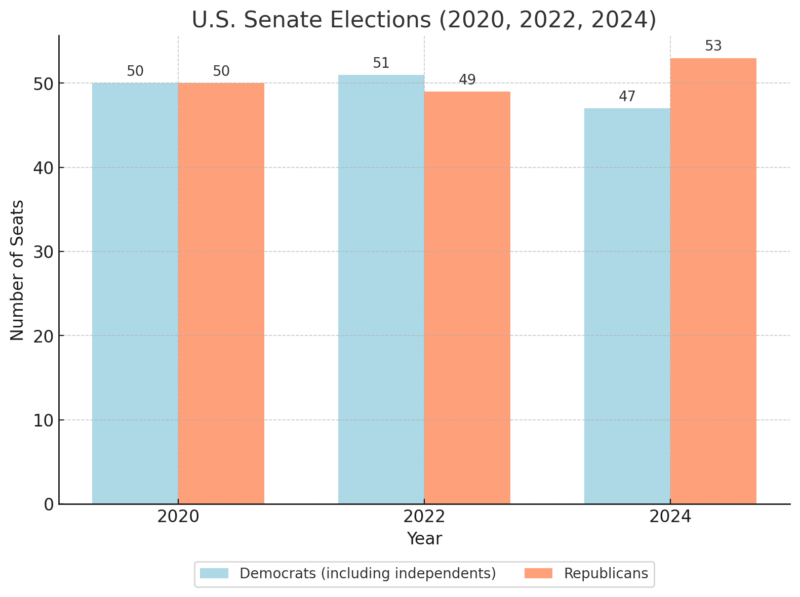
Senate control changed in three stages.
Democrats gained three seats in the 2020 cycle. Victories in both Georgia runoff elections produced a 50 to 50 chamber. Vice President Kamala Harris gave Democrats control through her tie-breaking vote.
The 2022 election improved the Democratic position to 51 seats. John Fetterman’s victory in Pennsylvania created the gain. Democratic candidates also defended difficult races in Arizona, Georgia and Nevada.
Republicans reversed the result in 2024. The party flipped West Virginia, Montana, Ohio and Pennsylvania. Democrats retained Arizona and Nevada but did not gain a Republican-held seat.
The 2024 Senate results collected by Ballotpedia show how the four Republican pickups produced a 53 to 47 party alignment when the two independents who work with Democrats are counted with the Democratic side.
John Thune became majority leader. The Senate’s official leadership page identifies the current party leaders, and its party division history records the 119th Congress as 53 Republicans, 45 Democrats and two independents.
Republican Senate control matters for judges, cabinet officials and other presidential appointments. The majority can confirm Trump’s nominees without Democratic votes if Republicans remain united.
Governors Tell a Less Partisan Story
Governors are more likely than presidents to win support from voters outside their party. State races focus more heavily on budgets, schools, roads, disaster response and the candidate’s local reputation.
Republicans control much of the South, Great Plains and Mountain West. Democrats dominate the West Coast and much of the Northeast.
Several governors remain popular in states that supported the other party for president. Republican Phil Scott has repeatedly won in Vermont. Democrats Andy Beshear in Kentucky, Laura Kelly in Kansas and Josh Shapiro in Pennsylvania govern states that Trump carried in 2024.
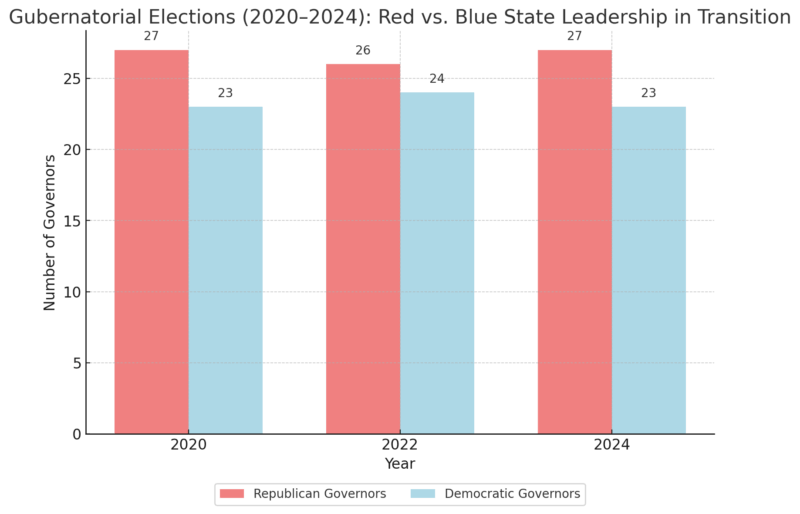
The 2020 Governor Elections Produced One Flip
Eleven states elected governors in 2020. Montana produced the only party change.
Republican Greg Gianforte won the open seat after Democratic Gov. Steve Bullock reached his term limit. A Vox report on the Montana race detailed the Republican victory.
The result left Republicans with 27 governors and Democrats with 23.
Vermont and New Hampshire re-elected Republican governors even though both states voted Democratic for president. West Virginia and Missouri gave Republican gubernatorial candidates comfortable victories.
Democrats Gained Ground in 2022
Thirty-six states elected governors in 2022. Democrats gained Arizona, Maryland and Massachusetts. Republicans defeated Democratic Gov. Steve Sisolak in Nevada.
The net result was a gain of two governorships for Democrats.
Katie Hobbs won Arizona. Wes Moore became Maryland’s first Black governor. Maura Healey won Massachusetts and became the first woman elected governor of that state.
The cycle ended with 26 Republican governors and 24 Democratic governors.
A linked NBC report on Democratic targets for 2026 illustrates how the party later tried to build on its stronger midterm performance.
Louisiana Moved Republican in 2023
The balance changed again when Republican Jeff Landry won the Louisiana governor’s race. He succeeded term-limited Democratic Gov. John Bel Edwards.
That election returned the national count to 27 Republican governors and 23 Democratic governors.
Every Party Defended Its Governor Seats in 2024
All 11 gubernatorial races in 2024 ended with the incumbent party retaining control.
Democrat Josh Stein won North Carolina despite Trump’s presidential victory there. Republican Kelly Ayotte kept New Hampshire under Republican leadership after Chris Sununu declined to seek another term.
The results showed that governor races still permit more split-ticket voting than presidential races.
Virginia Flipped and New Jersey Stayed Democratic in 2025
Only Virginia and New Jersey elected governors in 2025. Democrats won both races.
Abigail Spanberger succeeded term-limited Republican Gov. Glenn Youngkin in Virginia. Mikie Sherrill kept New Jersey under Democratic control after Phil Murphy reached his term limit.
The 2025 gubernatorial results moved the national balance to 26 Republican governors and 24 Democratic governors.
Virginia’s change carried additional weight because Democrats already controlled both legislative chambers. Winning the governor’s office gave the party full state control.
The 2026 Governor Elections Put 36 States on the Ballot
The two parties enter the 2026 governor elections defending the same number of seats. Democrats hold 18 of the offices on the ballot. Republicans also hold 18.
Fifteen governors cannot seek another term because of term limits. Several other incumbents have chosen not to run.
The 2026 governor election map places close attention on open or competitive races in Arizona, Georgia, Iowa, Michigan, Nevada, Ohio and Wisconsin.
An open seat creates more uncertainty because no incumbent is present. Michigan, Georgia and Ohio all have term-limited governors. Wisconsin and Iowa also lack an incumbent candidate.
Governor races will affect state policy immediately. They will also help define the political position of each party before the 2028 presidential campaign begins.
The House Majority Has Almost No Room for Defections
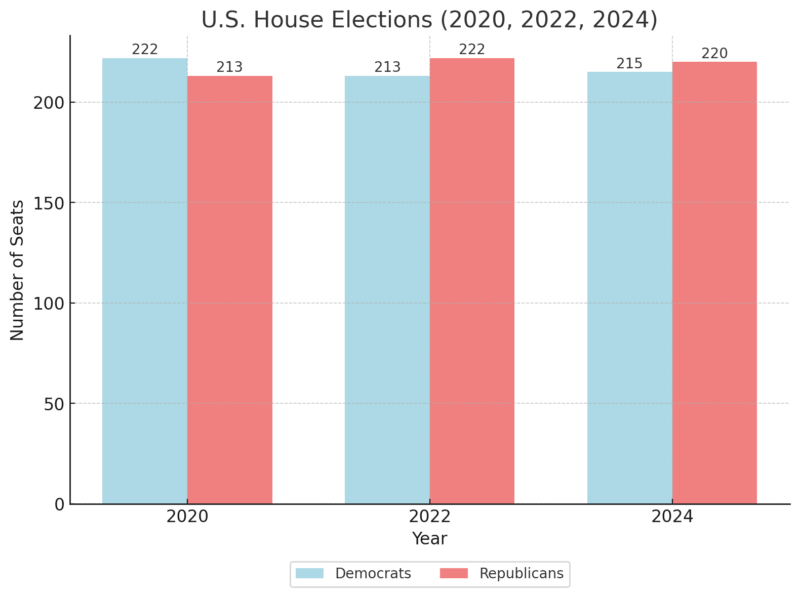
Democrats kept the House in 2020 with 222 seats. Republicans won 213 after gaining 13 seats.
The result gave Biden a Democratic Congress, but the House margin was too small for party leaders to ignore internal disagreements.
Republicans won control in 2022 with the same 222 to 213 split. Gains in New York and Florida proved decisive.
Predictions of a large Republican wave did not materialize. A Politico analysis of the midterms described how Democratic candidates limited losses in many competitive districts.
Republicans retained the House in 2024 with 220 seats to 215 for Democrats. The result gave Trump unified government but left House leaders with little protection against absences or dissent.
Competitive suburban districts in New York, California, Arizona and other states remain central to the 2026 contest. The University of Virginia Center for Politics described a relatively small initial battlefield with Democrats holding a possible advantage.
Vacancies, special elections and a party change have altered the working count during 2026. The House Press Gallery maintains the current breakdown, which can change before every vacancy is filled.
The small margin means Republican leaders cannot afford to lose a large group of their own members on party-line legislation.
The 2020 Election Claims and What Investigations Found
Trump and several allies challenged the 2020 result by alleging widespread fraud. State officials, courts, recounts, audits and federal agencies examined those claims.
No investigation found fraud on a scale capable of changing the national result.
Attorney General William Barr, who served under Trump, said the Justice Department had not found evidence that could have produced a different outcome. CBS News reported Barr’s statement after the department reviewed the allegations.
More than 60 legal challenges failed or were withdrawn. Judges rejected cases because of weak evidence, procedural problems or claims that did not support the requested remedy. A Brookings review of the court campaign examined the major cases and their outcomes.
Georgia conducted a hand recount and confirmed Biden’s victory. A Republican-backed review in Arizona also confirmed his win in Maricopa County.
| Event | Finding or Result |
|---|---|
| 2020 presidential election | Biden won 306 electoral votes and Trump won 232 |
| Federal election-security statement | No evidence that voting systems deleted, lost or changed votes |
| Major court challenges | No case established fraud capable of reversing the result |
| Georgia hand recount | Biden’s victory was confirmed |
| Arizona review | The review did not overturn Biden’s victory |
| Congressional certification | Congress certified the electoral vote after the January 6 attack |
Election Trust Became Part of the Red and Blue Divide
The failure of the legal challenges did not end the political dispute.
A CNN poll conducted in 2021 found that a large majority of Republicans believed Biden had not legitimately won. Views on the election became tied closely to party identity.
Republican-led states passed new identification requirements, shortened some voting periods and imposed tighter controls on ballot collection or drop boxes. Party leaders described the measures as protections against fraud.
Democratic-led states expanded early voting, mail voting and automatic registration. Their leaders argued that wider access increased participation without sacrificing security.
The split continues to shape disputes over mail ballot rules and the number of registered voters in the United States.
Common Changes in Republican-Led States
- Stricter voter-identification requirements
- Limits on ballot drop boxes or third-party ballot collection
- Greater emphasis on in-person voting
- More frequent voter-roll checks
Common Changes in Democratic-Led States
- Longer early-voting periods
- Automatic voter registration
- Broader access to mail ballots
- More ballot drop-off locations
The laws differ from state to state. Neither party follows one national state-level model.
How the Battleground States Moved Between 2020 and 2024

The election dispute influenced Republican motivation, but it does not fully explain Trump’s 2024 gains.
Economic conditions, immigration, candidate approval and concern about Biden’s performance also affected voters. Harris entered the race after Biden and had limited time to establish a separate campaign.
The BBC’s battleground-state summary confirmed that Trump won Georgia, Arizona, Pennsylvania, Michigan, North Carolina, Wisconsin and Nevada.
| State | 2020 Winner | 2024 Winner | Governor in 2026 |
|---|---|---|---|
| Arizona | Biden | Trump | Democrat |
| Georgia | Biden | Trump | Republican |
| Michigan | Biden | Trump | Democrat |
| Nevada | Biden | Trump | Republican |
| North Carolina | Trump | Trump | Democrat |
| Pennsylvania | Biden | Trump | Democrat |
| Wisconsin | Biden | Trump | Democrat |
The governor column explains why the red and blue labels require care. Five of the seven states that backed Trump have Democratic governors in 2026.
What to Watch in the 2026 Midterms
The 2026 election will not elect a president, but it could end unified Republican control in Washington.
Every House seat is on the ballot. Democrats need only a small net gain to take the chamber. Republicans must defend suburban and competitive districts without losing support in their rural base.
A Senate takeover presents a harder task for Democrats because Republicans began the Congress with 53 seats. Candidate quality and open seats will determine how many races become genuinely competitive.
State elections are equally important. Voters in 46 states will decide more than 6,000 legislative seats. Thirty-six governorships are also on the ballot.
The main questions are clear.
- Can Republicans defend their narrow House majority?
- Will Democrats convert dissatisfaction with Washington into state legislative gains?
- Can either party break the 26 to 24 governor split?
- Will Trump-voting states continue electing Democratic governors?
- Can either party expand its number of state trifectas?
Frequently Asked Questions
Washington Is Red but the States Remain Closely Split
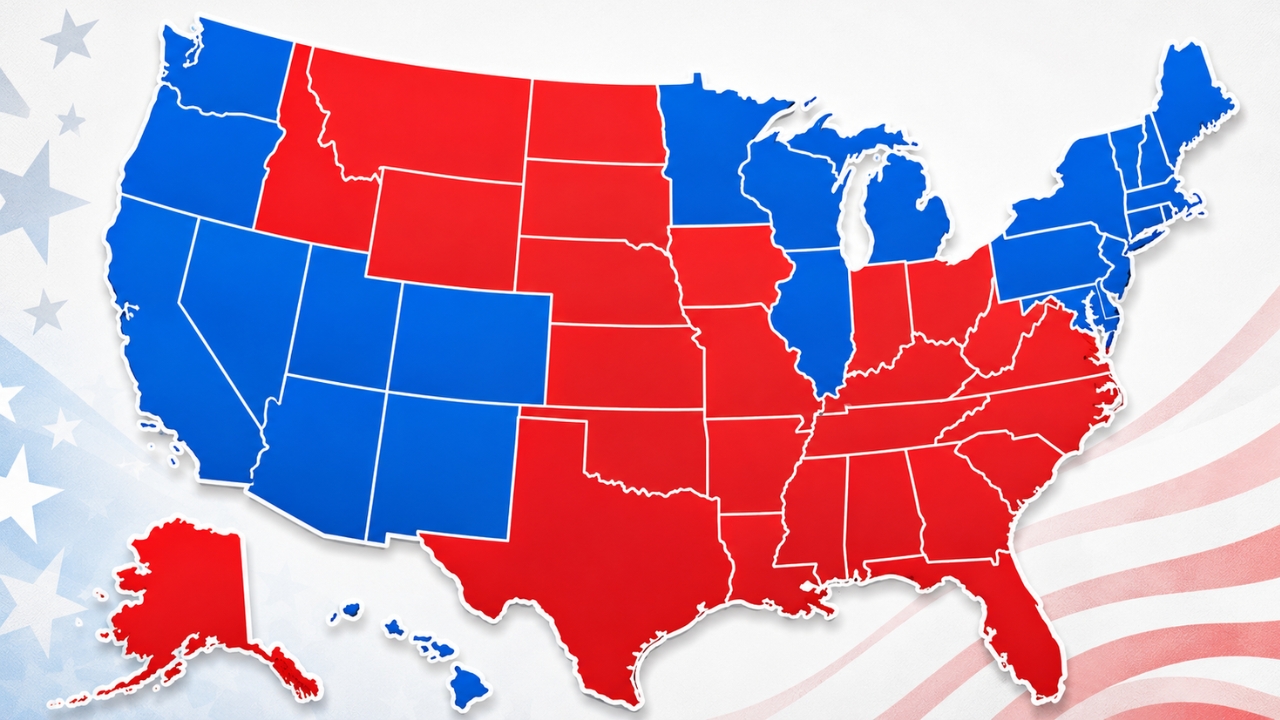
Trump’s 2024 victory gave Republicans control of the White House and helped the party win a 53-seat Senate majority. The GOP also retained the House, although its margin remains fragile.
State capitals present a different picture. Republicans have a two-governor advantage, but Democrats govern several states that voted for Trump. Virginia’s 2025 result also gave Democrats another state trifecta.
The largest gap appears in state legislatures. Republicans control more chambers, more legislative seats and more full state governments. That advantage gives the party greater influence over voting law, abortion, education, taxes and redistricting.
Democrats retain control of many of the country’s largest urban and coastal economies. Republicans dominate more states and most of the geographic interior.
Neither side holds a permanent advantage. The 2020 election moved six major battlegrounds toward Democrats. The 2024 election moved all six back to Republicans. Governor races produced a different result in several of the same states.
The 2026 midterms will test both maps at once. Control of Washington could change with a handful of House races. Control of state government will be decided through 36 governor elections and thousands of legislative contests.