
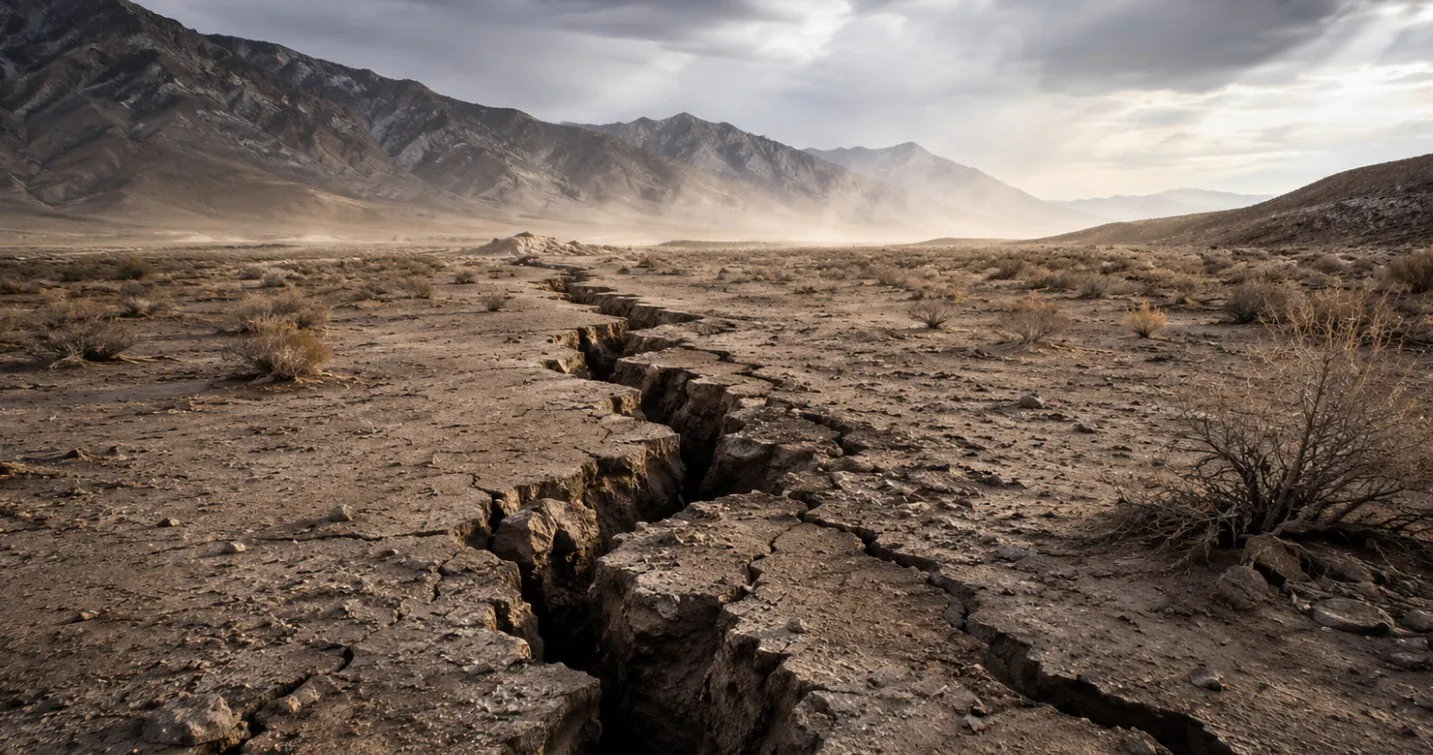
Two of the most volatile fault lines in California are packing more stress than they have held at any point since the Middle Ages. A striking new study shows this immense pressure is bottlenecking at the Cajon Pass, a critical geological chink in the armor northeast of Los Angeles.
The data does not pinpoint an exact date or time for the next major earthquake. However, it proves that the tectonic plumbing beneath the region is primed to a degree unseen in modern history.
The real danger lies in how the Cajon Pass behaves. Researchers warn it could act as an unpredictable “earthquake gate” that will either bottle up a tremor on a single fault line or open the floodgates for a catastrophic, multi-fault disaster.
Table of Contents
ToggleThe 1,000-Year Stress Model
The study, published in the peer-reviewed Journal of Geophysical Research: Solid Earth, relies on sophisticated computer modeling to track tectonic strain accumulation across the southern San Andreas and San Jacinto fault networks over the past ten centuries.
A collaborative team from the University of Hawaiʻi at Mānoa, the University of Bern, the U.S. Geological Survey (USGS), and UC San Diego discovered that stress along key segments has either matched or blown past the highest thresholds recorded in the model’s 1,000-year history.
| Core Metric | Real-World Implication |
|---|---|
| 1,000-Year Peak Strain | Multiple fault segments are more heavily loaded with tectonic energy than at any point since the Middle Ages. |
| The Cajon Pass “Gate” | The geographic junction could either bottleneck an oncoming rupture or act as a bridge that links two disasters into one. |
| Aligned Stress Levels | The San Andreas and San Jacinto faults are locked in a dangerous synchronization, a state historically linked to massive, multi-fault ruptures. |
| No Predictive Timeline | The study maps systemic structural vulnerability and hazardous accumulation, not an exact countdown clock. |
Why the Cajon Pass Keeps Seismologists Awake?
To understand the danger, look at the map: the Cajon Pass is the precise bottleneck where the southern San Andreas and San Jacinto systems converge.
In a standard earthquake scenario, a rupture ripping down one of these faults might naturally peter out when it hits the complex geometry of the pass, limiting the overall destruction. However, the study points to a far more ominous alternative: the exceptionally high stress alignment across both systems could allow a rupture to cleanly jump the tracks.
If an earthquake successfully breaches this gate, it would violently link both fault systems together. The resulting multi-fault event would unleash a significantly longer, more complex, and vastly more destructive earthquake capable of rattling a much wider swath of the Southland simultaneously.
What is “Tectonic Stress”?
When geologists talk about stress, they are describing the staggering physical force built up as massive tectonic plates grind past each other. Because the Earth’s crust isn’t smooth, these faults don’t slide seamlessly. Instead, they lock in place for decades or centuries, absorbing relentless pressure until the friction finally gives way all at once.
By modeling centuries of historical ruptures, the transfer of stress between neighboring segments, and deep-crustal movements, the research team pinpointed two areas bearing the brunt of this pressure: the San Jacinto-Bernardino segment and the Mojave South segment of the San Andreas.
This isn’t an explicit warning that a massive tremor will strike tomorrow or next week. Rather, it means the fault systems have crossed a threshold into a highly unstable, heavily loaded state that demands immediate attention from infrastructure planners and emergency managers.
The Worst-Case Scenario
While this specific paper focuses on physics rather than structural casualties, the historical baseline for a major southern San Andreas disaster is already grim.
For years, state agencies and scientists have relied on the ShakeOut Scenario to understand the impact of a hypothetical magnitude 7.8 rupture on the southern San Andreas Fault. That benchmark assessment projected:
- Upwards of 1,800 fatalities
- Roughly 50,000 injuries
- Direct economic damages eclipsing $200 billion
- Months-long disruptions to water, power, and transit grids crossing the fault line
A joint, dual-fault rupture triggered by a failure at the Cajon Pass could rewrite these estimates entirely, shifting the epicenter of the destruction and catching communities off guard.
What This Means for People in Southern California?
This data shouldn’t spark blind panic, but it should completely end complacency. Southern California has been built on a geological time bomb for generations; this study merely brings the clock into sharper focus.
If you live or work in the region, treat this as a stark reminder to revisit basic survival protocols:
- Verify if your home or workplace sits directly inside an active fault zone or liquefaction area.
- Bolt down heavy appliances, bookshelves, and televisions to prevent crushing injuries during intense shaking.
- Refresh emergency supplies, ensuring you have a multi-day stash of water, non-perishable food, prescription medications, flashlights, and fresh batteries.
- Establish an offline family communication plan, as cellular networks routinely collapse during major seismic events.
- Locate your home’s main gas and water valves and keep the tools necessary to shut them off nearby.
- Ensure your smartphone is configured to receive ShakeAlert alerts, and identify the safest “Drop, Cover, and Hold On” spots in every room.
The Bottom Line
The ground beneath Southern California is holding a historic amount of strain. With the San Andreas and San Jacinto faults hitting a 1,000-year stress high, the Cajon Pass stands as the critical junction that will shape the region’s next major disaster. Science can’t give us the exact date, but the message from the earth is unmistakable: the system is loaded, the threat is real, and the time to prepare is right now.
Related Posts:
- Scientists Just Found a Way to Regrow Cartilage…
- Scientists Just Made Pancreatic Cancer Tumors Vanish…
- Scientists Just Reversed Vision Loss in Mice, Humans…
- A Groundbreaking Eye Treatment Just Restored Vision…
- Radioactive Contamination Found in Western New York…
- A Newly Discovered Giant Virus Found in a Pond Is…