
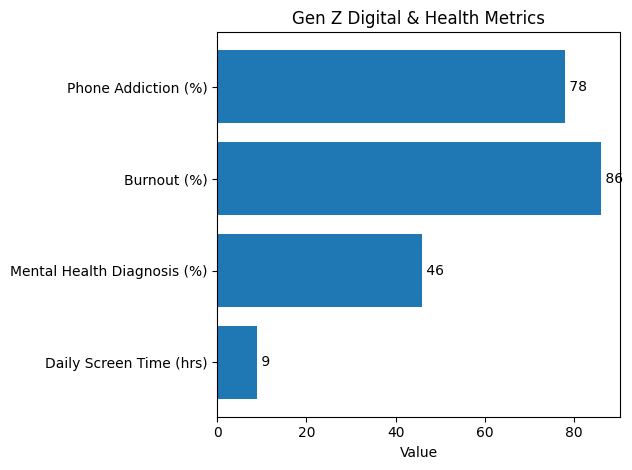
Here is a number that should stop you mid-scroll: the average Gen Z person, someone between 14 and 29 years old right now, spends roughly nine hours a day in front of screens.
That is more time than most adults sleep. More time than a standard workday. And it doesn’t count the passive exposure to notifications, pings, and alerts that fill the gaps between those active hours. When you do the math, this generation is spending more than half of every waking day staring at a glass rectangle.
The consequences are no longer theoretical. They are showing up in clinical diagnosis rates, workplace data, sleep studies, and the lived language of a generation that coined the phrase “brain rot” to describe what it feels like to be algorithmically overstimulated seven days a week.
Digital fatigue, once a vague productivity buzzword, has hardened into a genuine public health issue with measurable, compounding effects on physical health, cognitive function, and psychological well-being.
According to Harmony Healthcare IT’s May 2025 survey of 1,010 Gen Z Americans, nearly half have already received a formal mental health diagnosis, and over a third believe they’re living with something undiagnosed.
The Screen Time Problem Is Bigger Than We Measure
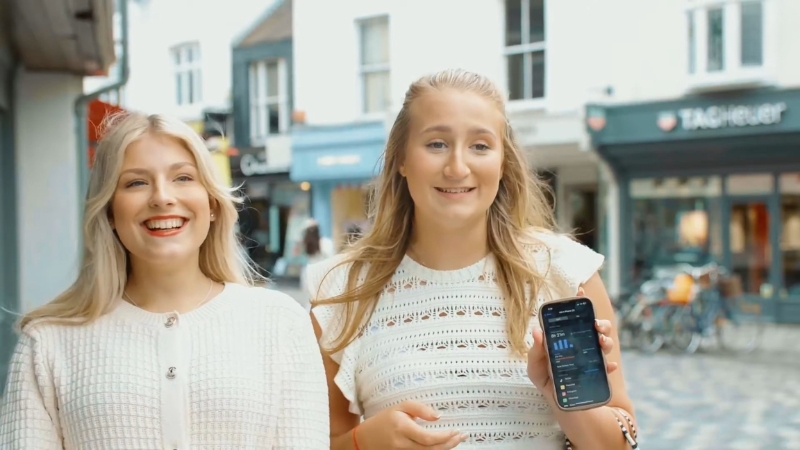
The standard measure everyone cites, daily phone screen time, is already alarming. According to Harmony Healthcare IT’s December 2024 survey of 1,001 Americans, Gen Z logs an average of 6 hours and 27 minutes on their phones alone, the highest of any generation.
Health experts recommend no more than two hours of recreational screen time per day. Gen Z is doing more than three times that just on their phone, before accounting for laptops, tablets, TVs, or gaming consoles.
When you fold in all screen types, the picture gets darker. The average Gen Z total is roughly 9 hours per day across all devices. The global average across all demographics sits at 6 hours and 40 minutes. Gen Z isn’t just a little above average; they’re running 35% higher than the rest of the world.
And notably, CDC National Health Interview Survey data from the 2021–2023 collection period found that 50.4% of teenagers now spend over 4 hours on screens on a typical weekday, excluding schoolwork.
Generation
Avg. Daily Phone Time
vs. Expert Limit (2hrs)
% Who Wants to Cut Back
Gen Z (14–29)
6h 27min
+323%
76%
Millennials (30–44)
5h 50min
+290%
61%
Gen X (45–59)
4h 55min
+247%
48%
Baby Boomers (60+)
4h 02min
+201%
34%
What the numbers also reveal is self-awareness without self-correction. The same Harmony Healthcare IT report found that a striking 76% of Gen Z say they spend too much time on their smartphones, the highest proportion of any generation.
Yet actual usage keeps climbing. Americans overall spend 5 hours and 16 minutes per day on their phones, a 14% jump from 2024, suggesting that awareness is not translating into behavioral change at any meaningful scale.
What Nine Hours a Day Does to a Brain and a Body
View this post on Instagram
There is now a substantial body of research linking high screen time, particularly social media consumption, to measurable mental health deterioration. A 2022 meta-analysis by Liu et al., which synthesized data across multiple studies, found that depression risk increases by approximately 13% for every additional hour of daily social media use.
Given that Gen Z’s social media consumption alone averages around 2.5 hours daily, the compounding math is significant.
The 2025 Cybersmile Digital Wellbeing Report, which surveyed 1,000 participants aged 16–24 across the UK, put some of the sharpest numbers yet to the gender gap in this crisis. 91% of young women say social media negatively affects their mental health, compared to 83% of men.
The same share, 91%, of women aged 16–24 feel unsatisfied with their lives after comparing them to others on social media. These aren’t soft perceptions; they are near-universal for an entire demographic.
Teenagers with 4 or more hours of daily screen time are more than twice as likely to report symptoms of anxiety or depression compared to those with lower exposure.
The physical toll is also well-documented and underreported. In Harmony Healthcare IT’s screen time survey, 69% of respondents had experienced a phone-related physical health issue in the past year.
The most common: eye strain, neck and shoulder pain, and headaches, and eye strain in particular is increasingly flagged as a clinical concern. Specialists at Mann Eye Institute, a Texas-based practice with board-certified ophthalmologists and optometrists, have seen screen-related conditions like dry eye and digital eye strain become a growing part of routine eye care in recent years.
Research published in CDC’s Preventing Chronic Disease journal confirms that screen use not only delays bedtime but can affect circadian timing and sleep physiology via light exposure.
The downstream effects of poor sleep are not minor. Sleep deprivation is independently associated with heightened rates of depression, mood disorders, reduced cognitive performance, and diminished immune function.
In other words, the screen-to-sleep-to-mental-health pipeline is not a hypothesis; it is the documented daily reality for millions of Gen Zers operating in a state of chronic low-grade exhaustion.
The Mental Health Numbers Are Stacking Up

Nearly half of all Gen Z Americans, 46%, have already received a formal mental health diagnosis, most commonly anxiety, depression, or ADHD, according to Harmony Healthcare, further 37% believe they have a condition that has not yet been diagnosed.
Taken together, that’s more than 8 in 10 young Americans either diagnosed or living with suspected, untreated mental health struggles.
Deloitte’s Global 2025 Gen Z and Millennial Survey, which polled over 23,000 respondents across 44 countries, found that 40% of Gen Z report feeling stressed or anxious most or all of the time, compared to 34% of Millennials.
Fully 47% of Gen Z rate their mental well-being as fair or poor. Mental health ranked as the second most cited societal concern for this generation globally, behind only the cost of living.
Indicator
Gen Z Rate
Comparison Group
Source
Formal mental health diagnosis
46%
,
Harmony Healthcare IT
Anxious/stressed most or all of the time
40%
34% Millennials
Deloitte 2025
Rate mental well-being as fair or poor
47%
41% Millennials
Deloitte 2025
Feel addicted to the phone or social media
78%
–
Harmony Healthcare IT
Depressed at work vs. other generations
35%
20% avg. worker
MetLife EBTS 2025
Currently in therapy
42%
+22% since 2022
Harmony Healthcare IT
Sources: Harmony Healthcare IT (May 2025, n=1,010); Deloitte Global 2025 Survey (n=23,000+); MetLife Employee Benefit Trends Study 2025
MetLife’s 2025 Employee Benefit Trends Study added important workplace data to this picture. Gen Z workers are 44% more likely to report burnout than the average employee (44% vs. 34%), and 35% say they feel depressed at work, nearly double the 20% reported across other age groups.
Nearly a third of Gen Z workers (30%) describe feeling isolated, and their self-reported engagement, productivity, and happiness at work all trail those of Boomer colleagues by double-digit margins. Harmony Healthcare IT’s separate survey went further: a staggering 86% of Gen Z workers say they are burned out.
Doomscrolling Is Not a Metaphor. It’s a Behavior Pattern With Clinical Consequences.
One of the more significant behavioral phenomena to emerge from the research is doomscrolling, the compulsive habit of scrolling through negative news and social feeds, driven by algorithmic design and negativity bias.
Research from Harmony Healthcare IT found that more than half of Gen Zers with anxiety, 54%, admit to excessive social media use or doomscrolling while trying to cope.
Separate 2024 survey data puts the share of Gen Z that doomscrolls regularly at approximately 51%, compared to 46% of Millennials and 31% of U.S. adults overall. Gen Z doesn’t just consume more digital content than older generations; they consume more of the most psychologically corrosive kind of it.
The consequences of this behavior pattern are not abstract. Research links chronic doomscrolling to poor life satisfaction, elevated stress, disrupted sleep, and worsened anxiety during crisis periods.
The infinite scroll design, deliberately engineered with no natural stopping point, makes habitual disengagement structurally difficult. Platforms are designed to be hard to leave, and that is not an accident.
Gen Z is also experiencing what researchers have started calling “digital loneliness”, a paradox in which heavy online connectivity intensifies rather than relieves feelings of social isolation.
MetLife found that 30% of Gen Z workers feel isolated, compared to 22% across other age groups. The generation that has never known a world without social media is also, by multiple measures, lonelier than the generations that came before it.
Teenagers with 4 or more hours of daily screen time are more than twice as likely to report symptoms of anxiety or depression compared to those with lower exposure.
Behavior
Gen Z
Millennials
Gen X / Boomers
Doomscroll regularly
51%
46%
~20–25%
Planned social media detox
63%
55%
33%
Feel addicted to phone/social media
78%
68%
44%
Overwhelmed by digital choice
58%
51%
38–45%
Used screens for an hour before bed
~60%+
~55%
~40%
The Pushback Is Real, But So Are Its Limits
Gen Z turn away from ‘addictive’ social media https://t.co/V6pvvpICXO
— BBC News (UK) (@BBCNews) November 26, 2023
Something is shifting culturally. The data on self-correction attempts is actually notable, and genuinely the most interesting part of this story. According to Harmony Healthcare IT, 68% of Gen Z have taken a social media break for their mental health, the highest intentional disconnection rate of any generation.
PartnerCentric’s May 2025 survey data shows 41% of Americans are now actively limiting their digital engagement, many using app-blocking tools and screen time trackers to enforce it.
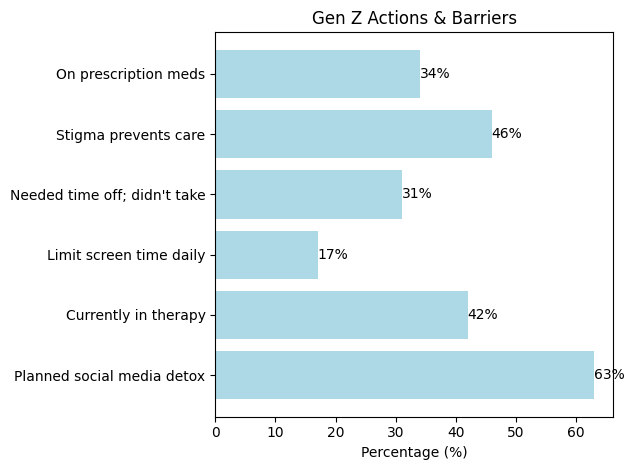
Gen Z is also driving a notable surge in therapy uptake. Harmony Healthcare IT’s May 2025 survey found 42% say they are currently in therapy, a 22% increase since 2022. The preference for telehealth is part of this: 60% of Gen Z prefer virtual care to in-person visits, which removes some of the access and stigma barriers that kept earlier generations out of treatment.
This generation is not passive about its mental health in the way that Boomers or Gen X were; it talks about it openly, normalizes it, and demands institutional responses to it.
But the structural tension remains unresolved. Deloitte’s 2025 survey found 74% of Gen Z workers said they needed time off due to stress, yet only 43% actually took it, citing career anxiety, financial pressure, and workplace stigma.
Despite growing awareness, 46% say stigma still prevents them from seeking mental health care. And the same phones they’re trying to limit are the ones running their detox timers, scheduling their therapy sessions, and delivering the “mindfulness content” they consume in lieu of actually logging off.
What This Looks Like by 2026
The picture that emerges from all of this data is not one of a generation that is broken or uniquely fragile. It is one of a generation operating under genuinely novel conditions, conditions no previous generation had to navigate, and doing so without adequate infrastructure, institutional support, or behavioral templates to follow.
The digital environment Gen Z was handed was not designed with their psychological health in mind. It was designed for engagement, retention, and maximum time-on-platform. The health consequences were foreseeable, and they were foreseen by researchers; they arrived anyway.
A 2025 meta-analysis synthesizing 32 randomized controlled trials involving 5,544 participants found that restricting social media produced consistent, measurable improvements in both depression and anxiety outcomes. The evidence for intervention is not equivocal. Cutting screen time works.
@alreadyathatgirl What is meadia feeding us now? #analog #digitalfatigue #offlinevibes #nostalgia #genz ♬ original sound – Tamara
The challenge is that the systems surrounding Gen Z, their workplaces, their social lives, their entertainment, their job searches, are almost entirely digitally mediated. Recommending they “just log off” is about as helpful as recommending that someone living in an industrial city with poor air quality “just breathe cleaner air.”
The digital fatigue crisis is not primarily a story about weak willpower or excessive phone attachment. It is a story about the cumulative cost of living inside a system that was optimized for everything except the long-term health of its users, and about a generation that is now, in real time, beginning to reckon with that bill.
Primary Sources & Data
- Harmony Healthcare IT, State of Gen Z Mental Health Survey
- Harmony Healthcare IT, American Phone Screen Time Report
- Deloitte Global 2025 Gen Z and Millennial Survey
- Deloitte Global, Gen Zs and Millennials on Mental Well-being at Work (2025)
- Fortune / MetLife Employee Benefit Trends Study 2025, Gen Z Depression & Burnout Data
- CDC / NCHS Data Brief No. 513, Daily Screen Time Among Teenagers, NHIS-Teen (July 2021–Dec 2023)
- CDC Preventing Chronic Disease, Screen Time and Health Outcomes Among U.S. Teenagers (2025)
- CDC / PMC, Associations Between Screen Time Use and Health Outcomes Among US Teenagers (2025)
- Grow Therapy, 60 Eye-Opening Mental Health Statistics for 2025 (includes Liu et al. meta-analysis cite)
- Harmony Healthcare IT, Gen Z Anxiety Statistics (n=997 Gen Z adults with anxiety)