
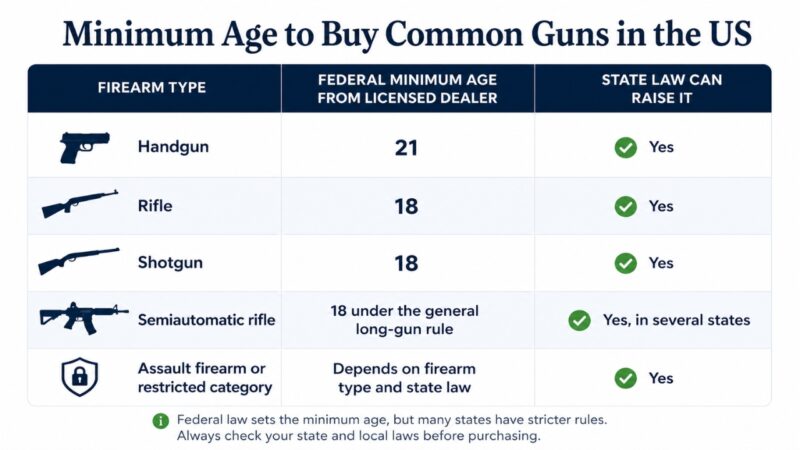
A buyer old enough to vote can buy a rifle or shotgun from a licensed gun dealer under federal law. A handgun sale through the same dealer requires the buyer to be 21.
Federal rules set the first line, while state laws decide how far the restriction goes. California, Colorado, Florida, Hawaii, Illinois, Rhode Island, and Vermont require buyers to be 21 for all firearm purchases. Other states keep the 21-year limit for handguns, semiautomatic rifles, or specific firearm categories.
The legal picture has shifted again ahead of 2026. Courts have reviewed age limits for buyers under 21, state laws have faced new challenges, and private transfers remain governed by a separate mix of federal and state rules. The result is a system where the legal age to buy a gun can change by firearm type, seller category, and state law.
- Federal law sets the minimum age at 21 for handgun purchases from licensed firearm dealers.
- Rifles and shotguns can generally be purchased from licensed firearm dealers at age 18 under federal law.
- Several states require buyers to be 21 for all firearm purchases, including California, Colorado, Florida, Hawaii, Illinois, Rhode Island, and Vermont.
- Some states apply the 21-year minimum only to handguns, semiautomatic rifles, or specific firearm categories.
- Private transfers follow a different federal framework, with state laws adding permits, background checks, or higher age limits in many cases.
Federal Minimum Age To Buy A Gun In The US
At a licensed gun dealer, the national rule is 21 for handguns and 18 for rifles and shotguns.
The rule comes from 18 U.S.C. § 922. Licensed dealers may not sell any firearm or ammunition to a person under 18.
For firearms other than rifles or shotguns, which covers handguns, the minimum age rises to 21.
State law can make the federal rule stricter. The same federal statute bars a licensed dealer from completing a sale when the purchase or possession would violate state law or a local ordinance that applies at the place of sale.
How Old Do You Have To Be To Buy A Handgun?
A person must be at least 21 to buy a handgun from a federally licensed firearm dealer. That rule also applies to handgun ammunition when the dealer knows, or has reasonable cause to believe, that the buyer is under 21.
The age rule for handguns has drawn renewed legal attention.
In 2025, the Fifth Circuit ruled that the federal restriction on licensed handgun sales to adults ages 18 to 20 violated the Second Amendment. The ruling did not erase every state or federal restriction for under-21 buyers, but it placed the dealer-sale rule back at the center of the legal debate.
How Old Do You Have To Be To Buy A Rifle Or Shotgun?
A person must be at least 18 to buy a rifle or shotgun from a federally licensed firearm dealer. Federal law places rifles and shotguns in a separate category from handguns, which is why the dealer-sale minimum is lower for long guns.
That federal age does not guarantee that every 18-year-old can complete a rifle or shotgun purchase in every state. Several states have raised the minimum age for some or all firearm purchases, and licensed dealers must follow state restrictions before completing a sale.
Buyers under 21 also face extra review when a sale goes through the federal background-check system. The FBI says the 2022 Bipartisan Safer Communities Act requires enhanced checks for under-21 buyers, including additional review of juvenile justice, mental health, and local law enforcement records when needed.
Licensed Dealers And Private Sales Have Different Age Rules

A gun bought from a licensed dealer enters the federal system before the sale is completed.
The dealer must verify the buyer, complete the federal paperwork, run the background check where required, and keep the sale record. A private transfer can follow a different route, especially when the seller is not operating as a firearms business.
Federal rules draw that line around business activity. Under current federal law, a person is treated as being engaged in the business of dealing firearms when they devote time, attention, and labor to dealing firearms as a regular course of trade or business, mainly to earn profit through repeated purchase and resale.
That definition separates a licensed dealer from an ordinary private seller.
Purchases From Licensed Firearm Dealers
Licensed dealers are the formal point of sale in federal gun law. A store sale, an online sale completed through a dealer, and a gun show sale handled by a dealer all fall under the dealer framework. The location may change, but the dealer’s obligation does not.
Gun store
Dealer sale
Online purchase shipped to a dealer
Dealer transfer before pickup
Gun show sale by a licensed dealer
Dealer sale
Private sale processed through a dealer
Dealer-facilitated transfer
Age limits are only one part of that process. A licensed dealer also has to follow federal transfer rules, background-check procedures and state restrictions that apply before the firearm leaves the dealer.
Private Sales And Unlicensed Transfers
View this post on Instagram
Private transfers do not automatically follow the same federal process as dealer sales. ATF says federal law bars an unlicensed person from transferring a handgun or handgun ammunition to someone the seller knows, or has reason to believe, is under 18.
For long guns, ATF says federal law has no minimum age for an unlicensed transfer, although state law may impose stricter rules.
Some states require private transfers to go through a licensed dealer. On the other hand, certain states require a permit or purchase authorization, while some also raise the purchase age above the federal floor.
Transfer Type
Federal Treatment
State Law Role
Dealer sale
Formal dealer process applies
May add higher age limits or extra steps
Private handgun transfer
Federal under-18 transfer limit applies
May require age 21, permit or background check
Private rifle or shotgun transfer
No federal minimum age listed by ATF
May set minimum age or require dealer processing
Interstate private transfer
Usually must go through a licensed dealer in the buyer state
Buyer state rules apply before transfer
ATF guidance for private sellers also warns that transfers to out-of-state buyers must go through a licensed firearm dealer in the state where the recipient lives.
The boundary between a private seller and a dealer has become a federal policy fight. In 2024, the federal government expanded how it interpreted sellers who are engaged in the business of dealing firearms.
In May 2026, ATF opened a new rulemaking process to revise parts of that approach, with the public comment period scheduled to run until August 4, 2026.
AP reported that the 2026 Justice Department move included a proposed rollback of the 2024 rule aimed at firearm sales outside traditional retail locations, including gun shows and online sales. The change put private-sale rules back in the national debate at the same time courts and states continue to revisit age restrictions.
Dealer Sale Versus Private Transfer
Question
Dealer Sale
Private Transfer
Does a licensed dealer handle the transfer?
Yes
Usually no
Is a federal dealer record created?
Yes
Usually no, unless processed through a dealer
Does the federal background-check system apply?
Yes, in ordinary dealer sales
Depends on state law or dealer involvement
Can state law raise the age limit?
Yes
Yes
Can the same firearm have a different process depending on the seller type?
Yes
Yes
The legal age to buy a gun can shift before the firearm type even enters the analysis.
How Old You Have To Be To Buy Accessories, Ammunition, And Gear
Gun purchase age laws do not always match the rules for ammunition, firearm accessories, concealed carry equipment, or protective gear.
Some firearm-related products fall under separate federal age restrictions, while others have no standalone federal minimum purchase age. State law and retailer policy can also change the rules depending on the item, the seller, and the buyer’s location.
That means a person who cannot legally buy a handgun from a licensed firearm dealer may still be able to buy certain accessories, storage products, optics, holsters, bags, or other carry-related gear, unless state law or a store policy says otherwise.
Ammunition Has Separate Federal Age Limits
Ammunition follows its own federal age framework.
Under 18 U.S.C. § 922(b)(1), a licensed importer, manufacturer, dealer, or collector may not sell any firearm or ammunition to someone the licensee knows, or has reasonable cause to believe, is under 18. The same statute also bars licensed sellers from selling ammunition “other than ammunition for a shotgun or rifle” to someone under 21.
In practice, that means handgun ammunition generally follows the 21-year federal dealer-sale rule, while rifle and shotgun ammunition generally follow the 18-year federal dealer-sale rule.
ATF guidance draws a different line for unlicensed transfers. ATF says federal law bars an unlicensed person from transferring handgun ammunition to someone the seller knows, or has reason to believe, is under 18. For long-gun ammunition, ATF lists no federal minimum age for an unlicensed transfer, although state law may still add restrictions.
| Seller Type | Handgun Ammunition | Rifle Or Shotgun Ammunition |
|---|---|---|
| Licensed dealer | 21 under federal law | 18 under federal law |
| Unlicensed private seller | Federal under-18 transfer limit applies | No federal minimum listed by ATF |
| State law role | May add background checks, permits, or higher age limits | May add background checks, permits, or higher age limits |
Some states add extra requirements beyond the federal ammunition age rule.
California’s Department of Justice has maintained an ammunition eligibility-check system for ammunition purchases, although California’s ammunition background-check law has also been subject to major federal court litigation.
New York requires a background check for ammunition purchases under its Concealed Carry Improvement Act system, and the New York Attorney General reported in 2025 that a court decision upheld the state’s ammunition background-check law.
Retailer policy can be stricter than federal law as well. Walmart says it raised the minimum age to purchase firearms and ammunition in its stores to 21 in 2018, even though federal law allows licensed dealer sales of rifle and shotgun ammunition at 18.
Can You Buy Concealed Carry Gear Under The Age Of 21?
Most concealed carry accessories are not treated the same way as firearms under federal law.
Holsters, concealed carry purses, lockboxes, tactical backpacks, range bags, optics, gun belts, and concealed carry clothing generally do not have the same federal dealer-sale age limits that apply to firearms and ammunition.
That distinction matters because federal gun law defines and regulates firearms and ammunition differently from ordinary accessories. The federal age limits in 18 U.S.C. § 922(b)(1) apply to firearms and ammunition sold by licensees, not to every product that may be used with a firearm.
Still, a buyer may face restrictions in practice. Retailers can set their own age policies for tactical products, online orders, or items closely associated with firearm use. State law may also regulate certain products differently, especially when an item crosses into a separately regulated category.
Concealed carry gear can also raise safety and training issues, even when the product itself is not age-restricted like a firearm.
Elegant and Armed shows that a concealed carry purse should have a dedicated gun pocket and a stationary holster that covers the trigger, and it warns against placing an unholstered firearm loose inside a bag because other items could enter the trigger guard or make the firearm harder to access safely.
| Product Category | Federal Minimum Age Rule | State Or Retailer Role |
|---|---|---|
| Holsters | No standalone federal firearm-purchase age rule | Store policy may restrict sales |
| Concealed carry bags or purses | No standalone federal firearm-purchase age rule | Store policy may restrict sales |
| Gun belts and carry clothing | No standalone federal firearm-purchase age rule | Store policy may restrict sales |
| Optics and sights | No standalone federal firearm-purchase age rule | State law or retailer policy may apply |
| Lockboxes and storage gear | No standalone federal firearm-purchase age rule | State law or retailer policy may apply |
| Ammunition | 18 or 21 through licensed dealers, depending on ammunition type | State law may add checks, permits, or higher limits |
A person may, therefore, be old enough to buy a holster, lockbox, or range bag while still being too young to buy a handgun from a licensed dealer or handgun ammunition from that same dealer.
Body Armor Laws Can Be Different From Gun Laws
Body armor follows a separate legal framework from firearm purchases.
Federal law does not create a general 18-or-21 minimum purchase age for civilian body armor in the same way it does for dealer firearm and ammunition sales. Instead, 18 U.S.C. § 931 makes it unlawful for a person to purchase, own, or possess body armor if that person has been convicted of a felony that is a crime of violence, or a comparable state offense.
State law can go further. New York, for example, regulates the purchase, sale, and use of body armor through a state-law system tied to eligible professions. The New York Department of State says state rules require criteria for professions eligible to purchase, sell, or use body armor.
That creates situations where a buyer may legally purchase concealed carry gear or firearm accessories while facing stricter rules for firearms, ammunition, or body armor.
| Item | Federal Treatment | Example Of Added Restriction |
|---|---|---|
| Handgun | Dealer sale generally requires buyer to be 21 | State law may also require permits or waiting periods |
| Rifle or shotgun | Dealer sale generally requires buyer to be 18 | Some states raise the age to 21 |
| Handgun ammunition | Dealer sale generally requires buyer to be 21 | Some states require ammunition background checks |
| Rifle or shotgun ammunition | Dealer sale generally requires buyer to be 18 | Some states require ammunition background checks |
| Holsters and carry bags | No standalone federal firearm-purchase age rule | Retailer policy may restrict sales |
| Body armor | Violent felons are federally prohibited | State law may restrict civilian sale or use |
The key point is that firearm age rules are only one part of the larger purchase landscape. Ammunition, accessories, carry equipment, storage gear, optics, and body armor can each follow a different legal path depending on federal law, state law, seller type, and retailer policy.
How Old You Have To Be To Buy A Gun In Each State In 2026
State law can raise the minimum age above the federal baseline.
Everytown Research lists 21 states with a purchase-age policy stricter than the basic federal rule, although the details vary by firearm type.
Some states set 21 for all firearms, some apply 21 only to handguns, and others apply higher limits to semiautomatic rifles or assault firearm categories.
State
Minimum Age Rule Listed For 2026
Alabama
No raised purchase-age policy listed
Alaska
No raised purchase-age policy listed
Arizona
No raised purchase-age policy listed
Arkansas
No raised purchase-age policy listed
California
21 for all firearms
Colorado
21 for all firearms
Connecticut
21 for handguns and semi-automatic centerfire rifles that have or accept a 5+ round magazine; 18 for other rifles and shotguns
Delaware
Listed as 21 for all firearms, but a 2025 court ruling struck down the age-21 law
Florida
21 for all firearms
Georgia
No raised purchase-age policy listed
Hawaii
21 for all firearms
Idaho
No raised purchase-age policy listed
Illinois
21 for all firearms
Indiana
No raised purchase-age policy listed
Iowa
No raised purchase-age policy listed
Kansas
No raised purchase-age policy listed
Kentucky
No raised purchase-age policy listed
Louisiana
No raised purchase-age policy listed
Maine
No raised purchase-age policy listed
Maryland
21 for handguns; 18 for rifles and shotguns
Massachusetts
21 for handguns and semiautomatic long guns; 18 for other long guns
Michigan
No raised purchase-age policy listed
Minnesota
No raised purchase-age policy listed
Mississippi
No raised purchase-age policy listed
Missouri
No raised purchase-age policy listed
Montana
No raised purchase-age policy listed
Nebraska
21 for handguns; 18 for rifles and shotguns
Nevada
21 for handguns; 18 for rifles and shotguns
New Hampshire
No raised purchase-age policy listed
New Jersey
21 for handguns; 18 for rifles and shotguns
New Mexico
21 for handguns; 18 for rifles and shotguns
New York
21 for handguns and semiautomatic rifles; 18 for other rifles and shotguns
North Carolina
No raised purchase-age policy listed
North Dakota
No raised purchase-age policy listed
Ohio
21 for handguns; 18 for rifles and shotguns
Oklahoma
No raised purchase-age policy listed
Oregon
21 for handguns; 18 for rifles and shotguns
Pennsylvania
21 for handguns; 18 for rifles and shotguns
Rhode Island
21 for all firearms
South Carolina
No raised purchase-age policy listed
South Dakota
No raised purchase-age policy listed
Tennessee
No raised purchase-age policy listed
Texas
No raised purchase-age policy listed
Utah
No raised purchase-age policy listed
Vermont
21 for all firearms
Virginia
21 for handguns and assault firearms; 18 for other rifles and shotguns
Washington
21 for handguns and semiautomatic assault rifles; 18 for all other long guns
West Virginia
No raised purchase-age policy listed
Wisconsin
No raised purchase-age policy listed
Wyoming
No raised purchase-age policy listed
California, Colorado, Florida, Hawaii, Illinois, Rhode Island, and Vermont fall into the strictest category, with a minimum purchase age of 21 for all firearms.
Maryland, Nebraska, Nevada, New Jersey, New Mexico, Ohio, Oregon, and Pennsylvania use a narrower rule, setting the minimum at 21 for handguns and 18 for rifles and shotguns.
Connecticut, Massachusetts, New York, Virginia, and Washington take a more targeted approach, applying higher age limits to semiautomatic rifles, assault firearms or other specific firearm categories.
Delaware should be treated separately. A 2025 court ruling struck down the age provisions in House Bill 451, which had raised the minimum firearm purchase age from 18 to 21.
Background Checks For Buyers Under 21
Today, President Biden signed the Bipartisan Safer Communities Act into law.
This important gun safety legislation will fund crisis intervention, including red flag laws, require young people to undergo enhanced background checks, and more. pic.twitter.com/LtpQMismiP
— The White House 46 Archived (@WhiteHouse46) June 25, 2022
Federal background checks for younger buyers changed after the Bipartisan Safer Communities Act, passed in June 2022.
The law expanded the National Instant Criminal Background Check System process for firearm buyers ages 18 to 20, adding a review of juvenile criminal records, juvenile justice information and certain mental-health records that may be held outside the main federal databases.
A buyer in that age group still begins with the standard dealer process. The buyer completes ATF Form 4473, the licensed dealer sends biographic information to NICS, and the system checks three national databases: the National Crime Information Center, the Interstate Identification Index and the NICS Indices.
For non-U.S. citizens, the check also includes applicable immigration databases.
How Enhanced Background Checks Work?
For buyers under 21, the background check can move beyond the automated database search.
NICS can contact agencies connected to the buyer’s residential address, including local law enforcement, state criminal-history or juvenile-justice repositories, and state custodians of mental-health adjudication records.
The purpose is to find disqualifying juvenile records that may never have reached the federal databases used in a routine check.
Step
What Happens
The buyer starts the purchase
ATF Form 4473 is completed at a licensed dealer
Dealer submits the check
The dealer sends the buyer information to NICS
NICS runs national databases
NCIC, III, and NICS Indices are checked
Under-21 review begins
NICS may contact state and local agencies
Additional records are reviewed
Juvenile criminal, juvenile justice and mental-health records may be checked
Final status is returned
The transaction receives a proceed, delay or denial response
Records Reviewed During Under-21 Firearm Checks

The enhanced process focuses on records that can be difficult to capture through a standard check. Juvenile records, local incident information, and mental-health adjudication records may sit with state courts, local law-enforcement agencies, or state-level record custodians.
FBI guidance says NICS may request information about juvenile criminal behavior, delinquency, mental-health adjudications, or commitments that could disqualify a person under 21 from receiving or possessing a firearm.
Record Category
Why It Matters
Juvenile criminal history
A past juvenile offense may create a firearm prohibition under federal or state law
Juvenile delinquency records
Some records may show conduct that disqualifies the buyer
Mental-health adjudications
Court or official findings may affect firearm eligibility
Mental-health commitments
Certain commitments can create a federal firearm prohibition
Local law enforcement records
Local agencies may hold incident details absent from federal databases
State criminal-history repositories
State systems may contain records or dispositions needed for a final NICS decision
Why Some Dealer Sales Can Take Longer?
A routine NICS check can return within minutes. When a case requires more research, federal law normally gives examiners three business days before the dealer can decide whether to transfer the firearm.
For under-21 buyers, the Bipartisan Safer Communities Act allows the review period to extend to 10 business days when cause exists for more investigation.
The added time is tied to record access. Local agencies may need to locate juvenile files, confirm a court disposition or decide whether state privacy rules allow a response.
FBI reporting says early under-21 checks moved more slowly because some state and local agencies were unfamiliar with the process or restricted by juvenile-record and mental-health privacy laws.
Review Stage
Typical Timing
Routine NICS response
Often within minutes
Standard delayed transaction window
3 business days
Under-21 extended review when a cause exists
Up to 10 business days
FBI reported average processing time after improvements
About 4 calendar days
FBI reported average denial time after improvements
About 2 days
What The FBI Data Shows About Under-21 Checks
The FBI reported that enhanced checks began in October 2022.
By March 2024, NICS had conducted enhanced reviews on more than 200,000 under-21 transactions and denied more than 600 transactions based only on information found through the expanded process.
A later Justice Department summary reported more than 260,000 completed under-21 enhanced checks and 800 prevented firearm purchases based solely on information revealed through the enhanced review.
Reported Measure
Figure
Enhanced checks began
October 2022
FBI total reported in March 2024
More than 200,000 checks
FBI denials reported in March 2024
More than 600 denials
Justice Department later total
More than 260,000 checks
Justice Department later prevented purchases
800 purchases
An 18-, 19- or 20-year-old buyer may qualify under the age rule for a rifle or shotgun at a licensed dealer, yet still face a longer background-check review. The dealer sale can move forward only after the NICS result allows it or the legal waiting period expires under the applicable rules.
For a buyer, the under-21 review can mean added time before pickup. For a dealer, it means a transaction involving a younger buyer may remain open while NICS contacts state and local agencies.
For state and local agencies, it means a federal request may arrive for records tied to juvenile conduct, delinquency, mental-health adjudication or commitment history.
FAQs
Bottom Line

Federal law sets the starting point for gun purchase age in the United States: 21 for handguns bought from licensed dealers and 18 for rifles and shotguns bought from licensed dealers.
State law can raise those limits, and several states now require buyers to be 21 for all firearms or for specific categories such as handguns, semiautomatic rifles, or assault firearms.
Private transfers, online purchases, gun show sales, and family transfers can also follow different rules depending on the seller, the firearm, and the state.
A buyer who meets the federal age requirement may still face a higher state minimum, a permit rule, an enhanced background check, or a court-related change in how the law applies.