
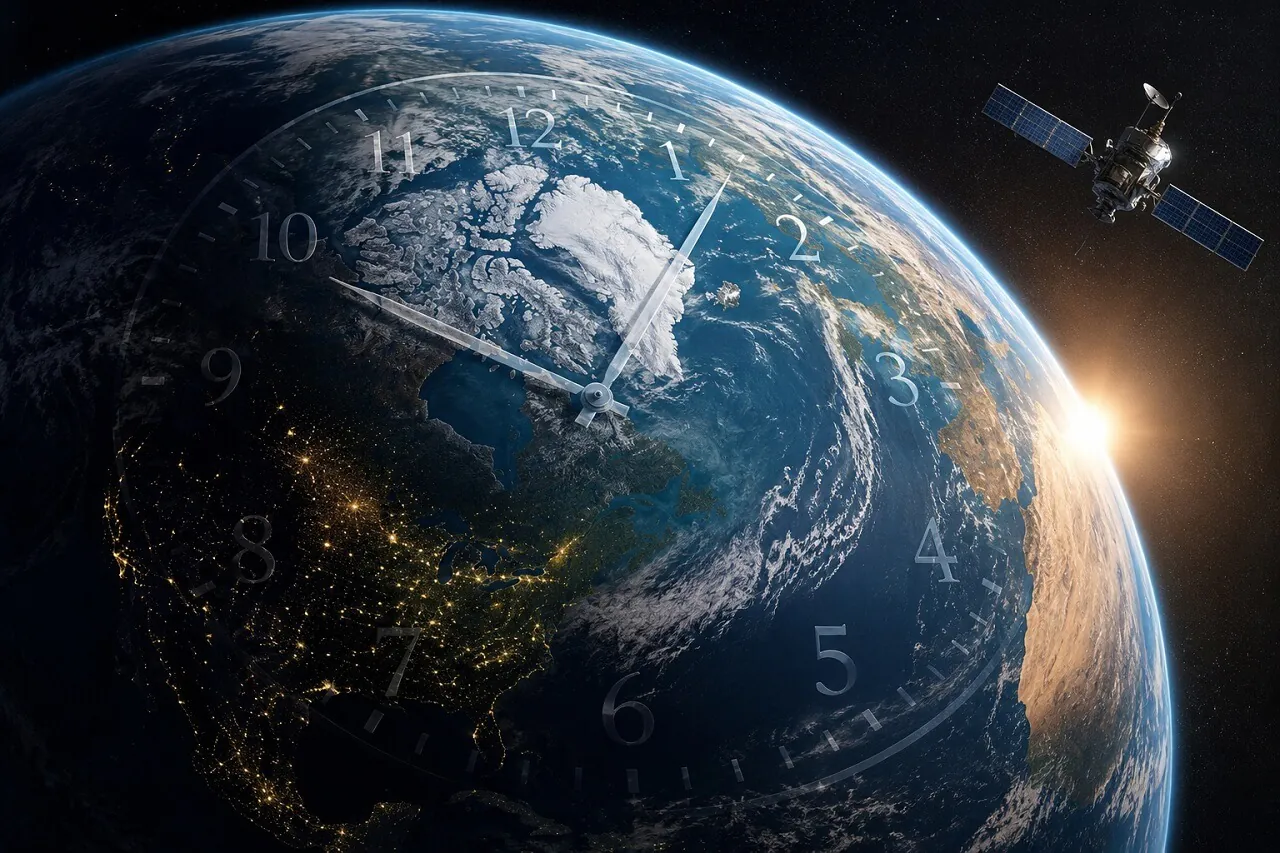
Days on Earth are getting longer, but nobody should expect an extra hour of sleep, a longer workday or a broken 24-hour clock anytime soon.
The change is tiny: a new study says climate-driven sea-level rise is lengthening the day by about 1.33 milliseconds per century. That means the planet is slowing by an amount far too small for people to feel, yet large enough for scientists to measure with satellites, fossil records and precision timing systems.
The question returned to public attention after The Wall Street Journal reported on the new Earth rotation study and Popular Mechanics examined how groundwater pumping has shifted Earth rotation pole. Both stories point to the same larger idea: moving water around the planet can slightly change how Earth spins.
So, Are Days Actually Getting Longer?
@astrokobi The days are getting LONGER (literally) #spacetok #nasa #moon #earth #astrokobi ♬ Spooky, quiet, scary atmosphere piano songs – Skittlegirl Sound
Yes. The length of a day is not fixed perfectly at 24 hours. Earth rotation changes because of the Moon, ocean tides, movement inside the planet, atmosphere, sea-level rise, ice loss and water storage on land.
The new study, published in Journal of Geophysical Research: Solid Earth, found that modern climate change is adding about 1.33 milliseconds per century to day length. The University of Vienna says that rate is unprecedented in the past 3.6 million years.
Still, a millisecond is just one-thousandth of a second. At the current climate-related rate, one full second of extra day length would take about 75,000 years. A full extra hour would take far longer than any human planning horizon.
How Melting Ice Can Slow The Planet?
Earth spins faster or slower depending partly on where its mass sits. When polar ice melts, water moves away from high latitudes and into the oceans. More mass shifts farther from the rotation axis, and Earth rotation slows slightly.
The usual comparison is a figure skater. Arms pulled in make the skater spin faster. Arms extended make the skater spin slower. Earth is not a skater, but the physics is similar enough for the idea to work.
The ETH Zurich summary of the research says the team reconstructed past day-length changes using fossil remains of benthic foraminifera, tiny marine organisms whose shell chemistry can help track ancient sea levels.
The Moon Has Been Slowing Earth For Much Longer
Climate change is not the only reason days lengthen. The Moon has been slowing Earth rotation for billions of years through tidal braking.
NASA says tidal braking has played a dominant role through Earth history and increases day length by about 2.3 milliseconds per century. That long-term lunar effect is one reason ancient Earth had shorter days than modern Earth.
The new study does not replace the Moon story. It adds a modern human-driven layer. The researchers say climate influence on day length could become even larger by the end of the century if sea-level rise accelerates.
The 31.5-Inch Earth Tilt
Popular Mechanics focused on another water-driven rotation effect: groundwater pumping. A 2023 study in Geophysical Research Letters estimated that humans depleted about 2,150 gigatons of groundwater between 1993 and 2010, shifting Earth rotation pole by roughly 31.5 inches and adding about 0.24 inches to global sea level.
That does not mean Earth tipped over in a dangerous way. Earth rotation pole naturally moves. The useful point is that human water use has become large enough to show up in planetary motion data.
Groundwater pumped from aquifers does not vanish. Much of it ends up moving through farms, cities, rivers and oceans. That transfer changes where water mass sits on Earth, and the spin system responds.
Can People Feel Any Of This?
No. A change measured in milliseconds per century will not change daily life in any obvious way. Clocks will still show 24-hour days. Sunrises and sunsets will not suddenly drift because of the new study.
The practical concern sits in precision systems. Space navigation, satellites, GPS, astronomy and global timekeeping depend on accurate knowledge of Earth rotation. Even tiny changes can matter when a spacecraft, a satellite signal or a navigation system needs exact timing.
That is why scientists care about a number that sounds absurdly small to everyone else.
The Science Is Getting More Precise
Modern Earth rotation can be measured with satellites and geodetic systems. Looking millions of years into the past is harder. The new work connects fossil chemistry, sea-level reconstruction and physics-informed modeling to estimate how climate affected day length over deep time.
The researchers found one older period, around 2 million years ago, when the rate came close to the modern change. The current rate still stands out because it is tied to rapid modern sea-level rise and ice loss.
The study gives scientists a longer comparison window. Instead of asking only whether Earth rotation is changing now, the work asks whether the current rate looks unusual against millions of years of climate history. The answer from the University of Vienna and ETH Zurich team is yes.
Bottom Line
Days on Earth are getting longer, but the change is microscopic by human standards. The new estimate places climate-related lengthening at about 1.33 milliseconds per century, a rate researchers say is unmatched in the past 3.6 million years.
The finding does not mean the 24-hour day is about to disappear. It does show that ice melt, sea-level rise and groundwater use are large enough to affect the spin of the planet. For regular people, the clock stays the same. For scientists tracking satellites, navigation and Earth systems, those tiny changes are another signal of how deeply human activity is now tied to the planet itself.
Related Posts:
- Cancer Spreads Using Tiny Invisible Bubbles,…
- A Tiny Gut Molecule Might Cut Type 2 Diabetes Risk,…
- A Groundbreaking Eye Treatment Just Restored Vision…
- Paul AI Sensor Flags 486 Health Changes, Fall Risk…
- Houston Population in 2026 Reaches 2.4 Million as…
- Why This Tiny DNA Clue Could Change Breast Cancer Care