
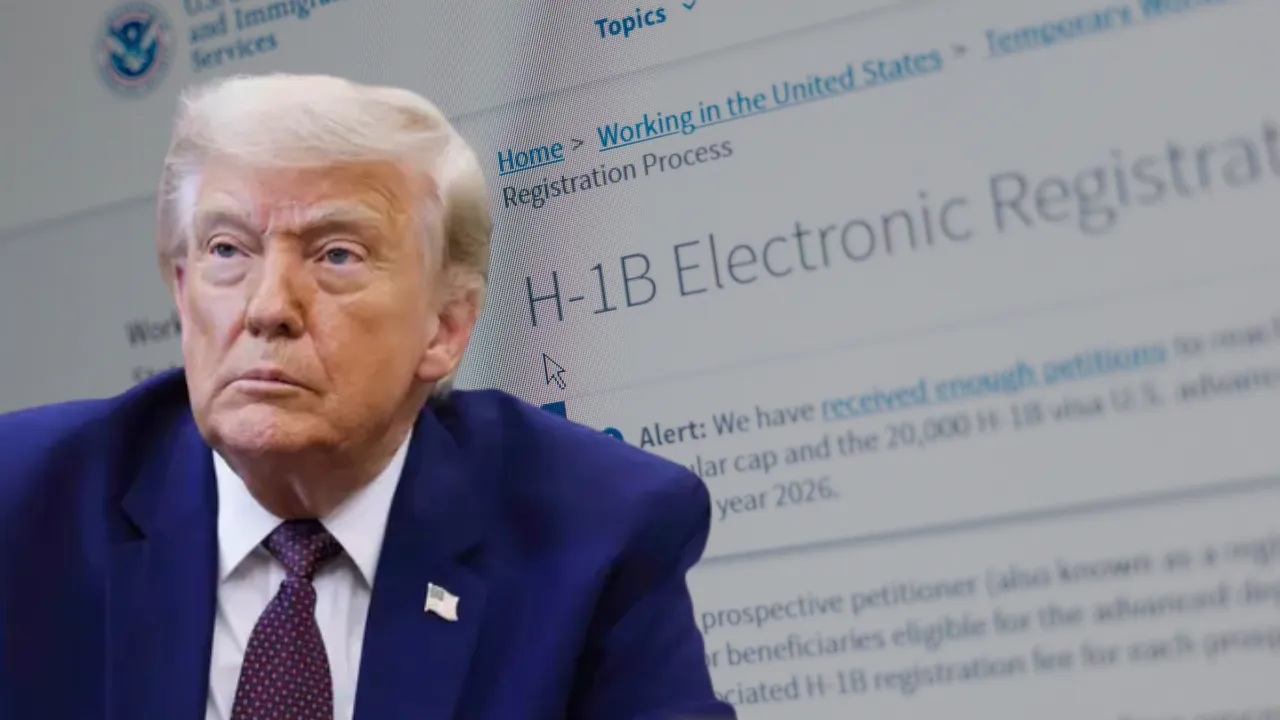
A federal judge has blocked a Trump administration policy that would have charged a massive $100,000 fee for new H-1B visa petitions. The ruling turns a tense battle over skilled immigration into a high-stakes legal test regarding executive power, taxation, and the financial cost of recruiting foreign-born talent.
U.S. District Judge Leo Sorokin in Boston ruled in favor of 20 states fighting the fee, stating the administration bypassed Congress and violated the Administrative Procedure Act.
According to the Associated Press, Sorokin concluded that the policy essentially functioned as an unauthorized tax on H-1B petitions.
While the decision offers immediate relief to universities, hospitals, tech firms, and foreign professionals navigating a chaotic visa season, the legal battle is far from over.
The administration is expected to appeal, and a conflicting ruling in another federal court means employers will need to keep a close eye on official agency updates before finalizing their next hiring moves.
Why the H-1B Fee Was Shot Down?
At the heart of the case was a staggering $100,000 fee attached to new H-1B visa petitions. The administration pitched the policy as a protective measure to stop companies from undercutting local talent and passing over American workers for roles that could be filled domestically.
The court, however, wasn’t buying that logic. Judge Sorokin made it clear that the executive branch overstepped its bounds by imposing such a hefty charge.
According to the ruling, the fee didn’t just cover paperwork; it effectively acted as an unauthorized tax on H-1B petitions, something only Congress has the constitutional power to create.
Key Issue
The Administration’s Policy
The Court’s Verdict
The Fee Amount
Imposed a $100,000 charge on new H-1B filings.
Ruled that the amount went way beyond a standard processing fee.
Legal Authority
Claimed the executive branch had the power under broad immigration laws.
Stated that Congress never gave the administration the power to levy taxes.
The Process
Pushed the policy through via rapid executive action.
Found that the administration violated the Administrative Procedure Act.
Real-World Impact
Drastically increased the cost of bringing on foreign talent.
Warned that it unfairly blocked states and public centers from hiring crucial staff.
While the immediate $100,000 hurdle has been cleared, pending appeals and conflicting lawsuits mean this battle will likely drag on for months.
The Legal Loophole That Blocked the New H-1B Fee
View this post on Instagram
The entire lawsuit came down to whether the administration was charging a fee or creating a tax.
Government agencies are allowed to set reasonable fees just to cover the cost of processing paperwork. But when a policy is designed to penalize employers or restrict access, it legally becomes a tax, and the executive branch cannot pass a tax without Congress approving it first.
This distinction matters because a $100,000 penalty completely breaks the hiring budgets for public institutions. It forces a hospital to pass on a critical specialist, stops a university from bringing in a top researcher, and prevents a local school district from hiring a qualified teacher.
That heavy financial burden is exactly why state governments sued to block the rule. They argued that the extreme cost would make it impossible to fill vacant roles in healthcare and education, fields that are already struggling with severe worker shortages.
The ruling is part of a larger trend where federal judges are pushing back against the administration’s use of executive orders to bypass lawmakers on major economic policies. Similar legal fights are playing out right now across trade and labor sectors, and this decision officially puts skilled immigration on that same battleground.
What H-1B Visas Actually Cover?
The H-1B program allows U.S. employers to temporarily hire foreign workers in specialty occupations. USCIS describes those jobs as roles requiring highly specialized knowledge and at least a bachelor’s degree in the specific specialty, or an equivalent qualification.
Technology companies are the best-known users of H-1B visas, but the program reaches beyond software. Colleges, hospitals, medical research centers, engineering firms, school systems, and public institutions also use it when they cannot fill certain specialized roles domestically.
That broader labor picture is why the ruling belongs on an employment and demographics site, not only in an immigration-law column.
Sector
Why H-1B Can Matter
What A $100,000 Fee Could Do
Technology
Employers use H-1B for engineers, developers, AI roles and specialized technical jobs
Large firms could absorb some cost, while smaller firms could be priced out
Healthcare
Hospitals and clinics may sponsor physicians, researchers and specialized staff
Hard-to-fill roles could become harder to staff
Higher education
Universities use skilled foreign workers in teaching, research and lab roles
Research hiring and faculty recruitment could slow
Public schools
Some districts rely on foreign teachers in shortage areas
Lower-budget districts could lose access to candidates
Startups
Smaller companies hire specialized talent when domestic hiring is difficult
The fee could act like a barrier before hiring even begins
That does not mean every H-1B petition represents an unfilled domestic job. Critics of the program argue that some employers use it to hold down labor costs or avoid hiring U.S. workers.
Supporters argue that H-1B fills gaps in specialized fields and supports job growth around teams that need those skills. The court ruling does not resolve that economic argument. It addresses whether the administration had lawful authority to impose the fee.
The Employers Most Exposed To The H-1B Fee

The timing makes the decision more important. The U.S. labor market is still adding jobs, but hiring is uneven by sector. The May 2026 jobs report shows that employers added 172,000 jobs while unemployment remained at 4.3%. That is a stable headline, yet shortages remain in specific industries.
Healthcare is one of those industries. We reported that the U.S. health industry employs roughly 19 to 20 million people, making it one of the largest employment sectors in the country. Staffing pressure in healthcare does not disappear because the national unemployment rate looks stable.
Software is another pressure point. U.S. software jobs are projected to grow 15 percent by 2034. That growth forecast helps explain why companies continue to fight over skilled technical hiring even during periods of layoffs, restructurings, and slower hiring plans.
In our report on how immigration shapes the U.S. workforce, Census-linked projections showed how immigration levels affect the size of the future working-age population. BLS data also show that foreign-born workers accounted for 19.1 percent of the U.S. civilian labor force in 2025.
That labor force connection is the part missing from many quick political arguments. Skilled immigration does not sit outside the economy. It is part of how employers, universities, hospitals, and research institutions plan staffing.
What does the Ruling Mean for Employers and Visa Holders Right Now?
Big setback for Trump: A federal Court in Boston ruled his $100,000 fee on new H-1B visas unlawful, calling it an unauthorized tax exceeding executive authority.
The fee, part of the September 2025 proclamation to protect U.S. workers, drew immediate relief from tech firms and… pic.twitter.com/4TU4ldrMCu
— Megh Updates 🚨™ (@MeghUpdates) June 8, 2026
For employers, the immediate takeaway is relief mixed with a heavy dose of caution. While the court blocked the $100,000 fee, pending appeals could easily disrupt hiring timelines again.
For now, corporate immigration lawyers and HR teams are waiting on formal processing instructions from USCIS and the Department of Homeland Security before filing new paperwork.
For H-1B workers and applicants, the decision removes a massive financial barrier that threatened to derail their careers. The sudden fee had triggered widespread panic among foreign graduates planning U.S. careers, workers waiting abroad, and companies trying to figure out if sponsoring talent was still financially viable.
The ruling is a lifeline for smaller organizations. While a massive tech firm might absorb high legal fees, a rural hospital, a public school district, a university lab, or a bootstrapped startup simply cannot.
For these employers, a six-figure penalty transformed hiring skilled professionals from a difficult task into an impossible one.
Group
Immediate Impact
What to Watch For Next
Employers
Immediate relief from the massive cost barrier.
New petition instructions and government appeal filings.
H-1B Applicants
Lower risk of having sponsorship canceled over costs.
Whether the government tries to pause the ruling during appeal.
Universities
Restored the ability to sponsor researchers and faculty.
Updated guidelines on how research roles are processed.
Hospitals
Green light to resume hiring specialized medical staff.
Official confirmation that regular visa processing has resumed.
State Governments
A major legal victory protecting public-sector hiring.
Conflicting rulings from other federal appeals courts.
How This Fits The Wider Trump Immigration Agenda
The H-1B ruling lands during a period when immigration policy is affecting several parts of the labor market at once.
We recently reported on a warning that Trump’s deportation policies can cost jobs in construction, including among U.S.-born workers in regions where employers scale down because crews shrink. That report focused on lower-wage and non-college labor markets.
The H-1B case focuses on the other end of the labor market: physicians, engineers, researchers, software workers, faculty, and other specialized professionals. Together, the stories show that immigration policy is now pressing on both blue-collar and high-skill staffing pipelines.
The issue also sits beside the administration’s focus on citizenship and legal status. Our team at NCHStats previously covered the Trump DOJ denaturalization push, which raised questions about how changes in legal status can reach people already integrated into U.S. communities and workplaces.
The same pattern appears here. The fee was presented as labor protection. The court case asked whether the legal tool used to pursue that goal was lawful.
The economic result could affect employers who already face shortages.
Bottom Line
@bloombergpolitics A federal judge struck down a $100,000 fee President Donald Trump ordered for H-1B visa applications, providing a reprieve for US technology companies that rely on hiring skilled foreign workers. Michael Shepard explains. #US #news #Politics #immigration #government ♬ original sound – Bloomberg Politics
The federal court decision blocks the Trump administration $100,000 H-1B fee and gives employers short-term relief, but it does not end the national fight over skilled immigration.
The ruling is important because it treats the fee as more than an immigration charge. It frames the policy as a tax-like financial barrier that requires congressional authority.
That makes the case part of a wider debate over how far a president can go when immigration policy carries major economic costs.
For workers, employers, and states, the next few weeks will be about guidance and appeals. For the broader economy, the larger question remains: how the United States balances job protection claims with the need for skilled workers in healthcare, education, research, software, and other sectors already facing serious staffing pressure.
Also read: Latest Donald Trump State Approval Map