

Federal mortality data show that the age-adjusted Parkinson disease death rate among U.S. adults age 65 and older fell to 72.0 deaths per 100,000 standard population in 2024.
Age-adjusted mortality rose from 2014 to 2021, increasing to 76.3 after 57.2, then fell to 72.0 in 2024.
Total Parkinson disease deaths among adults aged 65 and older increased across the same period: 25,482 in 2014, 37,568 in 2021, and 39,935 in 2024.
Findings appeared in NCHS Data Brief No. 563, “Parkinson Disease Mortality Among Adults Age 65 and Older: United States, 2024,” published June 4, 2026, by Ellen A. Kramarow, PhD, Loraine A. Escobedo, PhD, MPH, and Betzaida Tejada-Vera, MS.
The analysis used mortality data from the National Vital Statistics System.
Why Does This Data Actually Matter?

Parkinson’s disease is a progressive neurodegenerative disease linked with tremors, muscle stiffness, slower movement, and balance problems.
Symptoms can worsen over time and may include cognitive difficulties and other nonmotor symptoms.
Research into Parkinson’s disease also uses laboratory tools to study disease biology, including recombinant monoclonal antibodies that detect alpha-synuclein, a protein associated with Lewy body pathology.
For example, one research-use-only antibody targets phosphorylated alpha-synuclein at serine 129 and is listed for laboratory methods such as immunohistochemistry, immunocytochemistry, Western blot, and ELISA.
These tools may help researchers study Parkinson-related pathology, but they are not treatments, and the mortality data do not assess any specific therapy or research reagent.
The mortality data do not assess the effect of any specific therapy or research reagent.
In 2024, Parkinson’s disease ranked as the ninth leading cause of death among adults aged 65 and older.
Age-adjusted mortality reached 76.3 deaths per 100,000 in 2021, the highest reported point in the period. By 2024, the rate fell to 72.0, but it stayed above the 2014 rate of 57.2.
Trend Over Time – 2014 to 2024
Parkinson’s disease mortality among older adults rose across much of 2014 to 2021, then declined by 2024.
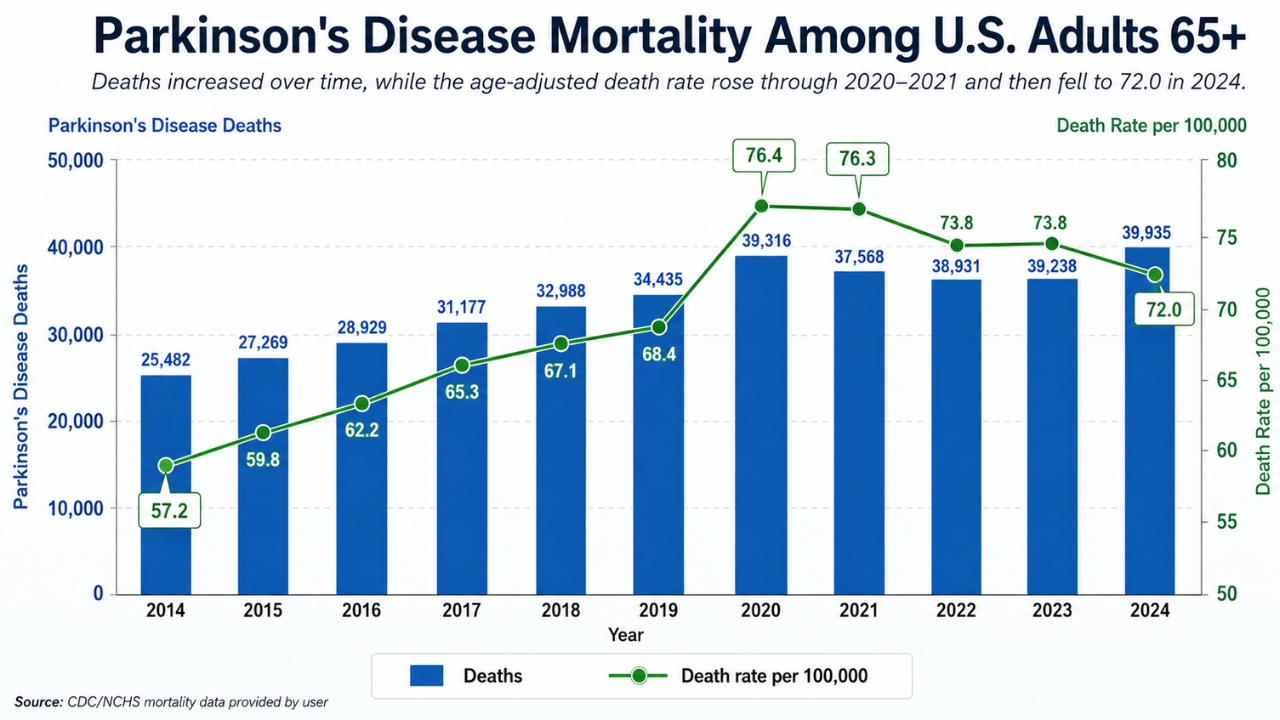
CDC/NCHS reported a statistically significant increase from 2014 to 2021. A decrease from 2021 to 2024 was not statistically significant, although the 2024 rate was significantly lower than the 2021 rate.
Men had rates about twice as high as women throughout 2014 to 2024.
In 2024, men had 24,690 deaths and a rate of 105.6 deaths per 100,000. Women had 15,245 deaths and a rate of 47.6.
Male mortality peaked at 112.5 in 2020 and was 112.3 in 2021, then fell to 105.6 in 2024. Female mortality was 51.0 in 2020, 50.8 in 2021, and 47.6 in 2024.
Sex Differences
New data brief from the CDC on Parkinson disease mortality.
“Parkinson disease death rates for men were about 2 times higher than death rates for women throughout the period.” pic.twitter.com/CvYDdAstsz— James L. Nuzzo, PhD (@JamesLNuzzo) June 6, 2026
Men had substantially higher Parkinson’s disease death rates than women in 2024.
Men accounted for 24,690 deaths and had an age-adjusted rate of 105.6 deaths per 100,000. Women accounted for 15,245 deaths and had a rate of 47.6.
Men made up about 62% of Parkinson’s disease deaths among adults aged 65 and older in 2024, with 24,690 of 39,935 deaths.
CDC/NCHS found significantly higher male death rates in each age group studied: ages 65 to 74, ages 75 to 84, and ages 85 and older.
Male rates were also significantly higher across all race and Hispanic-origin groups except American Indian and Alaska Native non-Hispanic adults.
Age Differences
Parkinson’s disease death rates increased sharply with age in 2024:
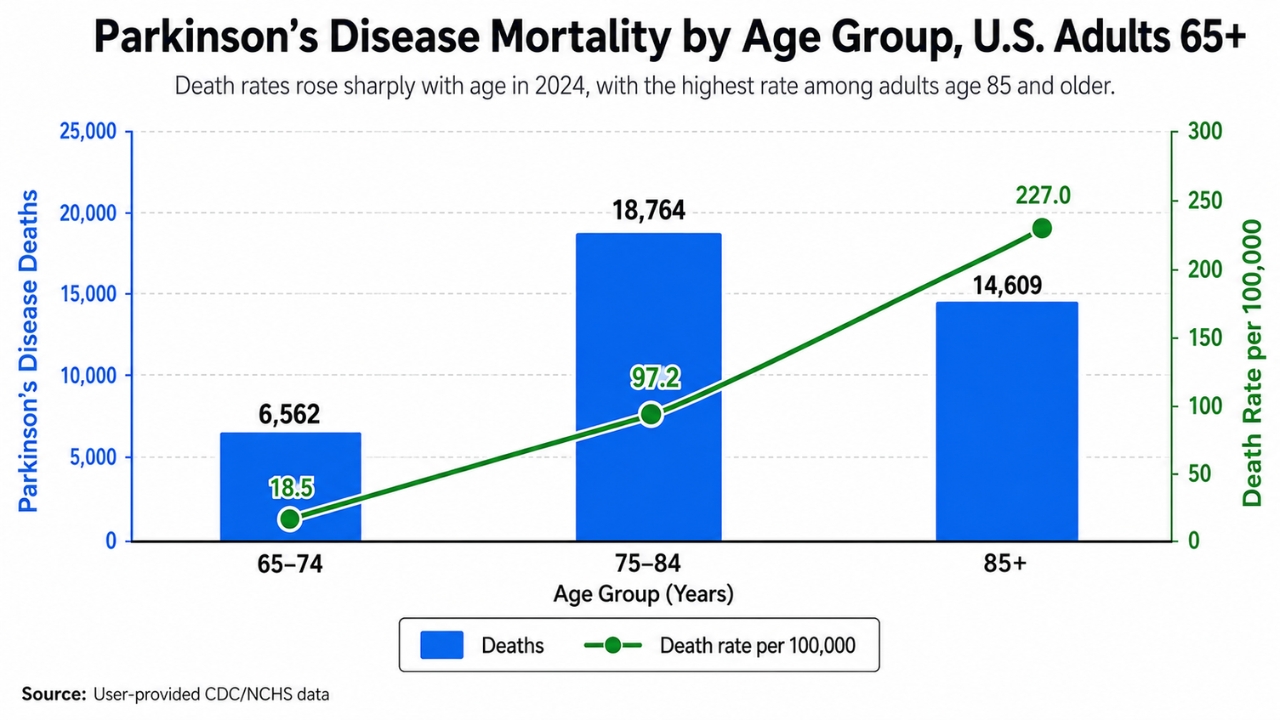
Adults age 85 and older had a rate more than 12 times the rate among adults ages 65 to 74.
Men ages 65 to 74 had 4,308 deaths and a rate of 25.8. Men ages 75 to 84 had 12,095 deaths and a rate of 141.0. Men aged 85 and older had 8,287 deaths and a rate of 343.3.
Women ages 65 to 74 had 2,254 deaths and a rate of 12.0. Women ages 75 to 84 had 6,669 deaths and a rate of 62.2. Women aged 85 and older had 6,322 deaths and a rate of 157.2.
CDC/NCHS reported statistically significant differences between ages 65 to 74 and the two older groups, and between ages 75 to 84 and ages 85 and older.
Race and Ethnicity Differences
White non-Hispanic adults age 65 and older had the highest age-adjusted Parkinson disease death rate in 2024:
- White, non-Hispanic: 34,056 deaths, 81.7 deaths per 100,000
- Hispanic: 2,403 deaths, 47.8
- Asian, non-Hispanic: 1,289 deaths, 43.9
- Black, non-Hispanic: 1,879 deaths, 37.7
- American Indian and Alaska Native, non-Hispanic: 119 deaths, 35.1
White non-Hispanic adults accounted for roughly 85% of Parkinson’s disease deaths among adults age 65 and older in 2024, with 34,056 of 39,935 deaths.
Among men age 65 and older, rates were highest for White non-Hispanic men:
- White, non-Hispanic men: 21,212 deaths, 118.9
- Hispanic men: 1,402 deaths, 67.7
- Asian, non-Hispanic men: 748 deaths, 60.8
- Black, non-Hispanic men: 1,139 deaths, 60.7
- American Indian and Alaska Native, non-Hispanic men: 64 deaths, 41.2
Among women age 65 and older, rates were also highest for White non-Hispanic women.
- White, non-Hispanic women: 12,844 deaths, 54.0
- Hispanic women: 1,001 deaths, 33.8
- American Indian and Alaska Native, non-Hispanic women: 55 deaths, 29.7
- Black, non-Hispanic women: 740 deaths, 24.1
CDC/NCHS cautioned that race and Hispanic-origin misclassification on death certificates can underestimate death rates by 3% for Asian non-Hispanic and Hispanic people, and by 34% for American Indian and Alaska Native non-Hispanic people.
State-Level Variation
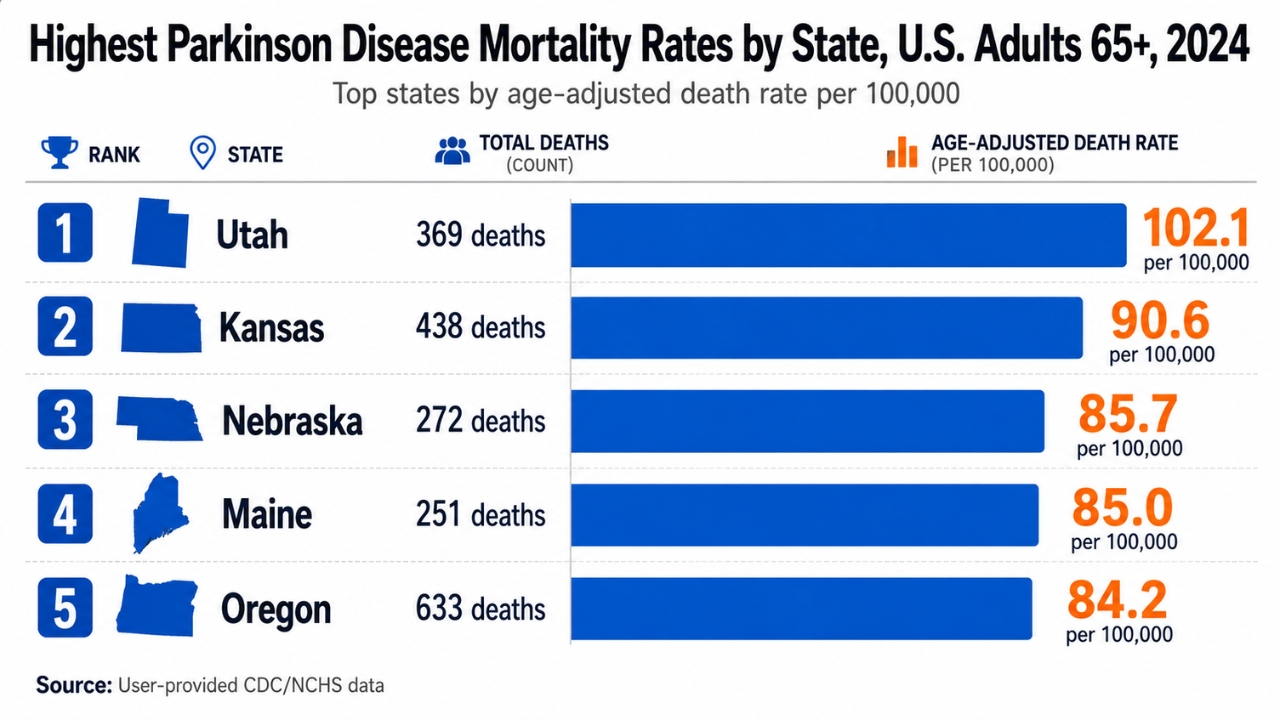
Parkinson’s disease mortality varied widely by state in 2024, ranging between 47.7 deaths per 100,000 in New York and 102.1 in Utah.
Highest rates:
Lowest rates:
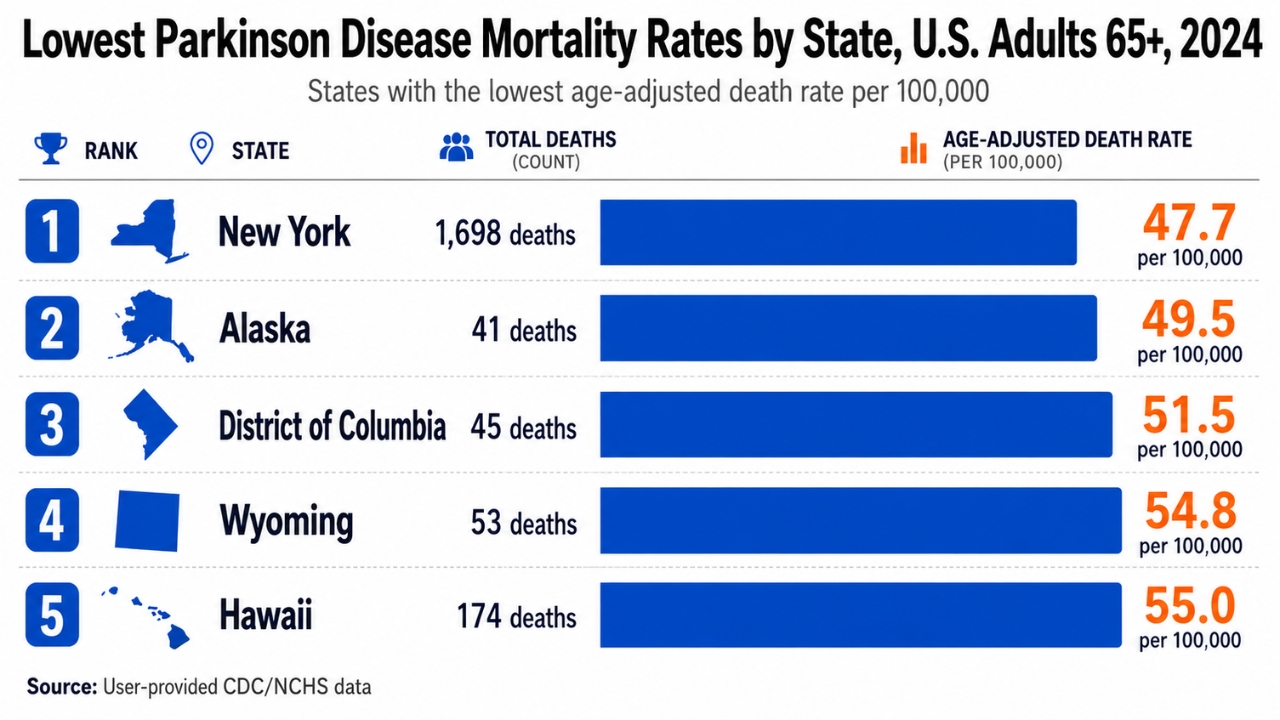
Largest death counts:
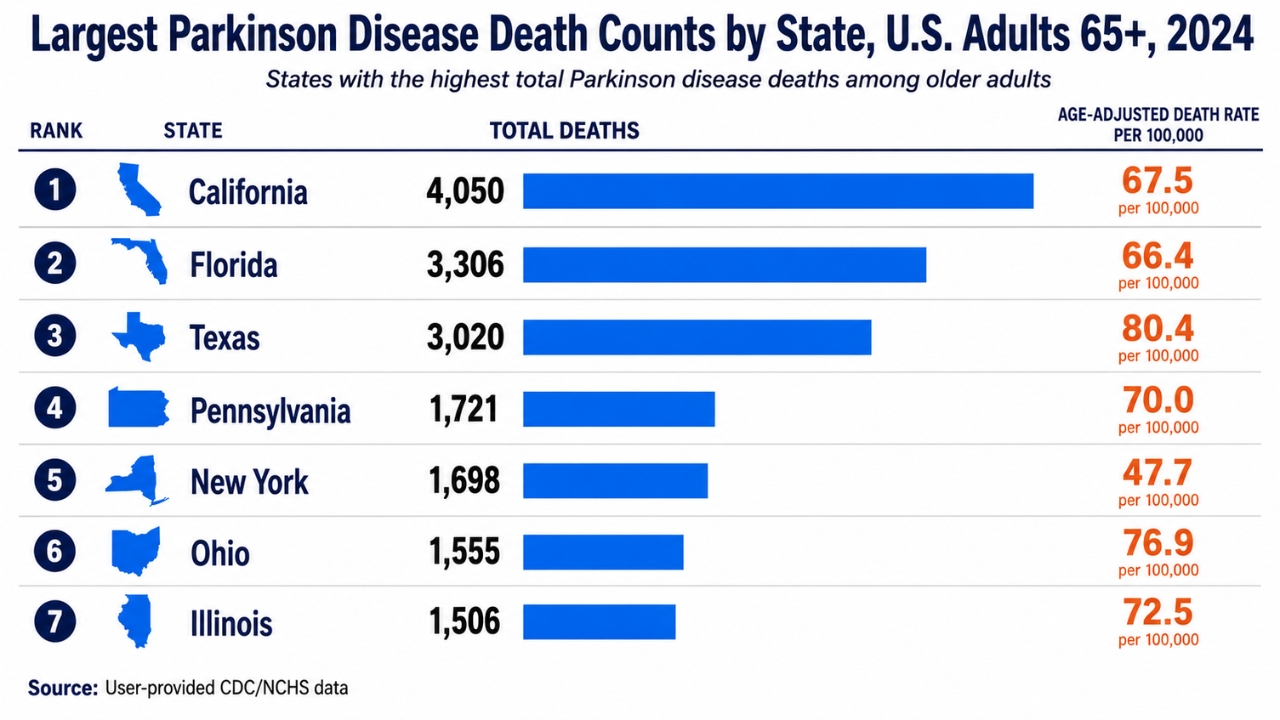
CDC/NCHS grouped state rates into four map ranges: 47.7 to 69.7, 69.8 to 76.6, 76.7 to 79.4, and 79.5 to 102.1.
Data Source and Methods
Mortality data came through the National Vital Statistics System and were accessed using CDC WONDER.
Parkinson’s disease deaths were identified using ICD-10 underlying cause-of-death codes G20 for Parkinson’s disease and G21 for secondary Parkinsonism.
Age-adjusted death rates were calculated using the direct method and the 2000 U.S. standard population.
Pairwise comparisons used a z-test with an alpha level of 0.05. CDC/NCHS said “higher than” and “lower than” indicated statistically significant differences.
Trend analysis used the Joinpoint Regression Program, Version 5.0.2, with weighted least-squares regression models fitted to rates on the log-transformation scale.
Race and Hispanic origin were categorized using 1997 Office of Management and Budget standards. Race categories were single-race categories, and Hispanic people could be of any race.
FAQs
Closing Thoughts
View this post on Instagram
Parkinson’s disease mortality among older Americans declined to 72.0 deaths per 100,000 in 2024, down from 76.3 in 2021, following an earlier rise that began at 57.2 in 2014.
Death counts still increased, reaching 39,935 in 2024 after 37,568 in 2021 and 25,482 in 2014.
Burden stayed concentrated among men, adults aged 85 and older, non-Hispanic White adults, and residents of higher-rate states, including Utah, Kansas, Nebraska, Maine, and Oregon.